Refine listing
Actions for selected content:
2837 results in 11xxx
An improvement of a transcendence measure of Galochkin and Mahler's S-numbers
- Part of
-
- Journal:
- Journal of the Australian Mathematical Society. Series A. Pure Mathematics and Statistics / Volume 52 / Issue 1 / February 1992
- Published online by Cambridge University Press:
- 09 April 2009, pp. 130-140
- Print publication:
- February 1992
-
- Article
-
- You have access
- Export citation
Large transcendence degree
- Part of
-
- Journal:
- Journal of the Australian Mathematical Society. Series A. Pure Mathematics and Statistics / Volume 51 / Issue 3 / December 1991
- Published online by Cambridge University Press:
- 09 April 2009, pp. 400-422
- Print publication:
- December 1991
-
- Article
-
- You have access
- Export citation
On pairs of cubic Diophantine inequalities
- Part of
-
- Journal:
- Mathematika / Volume 38 / Issue 2 / December 1991
- Published online by Cambridge University Press:
- 26 February 2010, pp. 250-263
- Print publication:
- December 1991
-
- Article
- Export citation
-
The problem of finding rational points on varieties defined by two additive cubic equations has attracted some interest. Davenport and Lewis [12], Cook [8] and Vaughan [16] showed that the pair of equations
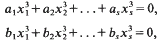
with integer coefficients a,, bt always has a nontrivial solution when s = 18, s = 17, and 5 = 16 respectively. Vaughan's result in s = 16 variables is best possible since there are examples of pairs of equations (1) with s = 15 which fail to vanish simultaneously in the 7-adic field. However if the existence of a 7-adic solution is assured then Baker and Briidern [2], building on work of Cook [9], showed that s = 16 could be replaced by s = 15, and recently Briidern [5] has obtained the result with s = 14.
Small solutions of quadratic congruences, II
- Part of
-
- Journal:
- Mathematika / Volume 38 / Issue 2 / December 1991
- Published online by Cambridge University Press:
- 26 February 2010, pp. 264-284
- Print publication:
- December 1991
-
- Article
- Export citation
-
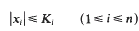
Let Q(x) = Q(x1,…, xn) є ęZ x1, …, xn] be a quadratic form. The primary purpose of this paper is to bound the smallest non-zero solution of the congruence Q(x) = 0 (mod q). The problem may be formulated as follows. We ask for the least bound Bn(q) such that, for any Ki > 0 satisfying

and any Q, the congruence has a non-zero solution satisfying
On the quadratic reciprocity law
- Part of
-
- Journal:
- Journal of the Australian Mathematical Society. Series A. Pure Mathematics and Statistics / Volume 51 / Issue 3 / December 1991
- Published online by Cambridge University Press:
- 09 April 2009, pp. 423-425
- Print publication:
- December 1991
-
- Article
-
- You have access
- Export citation
Quartic normal extensions of the rational field
- Part of
-
- Journal:
- Journal of the Australian Mathematical Society. Series A. Pure Mathematics and Statistics / Volume 51 / Issue 3 / December 1991
- Published online by Cambridge University Press:
- 09 April 2009, pp. 473-482
- Print publication:
- December 1991
-
- Article
-
- You have access
- Export citation
Constructive packings of cross polytopes
- Part of
-
- Journal:
- Mathematika / Volume 38 / Issue 2 / December 1991
- Published online by Cambridge University Press:
- 26 February 2010, pp. 376-380
- Print publication:
- December 1991
-
- Article
- Export citation
-
The n-dimensional cross polytope, |x|+|x2|+…+|xn≤1, can be lattice packed with density δ satisfying

but proofs of this, such as the Minkowski-Hlawka theorem, do not actually provide such packings. That is, they are nonconstructive. Here we exhibit lattice packings whose density satisfies only

but by a highly constructive method. These are the densest constructive lattice packings of cross polytopes obtained so far.
The asymptotics of random sieves
- Part of
-
- Journal:
- Mathematika / Volume 38 / Issue 2 / December 1991
- Published online by Cambridge University Press:
- 26 February 2010, pp. 285-302
- Print publication:
- December 1991
-
- Article
- Export citation
Rigidity of Decomposition laws and number fields
- Part of
-
- Journal:
- Journal of the Australian Mathematical Society. Series A. Pure Mathematics and Statistics / Volume 51 / Issue 2 / October 1991
- Published online by Cambridge University Press:
- 09 April 2009, pp. 171-186
- Print publication:
- October 1991
-
- Article
-
- You have access
- Export citation
Diophantine approximation by continued fractions
- Part of
-
- Journal:
- Journal of the Australian Mathematical Society. Series A. Pure Mathematics and Statistics / Volume 51 / Issue 2 / October 1991
- Published online by Cambridge University Press:
- 09 April 2009, pp. 324-330
- Print publication:
- October 1991
-
- Article
-
- You have access
- Export citation
-
Let ξ be an irrational number with simple continued fraction expansion
 be its ith convergent. Let Mi = [ai+1,…, a1]+ [0; ai+2, ai+3,…]. In this paper we prove that Mn−1 < r and Mn R imply
  which generalizes a previous result of the author.
 which generalizes a previous result of the author.
Digit patterns and transcendental numbers
- Part of
-
- Journal:
- Journal of the Australian Mathematical Society. Series A. Pure Mathematics and Statistics / Volume 51 / Issue 2 / October 1991
- Published online by Cambridge University Press:
- 09 April 2009, pp. 216-236
- Print publication:
- October 1991
-
- Article
-
- You have access
- Export citation
-
We use a theorem of Loxton and van der Poorten to prove the transcendence of certain real numbers defined by digit patterns. Among the results we prove are the following. If k is an integer at least 2, P is any nonzero pattern of digits base k, and
 counts the number of occurrences (mod r) of p in the base k representation of n, then
  is transcendental except when k = 3, P = 1 and r = 2. When (r, k − 1) = 1 the linear span of the numbers
  has infinite dimension over Q, where P ranges over all patterns base k without leading zeros.
 counts the number of occurrences (mod
  is transcendental except when
  has infinite dimension over Q, where
 On some diophantine problems involving powers and factorials
- Part of
-
- Journal:
- Journal of the Australian Mathematical Society. Series A. Pure Mathematics and Statistics / Volume 51 / Issue 1 / August 1991
- Published online by Cambridge University Press:
- 09 April 2009, pp. 1-7
- Print publication:
- August 1991
-
- Article
-
- You have access
- Export citation
Generalised simultaneous approximation of functions
- Part of
-
- Journal:
- Journal of the Australian Mathematical Society. Series A. Pure Mathematics and Statistics / Volume 51 / Issue 1 / August 1991
- Published online by Cambridge University Press:
- 09 April 2009, pp. 50-61
- Print publication:
- August 1991
-
- Article
-
- You have access
- Export citation
Bounds for the solutions of some diophantine equations in terms of discriminants
- Part of
-
- Journal:
- Journal of the Australian Mathematical Society. Series A. Pure Mathematics and Statistics / Volume 51 / Issue 1 / August 1991
- Published online by Cambridge University Press:
- 09 April 2009, pp. 8-26
- Print publication:
- August 1991
-
- Article
-
- You have access
- Export citation
Additive relations in fields
- Part of
-
- Journal:
- Journal of the Australian Mathematical Society. Series A. Pure Mathematics and Statistics / Volume 51 / Issue 1 / August 1991
- Published online by Cambridge University Press:
- 09 April 2009, pp. 154-170
- Print publication:
- August 1991
-
- Article
-
- You have access
- Export citation
On the number of integral ideals of given norm and ray-class
- Part of
-
- Journal:
- Mathematika / Volume 38 / Issue 1 / June 1991
- Published online by Cambridge University Press:
- 26 February 2010, pp. 185-190
- Print publication:
- June 1991
-
- Article
- Export citation
-
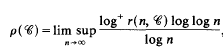
Let K be an algebraic number field, [K: Q] = κ є N; only the case κ > 1 is of interest in this paper. Let f be any non-zero ideal in ZK, the ring of integers of K, and let b be any ray-class (modx f) of K. In this paper we answer a question of P. Erdös (private communication) about the “maximum-growth-rate” of the functions

and

the sum here taken over all ray-classes (modx f), while N(a) is the absolute norm of a. Let
and
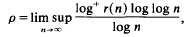
where, as usual, for x є R, log+ x - log max {1, x}. We prove
THEOREM 1. For every f, b we have


The dual lattice of an extreme six-dimensional lattice
- Part of
-
- Journal:
- Journal of the Australian Mathematical Society. Series A. Pure Mathematics and Statistics / Volume 50 / Issue 3 / June 1991
- Published online by Cambridge University Press:
- 09 April 2009, pp. 373-383
- Print publication:
- June 1991
-
- Article
-
- You have access
- Export citation
Optimal approximation by continued fractions
- Part of
-
- Journal:
- Journal of the Australian Mathematical Society. Series A. Pure Mathematics and Statistics / Volume 50 / Issue 3 / June 1991
- Published online by Cambridge University Press:
- 09 April 2009, pp. 481-504
- Print publication:
- June 1991
-
- Article
-
- You have access
- Export citation
Slice discrepancy and irregularities of distribution on spheres
- Part of
-
- Journal:
- Mathematika / Volume 38 / Issue 1 / June 1991
- Published online by Cambridge University Press:
- 26 February 2010, pp. 105-116
- Print publication:
- June 1991
-
- Article
- Export citation
A note on lattices of rational functions
- Part of
-
- Journal:
- Mathematika / Volume 38 / Issue 1 / June 1991
- Published online by Cambridge University Press:
- 26 February 2010, pp. 10-13
- Print publication:
- June 1991
-
- Article
- Export citation
-
One may perhaps doubt whether in the geometry of numbers any particular family of lattices deserves such an attention as, for example, BCH codes receive in coding theory. However, only recently a quite interesting family has emerged. The general case of these lattices considered by Rosenbloom and Tsfasman [5, Section 2] parallels Goppa's construction of codes from algebraic curves. Here we shall take a closer look at the case of genus zero where some special features of Goppa's early codes will show up again: There is a lattice Λ (L, g) in n-dimensional euclidean space associated with a subset L of the field
 , and a polynomial g satisfying g(є) ≠ for all λ є L. For g = zd previously known sphere packings are recovered and generalized. A nonconstructive argument shows that for n → ∞ and some irreducible polynomials g Minkowski's lower packing bound is met (this being not achieved in [5] where q is fixed, but the genus grows; cf. also [4]).
 ,
, 