Refine listing
Actions for selected content:
107 results in 35Pxx
Spectral Convergence for High-Contrast Elliptic Periodic Problems with a Defect Via Homogenization
- Part of
-
- Journal:
- Mathematika / Volume 55 / Issue 1-2 / December 2009
- Published online by Cambridge University Press:
- 21 December 2009, pp. 29-57
- Print publication:
- December 2009
-
- Article
- Export citation
The difference of consecutive eigenvalues
- Part of
-
- Journal:
- Journal of the Australian Mathematical Society. Series A. Pure Mathematics and Statistics / Volume 57 / Issue 3 / December 1994
- Published online by Cambridge University Press:
- 09 April 2009, pp. 305-315
-
- Article
-
- You have access
- Export citation
-
Let M be a smooth bounded domain in Rn with smooth boundary, n ≥ 2, and
 . We prove an inequality involving the first k + 1 eigenvalues of the eigenvalue problem:
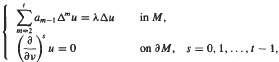 where am−1 ≥ 0 are constants and at−1 = 1. We also obtain a uniform estimate of the upper bound of the ratios of consecutive eigenvalues.
 . We prove an inequality involving the first
On the consecutive eigenvalues of the Laplacian of a compact minimal submanifold in a sphere
- Part of
-
- Journal:
- Journal of the Australian Mathematical Society. Series A. Pure Mathematics and Statistics / Volume 50 / Issue 3 / June 1991
- Published online by Cambridge University Press:
- 09 April 2009, pp. 409-416
-
- Article
-
- You have access
- Export citation
An extension of the principle of spatial averaging for inertial manifolds
- Part of
-
- Journal:
- Journal of the Australian Mathematical Society. Series A. Pure Mathematics and Statistics / Volume 66 / Issue 1 / February 1999
- Published online by Cambridge University Press:
- 09 April 2009, pp. 125-142
-
- Article
-
- You have access
- Export citation
Trapped modes in a waveguide with a thick obstacle
- Part of
-
- Journal:
- Mathematika / Volume 51 / Issue 1-2 / December 2004
- Published online by Cambridge University Press:
- 26 February 2010, pp. 171-186
- Print publication:
- December 2004
-
- Article
- Export citation
-
The problem of finding necessary and sufficient condi-tions for the existence of trapped modes in waveguides has been known since 1943. [10]. The problem is the following: consider an infinite strip M in ℝ2(or an infinite cylinder with the smooth boundary in ℝn). The spectrum of the(positive) Laplacian, with either Dirichlet or Neumann boundary conditions, acting on this strip is easily computable via the separation of variables; the spectrum is absolutely continuous and equals [v0,+∞). Here, v0 is the first threshold, i.e., eigenvalue of the cross-section of the cylinder (so v0 = 0 in the case of Neumann conditions). Let us now consider the domain
 (the waveguide) which is a smooth compact perturbation of M (for example, weinsert an obstacle inside M). The essential spectrum of the Laplacian acting on still equals [v0, +ℝ), but there may be additional eigenvalues, which are often called trapped modes; the number of these trapped modes can be quite large, see examples in [11] and [8].
 (the
(the Strong ergodicity for Markov processes by coupling methods
- Part of
-
- Journal:
- Journal of Applied Probability / Volume 39 / Issue 4 / December 2002
- Published online by Cambridge University Press:
- 14 July 2016, pp. 839-852
- Print publication:
- December 2002
-
- Article
- Export citation
On the spectra of singular elliptic operators
- Part of
-
- Journal:
- Mathematika / Volume 23 / Issue 1 / June 1976
- Published online by Cambridge University Press:
- 26 February 2010, pp. 107-115
- Print publication:
- June 1976
-
- Article
- Export citation
