To save content items to your account,
please confirm that you agree to abide by our usage policies.
If this is the first time you use this feature, you will be asked to authorise Cambridge Core to connect with your account.
Find out more about saving content to .
To save content items to your Kindle, first ensure no-reply@cambridge.org
is added to your Approved Personal Document E-mail List under your Personal Document Settings
on the Manage Your Content and Devices page of your Amazon account. Then enter the ‘name’ part
of your Kindle email address below.
Find out more about saving to your Kindle.
Note you can select to save to either the @free.kindle.com or @kindle.com variations.
‘@free.kindle.com’ emails are free but can only be saved to your device when it is connected to wi-fi.
‘@kindle.com’ emails can be delivered even when you are not connected to wi-fi, but note that service fees apply.
I don't trust men. I’ve had very bad father issues,
stepfather issues. So, men wasn’t…I don't trust men easily.
Most of my friends are women’. (Men's group participant, 2014)
During the psychotherapeutic encounter with men, gender is not regarded as some fixed aspect that determines who men are, but a fluid expression of their larger socio-culturally constructed selves that dynamically responds to the diverse and unique times and places they may find themselves in (Oyěwùmí, 1997). In men's groups, gender is the ‘stock in trade’ – a healing ‘essential’. So, whether it is an embodied, socio-economic, cultural, or spiritual dimension, all are put to work in the service of personal growth and development. This involves not just the gender of the men's group participants, but also the gender of the healer, the men's group facilitator, the meanings and contestations of manhood of collectives of men's group participants, and the surrounding contexts of gender, femininities and masculinities (Oyěwùmí, 1997).
In this chapter I explore the therapeutic benefits that may accrue owing to the addition of a male co-facilitator to a men's group that has always been facilitated by a female facilitator. I draw on clinical case material as it emerged during the termination session in which the group therapy participants reviewed their therapeutic gains, as part of the annual group closure ritual, of this long-term psychodynamically-orientated men's group.
I am pleased and honoured to contribute a foreword to this book. What first caught my attention about the book, Masculinity Meets Humanity: An Adapted Model of Masculinised Psychotherapy is the articulation of its central concern in the abstract:
The central concern of this book is with masculinised mental health care for boys and men who voluntarily swop male victory narratives with stories of personal pain and vulnerability as the pathway to personal transformation and freedom from psycho-social distress. Masculinised psychotherapy enables gender-consistent and gender-sensitive intimacy exchanges of closeness and distance between men, within an explicitly masculine therapeutic frame, for enhanced personal growth and transformation.
As a background, I was born in the dusty township of Katlehong, Natalspruit, in Germiston in the 1950s, where the notions of manhood and masculinity were epitomised by the tough and violent tsotsi culture. But a large part of my formative years took place in a typical Lesotho rural subsistence farming household in the 1960s and 1970s. My Lesotho family was of landed gentry. It owned vast acres of arable land; hundreds of livestock – cattle, sheep, goats, horses and donkeys. As a Mosotho boy my primary responsibility was to herd cattle, and to fight battles with other boys from neighbouring villages for control of pasturelands. I was socialised into being tough; to not cry; to fight hard, and not to back down. My own father's idea of a ‘real’ man was that of a hardened, emotionless male who excelled in Sesotho assumptions of manhood and masculinity, real or perceived. The Sesotho saying: “Monna ke nku; ha a lle” (a man is like a sheep; he doesn't cry) was the mantra I embraced and internalised.
Soon after taking on the position as manager of a student counselling service midway through 2008, I initiated a process of change management and culture building to add group psychotherapy to the menu of psychotherapeutic services available to the student clients. This shift towards group psychotherapy was motivated partially by a wish that group therapy interventions would help the service cope with a demand for individual counselling that it was unable to meet. As reported in international literature at that time, university students tended to present at student counselling centres with increasingly severe psychological distress (Kitsrow, 2009).
Coupled with the chronic lack of student support resources of the university, the socioeconomic status of most students who sought support from the counselling centre was poor or ‘struggling to make ends meet’ (Letseka & Breier, 2008). Their personal histories were littered with a litany of abuses and dysfunction (Kalenga & Samukelisiwe, 2015; Maharaj, 2018). Their identity development was already marred by the failures of severely weakened family systems (Budlender & Lund, 2011), significant experiences of parental absence, failure and neglect (Kalenga & Samukelisiwe, 2015), and the structural cultural violence of poverty, unemployment (Leibbrandt, Woolard, McEwen, & Koep, 2010), and inequality endemic to the South African context (Van Zyl, 2016).
‘But certainly not at the beginning. I don't think
I would have been personally comfortable to unpack everything in a group
where there were males and females. I think the all-male factor…
uhm… made it easier for me.’ (Men's group participant, 2012)
Against the backdrop of the fragility and vexations of gender, this chapter delves into related paradigmatic issues, debates and contestations around psychosocial change work with men. There are several binaries to navigate, such as women as victims, men as perpetrator; females targeted and male absence from interventions; and female engagement versus male disengagement from emotion-related practices.
Gender has been referred to as socially acquired male and female roles, internalised norms and standards about how men and women ought to behave (Otiso, 2017). Gender is shaped by its surrounding social contexts and is an elusive, hard-to-pin-down, unstable social category (Burkhalter & Eagle, 2015). Burkhalter and Eagle (2015) caution that gender is such a part of us that it is rendered invisible. These authors affirm the inescapability of gendering self and others. We may consciously or unconsciously interpret the attitudes and behaviours of others in accordance with our socialised scripts about the behaviour of men and women. Gendered expectations may thus intrude themselves in everything we do, including psychotherapy (Burkhalter & Eagle, 2015). Perhaps for some of these reasons, gender can be such a minefield of strong and polarised opinions that do not always assist one to usefully understand the ‘boy crisis’, gender differences and how to integrate gender in the treatment of boys and men (Haen, 2011).
‘I would like to thank all the group members for their participation.
The sessions helped me to discover and rediscover myself.
Attending group sharing sessions was like a relief from the outside world
but at the end of each session, I would feel strong again and ready to face real life challenges.
It made me never to lose hope but to be confident of myself and my capabilities’. (Men's group participant, 2009)
Psychotherapy for all by involving all (Patel, 2014)
This writing started on a personal note of needing to resolve concerns of my experience of professional alienation in the discipline of psychology. A psychotherapy group which was, by chance, populated by males only was, over time, adapted to the treatment preferences of diverse male audiences by myself, a female group facilitator. The process of modifying therapeutic interventions to take the needs of boys and men into consideration seemingly simultaneously integrated me into the profession of psychology. I went on to carve out a niche for myself as a provider of male gender conscious psychotherapy, having learnt from boys and men how to be a masculine-affirming psychotherapist to male clients.
The culture and practice of group psychotherapy operated as a ‘Trojan horse’, in which to transfer indigenous beliefs and practices into the psychotherapy treatment for a predominantly young black student population. Group psychotherapy created flashes of pragmatism and a client base of responsive ‘test subjects’ apparently receptive, conversant with and most importantly, welcoming of the African (relational-ethical) discourses inserted into the psychotherapy process.
‘We all saw the thread of humanity that linked us all
even though we were all so different.’ (Men's group participant, 2021)
Introduction
The two treatment models for men who batter that were developed in America during the 1970s were distinct from one another owing to strong assumptions and beliefs about gender, men and masculinities (Mankowski, Haaken & Silvergleid, 2002). The Duluth model of feminist power and control attributed violent male behaviour – expressed by particular men as assertions of control and an intention to harm women – to patriarchy (Dutton & Corvo, 2007). Men's dominant beliefs are directly contested by structured educational interventions, which also call for an end to violence against women (Mankowski, et al., 2002).
The unstructured group psychotherapy model, in contrast, is a masculinised group therapy setting that gives an ‘insider view’ of the psychological and personal forces that influence men's lives (ibid). This method de-emphasises strict adherence to structure and promotes open-ended processes while encouraging active participation. It is predicated on the idea that men are capable of engaging in non-directive, open-ended psychological discourse. Male participants in interpersonal unstructured group psychotherapy are expected to take ownership of both the symptomatic and developmental aspects of their behaviour. This directly contradicts unspoken beliefs that men are less capable navigators of their inner worlds (Jennings, 1987).
For Jennings (1987), prioritising attention to the underlying causes of male battering may be a more effective strategy in the prevention and treatment of male violence, as opposed to a direct confrontation of the abuser's dominating belief structure.
‘But then again, I remember something my grandfather told me
that once you start crying you will never stop.
So those are the other things you keep on thinking as a result.
The tears wouldn't come because
I actually trained myself not to cry.’ (Men's group participant, 2013)
Introduction
In an ubuntu personhood framework, men are validated as reflexive, emotionally responsive and dynamically transformative beings. Clinical discussions of male-focused psychotherapy suggest that there is male capacity to engage emotions to achieve selftransformation, despite masculine tendencies towards power-assertive interpersonal behaviours. Meanwhile, research progressively reveals that mental health problems are not just more prevalent among men than women, but that men suffer more serious mental health issues than women, while mental health care utilisation remains largely the preserve of women (Affleck, Carmichael & Whitley, 2018).
What is perhaps required is to increase the number of men entering psychotherapy to facilitate the integration of therapy as part of masculine identity. In this way, typically feminised therapeutic culture can become a site that is consistent with and welcoming of manhood character and performances. That is what I turn to next: consideration of the therapeutic encounter as harmonising with male discursive practices.
This chapter covers the adaptation of several therapeutic activities such as alliance building and emotional expression to reflect ‘everyday’ masculine discursive practices. Through citing clinical encounters with male clients, I illustrate how altered assumptions about male gender paved the way for the adaptation of psychotherapy practices to manifest masculine identities. I look towards masculinised psychotherapy as the appropriation of ‘everyday’ masculine discursive practices as integral to psychotherapy process.
‘I learnt that we are all dealing with life the best we can
and that if one opens one's heart to the pain of others,
interactions with others become more real.’ (Men's group participant, 2012)
Introduction
Men are everywhere, and some might even say ‘everything is about men’, after all, dominance is associated with being a man, as suggested by the concept of hegemonic masculinity, the most desired status of manhood (Connell & Messerschmidt, 2005). Apparently, men compete for the achievement of hegemonic masculinity (Connell & Messerschmidt, 2005), but when it comes to psychotherapy citizenship, they are an absent and neglected population (Seidler, et al., 2016). Scientific literature suggests that men, especially certain kinds of male gender roles and psychotherapeutic discourses are mutually exclusive (Fischer & Good, 1997; Levant, Hall, & Hasan, 2009; Parker, Taylor, & Bagby, 1998).
This chapter concerns the therapeutic care of a special male minority who have participated in the adapted model of all-male group psychotherapy at two psychotherapy treatment sites. Masculinised psychotherapy evolved on the campus of the University of the Western Cape (UWC) since 2009, and within a year extended to a small, part-time private practice. My leaving the employment of the university in September 2016 ended the oncampus men's groups, but they continued as for-fee male-focused therapeutic services such as father-son dyadic psychotherapy, men's groups, individual therapy with men, family, and couple's therapy in private practice. I will discuss the treatment sites, clinical dynamics, client demographics and group therapy culture and practices in the starting and sustaining of men's groups, with reference to clinical case material.
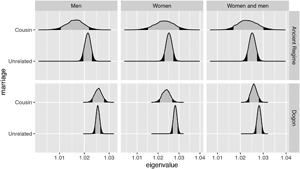
Cousin marriage, a spousal union between close kin, occurs at high frequencies in many parts of the world. The rates of cousin marriage in humans are concordant with empirical studies that challenge the traditionally held view that reproduction with kin is generally avoided in animals. Similarly, some theoretical models in animal behaviour show that inbreeding avoidance is more constrained than previously thought. Such studies highlight the importance of quantifying the costs and benefits of reproduction among close kin over the whole life-course. Here, we use genealogical data from two human populations with high frequencies of cousin marriage (the Dogon from Mali, and the Ancien Régime nobility from Europe) to estimate these potential costs and benefits. We compare age-specific fertility and survival curves, as well as the projected growth rates, of subpopulations of each marriage type. Fitness costs of cousin marriage are present in terms of reduced child survival (in both populations), while benefits exist as increased fertility for men (in the Dogon) and for women (in the Ancien Régime nobility). We also find some differences in the projected growth rates of lineages as a function of marriage type. Finally, we discuss the trade-offs that might shape marriage decisions in different ecological conditions.
Self-reflection is often viewed positively; paradoxically, however, it is also associated with distress, potentially because of its relationship with rumination. Focusing self-reflection on positive themes may be one way to promote adaptive self-reflection. This study examined whether the disposition to engage in self-reflection motivates use of a journal containing positively focused writing prompts and moderates the benefit gained from it, specifically when rumination is controlled for. For 28 days, participants (N = 152) accessed an app-based mental health intervention containing various features, including the aforementioned journal. Outcomes of self-regulation and psychological wellbeing were assessed, controlling for time spent using other app features. As expected, journaling was associated with improvements in psychological wellbeing but only when baseline self-reflection was average or higher. Journaling was also initially associated with improvements in self-regulation, but this was diminished after controlling for time spent using other app features. Findings suggest self-reflection could be a strength for fostering wellbeing when it is directed in a positive way.
To date, the evidence regarding the effect of bilingualism/multilingualism on short-term memory (STM) and working memory (WM) capacity is inconclusive. This study investigates whether multilingualism has a positive effect on the verbal STM and WM capacity of neurotypical middle-aged and older individuals. Eighty-two L1-Norwegian sequential bilingual/multilingual academics were tested with tasks measuring verbal STM/WM capacity. Degree of bilingualism/multilingualism for each participant was estimated based on a comprehensive questionnaire. Different measures of bilingualism/multilingualism were used. Data on potentially influencing non-linguistic factors were also collected. Correlation and regression analyses showed that multilingualism impacts both verbal STM and verbal WM. In particular, all analyses showed that number of known foreign languages was the strongest predictor of verbal STM and WM capacity. The results are discussed in light of recent studies on the impact of bilingualism on STM/WM and on recent proposals regarding the mechanism underlying so-called bilingual advantage.
A long-standing question about bilingualism concerns which representations are shared across languages. Recent work has revealed a bilingual Sentence Superiority Effect (SSE) among French–English bilinguals reading mixed-language sentences: identification of target words is more accurate in syntactically grammatical than ungrammatical sentences. While this ability to connect words across the two languages has been attributed to a rapid parsing of shared syntactic representations, outstanding questions remain about the role of semantics. Here, we replicate the SSE in Spanish–English bilinguals (e.g., better identification of vacío in “my vaso is vacío” [my glass is empty] than “is vaso my vacío” [is glass my empty]). Importantly, we report evidence that semantics do contribute to word identification, but significantly less than syntax and only in the context of syntactically grammatical sentences. Moreover, the effect is moderated by language proficiency, further constraining the conditions under which shared cross-linguistic representations are rapidly accessed in the bilingual mind.
A large literature has shown that language context –mixing and switching between languages – impacts lexical access processes during bilingual speech production. Recent work has suggested parallel contextual effects of language context on the phonetic realization of speech sounds, consistent with interactions between lexical access and phonetic processes. In this pre-registered study, we directly examine the link between lexical access and phonetic processes in Spanish–English bilinguals using picture naming. Using automated acoustic analysis, we simultaneously gather measures of reaction time (indexing lexical access) and acoustic properties of the initial consonant and vowel (indexing phonetic processes) for the same speakers on the same trials. Across measures, we find consistent, robust effects of mixing and language dominance. In contrast, while switching effects are robust in reaction time measures, they are not detected in phonetic measures. These inconsistent effects suggest there are constraints on the degree of interaction between lexical access and phonetic processes.
The effect of milorganite, a commercially available organic soil amendment, on soil nutrients, plant growth, and yield has been investigated. However, its effect on soil hydraulic properties remains less understood. Therefore, this study aimed to investigate the effect of milorganite amendment on soil evaporation, moisture retention, hydraulic conductivity, and electrical conductivity of a Krome soil. A column experiment was conducted with two milorganite application rates (15 and 30% v/v) and a non-amended control soil. The results revealed that milorganite reduced evaporation rates and the length of Stage I of the evaporation process compared with the control. Moreover, milorganite increased moisture retention at saturation and permanent wilting point while decreasing soil hydraulic conductivity. In addition, milorganite increased soil electrical conductivity. Overall, milorganite resulted in increased soil moisture retention; however, moisture in the soil may not be readily available for plants due to increased soil salinity.