To save content items to your account,
please confirm that you agree to abide by our usage policies.
If this is the first time you use this feature, you will be asked to authorise Cambridge Core to connect with your account.
Find out more about saving content to .
To save content items to your Kindle, first ensure no-reply@cambridge.org
is added to your Approved Personal Document E-mail List under your Personal Document Settings
on the Manage Your Content and Devices page of your Amazon account. Then enter the ‘name’ part
of your Kindle email address below.
Find out more about saving to your Kindle.
Note you can select to save to either the @free.kindle.com or @kindle.com variations.
‘@free.kindle.com’ emails are free but can only be saved to your device when it is connected to wi-fi.
‘@kindle.com’ emails can be delivered even when you are not connected to wi-fi, but note that service fees apply.
This book examines the profound impact of Liberty University, church planting networks, and grassroots mobilization on shaping U.S. policy toward Israel. It explores how Dr. Jerry Falwell, through his leadership at Liberty University and the Moral Majority, built a vast evangelical network that successfully influenced Congress and the White House. The book delves into the political power of Liberty alumni, who established churches across the United States, integrating Christian Zionism into their teachings and mobilizing congregations to support pro-Israel policies. Through archival research, interviews, and policy analysis, the study traces the evolution of evangelical involvement in U.S. politics, highlighting the unique relationship between Falwell and Israeli Prime Minister Menachem Begin. It examines how Falwell positioned himself as an advocate for Israel, lobbying for policies such as the relocation of the U.S. embassy to Jerusalem. The book also explores the role of church planting as a political strategy, showing how local religious communities became conduits for mobilizing grassroots support for Israel. By shedding light on the intersection of faith, politics, and diplomacy, this book provides a compelling analysis of how evangelical activism continues to shape U.S.-Israel relations and the broader conservative agenda in America.
State-registered religion is puzzling because it can be portrayed as both an opponent and a partner of the state. While registered religions need to be receptive to the rules of the government, they also need to satisfy the needs of their congregants. In light of the Communist Party’s increasing repression, I investigate how this complex positioning between the government and the congregation has influenced the content of sermons in state-approved Protestant churches. Using computational text analysis on sermons from a state-approved Protestant church in China between 2009 and 2021, I analyze the pastors’ degree and composition of self-censorship in their receptiveness to changes over time, as well as to politically and religiously sensitive dates. By focusing on sermons shared in state-approved churches, I shed light on the complex positions in which these Party-registered pastors maneuver. This research also contributes to the broader discussion of civil rights and state-society relations in the context of a strong authoritarian state.
Is there a human nature? Can knowledge of it help us live better lives? This book synthesises ancient and modern philosophical ideas and draws on scientific research to answer yes to both these questions. It develops an innovative normative theory on the basis of commonsensical, naturalistic, premisses; and it defends an Aristotelian normative theory -- whereby we should understand human goods as realisations or perfections of human nature -- against both traditional and emerging challenges to perfectionist ethics, including evolutionary biology and transhumanism. The result is a ground-breaking theory of 'natural perfectionism', which both returns perfectionistic ethics to its Aristotelian roots and shows how this is compatible with evolutionary biology and cognitive science. At a time when the very idea of human nature is viewed as something that can be readily transcended, this work recalls us to a realistic, sober and better-founded vision of it.
Mark Noll famously began his 1994 book, “The scandal of the evangelical mind is that there is not much of an evangelical mind.” Through the narrative of author Rachel Held Evans’s life, this article explores the intellectual state of the evangelical tradition during her lifetime, 1981–2019. Evans, a prolific author, blogger, and social media voice, was raised in conservative evangelicalism in Birmingham, Alabama, and Dayton, Tennessee. Her intellectual journey and abundant reading led her to challenge conservative evangelical views of gender and sexuality, creation, and hell, while holding to historic Christian beliefs. After experiencing rejection in-person and online from conservatives, especially Reformed Protestants associated with New Calvinism, she eventually renounced her beloved faith tradition of origin, evangelicalism. I argue that Evans’s faith trajectory illuminates the intellectual weaknesses of evangelicalism that Noll identified in 1994 and suggests that these weaknesses did not ameliorate in the first two decades of the twenty-first century. The intellectual state of evangelicalism, and its attendant political dimensions, was a key factor in Evans’s reluctant separation from evangelicalism, as it was for many of her contemporaries.
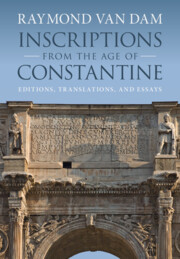
The reign of Constantine, Roman emperor from 306 to 337, was one of the most important periods in world history. Although literary texts often represented him as the first Christian emperor, the inscriptions engraved on monuments, statue bases, and milestones offer alternative perspectives. Inscriptions highlight the influence of the other emperors, the prominence of senators at Rome, the civic traditions for praising benefactors in provincial cities, the logistics of the economy, and the abiding importance of traditional cults. This book includes the Greek and Latin texts of over 800 inscriptions from the early fourth century, with translations and critical annotations. An extended Introduction and almost 200 short essays provide context by explaining the issues and problems, correlating the literary texts, and comparing the legends and images of coins. Without the emperor as the constant focus, the Age of Constantine becomes all the more fascinating.
Traditional narratives of the origin of Andover Theological Seminary and theological education more broadly in the United States focus upon the theological and intellectual justifications for the creation of this first form of graduate education in the United States. Such narratives, however, obscure the political motivations behind Andover’s founding. Jedidiah Morse, one of the primary architects of Andover, designed the school to support his religious, nationalistic, and imperialistic ambitions for the young nation. Morse drew upon his knowledge and experience as a geographer and his antagonism toward democracy to construct a new educational institution with the capacity to support the United States through the production of clergy. This article draws upon Geographic Information Systems (GIS) and the spatial humanities to help understand both the establishment and political influence of Andover Theological Seminary. In so doing, it contends that Andover was far more than a theologically focused institution. Instead, it sought to shape the nation through a network of educated clergy committed to settling the North American geography and beyond. Andover was established as part of an evangelical infrastructure designed to undergird the co-constructed projects of religious nationalism and imperialism in the first half of the nineteenth century.
'Why is there something rather than nothing?' is a question that is arguably as old as philosophy itself. Nevertheless, despite the fact that it is of perennial philosophical, scientific, and religious interest, it receives less attention than many other classic questions in philosophy. And despite continued fascination with 'the Question', and its status as one of the great intellectual mysteries, there are few academic book-length discussions of the subject. This book serves as the definitive guide to the Question. It includes a discussion of the proper interpretation of the Question, whether it can be expected to have an answer, an overview of the major answers which have been proposed, and, most significantly, a new and innovative explanation for why there is something rather than nothing.
This paper examines the transformation of Anglican identity during a particularly intense period of decolonisation and political activism in Aotearoa New Zealand: 1970s to 1980s. Particular focus is given to the Revd Dr George Armstrong, an icon of Anglican activism in this era. Being at the forefront of demonstrations against nuclear warships, the apartheid-era Springbok Rugby Tour, and racism against Māori, Armstrong redefined his priestly role and the place of liturgy through public resistance. I argue that Armstrong’s emergence as the nation’s foremost priestly activist is best understood within the context of a decolonising New Zealand with implications for how the broader Anglican Church was renegotiating its role with the nation. This paper explores the key events and theological influences shaping Armstrong’s witness, including the role of protests, liturgy, and shifting assessments of settler colonial Anglicanism.
This book explores the religious, political and cultural implications of a collision of highly charged polemic prompted by the mass ejection of Puritan ministers from the Church of England in 1662, providing an in-depth study of this heated exchange centring on the departing ministers' farewell sermons. Many of these valedictions, delivered by hundreds of dissenting preachers in the weeks before Bartholomew's Day, would be illegally printed and widely distributed, provoking a furious response from government officials, magistrates and bishops. The book re-interprets the political significance of ostensibly moderate Puritan clergy, arguing that their preaching posed a credible threat to the restored political order.
This book compares the worldviews and factors that promoted or, indeed, opposed anti-semitism amongst Catholics in Germany and England after the First World War. As a prequel to books on Hitler, fascism and genocide, it turns towards ideas and attitudes that preceded and shaped the ideologies of the 1920s and 1940s. Apart from the long tradition of Catholic anti-Jewish prejudices, the book discusses new and old alternatives to European modernity offered by Catholics in Germany and England. Numerous events in the interwar years provoked anti-Jewish responses among Catholics: the revolutionary end of the war and financial scandals in Germany; Palestine and the Spanish Civil War in England. At the same time, the rise of fascism and National Socialism gave Catholics the opportunity to respond to the anti-democratic and anti-semitic waves these movements created in their wake. The book is a political history of ideas that introduces Catholic views of modern society, race, nation and the ‘Jewish question’. It shows to what extent these views were able to inform political and social activity.
This chapter focuses on the scribal and printed circulation of the farewell sermons of the departing Bartholomean clergy, outlining the putative chronology of the translation of the Bartholomean manuscripts into print and examining how and why specific preachers came to be selected for publication. It evaluates whether Restoration authorities were successful in repressing circulation and argues that the natural disasters of 1665 and 1666 helped ensure that publication of the farewell sermons would not resume until the eighteenth century.