We partner with a secure submission system to handle manuscript submissions.
Please note:
You will need an account for the submission system, which is separate to your Cambridge Core account. For login and submission support, please visit the
submission and support pages.
Please review this journal's author instructions, particularly the
preparing your materials
page, before submitting your manuscript.
Click Proceed to submission system to continue to our partner's website.
To save this undefined to your undefined account, please select one or more formats and confirm that you agree to abide by our usage policies. If this is the first time you used this feature, you will be asked to authorise Cambridge Core to connect with your undefined account.
Find out more about saving content to .
To send this article to your Kindle, first ensure no-reply@cambridge.org is added to your Approved Personal Document E-mail List under your Personal Document Settings on the Manage Your Content and Devices page of your Amazon account. Then enter the ‘name’ part of your Kindle email address below. Find out more about sending to your Kindle.
Find out more about saving to your Kindle.
Note you can select to save to either the @free.kindle.com or @kindle.com variations. ‘@free.kindle.com’ emails are free but can only be saved to your device when it is connected to wi-fi. ‘@kindle.com’ emails can be delivered even when you are not connected to wi-fi, but note that service fees apply.
Let t, m > 2 and p > 2 be positive integers and denote by N(t, m, p) the largest integer for which there exists a t-uniform hypergraph with N (not necessarily distinct) edges and having no independent set of edges of size m and no vertex of degree exceeding p. In this paper we complete the determination of N(t, m, 3) and obtain some new bounds on N(t, 2, p).
It is shown that no functor F exists from the category of sets with injections, to the category of algebraically closed fields of given characteristic, with monomorphisms, having the properties that for all sets A. F(A) is an algebraically closed field having transcendence base A and for all injections f. F(f) extends f. There does exist such a functor from the category of linearly-ordered sets with order monomorphisms.
An application to model-theory using the same methods is given showing that while the theory of algebraically closed fields is ω-stable, its Skolemization is not stable in any power.
For the Weyl algebra A(k) and each finite dimensional division ring D over k, there exists a simple A(k)-module whose commuting ring is D.
It has been known for some time that if A(k) denotes the Weyl algebra over a field k of characteristic zero, the commuting ring of a simple A(k)-module is a division algebra finite dimensional over k (see the introduction of [1]). Which division algebras actually appear? Quebbemann [1] showed that if D is a finite dimensional division algebra whose center is k, then it occurs as a commuting ring. We complete this circle of ideas by showing that any D appears: a division algebra over k appears as the commuting ring of a simple A(k)-module if and only if it is finite dimensional over k.
Reynolds (1972), using character-theory, showed that the p-section sums span an ideal of the centre Z(kG) of the group algebra of a finite group G over a field k of characteristic dividing the order of G. In O'Reilly (1973) a character-free proof was given. Here we extend these techniques to show the existence of a wider class of ideals of Z(kG).
It is proved that a regular essentially closed and weakly homomorphically closed proper subclass of rings consists of semiprime rings. A regular class M defines a supernilpotent upper radical if and only if M consists of semiprime rings and the essential cover Mk of M is contained in the semisimple class S U M. A regular essentially closed class M containing all semisimple prime rings, defines a special upper radical if and only if M satisfies condition (S): every M-ring is a subdirect sum of prime M-rings. Thus we obtained a characterization of semisimple classes of special radicals; a subclas S of rings is the semisimple class of a special radical if and only if S is regular, subdirectly closed, essentially closed, and satisfies condition (S). The results are valid for alternative rings too.
In recent papers, Russell introduced the notions of functions of bounded kth variation (BVk functions) and the RSk integral. Das and Lahiri enriched Russell's works along with a convergence formula of RSk integrals depending on the convergence of integrands. In this paper a convergence theorem analogous to Arzela's dominated convergence theorem has been presented. An investigation to the convergence in kth variation has been made leading to some convergence theorems of RSk integrals depending on the convergence of integrators.
Here it is proved that if Q(x, y, z, t, u) is a real indefinite quinary quadratic form of type (4,1) and determinant D, then given any real numbers x0, y0, z0, t0, u0 there exist integers x, y, z, t, u such that

Let M be an n-dimensional complete Riemannian manifold with Ricci curvature bounded from below. Let be an N-dimensional (N < n) complete, simply connected Riemannian manifold with nonpositive sectional curvature. We shall prove in this note that if there exists an isometric immersion φ of M into with the property that the immersed manifold is contained in a ball of radius R and that the mean curvature vector H of the immersion has bounded norm ∥H∥ > H0, (H0 > 0) then R > H−10.
Let g(n, m) denote the maximal number of distinct rows in any (0, 1 )-matrix with n columns, rank < n, – 1, and all row sums equal to m. This paper determines g(n, m) in all cases:
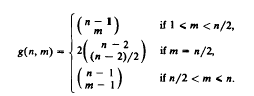
In addition, it is shown that if V is a k-dimensional vector subspace of any vector space, then V contains at most 2k vectors all of whose coordinates are 0 or 1.
An estimate for q2|α – p/;q| is obtained by considering the relation between the continued fractions for α and p / q. This leads to an extension of the standard result “q2|α – p/q| < 1 imples that for some n, p/q = (ipn + pn-1) / (iqn + qn-1) where i = 0, 1 or an+1 −1”.
A module M over a ring R is κ-projective, κ a cardinal, if M is projective relative to all exact sequence of R-modules 0 → A → B → C → 0 such that C has a generating set of cardinality less than κ. A structure theorem for κ-projective modules over Dedekind domains is proven, and the κ-projectivity of M is related to properties of ExtR (M, ⊕ R). Using results of S. Chase, S. Shelah and P. Eklof, the existence of non-projective и1-projective modules is shown to undecidable, while both the Continuum Hypothesis and its denial (Plus Martin's Axiom) imply the existence of a reduced И0-projective Z-module which is not free.
Sufficient conditons are given for the chaotic behaviour of difference equations defined in terms of continuous mappings in Rn. These conditions are applicable to both difference equations with snap-back repellors and with saddle points. They are applied here to the twisted-horseshoe difference equation of Guckenheimer, Oster and Ipaktchi.
We discuss the problem of constructing large graceful trees from smaller ones and provide a partial answer in the case of the product tree Sm {g} by way of a sample of sufficient conditions on g. Interlaced trees play an important role as building blocks in our constructions, although the resulting valuations are not always interlaced.
Characterisations of the distribution of a non-negative random variable are sought for which the Liapunov moment inequality is extended to give inequalities between inverse powers of moment ratios, which are known as mean sizes in considerations of particle size distributions. A solution is found for continuous distributions, and the conditions applied to a number of well-known distributions. A further class of distributions is considered for which the new inequalities hold but the inequality direction is reversed for some orders of the moments. The study involves examination of the signs of the third central moments of a family of distributions, obtained by a log transformation, from the weighted, or moment, distributions induced by the non-negative random variable.
We show that the problem of settling the existence of an n × n Hadamard matrix, where n is divisible by 4, is equivalent to that of finding the cardinality of a smallest set T of 4-circuits in the complete bipartite graph K n, n, such that T contains at least one circuit of each copy of K2,3 in Kn, n.