To save content items to your account,
please confirm that you agree to abide by our usage policies.
If this is the first time you use this feature, you will be asked to authorise Cambridge Core to connect with your account.
Find out more about saving content to .
To save content items to your Kindle, first ensure no-reply@cambridge.org
is added to your Approved Personal Document E-mail List under your Personal Document Settings
on the Manage Your Content and Devices page of your Amazon account. Then enter the ‘name’ part
of your Kindle email address below.
Find out more about saving to your Kindle.
Note you can select to save to either the @free.kindle.com or @kindle.com variations.
‘@free.kindle.com’ emails are free but can only be saved to your device when it is connected to wi-fi.
‘@kindle.com’ emails can be delivered even when you are not connected to wi-fi, but note that service fees apply.
The role of initial specimen diversion devices (ISDDs) in preventing contamination of central venous catheter (CVC) blood cultures is undefined. A model to simulate CVC colonization and contamination compared standard cultures with ISDD technique. ISDD detected 100% of colonized CVCs while decreasing false-positive cultures from 36% to 16%.
Achieving complex pulses with high-power lasers necessitates rigorous testing of specially designed optical components. The qualification of these components using complementary devices to access both the high-resolution and the large-aperture properties, followed by validation using propagation simulations, is proposed here. In particular, the topology of a large-aperture staircase-like Fresnel phase plate used to generate vortex pulses is qualified using a non-contact optical profiler and a large-aperture wavefront measurement setup based on a Shack–Hartmann sensor. The resulting topography is further used for simulating the focus of laser beams after passing through the phase plate. Step height distribution effects on the doughnut-shaped focus are identified, and avoiding the indicated pitfall in the design of the phase plate provides at least a 10-fold reduction of the irradiance modulation on the circumference of the focus in the super-Gaussian case.
A multifunctional optical diagnostic system, which includes an interferometer, a refractometer and a multi-frame shadowgraph, has been developed at the Shenguang-II upgrade laser facility to characterize underdense plasmas in experiments of the double-cone ignition scheme of inertial confinement fusion. The system employs a 266 nm laser as the probe to minimize the refraction effect and allows for flexible switching among three modes of the interferometer, refractometer and multi-frame shadowgraph. The multifunctional module comprises a pair of beam splitters that attenuate the laser, shield stray light and configure the multi-frame and interferometric modules. By adjusting the distance and angle between the beam splitters, the system can be easily adjusted and switched between the modes. Diagnostic results demonstrate that the interferometer can reconstruct electron density below 1019 cm–3, while the refractometer can diagnose density approximately up to 1020 cm–3. The multi-frame shadowgraph is used to qualitatively characterize the temporal evolution of plasmas in the cases in which the interferometer and refractometer become ineffective.
This chapter provides a comprehensive narrative of the central role of Stockholm in the evolution of climate change science, one of the most significant scientific specializations relevant for global environmental governance.. With roots in Stockholm-based Svante Arrhenius’ still remarkably precise calculations in the 1890s of the magnitude of the greenhouse effect, the narrative shows how Carl-Gustaf Rossby, after an initial career in the United States, returned to Sweden from where he managed to build and maintain institutions and networks on both sides of the Atlantic in the postwar decades and secure a stable base for a new understanding of the geophysics and chemistry of climate. Swedish climate science, including expertise in glaciology, became recognized as world-leading, with an early and firm institutional foothold being established at Stockholm University. Of global environmental relevance, it produced entrepreneurial science diplomats like Bert Bolin, a climate scientist and founding chair of the Intergovernmental Panel on Climate Change (IPCC). This trust-building combination of institutions, networks, and policies enabled the continued evolution of Stockholm-based innovative platforms for global environmental governance leadership.
The lubricated motion of an object near a deformable boundary presents striking subtleties arising from the coupling between the elasticity of the boundary and lubricated flow, including but not limited to the emergence of a lift force acting on the object despite the zero Reynolds number. In this study, we characterize the hydrodynamic forces and torques felt by a sphere translating in close proximity to a fluid interface, separating the viscous medium of the sphere's motion from an infinitely more viscous medium. We employ lubrication theory and perform a perturbation analysis in capillary compliance. The dominant response of the interface owing to surface tension results in a long-ranged interface deformation, which leads to a modification of the forces and torques with respect to the rigid reference case, that we characterize in detail with scaling arguments and numerical integrations.
Our contemporary understanding of political corruption draws from two different sources, a modern view that corruption occurs where officials follow improper procedures and a more ancient view of corruption as a systemic failure to live up to political ideals. The ability to shift between these views makes it easy for political partisans to locate corruption where it suits their political interests. Since accusations of corruption easily become challenges to the legitimacy of officeholders and institutions, there is danger in carelessness with the language of corruption. Awareness of these circumstances should lead us to be cautious with the language of corruption and to resist its slide toward becoming a mere means of political struggle.
Evidence-based insertion and maintenance bundles are effective in reducing the incidence of central line-associated bloodstream infections (CLABSI) in intensive care unit (ICU) settings. We studied the adoption and compliance of CLABSI prevention bundle programs and CLABSI rates in ICUs in a large network of acute care hospitals across Canada.
This chapter explores the knowledge creation aspect of contemporary tax reforms in Nigeria. It offers a historical perspective on this process which lets us see today’s reforms not only as the re-creation of long-retreated systems of state taxation-led ordering, but against the backdrop of what intervened in the meantime – a four-decade late-twentieth-century interregnum where revenue reliance on oil profits created a very different distributive system of government-as-knowledge. Today’s system of tax-and-knowledge is not just reform but an inversion of what came before.
In this chapter, I show how the current shift to digitalising tax administration in Kenya is connected to its colonial fiscal structures both in its design and implementation. Firstly, the idea that technology can help economic development in countries like Kenya has existed since colonial times and still features in current policies that endorse technology for economic development. Secondly, colonial structures are also present in the implementation strategies of a digital platform like the e-filing system central in this case study as they rely on colonial infrastructures for implementation. ITax, the e-filing system that is the focus of this chapter, was implemented quite rapidly and made mandatory within a short period. This chapter argues that the ‘promise’ of digitalisation as a driver of sustainability, modernisation, and economic growth is outweighed by the harm done by colonial history impacting its practice. I argue that colonial fiscal policies are still shaping Kenya’s tax practices. A closer look at Kenya’s colonial fiscal history is important for understanding how the current tax systems are shaped and informed by past practices.
In this chapter, we present the most important market forms that are relevant for understanding the functioning of energy markets and energy-related markets. This presentation is introduced by a deep discussion on the concepts of economies of scale and density, that are relevant to understand these market forms. We then discuss the following market forms: monopoly, perfect competition, monopolistic competition, and oligopoly. The presentation of these market forms is also integrated with some applications in the energy sector. For example, after presenting monopolies in a general way, we describe the natural monopoly and role regulation in the electricity and gas distribution sectors. At the end of the chapter, we discuss issues in developing countries related to the topics discussed in the chapter.
This chapter demonstrates how Sweden as a state, and in particular Stockholm as a city, has played an oversized role in the emergence of global environmental governance since the mid-1960s, with the 1972 Stockholm Conference on “the human environment” as a defining event. The chapter argues that “human” is a key word to identify the set of properties of Swedish society that can explain Sweden’s vanguard role, including strong popular movements, widespread social trust, robust social institutions, the high status of knowledge and research, and a rational positioning of Sweden as a progressive, nonaligned advocate of small state cooperation bringing advantages for both the country and its capital city. It is thus a counternarrative that is presented, in contrast to many conventional environmental narratives of decline, with theoretical and historiographical implications not only for environmental history but also for the understanding of what “environmental progress” might mean on the international level. The chapter identifies four “con”-words – contributing, connecting, convening, and contributing.
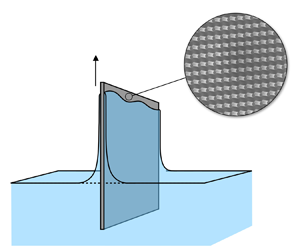
Surface roughness significantly modifies the liquid film thickness entrained when dip coating a solid surface, particularly at low coating velocity. Using a homogenization approach, we present a predictive model for determining the liquid film thickness coated on a rough plate. A homogenized boundary condition at an equivalent flat surface is used to model the rough boundary, accounting for both flow through the rough texture layer, through an interface permeability term, and slip at the equivalent surface. While the slip term accounts for tangential velocity induced by viscous shear stress, accurately predicting the film thickness requires the interface permeability term to account for additional tangential flow driven by pressure gradients along the interface. We find that a greater degree of slip and interface permeability signifies less viscous stress that would promote deposition, thus reducing the amount of free film coated above the textures. The model is found to be in good agreement with experimental measurements, and requires no fitting parameters. Furthermore, our model may be applied to arbitrary periodic roughness patterns, opening the door to flexible characterization of surfaces found in natural and industrial coating processes.
Citizen science is becoming very useful in surveying and monitoring biodiversity. Within the European Union LIFE medCLIFFS project, a network of volunteers has been established for the detection and long-term monitoring of invasive plant species that threaten the endemic flora of Mediterranean cliffs in northeastern Spain. Through iNaturalist, volunteers record various data along a series of 1-km transects. Based on the ca. 700 observations collected by volunteers in 2023 (the first year of the project), a simple and visually attractive methodology for assessing the recorded populations has been developed. This method classifies populations into one of three population dynamics categories: (1) propagative behavior (i.e., populations with seedlings or young plants but lacking senescent or dead individuals); (2) senescent behavior (i.e., showing senescent/dead plants but lacking seedlings/juveniles); and (3) a mixed behavior (i.e., containing both). This methodology, whose outputs are easily interpretable as heat maps, allows the collection of large datasets on invasive plants by citizen scientists, with two main purposes: (1) knowing which species are most concerning based on simple, straightforward observations of their population dynamics; and (2) identifying which regions of the study area are more problematic and where management efforts should therefore be directed.
This article makes the case for unearthing a long history of public humanities. The story begins with the very emergence of universities in the United States and continues through key moments where people of color and Indigenous people have shaped the history of public humanities. Risam makes the case against allowing the novelty of the term “public humanities” to erase this history and for resisting cooptation of public humanities by the neoliberal university.
This chapter offers an elaborate analysis of three recent cases by the Court of Justice of the EU in the context of EU free movement law. The cases deal with the questions of whether and to what extent the EU Member States are obliged to accept a family status created abroad even when it is incompatible with their own family law (such as same-sex marriage and same-sex parenthood) or is a status totally unknown in their legal system (such as the Islamic kafala). The chapter argues that the main approach chosen by the Court regarding same-sex marriage and same-sex parenthood created abroad, obliging the Member States to recognise them for the purpose of free movement only, may give rise to practical problems.