To save content items to your account,
please confirm that you agree to abide by our usage policies.
If this is the first time you use this feature, you will be asked to authorise Cambridge Core to connect with your account.
Find out more about saving content to .
To save content items to your Kindle, first ensure no-reply@cambridge.org
is added to your Approved Personal Document E-mail List under your Personal Document Settings
on the Manage Your Content and Devices page of your Amazon account. Then enter the ‘name’ part
of your Kindle email address below.
Find out more about saving to your Kindle.
Note you can select to save to either the @free.kindle.com or @kindle.com variations.
‘@free.kindle.com’ emails are free but can only be saved to your device when it is connected to wi-fi.
‘@kindle.com’ emails can be delivered even when you are not connected to wi-fi, but note that service fees apply.
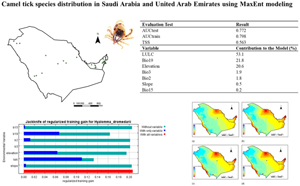
Ticks are important vectors and reservoirs of pathogens causing zoonotic diseases in camels and other livestock, rodents and other small mammals, birds and humans. Hyalomma dromedarii is the most abundant tick species in Saudi Arabia and United Arab Emirates (UAE) affecting primarily camels, and to a lesser extent, other livestock. Species presence data, land use/landcover, elevation, slope and 19 bioclimatic variables were used to model current and future distribution of H. dromedarii ticks using maximum entropy species distribution modelling (MaxEnt.). The model highlighted areas in the northern, eastern and southwestern parts of the study area as highly suitable for ticks. Several variables including land use/land cover (LULC) (53.1%), precipitation of coldest quarter (Bio19) (21.8%), elevation (20.6%), isothermality (Bio3) (1.9%), mean diurnal range [mean of monthly (max temp – min temp)] (Bio2) (1.8%), slope (0.5%), precipitation, seasonality (Bio15) (0.2%) influenced habitat suitability of ticks, predicting high tick density or abundance. Middle of the road scenario (ssp2-4.5) where CO2 levels remain similar to current levels, did not indicate a major change in the tick distributions. This tick distribution model could be used for targeting surveillance efforts and increasing the efficiency and accuracy of public health investigations and vector control strategies.
Extubation failure after neonatal cardiac surgery is associated with increased intensive care unit length of stay, morbidity, and mortality. We performed a quality improvement project to create and implement a peri-extubation bundle, including extubation readiness testing, spontaneous breathing trial, and high-risk criteria identification, using best practices at high-performing centers to decrease neonatal and infant extubation failure by 20% from a baseline of 15.7% to 12.6% over a 2-year period.
Methods
Utilising the transparency of the Pediatric Cardiac Critical Care Consortium database, five centres were identified as high performers, having better-than-expected neonatal extubation success rates with the balancing metric of as-expected or better-than-expected mechanical ventilation duration. Structured interviews were conducted with cardiac intensive care unit physician leadership at the identified centers to determine centre-specific extubation practices. Data from those interviews underwent qualitative content analysis which was used to develop a peri-extubation bundle. The bundle was implemented at a single-centre 17-bed cardiac intensive care unit. Extubation failure, defined as reintubation within 48 hours of extubation for anything other than a procedure, ventilator days and bundle compliance was tracked.
Results
There was a 41.4% decrease in extubation failure following bundle implementation (12 failures of 76 extubations pre-implantation; 6 failures of 65 extubations post-implementation). Bundle compliance was 95.4%. There was no difference in ventilator days (p = 0.079) between groups.
Conclusion
Implementation of a peri-extubation bundle created from best practices at high-performing centres reduced extubation failure by 41.4% in neonates and infants undergoing congenital heart surgery.
This chapter explores how notions of reciprocity shape new fiscal subjectivities in Ghana’s capital Accra. Drawing on historical sources, public debates and observations in public tax forums, I first discuss the long-term dynamics of ‘tax bargaining’ in Ghana since the colonial times, premised on power holders providing sufficient evidence of recipocity and return for tax payments. Secondly, this chapter provides a portrait of the intimate stakes of reciprocity between the state and citizens that characterize the process of becoming a taxpayer. By zooming in on the aspirations of a single female trader who went through the bureaucratic journey of formalizing her business and becoming a taxpayer, I propose the notion of the “nurturing state” to illustrate the intimate, personalized qualities of reciprocity that characterise emerging fiscal subjectivities in Ghana.
This article explores a new approach to anticipate the social impacts of disruptive products, using autonomous vehicles (AVs) as a case study. It highlights the limitations of current methods in predicting the social effects of new products and proposes that futures studies and strategic foresight can provide better techniques. The main hypothesis is that experts in social sciences can anticipate long-term social impacts by considering contextualized future product usages. The authors propose a new model called Representation–Usage–Impact (RUI), which combines expert knowledge from sociology and other fields. The article presents a detailed structure for the model and describes how experts can contribute their knowledge. Sessions were organized with experts to link AV usages with potential social impacts. The results demonstrate that social science experts can identify a wide range of potential long-term social impacts. The article suggests that the RUI model should be integrated and tested into design and decision-making tools to enhance the understanding of product impacts in practical contexts.
People living with dementia are often presumed to have no agency or capacity to act in the social world. They are often excluded from participating in research while research methodologies may not capture their embodied engagement with people and places. Yet, like everyone, people with dementia can express their agency in nuanced ways, for example, through emotions or embodied expression. In the conceptual framework discussed here, nuanced agency is conceived as consisting of non-deliberative elements (embodied, emotional, habituated, reflexive and intersubjective) and deliberative elements (choices or decisions and facilitative). Although people with dementia have been found to benefit from gardens with their sensory appeal, how they experience gardens is not well understood. This critical interpretive synthesis aims to explore how people with dementia experience nuanced forms of agency and citizenship in gardens. A conceptual framework of agency was developed to address the aim and support the analysis. Analysis of the 15 included studies highlighted the value of the conceptual framework in identifying a wider and more granular array of nuanced agency expressed in embodied form and through dialogue. This included expressions of intersubjective and facilitative agency that informed opportunities for people with dementia to experience relational citizenship socially in communal garden settings. These findings suggest an opportunity for researchers to explore the embodied agency of people living with dementia more comprehensively by applying theoretical concepts of agency. Further testing of the framework’s utility for guiding collection and analysis of primary data involving people with dementia in garden settings is recommended.
This chapter explores epistemic and organizational developments during the 1980s in fields such as climate and Earth system science, which today underpin global environmental governance. Operating within wider scientific networks and coordinating with organizations like United Nations Environment Programme (UNEP), World Meteorological Organization (WMO), and the Rockefeller Foundation, Stockholm-based individuals and institutions played decisive roles in international processes that took place at the interface of science and politics, also resulting in new institutions. The chapter explains how the Beijer Institute, led by Gordon Goodman, and Bert Bolin’s Meteorological Institute at Stockholm University helped orchestrate pivotal meetings in Villach, Austria, and Bellagio, Italy, that directly contributed to the 1987 Brundtland Report, provided impetus for the establishment of the IPCC in 1988, and increased the political stakes of climate change. The foundational stories of several Stockholm-based science and sustainable development-oriented institutions established during this period – the International Geosphere Biosphere Programme, the Stockholm Environment Institute, and the re-constituted Beijer Institute of Ecological Economics – are also elaborated.
Functional impairment is a major concern among those presenting to youth mental health services and can have a profound impact on long-term outcomes. Early recognition and prevention for those at risk of functional impairment is essential to guide effective youth mental health care. Yet, identifying those at risk is challenging and impacts the appropriate allocation of indicated prevention and early intervention strategies.
Methods
We developed a prognostic model to predict a young person’s social and occupational functional impairment trajectory over 3 months. The sample included 718 young people (12–25 years) engaged in youth mental health care. A Bayesian random effects model was designed using demographic and clinical factors and model performance was evaluated on held-out test data via 5-fold cross-validation.
Results
Eight factors were identified as the optimal set for prediction: employment, education, or training status; self-harm; psychotic-like experiences; physical health comorbidity; childhood-onset syndrome; illness type; clinical stage; and circadian disturbances. The model had an acceptable area under the curve (AUC) of 0.70 (95% CI, 0.56–0.81) overall, indicating its utility for predicting functional impairment over 3 months. For those with good baseline functioning, it showed excellent performance (AUC = 0.80, 0.67–0.79) for identifying individuals at risk of deterioration.
Conclusions
We developed and validated a prognostic model for youth mental health services to predict functional impairment trajectories over a 3-month period. This model serves as a foundation for further tool development and demonstrates its potential to guide indicated prevention and early intervention for enhancing functional outcomes or preventing functional decline.
Jehovah's Witnesses began as an informal Bible study group in the 1870s that sought to recover first-century Christian beliefs and practices. They disseminated literature announcing the expected reign of God's Kingdom and called themselves Bible Students. In 1931, they adopted the name Jehovah's Witnesses, epitomizing their belief in the Christian obligation to preach the gospel worldwide. Known for their ethic of nonviolence and their evangelizing work, and despite worshipping freely in most countries, Witnesses are subject to controversy, particularly vis-à-vis mainstream Christianity, the State, and secularized societies. The authors are practicing Jehovah's Witnesses who present this work as neither apologia nor official account, but as an emic description of the history, beliefs, identity, and organizational structure of Witnesses, and their societal interactions. While briefly covering main controversies, this Element focuses on the culture and lived experience of the millions comprising the Witness community. This title is also available as Open Access on Cambridge Core.
En este artículo, estudiamos qué factores individuales y contextuales explican la confianza en los sindicatos latinoamericanos. Utilizando datos de Latinobarómetro (2018–2020), mostramos que la confianza en los sindicatos es mayor entre personas de clase trabajadora y clase media asalariada, así como entre quienes se identifican con la izquierda y confían más en las instituciones políticas. A nivel contextual, la confianza es mayor en países neo-desarrollistas (por ejemplo, Brasil y Uruguay) y menor en países capitalistas tercerizados (por ejemplo, México y países centroamericanos). Contrario a nuestra hipótesis, también encontramos que la confianza en los sindicatos es alta en Chile (un país liberal-rentista con sindicatos débiles) y baja en algunos países redistributivo-rentistas (Venezuela) y neo-desarrollistas (Argentina). Para explicar estos resultados, analizamos cómo la confianza en los sindicatos depende de aspectos contextuales como la informalidad laboral, el desempleo, la inflación, el poder de los partidos de izquierda y el nivel de movilización social.
Despite growing awareness of the mental health damage caused by air pollution, the epidemiologic evidence on impact of air pollutants on major mental disorders (MDs) remains limited. We aim to explore the impact of various air pollutants on the risk of major MD.
Methods
This prospective study analyzed data from 170 369 participants without depression, anxiety, bipolar disorder, and schizophrenia at baseline. The concentrations of particulate matter with aerodynamic diameter ≤ 2.5 μm (PM2.5), particulate matter with aerodynamic diameter > 2.5 μm, and ≤ 10 μm (PM2.5–10), nitrogen dioxide (NO2), and nitric oxide (NO) were estimated using land-use regression models. The association between air pollutants and incident MD was investigated by Cox proportional hazard model.
Results
During a median follow-up of 10.6 years, 9 004 participants developed MD. Exposure to air pollution in the highest quartile significantly increased the risk of MD compared with the lowest quartile: PM2.5 (hazard ratio [HR]: 1.16, 95% CI: 1.09–1.23), NO2 (HR: 1.12, 95% CI: 1.05–1.19), and NO (HR: 1.10, 95% CI: 1.03–1.17). Subgroup analysis showed that participants with lower income were more likely to experience MD when exposed to air pollution. We also observed joint effects of socioeconomic status or genetic risk with air pollution on the MD risk. For instance, the HR of individuals with the highest genetic risk and highest quartiles of PM2.5 was 1.63 (95% CI: 1.46–1.81) compared to those with the lowest genetic risk and lowest quartiles of PM2.5.
Conclusions
Our findings highlight the importance of air pollution control in alleviating the burden of MD.
The interface of science and law is a territory frequently occupied by policymakers. In facilitating this interface, epistemic communities have become significant influencers in policymaking, especially at the European Union (EU) level, as a result of its complex multilevel governance system. In this article we assess the quality and nature of interactions between epistemic communities and EU stakeholders on the Horizon-funded project ‘PrecisionTox’, by deploying the concept of epistemic communities developed by Haas, as well as the learning modes of epistemic communities as presented and adapted by Dunlop. The overarching goal of PrecisionTox is to advance the safety assessment of chemicals by establishing a new, cost-effective testing paradigm built from evolutionary theory, which entails reduction, replacement, and refinement of mammalian testing (the 3Rs). The study shows that EU-funded projects can provide an excellent platform for building epistemic communities and forging alliances with EU policymakers, especially when novel technologies may be unlocked and socialized. This study also explores the early interaction of policymakers with epistemic communities through different forms of learning to better understand the complexities surrounding these new technologies in order to set an agenda for policy interventions.
Excavation at the site of Bhagatrav yielded four layers of cultural deposits: the lowermost being the Sorath Harappan, the upper two are medieval, and layer three caps the Sorath Harappan layer. A horn-deity painted dish was found in a stratified context at the lowest level. The medieval deposit includes turquoise glazed and celadon wares, followed by an abundance of Monochrome Glazed Ware, which is otherwise known as Khambhat ware. The date of the Sorath Harappan layer of the site, the time and space of the horn-deity motif in the Harappan world, and the date of Khambhat ware have long been subjects of discussion. With the help of a series of absolute dating (radiocarbon and luminescence), this paper attempts to place the site, horn-deity motif, and the Khambhat ware in the cultural chronology of Gujarat.
The innermost region of the Milky Way harbors the central molecular zone (CMZ). This region contains a large amount of molecular gas but a poor star formation rate considering the densities achieved by the gas in this region. We used the arepo code to perform a hydrodynamic and star formation simulation of the galaxy, where a Ferrers bar was adiabatically introduced. During the stage of bar imposition, the bar strength excites density waves close to the inner Lindblad resonance guiding material towards the inner galaxy, driving the formation of a ring that we qualitatively associate with the CMZ. During the simulation, we identified that the ring passes three main phases, namely: formation, instability, and quasi-stationary stages. During the whole evolution, and particularly in the quasi-stationary stage, we observe that the ring is associated with the x2 family of periodic orbits. Additionally, we found that most of the star formation occurs during the ring formation stage, while it drastically decreases in the instability stage. Finally, we found that when the gas has settled in a stable x2 orbit, the star formation takes place mostly after the dense gas passes the apocentre, triggering the conveyor-belt mechanism described in previous studies.
Despite 30 years of research on economic inequality, the question of whether government ideology affects inequality remains unresolved. As rising inequality poses a major challenge to contemporary democracies, we ask: (when) do parties matter regarding inequality? Our systematic analysis finds that research is divided, with a tendency toward a pessimistic “no.” We decipher the factors that account for this split in theoretically predictable ways. We assess the roles played by the type of inequality, the time horizon, and the impact of policy channels. Bivariate and multivariate analyses of 393 TSCS-regression findings show how the type of inequality and a neglect of top incomes, a focus on short- rather than long-term effects, and the inclusion of policy channels that absorb the effects of parties strongly codetermine the results. Effects septuple depending on how these factors are combined. We draw three lessons that, when combined, foster a shift toward a more optimistic perspective on the latitude of politics.
Halloysite nanotubes (often abbreviated as HNTs) are technologically important owing to their unique structural and morphological features. Some of these features pre-exist in the naturally hydrated halloysite-(10 Å) parent clay mineral; others may develop during its dehydration towards halloysite-(7 Å). This is the first infrared spectroscopic study of the transition to halloysite-(7 Å), which, in combination with X-ray diffraction (XRD), aimed at advancing the structural description of the process. Three cylindrical and two polygonal halloysite-(10 Å) samples, in both their H- and D-forms, were measured by attenuated total reflectance (ATR), non-invasively and in situ, following step-wise equilibration from 70% relative humidity (RH) to <10% RH and back to 70% RH at ambient temperature. This approach allowed for recording the spectrum of the dehydrating (but not rehydrating) interlayer in the νO–D range, without interference from the inner νOH groups, or from the inner-surface νOH of anhydrous interlayers already present in the parent material. Besides the well-known ‘hole’ H2O species, a new type of H2O-decorated defect was detected at frequencies normally dominated by the inner νOH. This defect is linked to the microenvironment created by the detachment between layer packets and forming ‘crevices’ or ‘slits’ upon dehydration. In addition, the study of the νSi–O spectrum demonstrated that the dehydration of halloysite-(10 Å) leads to the parallel formation of localized, ordered, kaolinite-like domains co-existing with regions of accumulated disorder. The as-produced halloysite-(7 Å) had a non-ideal, open structure that resisted rehydration because the kaolinite-like domains do not rehydrate and act as permanent cross-links.
Nitrogen (N) is the most significant nutrient affecting crop growth and development for all types of crops, except legumes. The goal of this study was to optimize the N level for cotton grown in a semi-arid environment to enhance growth and development, determine N status, and increase seed cotton yield and biomass. Two independent field experiments each three years in duration were conducted, from 2007 to 2009 (Exp.-I) and 2018 to 2020 (Exp.-II). Experiments were laid out in a randomized complete block design with three replicates. The N treatments in Exp.-I were comprised of 0, 40, 80, 120, 160, 200 and 240 kg N/ha, while treatments in Exp.-II were comprised of 0, 70, 140, 210 and 280 kg N/ha. A wide range of data sets for cotton traits were recorded, including canopy height, leaf area index, the N status of the leaf and stem, seed cotton yield and time-series biomass data. The higher N rates 240 and 280 kg N/ha performed better for all these traits. However, the highest leaf N contents were recorded for 210 kg N/ha. Based on these results, it is suggested that under semi-arid conditions, slightly higher rates than optimum or recommended N rates could be applied as a strategy by cotton growers for a higher seed cotton yield. The findings of this study may also increase profitability in other cotton-growing areas that have similar weather conditions.
Democratic electoral systems characteristically take a Count-and-Report Approach to enfranchised citizens’ failure to turn out in political elections: The number of non-votes is counted and publicly reported, but non-votes are given no effect in the allocation of political offices. We morally assess this model in the context of legislative elections, and argue that it is pro tanto less desirable than another, counterfactual model which we label Proportional Non-Voter Sortition. This model provides that citizens’ non-votes shall be legislatively represented by legislators who are selected by lot from the non-voting part of the demos, and whose share of seats is proportional to the aggregate rate of non-voting in the legislative election. Our assessment of the two models specifically turns on the claim that a democracy’s legislature should reflect the full diversity of political views that exists within its demos (legislative inclusivity), and it offers two reasons to expect that Proportional Non-Voter Sortition serves legislative inclusivity better than the Count-and-Report Approach: 1) Proportional Non-Voter Sortition uniquely incentivizes political parties to integrate non-voter views into their political agendas and mobilisation activities; and 2) Proportional Non-Voter Sortition additionally enables the legislative articulation and advocacy of non-voter views by placing people in the legislature who are descriptively representative of non-voters. Through our discussion of different models for the post-electoral management of non-votes, we contribute to a body of normative democratic theorizing about citizens’ non-voting, but raise a distinct question that so far has remained unexplored.