To save content items to your account,
please confirm that you agree to abide by our usage policies.
If this is the first time you use this feature, you will be asked to authorise Cambridge Core to connect with your account.
Find out more about saving content to .
To save content items to your Kindle, first ensure no-reply@cambridge.org
is added to your Approved Personal Document E-mail List under your Personal Document Settings
on the Manage Your Content and Devices page of your Amazon account. Then enter the ‘name’ part
of your Kindle email address below.
Find out more about saving to your Kindle.
Note you can select to save to either the @free.kindle.com or @kindle.com variations.
‘@free.kindle.com’ emails are free but can only be saved to your device when it is connected to wi-fi.
‘@kindle.com’ emails can be delivered even when you are not connected to wi-fi, but note that service fees apply.
Perceptualism is a prominent theory analyzing emotions as perceptual experiences of value. A long-standing challenge to perceptualism says that emotions cannot be perceptual because they are subject to normative assessments in terms of reasons and rationality, while perceptual experiences are not. I defend perceptualism from this charge. My argument begins by distinguishing two forms of normative assessment: fundamental and non-fundamental. Perceptualism is compatible with the latter (i.e., non-fundamental reasons and rationality); even sensory experiences are so assessable. I next argue that emotions are only non-fundamentally assessable. Following this argument, I outline a perceptualist-friendly theory of emotions as non-fundamentally normatively assessable.
Text is a major medium of contemporary interpersonal communication but is difficult for social scientists to study unless they have significant resources or the skills to build their own research platform. In this paper, we introduce a cloud-based software solution to this problem: ReChat, an online research platform for conducting experimental and observational studies of live text conversations. We demonstrate ReChat by applying it to a specific phenomenon of interest to political scientists: conversations among co-partisans. We present results from two studies, focusing on (1) self-selection factors that make chat participants systematically unrepresentative and (2) a pre-registered analysis of loquaciousness that finds a significant association between speakers’ ideological extremity and the amount they write in the chat. We conclude by discussing practical implications and advice for future practitioners of chat studies.
Nypa fruticans Wurmb is both a relic plant and a true mangrove. In China, wild populations are distributed only on Hainan Island and face significant challenges in regeneration from seedlings. This study explored the underlying causes of recruitment limitation by examining seed morphological traits from three distinct populations (Haikou, Wenchang and Wanning) and analysing seed germination and seedling growth characteristics under varying conditions. The key findings are as follows: fruiting and seed-setting rates for N. fruticans were notably low, standing at only 21 and 40%, respectively. The Wanning population exhibited significantly higher rates compared to the other two populations. Under natural conditions, the germination and seedling emergence rates were also modest, at 36.58 and 22.99%, respectively. The germination and emergence rates of the Wanning population were significantly greater than those of the Haikou and Wenchang populations. Meanwhile, seeds from a single population did not differ in germination rates among three in situ N. fruticans habitats, but seedling emergence rates differed significantly. Optimal conditions for seed germination involved a light intensity of 60%, a salinity of 5‰ and a flooding time of 8 h/day. In natural settings, these three environmental factors fall short of the ideal conditions. The study underscores that light, salinity and flooding are primary factors contributing to the limitations in N. fruticans seedling recruitment. In addition to advocating increased investment in scientific research and technology to address seed source issues, we recommend heightened efforts in habitat restoration, in situ conservation and the optimization of relocation and field return strategies to bolster N. fruticans populations.
Young stellar objects (YSOs) are protostars that exhibit bipolar outflows fed by accretion disks. Theories of the transition between disk and outflow often involve a complex magnetic field structure thought to be created by the disk coiling field lines at the jet base; however, due to limited resolution, these theories cannot be confirmed with observation and thus may benefit from laboratory astrophysics studies. We create a dynamically similar laboratory system by driving a $\sim$1 MA current pulse with a 200 ns rise through a $\approx$2 mm-tall Al cylindrical wire array mounted to a three-dimensional (3-D)-printed, stainless steel scaffolding. This system creates a plasma that converges on the centre axis and ejects cm-scale bipolar outflows. Depending on the chosen 3-D-printed load path, the system may be designed to push the ablated plasma flow radially inwards or off-axis to make rotation. In this paper, we present results from the simplest iteration of the load which generates radially converging streams that launch non-rotating jets. The temperature, velocity and density of the radial inflows and axial outflows are characterized using interferometry, gated optical and ultraviolet imaging, and Thomson scattering diagnostics. We show that experimental measurements of the Reynolds number and sonic Mach number in three different stages of the experiment scale favourably to the observed properties of YSO jets with $Re\sim 10^5\unicode{x2013}10^9$ and $M\sim 1\unicode{x2013}10$, while our magnetic Reynolds number of $Re_M\sim 1\unicode{x2013}15$ indicates that the magnetic field diffuses out of our plasma over multiple hydrodynamical time scales. We compare our results with 3-D numerical simulations in the PERSEUS extended magnetohydrodynamics code.

Digital health technologies have been enhancing the capacity of healthcare providers and, thereby, the delivery of targeted health services. The Southeast Asia Region (SEAR) has invested in strengthening digital public health. Many digital health interventions have been implemented in public health settings but are rarely assessed using the holistic health technology assessment (HTA) approach.
Methods
A systematic literature review was performed to provide an overview of evaluations of digital public health interventions in the World Health Organization (WHO) SEAR. Searches were conducted on four electronic databases. Screening title abstracts and full texts was independently conducted by two reviewers, followed by data extraction. Dimensions of HTA were analyzed against the EUnetHTA Core Model 3.0. Quality assessment of included articles was conducted using the JBI Checklist for Economic Evaluation and Consolidated Health Economic Evaluation Reporting Standards 2022 checklist to assess the reporting quality. The findings are presented using systematic evidence tables and bar charts.
Results
Of the forty-three studies screened at the full-text stage, thirteen studies conducted across six countries were included in the analysis. Telemedicine and m-health interventions were assessed in ten studies. Nine studies conducted cost-effectiveness analysis, and five assessments were conducted from a societal perspective. Four studies utilized more than one perspective for the assessment. Health problem definition and current use of technology, description and technical characteristics of the technology, clinical effectiveness, costs, economic evaluation, and organizational aspects were assessed by all the studies, whereas legal aspects were least assessed.
Conclusion
The lack of HTAs on digital public health interventions in the region highlights the need for capacity-building efforts.
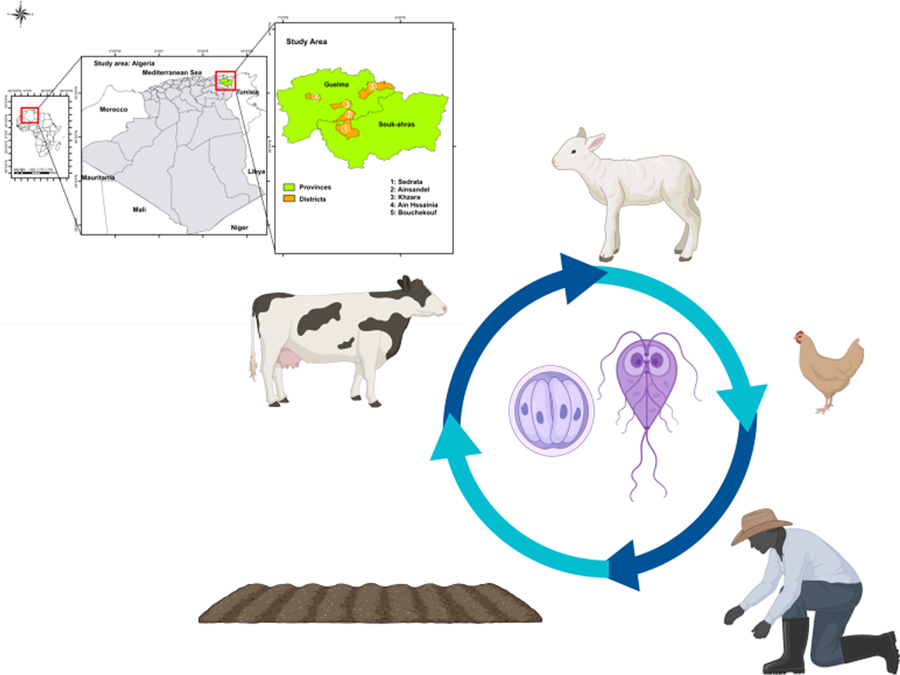
Gastrointestinal infections constitute a significant global health concern, particularly in tropical and subtropical regions, caused by various pathogens. Among these, Cryptosporidium spp. and Giardia duodenalis are noteworthy due to their zoonotic potential. In Algeria, molecular epidemiological data on cryptosporidiosis and giardiasis are limited. To fill this gap, the present study aimed to examine the transmission dynamics of Cryptosporidium spp., and Giardia duodenalis in various households. A total of 216 samples were collected from the rural Guelma and Souk Ahras provinces, located in the eastern part of Algeria. These included human and animal faeces, as well as water and soil samples. DNA was extracted, followed by nested PCR targeting the SSU rRNA gene to detect Cryptosporidium spp., while the gp60 gene was amplified for subtyping. Detection of G. duodenalis was performed by qPCR targeting the SSU rRNA gene, followed by amplification of tpi, bg and gdh genes for genotyping and subtyping. Several Cryptosporidium species, including C. bovis, C. ryanae, C. andersoni and C. parvum, were identified in human, animal and environmental samples. The zoonotic C. parvum subtype IIaA17G2R1 was detected in human, animal and soil samples. Giardia duodenalis assemblage B was detected in a human sample, while assemblage E was found in cattle and sheep. The current investigation underscores the importance of the One Health approach in addressing issues related to intestinal parasites, highlighting the need for improved surveillance and control measures in rural settings.
This paper reports on the process used to embark on one of the core strategies of Abu Dhabi’s Department of Health, which was to develop a roadmap for HTA implementation and institutionalization, based on the aspirations and needs of local stakeholders and making use of the evidence-informed deliberative processes framework. The paper also highlights the main features of the road map that may be expected to address some of the current challenges.
Methods
A series of activities were undertaken that informed the subsequent development of the roadmap. They comprised a situation analysis using a combination of desk research and semistructured (group) interviews with 45 stakeholders. The findings were discussed in two workshops; face-to-face with nonindustry stakeholders from Abu Dhabi, and online with industry representatives.
Results
Guided by the EDP framework, the roadmap provides instructions how to organize stakeholder involvement, how to identify and operationalize decision criteria, and how to ensure that the decision-making process is transparent. Specific guidance is given on establishing an HTA structure with an appropriate policy framework, the formulation of an HTA program, a communication strategy, as well as building and leveraging HTA expertise.
Conclusion
Broad stakeholder consultation has been instrumental toward the establishment of a comprehensive HTA framework in Abu Dhabi, and the development of a road map. The interest raised during stakeholder consultations and the commitments made hold promise for the adoption and establishment of EDP principles to support HTA in Abu Dhabi that have potential to contribute to a sustainable high-quality healthcare system.
This study investigated cases of pregnancy-related listeriosis in British Columbia (BC), Canada, from 2005 to 2014. We described all diagnosed cases in pregnant women (n = 15) and neonates (n = 7), estimated the excess healthcare costs associated with listeriosis, and calculated the fraction of stillbirths attributable to listeriosis, and mask cell sizes 1–5 due to data requirements. Pregnant women had a median gestational age of 31 weeks at listeriosis onset (range: 20–39) and on average delivered at a median of 37 weeks gestation (range: 20–40). Neonates experienced complications but no fatalities. Stillbirths occurred in 1–5 of 15 pregnant women with listeriosis, and very few (0.05–0.24%) of the 2,088 stillbirths in BC in the 10 years were attributed to listeriosis (exact numbers masked). Pregnant women and neonates with listeriosis had significantly more hospital visits, days in the hospital and physician visits than those without listeriosis. Pregnant women with listeriosis had 2.59 times higher mean total healthcare costs during their pregnancy, and neonates with listeriosis had 9.85 times higher mean total healthcare costs during their neonatal period, adjusting for various factors. Despite small case numbers and no reported deaths, these results highlight the substantial additional health service use and costs associated with individual cases of pregnancy-related listeriosis in BC.
Seed longevity influences the success of ex situ storage and preservation of plant genetic diversity and is thus a critical factor in conservation efforts. Rapid seed ageing experiments at high temperature and high humidity have been widely used to classify seed longevity for hundreds of plant species, with potential implications for longevity in ex situ conservation. In this approach, radicle emergence (R) is normally used as a measure of the viability of the seeds. However, R could overestimate the level of normal seedling development and, consequently, the perceived longevity of seeds. Here, seed lifespan for 33 alpine species was compared to assess whether germination criteria could affect seed longevity parameters. Seeds were exposed to controlled ageing [45°C, 60% relative humidity (RH)] and regularly sampled for germination assessment as both radicle emergence (R) and radicle plus cotyledon emergence (R + C). The time taken in storage for viability to fall to 50% (p50) was determined using probit analysis, including either R or R + C data. A coefficient of overestimation of seed longevity (OESL, %) was determined. The results highlight significant differences in seed longevity estimates both across species and the germination criteria. For 17 species, seed longevity estimated by R was significantly higher than that estimated using R + C, resulting in large variation in OESL (0.54–9.01 d). The introduction of OESL facilitates effective screening for seed longevity and recovery, enhancing the overall efficiency of conservation strategies for diverse species.
Improving access to and quality of maternal and infant healthcare are important leverage points to address worsening maternal and infant health disparities in the USA. This study evaluates the comprehensiveness of existing maternal and infant quality-of-care measures to identify aspects of quality that need greater attention in quality measurement.
Study design:
We conducted a structured, team-based qualitative review of 88 maternal and infant health measures indexed by the National Quality Forum (NQF), the Agency for Healthcare Research and Quality (AHRQ), the Centers for Medicare and Medicaid Services (CMS), and the National Committee for Quality Assurance (NCQA). We assessed discrete elements relevant to meaningfulness, feasibility, and usability following AHRQ National Quality Strategy (NQS) criteria, with input from researcher, clinician, and citizen scientist investigators. Descriptive statistics on coded measures were calculated using SPSS.
Results:
The most common AHRQ NQS priorities addressed were mortality (60%) and safety (48%). Average scores across elements were 59% for feasibility, 61% for practice usability, and 31% for policy usability. Fewer measures addressed coordination, affordability, or patient engagement in the postpartum period. Only 23% of measures were endorsed by NQF, only 17% of measures had publicly available benchmarks, and only 14% had specifications updated in the year prior to review.
Conclusions:
Findings from this study can inform the specification of a comprehensive, updated system for maternal and infant quality-of-care evaluation and can facilitate the development of new quality-of-care measures that address underrepresented maternal and infant health issues.
Objections to the orthodox doctrine of an eternal hell often rely on arguments that it cannot be a person’s own fault that she ends up in hell. The article summarizes and addresses three significant arguments which aim to show that it could not be any individual’s fault that they end up in hell. I respond to these objections by showing that those who affirm a classical picture of sin have Moorean reasons to reject these objections. That classical perspective holds that all (serious) sin involves choosing eternal destiny apart from God and that no sin could possibly be caused by God. Consequently, it is necessary for ending up in hell that someone commit a serious sin, and it is sufficient for ending up damned that one persists forever in sin. Since the objections conflict with Moorean commitments central to the classical perspective, those who hold to such a classical perspective on sin would have good reason to reject all these arguments, which involve assumptions that would entail that such a perspective is false.
Given a group G acting faithfully on a set S, we characterize precisely when the twisted Brin–Thompson group SVG is finitely presented. The answer is that SVG is finitely presented if and only if we have the following: G is finitely presented, the action of G on S has finitely many orbits of two-element subsets of S, and the stabilizer in G of any element of S is finitely generated. Since twisted Brin–Thompson groups are simple, a consequence is that any subgroup of a group admitting an action as above satisfies the Boone–Higman conjecture. In the course of proving this, we also establish a sufficient condition for a group acting cocompactly on a simply connected complex to be finitely presented, even if certain edge stabilizers are not finitely generated, which may be of independent interest.
Extant literature shows that small conversations with strangers can help improve individuals’ wellbeing while reducing feelings of loneliness. Nevertheless, previous studies on talking to strangers tend to focus on young participants in controlled experimental settings, leaving a gap in understanding older adults’ experiences and their likelihood of adopting talking to strangers as part of their daily healthy ageing practices. Considering the problem of worsened social isolation and loneliness among older people during the Covid-19 pandemic, it is even more important to include them in the promotion of social inclusion through micro-conversations with strangers. To understand older adults’ attitudes and experiences of talking to strangers, this study interviewed 19 older people based on their trial of talking to strangers over a three-month period. Findings reveal that their willingness and confidence varied by age and gender, with retired individuals being more active in engaging with strangers. Time constraints and lack of self-efficacy were identified as barriers, particularly among those still working or with caregiving responsibilities. Rather than personal gains, the act of kindness towards others was emphasised as the key motive. These insights are valuable for policy makers and organisations supporting older people’s wellbeing, highlighting the potential for older individuals to serve as conversation initiators, promoting mutual kindness and wellbeing in communities.
Historiographic studies of transnational environmental law (TEL) are increasingly relevant as scholars and practitioners search for ways in which to deliver more quickly and efficiently effective regulation that is responsive to global environmental issues. This article uses new and original archival research to better locate the Convention for the Preservation of Wild Animals, Birds and Fish in Africa (1900 London Convention) in its legal-scientific historical context. Most of the scholarship on this topic draws on historian John M. MacKenzie's groundbreaking analysis of what he called ‘the hunting cult’ and its role in the imperial advance into India, Africa, and elsewhere. When viewed through the dual lens of legal history and the history of science, the late 19th and early 20th centuries represented a period of transition during which a new science-based perspective advanced by evolutionary biologists was embraced by science-minded policymakers, and expressed in domestic law and foreign policy aimed at the preservation of endangered species and the protection of biodiversity. The 1900 London Convention is an early example of a modern TEL instrument informed by science and by values that today most recognize as being critically important and universal. The new history in this article also resonates as an example of how polarizing political narratives can delay law reform and the importance of maintaining focus on collaborative problem solving and science-based regulation of complex transnational environmental issues.
The endemic tree Neltuma caldenia Burk. and the shrub Neltuma flexuosa var depressa F.A. Roig (Fabaceae; subfam: Mimosoideae) are two promising species from the central region of Argentina, with high potential for use in the restoration of disturbed environments, for extensive livestock grazing and apiculture. Both species have seeds with physical dormancy. Ecological study of native species is important from the point of view of rehabilitation of degraded areas by natural regeneration or via seed-based programmes. The objective of this study was to evaluate soil seed bank persistence and seedling traits to understand variation among different populations of each of the study species growing along an ecological gradient and to identify potential components driving this variation. Home environments influenced seed bank persistence, which was higher in populations originating from more arid and unpredictable environments where it could act as a bet-hedging strategy between years and seasons. We also observed differences associated with seedling growth traits between the species and populations. Populations with higher seed persistence were associated with greater seedling growth in N. caldenia. The rapid elongation rate of N. caldenia seedlings growing in large populations and unstable environments could help their ability to escape drought by accessing deeper soil moisture and would confer a high relative competitive ability. In contrast, N. f. var depressa displayed higher seed persistence, which was associated with more arid and unstable conditions and correlated with lower seedling growth, possibly due to an inbreeding depression effect, resulting from the presence of mother plants in low-densities or being isolated from other individuals. There was no effect of population size on seed persistence. To better understand seed persistence and associated seedling trait variation, future studies need to consider the genotype, environment and landscape conditions.
This paper seeks to open an inquiry into the origins of astropolitics, an intellectual and popular imagination whose defining characteristic is the attempt to project geopolitical concepts and categories into outer space. I locate the roots of this vision not merely in Anglo-American maritime strategy but in the rather earthlier German tradition of geopolitics, more specifically in the work of the geographer Friedrich Ratzel and the political theorist Carl Schmitt. Surprisingly, however, my reverse chronology discovers that although the two men’s ideas reverberate through contemporary astropolitical discourses, they were both in fact, in different ways and for different reasons, hesitant about space colonisation. The paper makes sense of this finding and unpacks its implications for contemporary International Relations debates on off-earth politics.
In this article, I develop a neglected aspect of the value of hope in Kant’s philosophy. I do so by homing in on Section III of the 1793 essay “On the Common Saying.” In my interpretation, Kant argues that if one recognizes obligations to help future generations while also encountering people who violate these obligations, one is more likely to isolate oneself from society—what Kant calls the hatred of humanity or misanthropy. Thus, the article argues that hope is valuable for combating misanthropy, especially in the pursuit of intergenerational moral goals.
Community advisory boards (CABs) are a promising approach for strengthening patient and partner voices in community health center (CHC) evidence-based decision-making. This paper aims to describe how CHCs used CABs during the COVID-19 pandemic to improve the reach of testing among populations experiencing health disparities and identify transferable lessons for future implementation.
Methods:
This mixed methods study integrates brief quantitative surveys of community engagement (N = 20) and one-on-one qualitative interviews (N = 13) of staff and community partners engaged in CHC CABs with a cost analysis and qualitative feedback from CHC staff participating in an online learning community (N = 17).
Results:
Community partners and staff engaged in the CHC CABs reported high ratings of engagement, with all mean ratings of community engagement principles above a 4 (“very good” or “often”) out of 5. Qualitative findings provided a more in-depth understanding of experiences serving on the CHC CAB and highlighted how engagement principles such as trust and mutual respect were reflected in CAB practices. We developed a CHC CAB toolkit with strategies for governance and prioritization, cost estimates to ensure sustainment, guidance on integrating quality improvement expertise, testimonies from community members on the benefits of joining, and template agendas and facilitator training to ensure meeting success.
Conclusion:
In alignment with the Translational Science Benefits Model, this study expands research impact through comprehensive mixed methods measurement of community engagement and by transforming findings into an action-orientated guide for CHCs to implement CABs to guide evidence-based decision-making for community and public health impact.
From speech to privacy, broad public interests are increasingly governed online by policy decisions taken by private companies. We examine when and how firms make such decisions. In contrast to the shadow of hierarchy and functionalist explanations of private authority, we build an analytical framework based on business power and the economics literature concerned with two-sided markets. We argue that companies operating as digital platforms may use private actor governance to consolidate their influence. More precisely, public-interest regulation on one side of the market (e.g., protecting the privacy of end-users) may increase the dependence of firms on the other side of the market (e.g., increasing the price paid for information by advertisers). We probe our argument by looking at the privacy policy implemented by Apple in 2021. Our findings demonstrate the growing role played by digital companies in global regulatory debates and call attention to how market structures can simultaneously incentivize public-interest regulation and become a source of business power.