To save content items to your account,
please confirm that you agree to abide by our usage policies.
If this is the first time you use this feature, you will be asked to authorise Cambridge Core to connect with your account.
Find out more about saving content to .
To save content items to your Kindle, first ensure no-reply@cambridge.org
is added to your Approved Personal Document E-mail List under your Personal Document Settings
on the Manage Your Content and Devices page of your Amazon account. Then enter the ‘name’ part
of your Kindle email address below.
Find out more about saving to your Kindle.
Note you can select to save to either the @free.kindle.com or @kindle.com variations.
‘@free.kindle.com’ emails are free but can only be saved to your device when it is connected to wi-fi.
‘@kindle.com’ emails can be delivered even when you are not connected to wi-fi, but note that service fees apply.
This paper advances a theory of disease as domino dysfunction. It is often argued that diseases are biological dysfunctions. However, a theory of disease as biological dysfunction is complicated by some plausible cases of dysfunction that seem clearly non-pathological. I argue that pathological conditions are not just dysfunctions but domino dysfunctions, and that domino dysfunctions can be distinguished on principled biological grounds from non-pathological dysfunctions. I then show how this theory can make sense of the problem cases; they are not diseases because they are not domino dysfunctions.
The contribution offers a critical appraisal of the individual’s (in)access to justice when his or her fundamental rights have been violated during direct enforcement action by EU law enforcement authorities. Based on three case studies – ESMA, DG COMPETITION, OLAF – we argue that direct enforcement, and the shared activities and joint decisions of EU and national authorities it entails, have been ‘squeezed’ into the existing system of separated controls between the EU and the Member State legal orders. This brings with it challenges regarding the control over public power which may affect ‘access to’ and ‘justice’. The main argument of our contribution then is that in the current EU-constellation, courts are – contrary to what is generally assumed – not always, or in any case not necessarily, best-suited for remedying fundamental rights violations and providing the protection the individual needs. Therefore, the co-existing judicial and non-judicial remedies can address each other’s gaps and ultimately ensure a fully-fledged protection of fundamental rights if designed properly and aligned with each other and with national law.
Edited by
Daniel Benoliel, University of Haifa, Israel,Peter K. Yu, Texas A & M University School of Law,Francis Gurry, World Intellectual Property Organization,Keun Lee, Seoul National University
This chapter provides an introduction to Intellectual Property, Innovation and Economic Inequality. It begins by discussing the problem of economic inequality, including the scale of that problem, types of economic inequality, and extant research on such inequality. The chapter then outlines the structure of this volume, which is divided into three parts: (1) theoretical, empirical, and policy issues; (2) intellectual property and national inequality; and (3) intellectual property and global inequality.
We investigated the accuracy and completeness of four large language model (LLM) artificial intelligence tools. Most LLMs provided acceptable answers to commonly asked infection prevention questions (accuracy 98.9%, completeness 94.6%). The use of LLMs to supplement infection prevention consults should be further explored.
We study the incidence of Social Security taxes on teacher wages and employment. On average, we estimate teachers with Social Security coverage take home 9.6 percent less in wages than observationally similar teachers in similar districts without Social Security coverage. This accounts for about three-fourths of the 12.4-percent total Social Security tax. Moreover, our analysis suggests this is likely a lower-bound estimate of the true incidence of Social Security taxes – under reasonable assumptions, we cannot rule out full (100%) tax incidence on teacher wages. We find no evidence of tax incidence on teacher staffing levels.
This chapter introduces the main research themes of this book, which explores two current global developments. The first concerns the increased use of algorithmic systems by public authorities in a way that raises significant ethical and legal challenges. The second concerns the erosion of the rule of law and the rise of authoritarian and illiberal tendencies in liberal democracies, including in Europe. While each of these developments is worrying as such, in this book, I argue that the combination of their harms is currently underexamined. By analysing how the former development might reinforce the latter, this book seeks to provide a better understanding of how algorithmic regulation can erode the rule of law and lead to algorithmic rule by law instead. It also evaluates the current EU legal framework which is inadequate to counter this threat, and identifies new pathways forward.
In Chapter 3, I developed this book’s normative analytical framework by concretising the six principles that can be said to constitute the rule of law in the EU legal order. Drawing on this framework, in this chapter I now revisit each of these principles and carry out a systematic assessment of how public authorities’ reliance on algorithmic regulation can adversely affect them (Section 4.1). I then propose a theory of harm that conceptualises this threat, by juxtaposing the rule of law to algorithmic rule by law (Section 4.2). Finally, I summarise my findings and outline the main elements that should be considered when evaluating the aptness of the current legal framework to address this threat (Section 4.3).
In this paper, we study the employment of $\Sigma _1$-sentences with certificates, i.e., $\Sigma _1$-sentences where a number of principles is added to ensure that the witness is sufficiently number-like. We develop certificates in some detail and illustrate their use by reproving some classical results and proving some new ones. An example of such a classical result is Vaught’s theorem of the strong effective inseparability of $\mathsf {R}_0$.
We also develop the new idea of a theory being $\mathsf {R}_{0\mathsf {p}}$-sourced. Using this notion, we can transfer a number of salient results from $\mathsf {R}_0$ to a variety of other theories.
This chapter illustrates how soft law can have very real implications for the fundamental rights position of individuals. While the existence of an interference is often treated implicitly in the case law of the ECtHR and the CJEU, the chapter argues that interferences can result from soft law acts. For the EU this means that recourse to soft law does not in itself preclude the application of the Charter. How soft law may concretely interfere with fundamental rights is illustrated with a couple of examples from different policy areas. Having shown the possible fundamental rights implications of soft law, the chapter turns to remedies. Here the limitations of the EU’s system of judicial remedies is highlighted and the potential of non-judicial remedies is explored.
This research aimed to develop biomarkers for estimating ammonia (NH3) emissions from dairy cattle manure over a 15-day in vitro incubation system. To generate different levels of NH3 emissions, the experiment utilized four manure experimental groups: 1 urinary nitrogen (U) to 1 faecal nitrogen (F) ratio (CT), 2 U to 1 F ratio (2U1F), and CT and 2U1F with lignite application (CT + L and 2U1F + L, respectively). The addition of lignite to ruminant manure aimed to enhance environmental sustainability through its beneficial properties. Three biomarkers, nitrogen (N) isotopic fractionation (δ15N), N: potassium (K) ratio, and N: phosphorus (P) ratio, were investigated. Manure δ15N increased linearly when NH3 emission increased in CT and 2U1F groups (R2 = 0.79 and 0.90, respectively; P ≤ 0.001), while manure N: P decreased when NH3 emission increased in CT + L and 2U1F + L groups (R2 = 0.73 and 0.85, respectively; P ≤ 0.001). No useful relationship was found between N: K and NH3 emission, apart from in 2U1F group (R2 = 0.84; P ≤ 0.001). The experiment found manure δ15N and N: P are complementary biomarkers to predict NH3 emissions, from non-lignite and lignite groups, respectively.
Chapter 1 explores the contours of the religious practices of the Muisca in the early decades after the European invasion. To do so it unravels a series of overlapping assumptions and stereotypes about the functioning of their religious practices, social organisation, and political economy. While much of the historiography continues to take for granted that these people constituted a pagan laity led in the worship of a transcendental religion by a hierarchy of priests who performed sacrifices in temples, this chapter shows that these long-held narratives are fictions originating in the earliest descriptions of the region, later embellished and developed by seventeenth-century chroniclers. Instead, drawing a large corpus of colonial observations, it reveals a highly localised series of immanentist religous practices, centred on the maintenance of lineage deities that Spaniards called santuarios and a sophisticated ritual economy of reciprocal exchange, that were intimately connected to the workings of political power and economic production.
This study investigated the predictive use of dative verb constraints in Mandarin among home-country-raised native speakers and classroom learners (including both sequential L2 learners and heritage speakers). In a visual world eye-tracking experiment, participants made anticipatory looks to the upcoming argument (recipient versus theme) following categorical restrictions of non-alternating verbs and gradient bias of alternating verbs before the acoustic onset of the disambiguating noun. Crucially, no delay or reduction in the prediction effects was observed among L2 learners and heritage speakers in comparison with home-country-raised native speakers. Mandarin proficiency and dominant language (English versus other) did not modulate prediction effects among classroom learners. These findings provide direct support for the assumption of error-driven learning accounts of the dative alternation, that is, language users actively predict upcoming arguments based on verb information during real-time sentence processing.
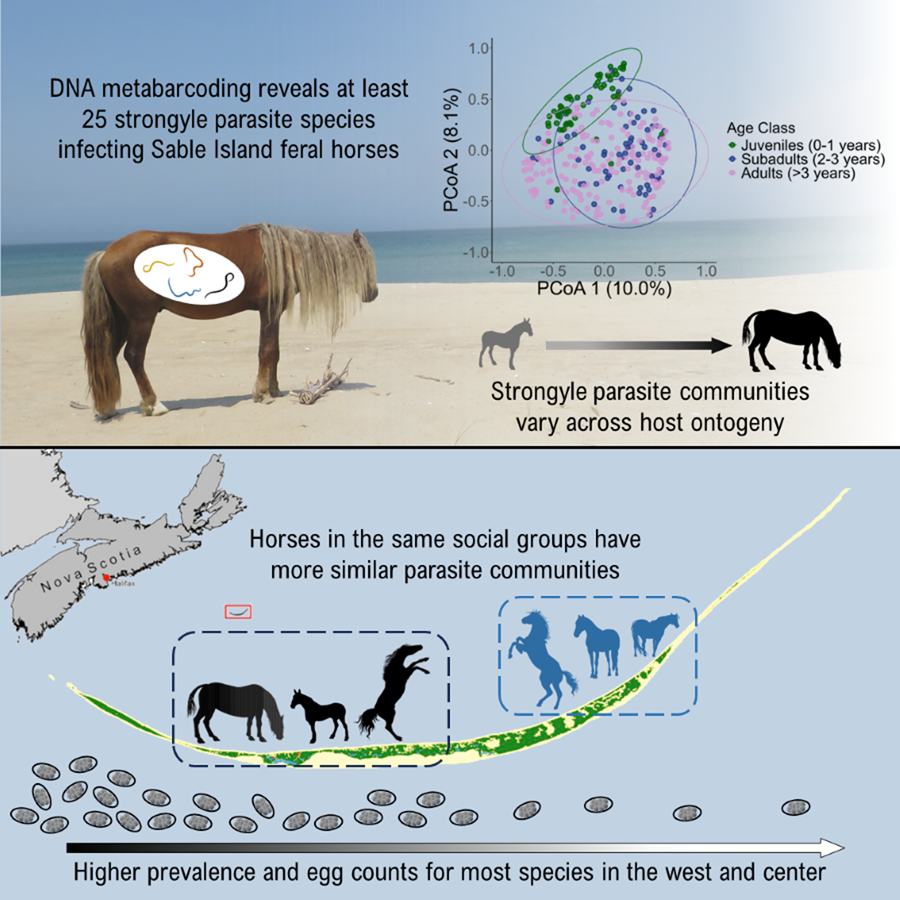
Identifying factors that drive among-individual variation in mixed parasitic infections is fundamental to understanding the ecology and evolution of host–parasite interactions. However, a lack of non-invasive diagnostic tools to quantify mixed infections has restricted their investigation for host populations in the wild. This study applied DNA metabarcoding on parasite larvae cultured from faecal samples to characterize mixed strongyle infections of 320 feral horses on Sable Island, Nova Scotia, Canada, in 2014 to test for the influence of host (age, sex and reproductive/social status) and environmental (location, local density and social group membership) factors on variation. Twenty-five strongyle species were identified, with individual infections ranging from 3 to 18 species with a mean richness (±1 s.d.) of 10.8 ± 3.1. Strongyle eggs shed in faeces were dominated by small strongyle (cyathostomins) species in young individuals, transitioning to large strongyles (Strongylus spp.) in adults. Egg counts were highest in young individuals and in the west or centre of the island for most species. Individuals in the same social group had similar parasite communities, supporting the hypothesis that shared environment may drive parasite assemblages. Other factors such as local horse density, sex, date and reproductive/social status had minimal impacts on infection patterns. This study demonstrates that mixed infections can be dynamic across host ontogeny and space and emphasizes the need to consider species-specific infection patterns when investigating mixed infections.
A large literature considers the mid-century a key turning point in punitive public opinion in the United States. This article examines racial and geographic heterogeneity in changing public opinion during the mid-century using data on death penalty support from as early as 1953. I find that the punitive turn is characterized by divergence in death penalty support between Black and White people, and that White Southerners grew more supportive than Whites in the non-South from before to after the turn. Additional tests identify that this regional divergence is unlikely to have arisen by chance. Heterogeneity in partisanship and responsiveness to regional violent crime support is consistent with the idea that crime rates themselves were meaningful in punitive attitude formation only insofar as they were mediated by additional socio-political forces.
Translational science rarely addresses the needs of rural communities, perpetuating health inequities. Furthermore, policy and resource allocation reflect this dynamic. Through a partnership between a rural community and a community engagement program, the Rural Health Initiative (RHI) was developed with the goal of building capacity for community-driven translational research in rural settings.
Methods:
We describe the process of forming the RHI and selection of a community health priority to motivate the translational research agenda in this particular rural setting. We used a mixed methods approach utilizing literature review, community survey data, and qualitative evaluation of community meeting discussions. Consensus on a final health priority was built through voting and comparison of voting responses across the three RHI counties through Fisher’s Exact test.
Results:
Four priority topics were identified through literature search, community needs assessment, state/national trend data, and community experts. Priority ranking from a community forum and survey selected the final health priority topic. Healthcare access was selected by all three counties in the RHI community as the most critical health priority to address.
Conclusions:
This program highlights the importance of and methods for community involvement in directing the research conducted in their community. Additionally, through this project, guidance was developed to define the role of community engagement programs supporting work led by communities.
In contemporary European law, it has become increasingly evident that EU law is not implemented according to the traditional distinction between direct and indirect administration, but through various forms of cooperation between national and EU authorities, as well as between national authorities themselves. These cooperative mechanisms generate so-called ‘composite procedures’, that is, administrative decision-making processes which involve administrative authorities belonging to more than one legal system for the implementation of EU law. This phenomenon has generated increasing scholar attention with attempts at offering taxonomies, labels, analyses of composite procedures in different EU policy fields, or insights regarding the question of access to justice. This chapter studies a less explored angle in this debate: the question of the remedies available to redress possible fundamental rights violations occurring in the context of the composite procedures. It first provides a categorisation of composite procedures, together with an examination of possible fundamental rights violations. The chapter then outlines the available remedies in selected scenarios, identifying possible gaps. The chapter will show that, while composite procedures are capable of violating both substantive and procedural EU fundamental rights, the current system of remedies seems to be ill-suited to provide effective remedies in multi-jurisdictional decision-making processes.
Edited by
Daniel Benoliel, University of Haifa, Israel,Peter K. Yu, Texas A & M University School of Law,Francis Gurry, World Intellectual Property Organization,Keun Lee, Seoul National University
This chapter criticizes the oversimplification of the binary North–South debate on intellectual property, innovation, and global inequality and highlights the wide geographic, sectoral, and income inequalities within middle-income countries. It begins by explaining why the arrival of these countries has called into question the North–South debate. The chapter then moves from the widely studied subject of global inequality to the underexplored topic of national inequality. Focusing on the intellectual property context, the discussion highlights the considerable subnational variations in the economic and technological conditions of middle-income countries. To combat national inequality, this chapter concludes by recommending interventions in three areas: (1) international norm-setting, (2) national policymaking, and (3) academic and policy research.