Refine listing
Actions for selected content:
144976 results in Open Access
2 - The Unequal Geographical Distribution of Innovative Activity
- from Part I - Theoretical, Empirical, and Policy Issues
-
-
- Book:
- Intellectual Property, Innovation and Economic Inequality
- Published online:
- 05 December 2024
- Print publication:
- 12 December 2024, pp 47-80
-
- Chapter
-
- You have access
- Open access
- HTML
- Export citation
FINITE-DIMENSIONAL DIFFERENTIAL-ALGEBRAIC PERMUTATION GROUPS
- Part of
-
- Journal:
- Journal of the Institute of Mathematics of Jussieu / Volume 24 / Issue 2 / March 2025
- Published online by Cambridge University Press:
- 12 December 2024, pp. 603-626
- Print publication:
- March 2025
-
- Article
-
- You have access
- Open access
- HTML
- Export citation
-
Several structural results about permutation groups of finite rank definable in differentially closed fields of characteristic zero (and other similar theories) are obtained. In particular, it is shown that every finite rank definably primitive permutation group is definably isomorphic to an algebraic permutation group living in the constants. Applications include the verification, in differentially closed fields, of the finite Morley rank permutation group conjectures of Borovik-Deloro and Borovik-Cherlin. Applying the results to binding groups for internality to the constants, it is deduced that if complete types p and q are of rank m and n, respectively, and are nonorthogonal, then the $(m+3)$rd Morley power of p is not weakly orthogonal to the $(n+3)$rd Morley power of q. An application to transcendence of generic solutions of pairs of algebraic differential equations is given.


Hilbert matrix operator acting between conformally invariant spaces
- Part of
-
- Journal:
- Canadian Mathematical Bulletin / Volume 68 / Issue 2 / June 2025
- Published online by Cambridge University Press:
- 12 December 2024, pp. 550-567
- Print publication:
- June 2025
-
- Article
-
- You have access
- Open access
- HTML
- Export citation
-
In this article, we study the action of the the Hilbert matrix operator $H$ from the space of bounded analytic functions into conformally invariant Banach spaces. In particular, we describe the norm of $H$ from $H^\infty $ into $\text {BMOA}$ and we characterize the positive Borel measures $\mu $ such that $H$ is bounded from $H^\infty $ into the conformally invariant Dirichlet space $M(D_\mu )$. For particular measures $\mu $, we also provide the norm of $H$ from $H^\infty $ into $M(D_\mu )$.


2 - The Settlers, Rescript Government, and the Foundations of the Kingdom
-
- Book:
- The Coming of the Kingdom
- Published online:
- 29 November 2024
- Print publication:
- 12 December 2024, pp 73-123
-
- Chapter
-
- You have access
- Open access
- HTML
- Export citation
Through the lens of Good Participatory Practice: Findings and lessons learned from the healthcare worker subcommittee of the COVID-19 Healthcare Worker Exposure Response and Outcomes Registry
-
- Journal:
- Journal of Clinical and Translational Science / Volume 9 / Issue 1 / 2025
- Published online by Cambridge University Press:
- 12 December 2024, e9
-
- Article
-
- You have access
- Open access
- HTML
- Export citation
7 - EU Accession to the ECHR
- from Part II - Remedies beyond the CJEU
-
-
- Book:
- Redressing Fundamental Rights Violations by the EU
- Published online:
- 21 December 2024
- Print publication:
- 12 December 2024, pp 177-206
-
- Chapter
-
- You have access
- Open access
- HTML
- Export citation
Yellow peril or model minority? Measuring Janus-faced prejudice toward Asians in the United States
-
- Journal:
- Political Science Research and Methods / Volume 14 / Issue 1 / January 2026
- Published online by Cambridge University Press:
- 12 December 2024, pp. 71-86
-
- Article
-
- You have access
- Open access
- HTML
- Export citation
Figures
-
- Book:
- Algorithmic Rule By Law
- Published online:
- 14 December 2024
- Print publication:
- 12 December 2024, pp xi-xii
-
- Chapter
-
- You have access
- Open access
- HTML
- Export citation
Part IV - Testing the Remedies System
-
- Book:
- Redressing Fundamental Rights Violations by the EU
- Published online:
- 21 December 2024
- Print publication:
- 12 December 2024, pp 269-421
-
- Chapter
-
- You have access
- Open access
- HTML
- Export citation
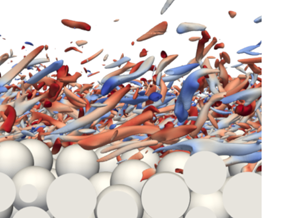
Turbulent flow over random sphere packs – an investigation by pore-resolved direct numerical simulation
-
- Journal:
- Journal of Fluid Mechanics / Volume 1001 / 25 December 2024
- Published online by Cambridge University Press:
- 12 December 2024, A29
-
- Article
-
- You have access
- Open access
- HTML
- Export citation
-
Pore-resolved direct numerical simulations have been performed to investigate the turbulent open-channel flow over a rough and permeable sediment bed, represented by a mono-disperse random sphere pack. After a careful validation, eleven cases were simulated to systemically sample a parameter space spanned by a friction Reynolds number $Re_\tau \in [150, 500]$ and a permeability Reynolds number $Re_K \in [0, 2.8]$. By varying the ratio of flow depth to sphere diameter within a range of $h/D \in \{ 3,5,10,\infty \}$, the influence of both Reynolds numbers on the flow field and the turbulence structure could be investigated independently. The simulation results are analysed within a time–space double-averaging framework, whereas flow visualizations provide insight into instantaneous fields. Based on the drag distribution, we propose a consistent interface description, which can be used to define both near-interface and outer-flow coordinates. In these near-interface coordinates, the profiles of the mean velocity and the total shear stress collapse. Furthermore, the proposed interface definition yields outer-layer coordinates, in which the flow and turbulence statistics over a rough and permeable bed reveal similarity to a smooth-wall flow at a similar $Re_\tau$. Within the parameter space, $Re_\tau$ has a strong influence on the wake region of the velocity profile. In contrast, $Re_K$ changes the wall-blocking effect and the shear intensity, which is reflected by the turbulence structure and vortex orientation in the near-interface region. As streamwise velocity streaks disappear and the vortex inclination increases with higher $Re_K$, differences between near-interface and outer-layer turbulence structure are reduced.


Copyright page
-
- Book:
- Redressing Fundamental Rights Violations by the EU
- Published online:
- 21 December 2024
- Print publication:
- 12 December 2024, pp iv-iv
-
- Chapter
-
- You have access
- Open access
- HTML
- Export citation
Part II - Intellectual Property and National Inequalities
-
- Book:
- Intellectual Property, Innovation and Economic Inequality
- Published online:
- 05 December 2024
- Print publication:
- 12 December 2024, pp 143-276
-
- Chapter
-
- You have access
- Open access
- HTML
- Export citation
Copyright page
-
- Book:
- Intellectual Property, Innovation and Economic Inequality
- Published online:
- 05 December 2024
- Print publication:
- 12 December 2024, pp iv-iv
-
- Chapter
-
- You have access
- Open access
- HTML
- Export citation
Personality Revisited: A Posthumous Tribute to Albert Bandura and David Magnusson
-
- Journal:
- European Review / Volume 33 / Issue 1 / February 2025
- Published online by Cambridge University Press:
- 12 December 2024, pp. 1-18
-
- Article
-
- You have access
- Open access
- HTML
- Export citation
New Canadian records and range expansion for Pterallastes thoracicus Loew (Diptera: Syrphidae)
-
- Journal:
- The Canadian Entomologist / Volume 156 / 2024
- Published online by Cambridge University Press:
- 12 December 2024, e41
-
- Article
-
- You have access
- Open access
- HTML
- Export citation
The first record of the appearance of green turtles in the winter in a summer-to-autumn habitat in northeast Japan
-
- Journal:
- Journal of the Marine Biological Association of the United Kingdom / Volume 104 / 2024
- Published online by Cambridge University Press:
- 12 December 2024, e111
-
- Article
-
- You have access
- Open access
- HTML
- Export citation
12 - Managed Trade and Technology Protectionism
- from Part III - Intellectual Property and Global Inequality
-
-
- Book:
- Intellectual Property, Innovation and Economic Inequality
- Published online:
- 05 December 2024
- Print publication:
- 12 December 2024, pp 305-323
-
- Chapter
-
- You have access
- Open access
- HTML
- Export citation
Optimizing organic muskmelon production by integrating mesotunnel row covers, inter-bed weed management, and pollination strategies
-
- Journal:
- Renewable Agriculture and Food Systems / Volume 39 / 2024
- Published online by Cambridge University Press:
- 12 December 2024, e31
-
- Article
-
- You have access
- Open access
- HTML
- Export citation
9 - Finding a New (Old?) Way Forward
- from Part III - Pushing the Boundaries
-
-
- Book:
- Redressing Fundamental Rights Violations by the EU
- Published online:
- 21 December 2024
- Print publication:
- 12 December 2024, pp 227-244
-
- Chapter
-
- You have access
- Open access
- HTML
- Export citation
Emerging trends: evaluating general purpose foundation models
-
- Journal:
- Natural Language Engineering / Volume 30 / Issue 6 / November 2024
- Published online by Cambridge University Press:
- 12 December 2024, pp. 1323-1335
-
- Article
-
- You have access
- Open access
- HTML
- Export citation
