Refine search
Actions for selected content:
18 results
Rational ellipticity of G-manifolds from their quotients
- Part of
-
- Journal:
- Compositio Mathematica / Volume 161 / Issue 2 / February 2025
- Published online by Cambridge University Press:
- 09 June 2025, pp. 244-256
- Print publication:
- February 2025
-
- Article
- Export citation
-
We prove that if a compact, simply connected Riemannian G-manifold M has orbit space $M/G$ isometric to some other quotient $N/H$ with N having zero topological entropy, then M is rationally elliptic. This result, which generalizes most conditions on rational ellipticity, is a particular case of a more general result involving manifold submetries.


Surfaces of section for geodesic flows of closed surfaces
- Part of
-
- Journal:
- Ergodic Theory and Dynamical Systems / Volume 45 / Issue 6 / June 2025
- Published online by Cambridge University Press:
- 15 November 2024, pp. 1698-1733
- Print publication:
- June 2025
-
- Article
-
- You have access
- Open access
- HTML
- Export citation
-
We prove several results concerning the existence of surfaces of section for the geodesic flows of closed orientable Riemannian surfaces. The surfaces of section $\Sigma $ that we construct are either Birkhoff sections, which means that they intersect every sufficiently long orbit segment of the geodesic flow, or at least they have some hyperbolic components in $\partial \Sigma $ as limit sets of the orbits of the geodesic flow that do not return to $\Sigma $. In order to prove these theorems, we provide a study of configurations of simple closed geodesics of closed orientable Riemannian surfaces, which may have independent interest. Our arguments are based on the curve shortening flow.


Joint partial equidistribution of Farey rays in negatively curved manifolds and trees
- Part of
-
- Journal:
- Ergodic Theory and Dynamical Systems / Volume 44 / Issue 9 / September 2024
- Published online by Cambridge University Press:
- 08 January 2024, pp. 2700-2736
- Print publication:
- September 2024
-
- Article
- Export citation
On the ergodicity of unitary frame flows on Kähler manifolds
- Part of
-
- Journal:
- Ergodic Theory and Dynamical Systems / Volume 44 / Issue 8 / August 2024
- Published online by Cambridge University Press:
- 16 October 2023, pp. 2143-2172
- Print publication:
- August 2024
-
- Article
- Export citation
-
Let $(M,g,J)$ be a closed Kähler manifold with negative sectional curvature and complex dimension $m := \dim _{\mathbb {C}} M \geq 2$. In this article, we study the unitary frame flow, that is, the restriction of the frame flow to the principal $\mathrm {U}(m)$-bundle $F_{\mathbb {C}}M$ of unitary frames. We show that if $m \geq 6$ is even and $m \neq 28$, there exists $\unicode{x3bb} (m) \in (0, 1)$ such that if $(M, g)$ has negative $\unicode{x3bb} (m)$-pinched holomorphic sectional curvature, then the unitary frame flow is ergodic and mixing. The constants $\unicode{x3bb} (m)$ satisfy $\unicode{x3bb} (6) = 0.9330...$, $\lim _{m \to +\infty } \unicode{x3bb} (m) = {11}/{12} = 0.9166...$, and $m \mapsto \unicode{x3bb} (m)$ is decreasing. This extends to the even-dimensional case the results of Brin and Gromov [On the ergodicity of frame flows. Invent. Math. 60(1) (1980), 1–7] who proved ergodicity of the unitary frame flow on negatively curved compact Kähler manifolds of odd complex dimension.


Geometric filling curves on punctured surfaces
- Part of
-
- Journal:
- Glasgow Mathematical Journal / Volume 65 / Issue 2 / May 2023
- Published online by Cambridge University Press:
- 15 December 2022, pp. 383-400
-
- Article
- Export citation
-
This paper is about a type of quantitative density of closed geodesics and orthogeodesics on complete finite-area hyperbolic surfaces. The main results are upper bounds on the length of the shortest closed geodesic and the shortest doubly truncated orthogeodesic that are $\varepsilon$-dense on a given compact set on the surface.

Counting closed geodesics in a compact rank-one locally CAT(0) space
- Part of
-
- Journal:
- Ergodic Theory and Dynamical Systems / Volume 42 / Issue 3 / March 2022
- Published online by Cambridge University Press:
- 27 August 2021, pp. 1220-1251
- Print publication:
- March 2022
-
- Article
- Export citation
-
Let X be a compact, geodesically complete, locally CAT(0) space such that the universal cover admits a rank-one axis. Assume X is not homothetic to a metric graph with integer edge lengths. Let $P_t$ be the number of parallel classes of oriented closed geodesics of length at most t; then $\lim \nolimits _{t \to \infty } P_t / ({e^{ht}}/{ht}) = 1$, where h is the entropy of the geodesic flow on the space $GX$ of parametrized unit-speed geodesics in X.


Counting and equidistribution in quaternionic Heisenberg groups
- Part of
-
- Journal:
- Mathematical Proceedings of the Cambridge Philosophical Society / Volume 173 / Issue 1 / July 2022
- Published online by Cambridge University Press:
- 08 July 2021, pp. 67-104
- Print publication:
- July 2022
-
- Article
- Export citation
-
We develop the relationship between quaternionic hyperbolic geometry and arithmetic counting or equidistribution applications, that arises from the action of arithmetic groups on quaternionic hyperbolic spaces, especially in dimension 2. We prove a Mertens counting formula for the rational points over a definite quaternion algebra A over ${\mathbb{Q}}$ in the light cone of quaternionic Hermitian forms, as well as a Neville equidistribution theorem of the set of rational points over A in quaternionic Heisenberg groups.

A min-max characterization of Zoll Riemannian metrics
- Part of
-
- Journal:
- Mathematical Proceedings of the Cambridge Philosophical Society / Volume 172 / Issue 3 / May 2022
- Published online by Cambridge University Press:
- 29 April 2021, pp. 591-615
- Print publication:
- May 2022
-
- Article
- Export citation
Short closed geodesics with self-intersections
- Part of
-
- Journal:
- Mathematical Proceedings of the Cambridge Philosophical Society / Volume 169 / Issue 3 / November 2020
- Published online by Cambridge University Press:
- 24 January 2020, pp. 623-638
- Print publication:
- November 2020
-
- Article
- Export citation
Open problems and questions about geodesics
- Part of
-
- Journal:
- Ergodic Theory and Dynamical Systems / Volume 41 / Issue 3 / March 2021
- Published online by Cambridge University Press:
- 06 December 2019, pp. 641-684
- Print publication:
- March 2021
-
- Article
- Export citation
A COMPACTNESS PRINCIPLE FOR MAXIMISING SMOOTH FUNCTIONS OVER TOROIDAL GEODESICS
- Part of
-
- Journal:
- Bulletin of the Australian Mathematical Society / Volume 100 / Issue 1 / August 2019
- Published online by Cambridge University Press:
- 01 February 2019, pp. 148-154
- Print publication:
- August 2019
-
- Article
-
- You have access
- Export citation
-
Let $f\in C^{2}(\mathbb{T}^{2})$ have mean value 0 and consider where
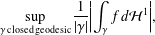 $$\begin{eqnarray}\sup _{\unicode[STIX]{x1D6FE}\,\text{closed geodesic}}\frac{1}{|\unicode[STIX]{x1D6FE}|}\biggl|\int _{\unicode[STIX]{x1D6FE}}f\,d{\mathcal{H}}^{1}\biggr|,\end{eqnarray}$$ $\unicode[STIX]{x1D6FE}$ ranges over all closed geodesics $\unicode[STIX]{x1D6FE}:\mathbb{S}^{1}\rightarrow \mathbb{T}^{2}$ and $|\unicode[STIX]{x1D6FE}|$ denotes its length. We prove that this supremum is always attained. Moreover, we can bound the length of the geodesic $\unicode[STIX]{x1D6FE}$ attaining the supremum in terms of the smoothness of the function: for all $s\geq 2$,
  $$\begin{eqnarray}|\unicode[STIX]{x1D6FE}|^{s}{\lesssim}_{s}\biggl(\max _{|\unicode[STIX]{x1D6FC}|=s}\Vert \unicode[STIX]{x2202}_{\unicode[STIX]{x1D6FC}}f\Vert _{L^{1}(\mathbb{T}^{2})}\biggr)\Vert \unicode[STIX]{x1D6FB}f\Vert _{L^{2}}\Vert f\Vert _{L^{2}}^{-2}.\end{eqnarray}$$


Geodesic Flows Modelled by Expansive Flows
- Part of
-
- Journal:
- Proceedings of the Edinburgh Mathematical Society / Volume 62 / Issue 1 / February 2019
- Published online by Cambridge University Press:
- 28 August 2018, pp. 61-95
-
- Article
- Export citation
SUB-RIEMANNIAN RICCI CURVATURES AND UNIVERSAL DIAMETER BOUNDS FOR 3-SASAKIAN MANIFOLDS
- Part of
-
- Journal:
- Journal of the Institute of Mathematics of Jussieu / Volume 18 / Issue 4 / July 2019
- Published online by Cambridge University Press:
- 21 June 2017, pp. 783-827
- Print publication:
- July 2019
-
- Article
- Export citation
-
For a fat sub-Riemannian structure, we introduce three canonical Ricci curvatures in the sense of Agrachev–Zelenko–Li. Under appropriate bounds we prove comparison theorems for conjugate lengths, Bonnet–Myers type results and Laplacian comparison theorems for the intrinsic sub-Laplacian. As an application, we consider the sub-Riemannian structure of 3-Sasakian manifolds, for which we provide explicit curvature formulas. We prove that any complete 3-Sasakian structure of dimension $4d+3$, with $d>1$, has sub-Riemannian diameter bounded by $\unicode[STIX]{x1D70B}$. When $d=1$, a similar statement holds under additional Ricci bounds. These results are sharp for the natural sub-Riemannian structure on $\mathbb{S}^{4d+3}$ of the quaternionic Hopf fibrations: whose exact sub-Riemannian diameter is
 $$\begin{eqnarray}\mathbb{S}^{3}{\hookrightarrow}\mathbb{S}^{4d+3}\rightarrow \mathbb{HP}^{d},\end{eqnarray}$$ $\unicode[STIX]{x1D70B}$, for all $d\geqslant 1$.


Location of geodesics and isoperimetric inequalities in Denjoy domains
- Part of
-
- Journal:
- Proceedings of the Edinburgh Mathematical Society / Volume 55 / Issue 1 / February 2012
- Published online by Cambridge University Press:
- 15 June 2011, pp. 245-269
-
- Article
-
- You have access
- Export citation
A Global algorithm for geodesics
- Part of
-
- Journal:
- Journal of the Australian Mathematical Society. Series A. Pure Mathematics and Statistics / Volume 65 / Issue 1 / August 1998
- Published online by Cambridge University Press:
- 09 April 2009, pp. 37-50
-
- Article
-
- You have access
- Export citation
A NOTE ON THE UNCLOUDING THE SKY OF NEGATIVELY CURVED MANIFOLDS
- Part of
-
- Journal:
- Bulletin of the Australian Mathematical Society / Volume 77 / Issue 3 / June 2008
- Published online by Cambridge University Press:
- 01 June 2008, pp. 413-424
- Print publication:
- June 2008
-
- Article
-
- You have access
- Export citation
Random motions at finite velocity in a non-Euclidean space
- Part of
-
- Journal:
- Advances in Applied Probability / Volume 39 / Issue 2 / June 2007
- Published online by Cambridge University Press:
- 01 July 2016, pp. 588-611
- Print publication:
- June 2007
-
- Article
-
- You have access
- Export citation
Principal component analysis for Riemannian manifolds, with an application to triangular shape spaces
- Part of
-
- Journal:
- Advances in Applied Probability / Volume 38 / Issue 2 / June 2006
- Published online by Cambridge University Press:
- 01 July 2016, pp. 299-319
- Print publication:
- June 2006
-
- Article
-
- You have access
- Export citation
