Refine search
Actions for selected content:
7008 results in Algorithmics, Complexity, Computer Algebra, Computational Geometry
Harnessing the unwieldy MEX function
-
-
- Book:
- Games of No Chance 4
- Published online:
- 30 May 2025
- Print publication:
- 16 April 2015, pp 77-94
-
- Chapter
- Export citation
Computer analysis of Sprouts with nimbers
-
-
- Book:
- Games of No Chance 4
- Published online:
- 30 May 2025
- Print publication:
- 16 April 2015, pp 161-182
-
- Chapter
- Export citation
Orientability Thresholds for Random Hypergraphs
- Part of
-
- Journal:
- Combinatorics, Probability and Computing / Volume 24 / Issue 5 / September 2015
- Published online by Cambridge University Press:
- 23 March 2015, pp. 774-824
-
- Article
- Export citation
A Combinatorial Approach to a Model of Constrained Random Walkers
- Part of
-
- Journal:
- Combinatorics, Probability and Computing / Volume 25 / Issue 2 / March 2016
- Published online by Cambridge University Press:
- 16 March 2015, pp. 222-235
-
- Article
- Export citation
-
In [1], the authors consider a random walk (Z n,1, . . ., Z n,K+1) ∈ ${\mathbb{Z}}$ K+1 with the constraint that each coordinate of the walk is at distance one from the following coordinate. A functional central limit theorem for the first coordinate is proved and the limit variance is explicited. In this paper, we study an extended version of this model by conditioning the extremal coordinates to be at some fixed distance at every time. We prove a functional central limit theorem for this random walk. Using combinatorial tools, we give a precise formula of the variance and compare it with that obtained in [1].

On the Chromatic Thresholds of Hypergraphs
- Part of
-
- Journal:
- Combinatorics, Probability and Computing / Volume 25 / Issue 2 / March 2016
- Published online by Cambridge University Press:
- 06 March 2015, pp. 172-212
-
- Article
- Export citation
-
Let $\mathcal{F}$ be a family of r-uniform hypergraphs. The chromatic threshold of $\mathcal{F}$ is the infimum of all non-negative reals c such that the subfamily of $\mathcal{F}$ comprising hypergraphs H with minimum degree at least $c \binom{| V(H) |}{r-1}$ has bounded chromatic number. This parameter has a long history for graphs (r = 2), and in this paper we begin its systematic study for hypergraphs.
Łuczak and Thomassé recently proved that the chromatic threshold of the so-called near bipartite graphs is zero, and our main contribution is to generalize this result to r-uniform hypergraphs. For this class of hypergraphs, we also show that the exact Turán number is achieved uniquely by the complete (r + 1)-partite hypergraph with nearly equal part sizes. This is one of very few infinite families of non-degenerate hypergraphs whose Turán number is determined exactly. In an attempt to generalize Thomassen's result that the chromatic threshold of triangle-free graphs is 1/3, we prove bounds for the chromatic threshold of the family of 3-uniform hypergraphs not containing {abc, abd, cde}, the so-called generalized triangle.
In order to prove upper bounds we introduce the concept of fibre bundles, which can be thought of as a hypergraph analogue of directed graphs. This leads to the notion of fibre bundle dimension, a structural property of fibre bundles that is based on the idea of Vapnik–Chervonenkis dimension in hypergraphs. Our lower bounds follow from explicit constructions, many of which use a hypergraph analogue of the Kneser graph. Using methods from extremal set theory, we prove that these Kneser hypergraphs have unbounded chromatic number. This generalizes a result of Szemerédi for graphs and might be of independent interest. Many open problems remain.


First-Order Convergence and Roots†
- Part of
-
- Journal:
- Combinatorics, Probability and Computing / Volume 25 / Issue 2 / March 2016
- Published online by Cambridge University Press:
- 24 February 2015, pp. 213-221
-
- Article
- Export citation
The (7, 4)-Conjecture in Finite Groups
- Part of
-
- Journal:
- Combinatorics, Probability and Computing / Volume 24 / Issue 4 / July 2015
- Published online by Cambridge University Press:
- 10 February 2015, pp. 680-686
-
- Article
- Export citation
A Computational Introduction to Number Theory and Algebra
-
- Published online:
- 05 February 2015
- Print publication:
- 04 December 2008
On Directed Versions of the Hajnal–Szemerédi Theorem
-
- Journal:
- Combinatorics, Probability and Computing / Volume 24 / Issue 6 / November 2015
- Published online by Cambridge University Press:
- 05 February 2015, pp. 873-928
-
- Article
- Export citation
Monotone Cellular Automata in a Random Environment
- Part of
-
- Journal:
- Combinatorics, Probability and Computing / Volume 24 / Issue 4 / July 2015
- Published online by Cambridge University Press:
- 02 February 2015, pp. 687-722
-
- Article
- Export citation
-
In this paper we study in complete generality the family of two-state, deterministic, monotone, local, homogeneous cellular automata in $\mathbb{Z}$d with random initial configurations. Formally, we are given a set $\mathcal{U}$ = {X1,. . . , Xm} of finite subsets of $\mathbb{Z}$d \ {0}, and an initial set A0 ⊂ $\mathbb{Z}$d of ‘infected’ sites, which we take to be random according to the product measure with density p. At time t ∈ $\mathbb{N}$, the set of infected sites At is the union of At-1 and the set of all x ∈ $\mathbb{Z}$d such that x + X ∈ At-1 for some X ∈ $\mathcal{U}$. Our model may alternatively be thought of as bootstrap percolation on $\mathbb{Z}$d with arbitrary update rules, and for this reason we call it $\mathcal{U}$-bootstrap percolation.
In two dimensions, we give a classification of
$\mathcal{U}$-bootstrap percolation models into three classes – supercritical, critical and subcritical – and we prove results about the phase transitions of all models belonging to the first two of these classes. More precisely, we show that the critical probability for percolation on ($\mathbb{Z}$/n$\mathbb{Z}$)2 is (log n)−Θ(1) for all models in the critical class, and that it is n−Θ(1) for all models in the supercritical class.The results in this paper are the first of any kind on bootstrap percolation considered in this level of generality, and in particular they are the first that make no assumptions of symmetry. It is the hope of the authors that this work will initiate a new, unified theory of bootstrap percolation on
$\mathbb{Z}$d.


Easily Testable Graph Properties
- Part of
-
- Journal:
- Combinatorics, Probability and Computing / Volume 24 / Issue 4 / July 2015
- Published online by Cambridge University Press:
- 02 February 2015, pp. 646-657
-
- Article
- Export citation
-
A graph on n vertices is ε-far from a property $\mathcal{P}$ if one has to add or delete from it at least εn2 edges to get a graph satisfying $\mathcal{P}$. A graph property $\mathcal{P}$ is strongly testable if for every fixed ε > 0 it is possible to distinguish, with one-sided error, between graphs satisfying $\mathcal{P}$ and ones that are ε-far from $\mathcal{P}$ by inspecting the induced subgraph on a random subset of at most f(ε) vertices. A property is easily testable if it is strongly testable and the function f is polynomial in 1/ε, otherwise it is hard. We consider the problem of characterizing the easily testable graph properties, which is wide open, and obtain several results in its study. One of our main results shows that testing perfectness is hard. The proof shows that testing perfectness is at least as hard as testing triangle-freeness, which is hard. On the other hand, we show that being a cograph, or equivalently, induced P3-freeness where P3 is a path with 3 edges, is easily testable. This settles one of the two exceptional graphs, the other being C4 (and its complement), left open in the characterization by the first author and Shapira of graphs H for which induced H-freeness is easily testable. Our techniques yield a few additional related results, but the problem of characterizing all easily testable graph properties, or even that of formulating a plausible conjectured characterization, remains open.

A Numerical Lower Bound for the Spectral Radius of Random Walks on Surface Groups
- Part of
-
- Journal:
- Combinatorics, Probability and Computing / Volume 24 / Issue 6 / November 2015
- Published online by Cambridge University Press:
- 29 January 2015, pp. 838-856
-
- Article
- Export citation
Lazy Cops and Robbers on Hypercubes
- Part of
-
- Journal:
- Combinatorics, Probability and Computing / Volume 24 / Issue 6 / November 2015
- Published online by Cambridge University Press:
- 29 January 2015, pp. 829-837
-
- Article
- Export citation
On the Length of a Random Minimum Spanning Tree
- Part of
-
- Journal:
- Combinatorics, Probability and Computing / Volume 25 / Issue 1 / January 2016
- Published online by Cambridge University Press:
- 23 January 2015, pp. 89-107
-
- Article
- Export citation
-
We study the expected value of the length Ln of the minimum spanning tree of the complete graph Kn when each edge e is given an independent uniform [0, 1] edge weight. We sharpen the result of Frieze [6] that limn→∞ $\mathbb{E}$(Ln) = ζ(3) and show thatwhere c1, c2 are explicitly defined constants.
 $$\mathbb{E}(L_n)=\zeta(3)+\frac{c_1}{n}+\frac{c_2+o(1)}{n^{4/3}},$$

Partial Shadows of Set Systems
- Part of
-
- Journal:
- Combinatorics, Probability and Computing / Volume 24 / Issue 5 / September 2015
- Published online by Cambridge University Press:
- 20 January 2015, pp. 825-828
-
- Article
- Export citation
-
The shadow of a system of sets is all sets which can be obtained by taking a set in the original system, and removing a single element. The Kruskal-Katona theorem tells us the minimum possible size of the shadow of $\mathcal A$ , if $\mathcal A$ consists of m r-element sets.
In this paper, we ask questions and make conjectures about the minimum possible size of a partial shadow for
$\mathcal A$ , which contains most sets in the shadow of $\mathcal A$ . For example, if  $\mathcal B$ is a family of sets containing all but one set in the shadow of each set of $\mathcal A$ , how large must $\mathcal B$ be?


Combinatorial Structures on van der Waerden sets
- Part of
-
- Journal:
- Combinatorics, Probability and Computing / Volume 24 / Issue 6 / November 2015
- Published online by Cambridge University Press:
- 09 January 2015, pp. 929-953
-
- Article
- Export citation
-
In this paper we provide two results. The first one consists of an infinitary version of the Furstenberg–Weiss theorem. More precisely we show that every subset A of a homogeneous tree T such that
where T(n) denotes the nth level of T, for all n in a van der Waerden set, for some positive real δ, contains a strong subtree having a level set which forms a van der Waerden set.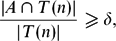 $\frac{|A\cap T(n)|}{|T(n)|}\geqslant\delta,$
 The second result is the following. For every sequence (mq )q∈ℕ of positive integers and for every real 0 < δ ⩽ 1, there exists a sequence (nq )q∈ℕ of positive integers such that for every D ⊆ ∪k ∏q=0 k-1[nq ] satisfying
for every k in a van der Waerden set, there is a sequence (Jq )q∈ℕ, where Jq is an arithmetic progression of length mq contained in [nq ] for all q, such that ∏q=0 k-1Jq ⊆ D for every k in a van der Waerden set. Moreover, working in an abstract setting, we may require Jq to be any configuration of natural numbers that can be found in an arbitrary set of positive density.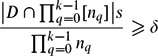 $\frac{\big|D\cap \prod_{q=0}^{k-1} [n_q]\big|s}{\prod_{q=0}^{k-1}n_q}\geqslant\delta$
The Sharp Threshold for Maximum-Size Sum-Free Subsets in Even-Order Abelian Groups
- Part of
-
- Journal:
- Combinatorics, Probability and Computing / Volume 24 / Issue 4 / July 2015
- Published online by Cambridge University Press:
- 09 January 2015, pp. 609-640
-
- Article
- Export citation
Decomposing Random Graphs into Few Cycles and Edges
- Part of
-
- Journal:
- Combinatorics, Probability and Computing / Volume 24 / Issue 6 / November 2015
- Published online by Cambridge University Press:
- 29 December 2014, pp. 857-872
-
- Article
- Export citation
References
-
- Book:
- Noise Sensitivity of Boolean Functions and Percolation
- Published online:
- 18 December 2014
- Print publication:
- 22 December 2014, pp 197-202
-
- Chapter
- Export citation
Contents
-
- Book:
- Noise Sensitivity of Boolean Functions and Percolation
- Published online:
- 18 December 2014
- Print publication:
- 22 December 2014, pp vii-x
-
- Chapter
- Export citation
