To save content items to your account,
please confirm that you agree to abide by our usage policies.
If this is the first time you use this feature, you will be asked to authorise Cambridge Core to connect with your account.
Find out more about saving content to .
To save content items to your Kindle, first ensure no-reply@cambridge.org
is added to your Approved Personal Document E-mail List under your Personal Document Settings
on the Manage Your Content and Devices page of your Amazon account. Then enter the ‘name’ part
of your Kindle email address below.
Find out more about saving to your Kindle.
Note you can select to save to either the @free.kindle.com or @kindle.com variations.
‘@free.kindle.com’ emails are free but can only be saved to your device when it is connected to wi-fi.
‘@kindle.com’ emails can be delivered even when you are not connected to wi-fi, but note that service fees apply.
We analysed the three-dimensional microstructure of sea ice by means of X-ray-micro computed tomography. Microscopic (brine- and air- pore sizes, numbers and connectivity) and macroscopic (salinity, density, porosity) properties of young Arctic sea ice were analysed. The analysis is based on ice cores obtained during spring 2016. Centrifuging of brine prior to CT imaging has allowed us to derive confident relationships between the open, vertically connected and total porosity of young sea ice at relatively high temperatures. We analysed the dependence of the microscopic properties on vertical position and total brine porosity. Most bulk properties (salinity, density) and pore space properties (pore sizes and their distribution) show a strong dependence on total brine porosity, but did not change significantly over the course of the field work. However, significant changes were observed for pore numbers (decreasing over time) and pore connectivity (increasing over time). CT-based salinity determinations are subject to larger than standard uncertainties (from conductivity), while the CT method yields important information about the salinity contributions from closed and open pores. We also performed a comparison of CT-based air porosity with calculations based on density from hydrostatic weighing. The consistency is encouraging and gives confidence to our CT-based results.
Understanding glacier drainage system behaviour and its response to increased meltwater production faces several challenges in the High Arctic because many glaciers are transitioning from polythermal to almost entirely cold thermal structures. We, therefore, used ground-penetrating radar data to investigate the thermal structure and drainage system of Waldemarbreen in Svalbard: a small High Arctic glacier believed to be undergoing thermal change. We found that Waldemarbreen retains up to 80 m of temperate ice in its upper reaches, but this thickness most likely is a relict from the Little Ice Age when greater ice volumes were insulated from winter cooling and caused greater driving stresses. Since then, negative mass balance and firn loss have prevented latent heat release and allowed near-surface ice temperatures to cool in winter, thus reducing the thickness of the temperate ice. Numerous reflectors that can be traced up-glacier are interpreted as englacial channels formed by hydrofracturing in the crevassed upper region of the glacier. The alternative cut and closure mechanism of conduit initiation only forms conduits in parts of the lower ablation area. Consequently, Waldemarbreen provides evidence that hydrofracturing at higher elevations can play a major role in englacial water drainage through cold ice.
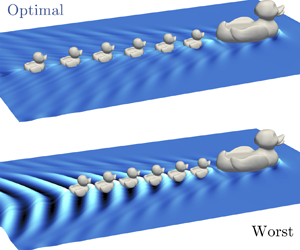
Vessels – in the widest sense – travelling on a water surface continuously do work the water surrounding it, causing energy to be radiated in the form of surface waves. The concomitant resistance force, the wave resistance, can account for as much as half the total drag on the vessel, so reducing it to a minimum has been a major part of ship design research for many decades. Whether the ‘vessel’ is an ocean-going ship or a swimming duckling, the physics governing the V-shaped pattern of radiated waves behind it is in essence the same, and just as fuel economy is important for commercial vessels, it is reasonable to assume that also swimming waterfowl seek to minimise their energy expenditure. Using theory and methods from classic marine hydrodynamics, Yuan et al. (J. Fluid Mech., vol. 928, 2021, R2) consider whether, by organising themselves optimally, ducklings in a row behind a mother duck can reduce, eliminate or even reverse their individual wave resistance. They describe two mechanisms which they term ‘wave riding’ and ‘wave passing.’ The former is intuitive: the ducklings closest to the mother can receive a forward push by riding its mother's stern waves. The latter is perhaps a more striking phenomenon: when the interduckling distance is precisely right, every duckling in the row can, in principle, swim without wave resistance due to destructive wave interference. The phenomenon appears to be the same as motivates the recent US military research project Sea Train, a row of unmanned vehicles travelling in row formation.
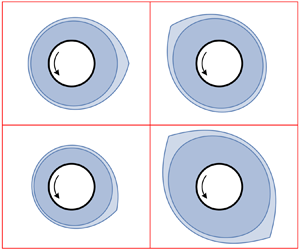
A detailed analysis of steady coating flow of a thin film of a viscous fluid on the outside of a uniformly rotating horizontal circular cylinder in the absence of surface-tension effects but in the presence of a non-uniform pressure distribution due to an irrotational airflow with circulation shows that the presence of the airflow can result in qualitatively different behaviour of the fluid film from that in classical coating flow. Full-film solutions corresponding to a continuous film of fluid covering the entire cylinder are possible only when the flux and mass of fluid do not exceed critical values, which are determined in terms of the non-dimensional parameters $F$ and $K$ representing the speed of the far-field airflow and the circulation of the airflow, respectively. The qualitative changes in the behaviour of the film thickness as $F$ and $K$ are varied are described. In particular, the film thickness can have as many as four stationary points and, in general, has neither top-to-bottom nor right-to-left symmetry. In addition, when the circulation of the airflow is in the same direction as the rotation of the cylinder the maximum mass of fluid that can be supported on the cylinder is always less than that in classical coating flow, whereas when the circulation is in the opposite direction the maximum mass of fluid can be greater than that in classical coating flow.
Although protected areas (PAs) play an important role in ecosystem conservation and climate change adaptation, no systematic information is available on PA protection of high-elevation freshwater ecosystems (e.g., lakes and watersheds with glaciers), their biodiversity and their ecosystem services in the tropical Andes. We therefore combined a literature review and map analysis of PAs of International Union for Conservation of Nature (IUCN) and national systems of PAs and freshwater ecosystems. We found that seven national parks were created for water resources protection but were not designed for freshwater conservation (i.e., larger watersheds). High-value biodiversity sites have not been protected, and new local PAs were created due to water resource needs. We quantified 31 Ramsar sites and observed that PAs cover 12% of lakes, 31% of glacial lakes and 12% of the total stream length in the tropical Andes. Additionally, 120 watersheds (average area 631 km2) with glaciers and 40% of the total glacier surface area were covered by PAs. Future research into the role of PAs in ecosystem services provision and more detailed freshwater inventories within and around PAs, especially for those dependent on glacier runoff, will fill key knowledge gaps for freshwater conservation and climate change adaptation in the tropical Andes.
Previous investigation of isolated landforms, on the eastern margin of the East Anglian Fenland, England, has demonstrated that they represent an ice-marginal delta and alluvial fan complex deposited at the margin of an ice lobe that entered the Fenland during the ‘Tottenhill glaciation’ (termed the ‘Skertchly Line’). They have been attributed, based on regional correlations, to a glaciation during the Late Wolstonian (i.e. Late Saalian) Substage (Drenthe Stadial, early Marine Isotope Stage (MIS) 6). This paper aimed to test this correlation by directly optically luminescence dating, for the first time, sediments found within the Skertchly Line at Shouldham Thorpe, Norfolk, and Maidscross Hill, Suffolk, together with those in associated kame terrace deposits at Watlington, Norfolk. Ages ranged from 244 ± 10 ka to 12.8 ± 0.46 ka, all the results being younger than MIS 8 with some clearly showing the landforms have been subsequently subjected to periglacial processes, particularly during the Late Devensian Substage (∼MIS 2). Most of the remainder fall within the range 169–212 ka and could be assigned to MIS 6, thus confirming the previously proposed age of the glaciation. The local and regional implications of these conclusions are discussed, the maximum ice limit being linked to that of the Amersfoort–Nijmegen glaciotectonic ridge limit in the central Netherlands.
The gas hydrate stability zone (GHSZ) is the essential condition for gas hydrate accumulation, which is controlled by three main factors: gas component, geothermal gradient and permafrost thickness. Based on the gas component of hydrate samples from drilling in Muri coalfield, the gas hydrate phase equilibrium curve was calculated using Sloan's natural gas hydrate phase equilibrium procedure (CSMHYD) program. Through temperature data processing of coalfield boreholes, some important data such as thickness of permafrost and geothermal gradient were obtained. The GHSZ parameters of a single borehole were calculated by programming based on the above basic data. The average thickness of GHSZ of 85 boreholes in Muri coalfield amounted to approximately 1000 m, indicating very broad space for gas hydrate occurrence. The isogram of GHSZ bottom depth drawn from single borehole data in Muri coalfield demonstrated the regional distribution characteristics of GHSZ, and identified three favourable areas of gas hydrate occurrence where the bottom of GHSZ had a burial depth >1500 m – namely, the southern part of Juhugeng Mining Area, the middle part of Duosuogongma Mining Area and the eastern part of Xuehuoli Mining Area.
Primitive lamprophyres in orogenic belts can provide crucial insights into the nature of the subcontinental lithosphere and the relevant deep crust–mantle interactions. This paper reports a suite of relatively primitive lamprophyre dykes from the North Qiangtang, central Tibetan Plateau. Zircon U–Pb ages of the lamprophyre dykes range from 214 Ma to 218 Ma, with a weighted mean age of 216 ± 1 Ma. Most of the lamprophyre samples are similar in geochemical compositions to typical primitive magmas (e.g. high MgO contents, Mg no. values and Cr, with low FeOt/MgO ratios), although they might have experienced a slightly low degree of olivine crystallization, and they show arc-like trace-element patterns and enriched Sr–Nd isotopic composition ((87Sr/86Sr)i = 0.70538–0.70540, ϵNd(t) = −2.96 to −1.65). Those geochemical and isotopic variations indicate that the lamprophyre dykes originated from partial melting of a phlogopite- and spinel-bearing peridotite mantle modified by subduction-related aqueous fluids. Combining with the other regional studies, we propose that slab subduction might have occurred during Late Triassic time, and the rollback of the oceanic lithosphere induced the lamprophyre magmatism in the central Tibetan Plateau.
This paper presents a compilation of atmospheric radiocarbon for the period 1950–2019, derived from atmospheric CO2 sampling and tree rings from clean-air sites. Following the approach taken by Hua et al. (2013), our revised and extended compilation consists of zonal, hemispheric and global radiocarbon (14C) data sets, with monthly data sets for 5 zones (Northern Hemisphere zones 1, 2, and 3, and Southern Hemisphere zones 3 and 1–2). Our new compilation includes smooth curves for zonal data sets that are more suitable for dating applications than the previous approach based on simple averaging. Our new radiocarbon dataset is intended to help facilitate the use of atmospheric bomb 14C in carbon cycle studies and to accommodate increasing demand for accurate dating of recent (post-1950) terrestrial samples.
The adoption of adaptive management plans has been advocated in order to ensure the most effective management of natural habitats. Here, it is demonstrated how a hierarchical structural equation model that is fitted to temporal ecological monitoring data from a number of sites may be used to generate quantitative local ecological predictions and how these predictions may form the basis of adaptive management plans. Local ecological predictions will be made for the cover of the dwarf shrub cross-leaved heath (Erica tetralix) on Danish wet heathlands, which is an indicator of the conservation status of wet heathlands under different management scenarios. Based on a realistic example, the model predictions conclude that grazing by livestock on wet heathlands with a relatively low cover of cross-leaved heath cannot be recommended as the only management practice. Generally, ecological monitoring data may be used to generate quantitative and credible local adaptive management plans where uncertainty is taken into account.
The fossil record of Early Triassic diapsids is very important to understand how the end-Permian mass extinction affected ecosystems and the patterns and processes involved in the subsequent biotic recovery. Vertebrate fossil assemblages of continental deposits in current-day South Africa, China, and Russia are the best source of information of this clade during the aftermath of the extinction event. Although considerably less sampled, the Induan continental rocks of the Panchet Formation of the Damodar Basin (eastern India) have also yielded a relatively diverse vertebrate assemblage composed of fishes, temnospondyls, synapsids, and a single proterosuchid taxon. Here, we report on a small isolated diapsid partial ilium (ISIR 1132) from the upper Panchet Formation. This specimen has a distinct morphology compared to other tetrapods that we know, including a shallow emargination on the dorsal margin of the anterior portion of the iliac blade, and ratio between height of iliac blade versus maximum height of iliac acetabulum at level of the dorsalmost extension of supraacetabular crest ≤0.45. Comparisons and a quantitative phylogenetic analysis found ISIR 1132 as a non-archosauromorph neodiapsid. This new specimen expands the reptile diversity in the Panchet Formation as well as for the rest of Gondwana, where Early Triassic non-archosauromorph neodiapsid species are extremely scarce.
Since their discovery, submarine hydrothermal vent systems have been pointed out as important places where chemical evolution on Earth could have occurred; and their role in the process has been highlighted. Similarly, some hypotheses have considered these systems in origin of life scenarios. In this way, many experiments have been developed, and the knowledge about these systems has increased. Due to their complexity, many experimental simulations have only included a few of the geochemical variables present in these environments, pressure and temperature. Other main variables have hardly been included, such as mineralogy, thermal and pH gradients, dissolved ions and/or redox reactions. As it has been understood, the dynamism and heterogeneity of these environments are huge, and it comprises different scales, from single vents to full hydrothermal fields. However, the vast majority of experiments focus on a specific part of these systems and do not include salinity, mineralogy and pH gradients. For this reason, in this paper, we pointed out some considerations about how this dynamism can be interpreted, and included in some models, as well their importance in prebiotic chemistry experiments and their extrapolations regarding the hypothesis about the origins of life.
Accelerator mass spectrometry (AMS) activities at the Inter-University Accelerator Centre (IUAC) in New Delhi, India, started with its 15UD Pelletron accelerator and cosmogenic radionuclide (CRN) measurements of 10Be and 26Al. Realizing the demand of a radiocarbon (14C) AMS facility in India, a 500kV Pelletron accelerator based AMS system was installed in 2015. This facility was designated with the lab code IUACD for 14C measurements. 14C dates measured in 2015 and 2016 were published in the first radiocarbon date list (see text for details). The present list is the second 14C date list and consists of dates measured from January to December 2017.
The modern Nile delta developed in the Middle and Late Holocene, and at its most northern-central point is situated at the Burullus Lagoon, which is environmentally diverse, including salt marshes, mudflats, and sand plains, and separated from a sea by a sand barrier overtopped with high sand dunes. The lagoon has been fed since the Middle Holocene by the Sebennitic branch of the Nile and marine intrusions through the Bughaz inlet. A sediment core (BO-1) was collected at the northeastern shore of the lagoon and sampled at centennial scale resolution in order to reconstruct the development of the lagoon. The results show that an initial and limited lagoon had developed at the end of the Early Holocene, but after a dry period ca. 7.2 cal ka BP it has been progressively transformed into a marshy area, with occasional inflows of sea water. Lower water level and higher salinity of the Burullus Lagoon at 6.0–5.5 and 4.8–4.2 cal ka BP reflected droughts in the Nile catchment. Thereafter, the river reactivated in the Burullus Lagoon area, and since 2.8 cal ka BP was accompanied by occasional inflows of sea water. Since ca. 0.8 cal ka BP, increased fluvial activity occurred in this part of the Nile delta, which terminated after construction of the Aswan dams in the twentieth century.
A new species of drywood termite (Isoptera: Kalotermitidae) is described from a nearly complete alate specimen preserved in early Miocene Ethiopian amber. Glyptotermes abyssinicus new species is distinguished by its U-shaped head with 12-segmented antennae, the ocelli separated from the eye margin, the right mandible with an obtuse angle between the apical and first marginal teeth, the left mandible with an obtuse angle between the apical and first + second marginal teeth, and the wing venation. This is the first termite reported from Ethiopian amber, and the fourth Miocene species of the extant genus Glyptotermes Froggatt, 1897, together with species previously described from diatomites of China and amber from the Dominican Republic. As the oldest report of the genus known from Africa, G. abyssinicus n. sp. constitutes an interesting new record for the biogeographical history of the kalotermitid lineage.
The mid-latitude Westerlies (MLW) are one of the most important atmospheric circulation systems in the Northern Hemisphere, exerting a huge influence on the climate of the region downwind, and thus on vegetation, water resources, and human wellbeing. However, the seasonal variation of the MLW during the Holocene is not yet been fully understood, especially when its contribution is the most important. Here, we used end-member (EM) modeling analysis of the grain-size distributions of a high-altitude aeolian sedimentary sequence (4452 m a.s.l.) from the Yarlung Zangbo River valley in the southern Tibetan Plateau to reveal variations in the winter MLW during the Holocene. Analysis of seasonal differences in modern atmospheric circulation suggests that the southern Tibetan Plateau was heavily influenced by the mid-latitude Westerlies at the 400, 500, and 600 hPa levels in winter, while it was seldom influenced at these levels in summer. Four grain-size end-members are identified, representing distinct aerodynamic environments, of which EM1 (modal grain size 8.1 μm) can be used as a proxy of the winter MLW. A reconstruction of the variation of the winter MLW during the Holocene based on EM1 revealed that a weaker winter MLW occurred during the Early to Middle Holocene, and a stronger winter MLW during the Middle to Late Holocene. Overall, we suggest that this change in the winter MLW was closely related to the insolation/temperature/pressure gradient between low and high latitudes in the Northern Hemisphere.
Bacillus pumilus SAFR-032, an endospore-forming bacterial strain, was investigated to determine its methylation pattern (methylome) change, compared to ground control, after direct exposure to space conditions onboard the International Space Station (ISS) for 1.5 years. The resulting ISS-flown and non-flown strains were sequenced using the Nanopore MinION and an in-house method and pipeline to identify methylated positions in the genome. Our analysis indicated genomic variants and m6A methylation increased in the ISS-flown SAFR-032. To complement the broader omics investigation and explore phenotypic changes, ISS-flown and non-flown strains were compared in a series of laboratory-based chamber experiments using an X-ray irradiation source (doses applied at 250, 500, 750, 1000 and 1250 Gy); results show a potentially higher survival fraction of ISS-flown DS2 at the two highest exposures. Taken together, results from this study document lasting changes to the genome by methylation, potentially triggered by conditions in spaceflight, with functional consequences for the resistance of bacteria to stressors expected on long-duration missions beyond low Earth orbit.
Because teeth are the most easily preserved part of the vertebrate skeleton and are particularly morphologically variable in mammals, studies of fossil mammals rely heavily on dental morphology. Dental morphology is used both for systematics and phylogeny as well as for inferences about paleoecology, diet in particular. We analyze the influence of evolutionary history on our ability to reconstruct diet from dental morphology in the mammalian order Carnivora, and we find that much of our understanding of diet in carnivorans is dependent on the phylogenetic constraints on diet in this clade. Substantial error in estimating diet from dental morphology is present regardless of the morphological data used to make the inference, although more extensive morphological datasets are more accurate in predicting diet than more limited character sets. Unfortunately, including phylogeny in making dietary inferences actually decreases the accuracy of these predictions, showing that dietary predictions from morphology are substantially dependent on the evolutionary constraints on carnivore diet and tooth shape. The “evolutionary ratchet” that drives lineages of carnivorans to evolve greater degrees of hypercarnivory through time actually plays a role in allowing dietary inference from tooth shape, but consequently requires caution in interpreting dietary inference from the teeth fossil carnivores. These difficulties are another reminder of the differences in evolutionary tempo and mode between morphology and ecology.
The uplift history of northeastern Asian continental margin has been the subject of much debate. The Sanjiang Basin is an ideal area to investigate the uplift history of this margin. We present new data from sandstone petrology, whole-rock geochemistry, U–Pb geochronology and Hf isotopy of detrital zircons to trace the provenance of the basin and to unravel the uplift history of the northeastern Asian continental margin. We investigated the chemical and plagioclase indices of alteration and index of compositional variability (CIA, PIA and ICV, respectively) in samples from two formations. The geochemical proxies indicate that source rocks were subjected to an intensified weathering process. Based on the high SiO2/Al2O3 values and low K2O, we infer that the two basinal strata experienced silicification and insignificant potassium metasomatism. Sandstone petrography is indicative of low degrees of sedimentary sorting, suggesting a proximal deposition. The provenance fingerprints of light rare earth, high-field-strength and transition metal elements indicate that parts of the provenance included recycled sediments, and that first-cycle sediments were derived mainly from felsic rocks with a minor contribution from intermediate and mafic rocks. The combined detrital zircon U–Pb ages and Hf isotopic results constrain the contributions of different source terranes over time. The provenance results, in combination with seismic profile interpretations from the Sanjiang Basin, suggest that the northeastern Asian continental margin experienced at least three stages of uplift, which were driven by subduction initiation of the Paleo-Pacific Ocean during the Jurassic Period, a plate motion change during the Early Cretaceous Epoch, and a shallowing of the slab dip angle during the Late Cretaceous Epoch.
The end-Cretaceous (K/Pg) mass extinction event is the most recent and well-understood of the “big five” and triggered establishment of modern terrestrial ecosystem structure. Despite the depth of research into this event, our knowledge of upper Maastrichtian terrestrial deposits globally relies primarily on assemblage-level data limited to a few well-sampled formations in North America, the Hell Creek and Lance Formations. These assemblages disproportionally affect our interpretations of this important interval. Multiple investigations have quantified diversity patterns within these assemblages, but the potential effect of formation-level size-dependent taphonomic biases and their implications on extinction dynamics remains unexplored. Here, the relationship between taphonomy and body size of the Hell Creek Formation and Lance Formation dinosaurs and mammals are quantitatively analyzed. Small-bodied dinosaur taxa (<70 kg) are consistently less complete, unlikely to be articulated, and delayed in their description relative to their large-bodied counterparts. Family-level abundance (particularly skeletons) is strongly tied to body mass, and the relative abundance of juveniles of large-bodied taxa similarly is underrepresented. Mammals show similar but nonsignificant trends. The results are remarkably similar to those from the Campanian-aged Dinosaur Park Formation, suggesting a widespread strong taphonomic bias against the preservation of small taxa, which will result in their seemingly depauperate diversity within the assemblage. This taphonomically skewed view of diversity and abundance of small-bodied taxa amid our best late Maastrichtian samples has significant implications for understanding speciation and extinction dynamics (e.g., size-dependent extinction selectivity) across the K/Pg boundary.