Refine search
Actions for selected content:
212706 results in Engineering
FLM volume 1004 Cover and Front matter
-
- Journal:
- Journal of Fluid Mechanics / Volume 1004 / 10 February 2025
- Published online by Cambridge University Press:
- 19 February 2025, p. f1
-
- Article
-
- You have access
- Export citation
Aircraft takeoff speed prediction with machine learning: parameter analysis and model development
-
- Journal:
- The Aeronautical Journal / Volume 129 / Issue 1336 / June 2025
- Published online by Cambridge University Press:
- 19 February 2025, pp. 1534-1549
-
- Article
- Export citation
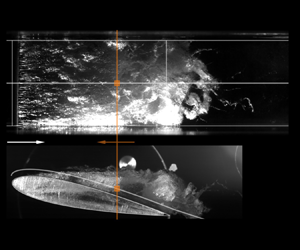
The transition from re-entrant flow-driven to shockwave-driven cloud cavitation
- Part of
-
- Journal:
- Journal of Fluid Mechanics / Volume 1004 / 10 February 2025
- Published online by Cambridge University Press:
- 19 February 2025, A13
-
- Article
-
- You have access
- Open access
- HTML
- Export citation
-
Understanding the mechanism of hydrodynamic cloud cavitation is crucial to reducing noise, vibration and wear. Recent studies have clarified the physics of two distinct formation mechanisms of cloud cavitation. Ganesh et al. (J. Fluid Mech., vol. 802, 2016, pp. 37–78) identified the propagation of bubbly shockwaves as a cloud detachment mechanism. Pelz et al. (J. Fluid Mech., vol. 817, 2017, pp. 439–454) explained the influence of Reynolds number and cavitation number on asymptotic growth of the cavity sheet and its periodic shedding caused by re-entrant flow. In this paper the two mechanisms are set in relation to each other. For this, we show firstly that the transition from re-entrant flow to shockwave-driven cloud cavitation is given by a kinematic condition, namely the asymptotic sheet length equates to the chord length, $\hat {a}=L$. For $\hat {a}>L$ shockwave-driven cloud cavitation dominates. For $\hat {a}< L$ re-entrant flow-driven cloud cavitation dominates. As the cavitation number decreases, the closure region of the cavity sheet reaches the trailing edge of the hydrofoil, identifying the trailing edge as a trigger for condensation shockwaves, particularly as re-entrant flow-driven cavitation diminishes. Since the sheet length is an implicit function of the cavitation number, the kinematic condition $\hat {a}/L=1$ results in a critical cavitation number ${\sigma _\mathrm {II,III}}$ that is calculated analytically and validated by experiments. Secondly, we derive the relationship between the Strouhal number and the asymptotic sheet length for re-entrant flow-driven cloud cavitation. The model presented here is thoroughly validated by experiments.


How might quantum computing impact climate change and the wider environment?
-
- Journal:
- Research Directions: Quantum Technologies / Volume 3 / 2025
- Published online by Cambridge University Press:
- 18 February 2025, e4
-
- Article
-
- You have access
- Open access
- HTML
- Export citation
FLM volume 1003 Cover and Front matter
-
- Journal:
- Journal of Fluid Mechanics / Volume 1003 / 25 January 2025
- Published online by Cambridge University Press:
- 18 February 2025, p. f1
-
- Article
-
- You have access
- Export citation
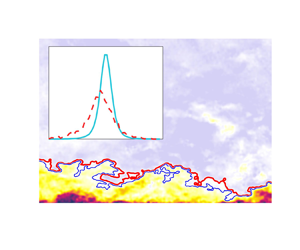
The instantaneous structure of a turbulent wall-bounded flow influenced by freestream turbulence: streamwise evolution
-
- Journal:
- Journal of Fluid Mechanics / Volume 1005 / 25 February 2025
- Published online by Cambridge University Press:
- 17 February 2025, A2
-
- Article
-
- You have access
- Open access
- HTML
- Export citation
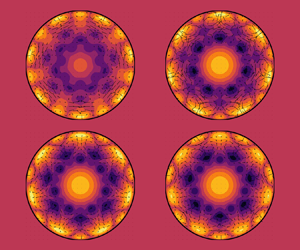
Stabilising nonlinear travelling waves in pipe flow using time-delayed feedback
-
- Journal:
- Journal of Fluid Mechanics / Volume 1005 / 25 February 2025
- Published online by Cambridge University Press:
- 17 February 2025, A3
-
- Article
-
- You have access
- Open access
- HTML
- Export citation
Battery-free head orientation measurement using passive RFID tags
-
- Journal:
- Wearable Technologies / Volume 6 / 2025
- Published online by Cambridge University Press:
- 17 February 2025, e7
-
- Article
-
- You have access
- Open access
- HTML
- Export citation
-
Real-time measurement of head rotation, a primary human body movement, offers potential advantages in rehabilitating head or neck motor disorders, promoting seamless human–robot interaction, and tracking the lateral glance of children with autism spectrum disorder for effective intervention. However, existing options such as cameras capturing the entire face or skin-attached sensors have limitations concerning privacy, safety, and/or usability. This research introduces a novel method that employs a battery-free RFID tag-based wearable sensor for monitoring head orientation, as a substitute for the existing options like camera. By attaching a pair of passive RFID tags to the front of the head at a specific distance from each other, the signal strength of each tag within the pair differs based on the discrepancy in distance from the RFID reader caused by head rotation. Important parameters including distance between the tags, distance from the reader, and tag types, are investigated to suggest optimal sensor design. In tests involving random head rotations by 10 healthy adults, there was a significant correlation between the orientation of the head and gaze in the yaw direction and the differences in signal strength from the sensor pairs. The correlation coefficients ( $ {r}^2 $) were satisfactory, at 0.88 for head and 0.83 for left eye pupil orientations. However, the sensor failed to estimate pitch rotations for head and gaze, due to the insufficient vertical spacing between the tags. No demographic factors appeared to influence the results.

The role of carbonate equilibrium in scale formation of calcium carbonate in a power plant open recirculating system
-
- Journal:
- Data-Centric Engineering / Volume 6 / 2025
- Published online by Cambridge University Press:
- 17 February 2025, e13
-
- Article
-
- You have access
- Open access
- HTML
- Export citation
Improving SINR with smart RIS solutions: exploring optimal dimensions and sizes
-
- Journal:
- International Journal of Microwave and Wireless Technologies / Volume 17 / Issue 1 / February 2025
- Published online by Cambridge University Press:
- 17 February 2025, pp. 1-10
-
- Article
-
- You have access
- HTML
- Export citation
Non-equivalence of quasi-linear dynamical systems and their statistical closures
-
- Journal:
- Journal of Fluid Mechanics / Volume 1005 / 25 February 2025
- Published online by Cambridge University Press:
- 14 February 2025, A4
-
- Article
-
- You have access
- Open access
- HTML
- Export citation
A transmitarray enabling broadband high-purity OAM vortex beams in the Ka-band
-
- Journal:
- International Journal of Microwave and Wireless Technologies / Volume 16 / Issue 10 / December 2024
- Published online by Cambridge University Press:
- 14 February 2025, pp. 1696-1704
-
- Article
- Export citation
-
This paper introduces a three-substrate layered transmitarray design that avoids the use of vias, aiming to produce broadband orbital angular momentum (OAM) vortex beams within the Ka-band. The suggested element configuration accomplishes a full 360∘ transmission phase while upholding a 1-dB transmission loss, with an overall thickness measuring 3.4 mm (equivalent to 0.34λ0 at 30.0 GHz). Its balanced unit cell arrangement amplifies its effectiveness in applications involving dual polarization. We examine the transmitarray behavior across four OAM modes (+1, +2, +3, +4 ), unveiling notable mode purity at operating frequency. Specifically, a broadband OAM vortex beam is achieved for the +1 mode during simulation. A square aperture transmitarray fed by a horn antenna is fabricated and measured to validate these simulated findings. Experimental results confirm the successful broadband vortex beam generation for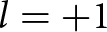 $l = +1$ mode across the frequency spectrum from 27.0 to 40.0 GHz, approximately 43.3%. Additionally, the proposed transmitarray achieves a peak gain of 21.7 dBi, accompanied by an 11.8% aperture efficiency. Noteworthy is the consistent maintenance of mode purity above 86%.
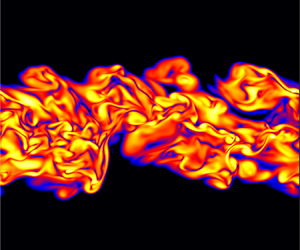
Transition to the buoyancy-dominated regime in a planar temporal forced plume
-
- Journal:
- Journal of Fluid Mechanics / Volume 1002 / 10 January 2025
- Published online by Cambridge University Press:
- 14 February 2025, A43
-
- Article
- Export citation
FLM volume 1002 Cover and Front matter
-
- Journal:
- Journal of Fluid Mechanics / Volume 1002 / 10 January 2025
- Published online by Cambridge University Press:
- 14 February 2025, p. f1
-
- Article
-
- You have access
- Export citation
2 - Biomass
-
-
- Book:
- Bioprocesses
- Published online:
- 24 January 2025
- Print publication:
- 13 February 2025, pp 8-81
-
- Chapter
- Export citation
5 - Chemical Product Design
-
-
- Book:
- Bioprocesses
- Published online:
- 24 January 2025
- Print publication:
- 13 February 2025, pp 173-229
-
- Chapter
- Export citation
1 - Introduction
-
-
- Book:
- Bioprocesses
- Published online:
- 24 January 2025
- Print publication:
- 13 February 2025, pp 1-7
-
- Chapter
- Export citation
Copyright page
-
- Book:
- Bioprocesses
- Published online:
- 24 January 2025
- Print publication:
- 13 February 2025, pp iv-iv
-
- Chapter
- Export citation
4 - Conservation, Logistics, and Risk Analysis
-
-
- Book:
- Bioprocesses
- Published online:
- 24 January 2025
- Print publication:
- 13 February 2025, pp 118-172
-
- Chapter
- Export citation
Contributors
-
- Book:
- Bioprocesses
- Published online:
- 24 January 2025
- Print publication:
- 13 February 2025, pp ix-x
-
- Chapter
- Export citation
