Refine search
Actions for selected content:
212706 results in Engineering
Soft back exosuit controlled by neuro-mechanical modeling provides adaptive assistance while lifting unknown loads and reduces lumbosacral compression forces
-
- Journal:
- Wearable Technologies / Volume 6 / 2025
- Published online by Cambridge University Press:
- 24 February 2025, e9
-
- Article
-
- You have access
- Open access
- HTML
- Export citation
Advanced plasma target from pre-ionized low-density foam for effective and robust direct laser acceleration of electrons
- Part of
-
- Journal:
- High Power Laser Science and Engineering / Volume 13 / 2025
- Published online by Cambridge University Press:
- 24 February 2025, e3
-
- Article
-
- You have access
- Open access
- HTML
- Export citation
Scattering of surface waves by ocean currents: the U2H map
- Part of
-
- Journal:
- Journal of Fluid Mechanics / Volume 1005 / 25 February 2025
- Published online by Cambridge University Press:
- 24 February 2025, A12
-
- Article
-
- You have access
- Open access
- HTML
- Export citation

Machine Learning with Python
- Principles and Practical Techniques
-
- Published online:
- 22 February 2025
- Print publication:
- 31 March 2026
-
- Textbook
- Export citation
Manipulation of mid- and high-frequency wall-pressure sources by streamwise finlets
-
- Journal:
- Journal of Fluid Mechanics / Volume 1005 / 25 February 2025
- Published online by Cambridge University Press:
- 21 February 2025, A8
-
- Article
- Export citation
Active learning for regression in engineering populations: a risk-informed approach
-
- Journal:
- Data-Centric Engineering / Volume 6 / 2025
- Published online by Cambridge University Press:
- 21 February 2025, e16
-
- Article
-
- You have access
- Open access
- HTML
- Export citation
A negative charge at position D+5 of Motif A is critical for function of the major facilitator superfamily multidrug/H+ antiporter MdtM’ – RETRACTION
-
- Journal:
- Experimental Results / Volume 4 / 2023
- Published online by Cambridge University Press:
- 21 February 2025, e21
-
- Article
-
- You have access
- Open access
- HTML
- Export citation
Thermodynamic growth of sea ice: assessing the role of salinity using a quasi-static modelling framework
-
- Journal:
- Journal of Fluid Mechanics / Volume 1005 / 25 February 2025
- Published online by Cambridge University Press:
- 21 February 2025, A7
-
- Article
-
- You have access
- Open access
- HTML
- Export citation

Analysis and removal of spurious pressure oscillations in Boltzmann-equation-based mesoscopic simulation of incompressible turbulence
-
- Journal:
- Journal of Fluid Mechanics / Volume 1005 / 25 February 2025
- Published online by Cambridge University Press:
- 21 February 2025, A9
-
- Article
- Export citation
Competition between protons and substrate for binding to the major facilitator superfamily multidrug/H+ antiporter MdtM’ – RETRACTION
-
- Journal:
- Experimental Results / Volume 4 / 2023
- Published online by Cambridge University Press:
- 21 February 2025, e20
-
- Article
-
- You have access
- Open access
- HTML
- Export citation

Cross-variable amplitude-frequency coupling during intermittency in a turbulent thermoacoustic system
-
- Journal:
- Journal of Fluid Mechanics / Volume 1005 / 25 February 2025
- Published online by Cambridge University Press:
- 21 February 2025, A11
-
- Article
- Export citation
-
We investigate flame–acoustic interactions in a turbulent combustor during the state of intermittency before the onset of thermoacoustic instability using complex networks. Experiments are performed in a turbulent bluff-body stabilised dump combustor where the inlet airflow rate is varied quasi-statically and continuously. We construct a natural visibility graph from the local heat release rate fluctuations ( $\dot {q}'$) at each location. Comparing the average degree during epochs of high- and low-amplitude acoustic pressure oscillations ( $p'$) during the state of intermittency, we detect frequency modulation in $\dot {q}'$. Through this approach, we discover unique spatial patterns of cross-variable coupling between the frequency of $\dot {q}'$ and the amplitude of $p'$. The frequency of $\dot {q}'$ increases in regions of flame anchoring owing to high-frequency excitation of the flow and flame during epochs of high-amplitude $p'$ dynamics. However, the frequency of $\dot {q}'$ decreases in regions associated with flame-front distortions by large coherent vortices. In experiments with continuously varying airflow rates, the spatial pattern of frequency modulation varies with an increase in the average amplitude of $p'$ owing to an increase in the epochs of periodic $p'$ dynamics and the size of vortices forming in the flow. Dynamic shifts in the location of flame anchoring induce low-frequency fluctuations in $\dot {q}'$ during very-high-amplitude intermittent $p'$ dynamics. Our approach using conditional natural visibility graphs thus reveals the spatial pattern of amplitude-frequency coupling between the co-evolving flame and the acoustic field dynamics in turbulent reacting flows.


When does the elastic regime begin in viscoelastic pinch-off?
-
- Journal:
- Journal of Fluid Mechanics / Volume 1005 / 25 February 2025
- Published online by Cambridge University Press:
- 21 February 2025, A10
-
- Article
-
- You have access
- Open access
- HTML
- Export citation
-
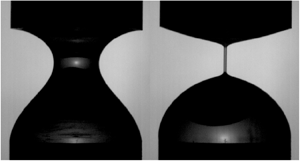
In this experimental and numerical study, we revisit the question of the onset of the elastic regime in viscoelastic pinch-off. This is relevant to all modern filament thinning techniques, which aim to measure the extensional properties of low-viscosity polymer solutions. Examples are the slow retraction method (SRM) for capillary breakup extensional rheometry (CaBER), or the dripping method, in which a drop detaches from a nozzle. As part of these techniques, a stable liquid bridge is brought slowly to its stability threshold, where capillary-driven thinning starts. This thinning slows down dramatically at a critical radius $h_1$, marking the onset of the elasto-capillary regime, characterised by a filament of nearly uniform radius. While a theoretical scaling exists for this transition in the case of the classical step-strain CaBER protocol, where polymer chains stretch without relaxing during the fast plate separation, we show that this theory is not necessarily valid for a slow protocol such as the SRM. In that case, polymer chains start stretching (beyond their equilibrium coiled configuration) only when the bridge thinning rate becomes comparable to the inverse of their relaxation time. We derive a universal scaling for $h_1$, valid for both low- and high-viscosity polymer solutions. This scaling is validated by CaBER experiments with a slow plate separation protocol using different polymer solutions, plate diameters and sample volumes, as well as by numerical simulations using the FENE-P model.


Risk management in the era of data-centric engineering
-
- Journal:
- Data-Centric Engineering / Volume 6 / 2025
- Published online by Cambridge University Press:
- 20 February 2025, e15
-
- Article
-
- You have access
- Open access
- HTML
- Export citation
Analysing complexity in approach control units of metroplex airspaces: insights from air traffic controllers
-
- Journal:
- The Aeronautical Journal / Volume 129 / Issue 1336 / June 2025
- Published online by Cambridge University Press:
- 20 February 2025, pp. 1665-1682
-
- Article
- Export citation
Computational near-field and far-field parameter measurement of high-power lasers using modified coherent modulation imaging
-
- Journal:
- High Power Laser Science and Engineering / Volume 13 / 2025
- Published online by Cambridge University Press:
- 20 February 2025, e28
-
- Article
-
- You have access
- Open access
- HTML
- Export citation
Predictive control of musculotendon loads across fast and slow-twitch muscles in a simulated system with parallel actuation
-
- Journal:
- Wearable Technologies / Volume 6 / 2025
- Published online by Cambridge University Press:
- 20 February 2025, e8
-
- Article
-
- You have access
- Open access
- HTML
- Export citation
-
Research in lower limb wearable robotic control has largely focused on reducing the metabolic cost of walking or compensating for a portion of the biological joint torque, for example, by applying support proportional to estimated biological joint torques. However, due to different musculotendon unit (MTU) contractile speed properties, less attention has been given to the development of wearable robotic controllers that can steer MTU dynamics directly. Therefore, closed-loop control of MTU dynamics needs to be robust across fiber phenotypes, that is ranging from slow type I to fast type IIx in humans. The ability to perform closed-loop control the in-vivo dynamics of MTUs could lead to a new class of wearable robots that can provide precise support to targeted MTUs for preventing onset of injury or providing precision rehabilitation to selected damaged tissues. In this paper, we introduce a novel closed-loop control framework that utilizes nonlinear model predictive control to keep the peak Achilles tendon force within predetermined boundaries during diverse range of cyclic force production simulations in the human ankle plantarflexors. This control framework employs a computationally efficient model comprising a modified Hill-type MTU contraction dynamics component and a model of the ankle joint with parallel actuation. Results indicate that the closed-form muscle-actuation model’s computational time is in the order of microseconds and is robust to different muscle contraction velocity properties. Furthermore, the controller achieves tendon force control within a time frame below $ 18\mathrm{ms} $, aligning with the physiological electromechanical delay of the MTU and facilitating its potential for future real-world applications.

A higher-order spectral element method for modeling eccentric anisotropic multilayered waveguides via transformation optics
-
- Journal:
- International Journal of Microwave and Wireless Technologies / Volume 17 / Issue 5 / June 2025
- Published online by Cambridge University Press:
- 19 February 2025, pp. 766-773
-
- Article
- Export citation
High-brightness betatron X-ray source driven by the SULF-1 PW laser
-
- Journal:
- High Power Laser Science and Engineering / Volume 13 / 2025
- Published online by Cambridge University Press:
- 19 February 2025, e31
-
- Article
-
- You have access
- Open access
- HTML
- Export citation
Apollon Real-Time Adaptive Optics: astronomy-inspired wavefront stabilization in ultraintense lasers
- Part of
-
- Journal:
- High Power Laser Science and Engineering / Volume 13 / 2025
- Published online by Cambridge University Press:
- 19 February 2025, e29
-
- Article
-
- You have access
- Open access
- HTML
- Export citation
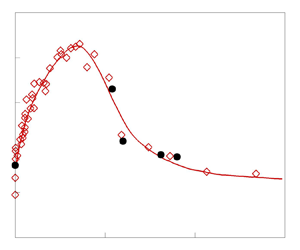
Transition reversal over a blunt plate at Mach 5
-
- Journal:
- Journal of Fluid Mechanics / Volume 1005 / 25 February 2025
- Published online by Cambridge University Press:
- 19 February 2025, A5
-
- Article
-
- You have access
- Open access
- HTML
- Export citation
-
In this work, the stability and transition to turbulence over blunt flat plates with different leading-edge radii are investigated computationally. The benchmark experimental work for comparative studies is conducted by Borovoy et al. (AIAA J., vol. 60, 2022, pp. 497–507). The freestream Mach number is 5, the unit Reynolds number is $6\times 10^7$ m $^{-1}$, and the maximum nose-tip radius 3 mm exceeds the experimental reversal value. High-resolution numerical simulation and stability analysis are performed. Three-dimensional broadband perturbation is added on the far field boundary to initiate the transition. The highlight of this work is that the complete physical process is considered, including the three-dimensional receptivity, linear and nonlinear instabilities, and transition. The experimental reversal phenomenon is reproduced favourably in the numerical simulation for the first time. Linear stability analysis shows that unstable first and second modes are absent in the blunt-plate flows owing to the presence of the entropy layer, although these modes are evident in the sharp-leading-edge case. Therefore, the transition on the blunt plate is due to non-modal instabilities. Numerical results for all the blunt-plate cases reveal the formation of streamwise streaky structures downstream of the nose (stage I) and then the presence of intermittent turbulent spots in the transitional region (stage II). In stage I, a preferential spanwise wavelength approximately 0.9 mm is selected for all the nose-tip radii, and low-frequency components are dominant. In stage II, high-frequency secondary instabilities appear to grow, which participate in the eventual breakdown. By contrast, leading-edge streaks are not remarkable in the sharp-leading-edge case, where transition is induced by oblique first and Mack second modes. The transition reversal beyond the critical nose-tip radius arises from an increasing magnitude of the streaky response in the early stage, while the transition mechanism stays similar qualitatively.


