To save content items to your account,
please confirm that you agree to abide by our usage policies.
If this is the first time you use this feature, you will be asked to authorise Cambridge Core to connect with your account.
Find out more about saving content to .
To save content items to your Kindle, first ensure no-reply@cambridge.org
is added to your Approved Personal Document E-mail List under your Personal Document Settings
on the Manage Your Content and Devices page of your Amazon account. Then enter the ‘name’ part
of your Kindle email address below.
Find out more about saving to your Kindle.
Note you can select to save to either the @free.kindle.com or @kindle.com variations.
‘@free.kindle.com’ emails are free but can only be saved to your device when it is connected to wi-fi.
‘@kindle.com’ emails can be delivered even when you are not connected to wi-fi, but note that service fees apply.
We have in the previous chapters identified different types of the raw materials and products that can ensure a transformation from a petroleum-based to a bio-based society. We have discussed how raw materials can be converted to the required end-products. Before we end up with the final purified product, we still need a number of separation and purification steps. We need to select proper separation methods to reduce the cost of the process and ensure the required quality of our product. In this chapter, we will define the key parameters that are necessary to know to identify the relevant processes. This includes feed concentration, particle characteristics, and solvent properties. The chapter will introduce the existing methods for product purification and introduce guidelines for the selection of the best technologies for the separation and purification processes.
This chapter will give you a fundamental understanding of microbial metabolism and the chemical and biochemical reactions associated with industrial biomass refining. After going through this chapter and solving the assignments, the reader will be able to describe biomass processing and perform the stoichiometric and kinetic calculations needed to solve given biomass processing challenges.
Perhaps paradoxically, it is vital for any newly founded company or established business not to focus exclusively on technology development, technology maturation, and product design. Of course, having a product that performs according to specification is critical, but if the market is not well understood, you have a flawed business model, or your manufacturing costs far exceed what customers are willing to pay for your product, then even if the technology is excellent the business might fail. This chapter is devoted to basic business concepts and fundamental principles in cost accounting, analysis, and market research. Topics include an introduction to value chains, calculating capital costs of building new plants or acquiring new units for production (CapEx), operational expenditures (OpEx), learning curve analysis, and assessment of profitability. The chapter will also introduce basic tools and methods for market research, which will provide the necessary insights to position your technology in a constantly evolving market.
The introduction of bioprocessing in industry will increase the demand for biomass from agricultural fields, forests, and the marine environment (see Chapter 2). Chapter 3 will give you an understanding of the challenges related to extraction and production of biomass, which have spatial effects on land and marine use, ecosystems, and biodiversity. The collection and production of biomass must be sustainable, and contribute to biodiversity and an ethical environment as described in the United Nations Sustainable Development Goals: SDG 15 Life on land, SDG 14 Life below water, SDG 13 Climate action, and SDG 11 Methods. You will be introduced to life cycle analysis (LCA), which is a tool designed for broader analyses of products or whole production systems as well as analyses of the categories of policies societies implement in order to guide and regulate the production and processing of biomass.
A central part at biorefinery plants is the conversion of raw materials to the product of interest. The conversion process can be chemical or biological. The chemical conversion will be explained in this chapter and the biological conversion in Chapter 9. The basic principle for the chemical reaction process will be explained, including catalytic reactions, reaction kinetics, and mass transport
This chapter delves into the crucial step of biomass pretreatment and its significance in a biorefinery. It begins by introducing a comprehensive definition of a biorefinery and the importance of pretreatment in biorefining. Various pretreatment methods, their advantages, disadvantages, and accompanying structural modifications to the biomass are explained. The general focus is on the impact of pretreatment on enzyme hydrolysis, an essential step in biomass conversion to renewable sugars for producing various bioproducts, including biofuels and biopolymers such as bioplastics. The chapter further discusses how pretreatments, if not balanced, could also contribute to downstream processing challenges, such as the generation of inhibitors. The chapter provides a comprehensive guide to grasping the necessity of pretreatment in biomass utilization for sustainable biorefining.
To address the challenges of high-manoeuver targets and limited line-of-sight from the interceptor’s side window, this paper proposes a three-dimensional target manoeuver compensation control (TMCC) guidance law based on compensation function observe (CFO) and a method for studying the terminal guidance handover region. First, a relative model of the missile-target engagement is established. Secondly, the CFO is used to estimate the target manoeuver state, and the estimated information is fed back to the controller of the orbit control engine to make the interception more accurate. Considering the limited line of sight of the side window, the body line of sight angle is constrained by controlling the attitude control engine. Then, the problem description for solving the handover area and the definition of the terminal guidance handover area were provided, and the algorithm design for the handover area was conducted, simplifying the solving process through the concept of area substitution. Simulation results indicate that the proposed terminal guidance law offers higher interception accuracy compared to traditional proportional guidance, and effectively validates the accuracy of the handover region calculation.
Our infrastructure and production is based on fossilized carbon feedstock. This fossil carbon used was once biogenic carbon that has undergone a natural thermochemical conversion and very similar products can be produced from biomass via thermochemical processing; enabling the utilization of the existing infrastructure. The thermochemical processes; pyrolysis, gasification, and combustion, are commercially available for coal but their adaption to biomass is lagging. Understanding both the chemical and physical differences and considering the process chemistry can, however, mitigate this. This chapter talks the reader though the carbon and process chemistry in the thermal and hydrothermal processing of biomass.
The effect of the polarizations of two counter-propagating relativistic laser pulses interacting with subwavelength thin solid-density foil is investigated. Three-dimensional particle-in-cell simulations and analytical modelling show that the interaction and resulting transverse instability depend strongly on the polarization directions as well as the intensity distribution of the resultant light field in the foil. The left- and right-handed circularly polarized laser pair with the same phase at the common focal spot in the ultrathin foil leads to the strongest distortion of the foil. The fastest growing mode and maximum growth rate depend mainly on the laser intensity. For all polarization and phase-difference combinations, the instability is weakest when the two laser pulses are exactly out of phase at the common focusing point in the foil.
For binary plug nozzle, the plug cone is exposed to high-temperature mainstream flow, making it one of the nozzle’s high-temperature components. This paper uses the Realizable k-ε turbulence model and the reverse Monte Carlo method to numerically investigate the aerodynamic and infrared radiation characteristics of the plug nozzle. Various slot cooling configurations were adopted to study the nozzle’s infrared radiation in detail. Results indicate that compared to the baseline nozzle, the plug nozzle’s performance is slightly reduced due to the decrease in effective area of flow over the plug cone. Introducing slot cooling at the rear edge provides significant infrared suppression benefits at low detection angles and notably reduces infrared radiation discrepancy with baseline nozzle at high detection angles. The cooling air from slots causes the nozzle jet to exhibit a ‘thermal layered’ feature. With the same total coolant mass flow, the ‘leading edge + trailing edge’ cooling configuration can lower the area-averaged wall temperature of the plug cone by 5.5% – 12.3%. However, its infrared radiation intensity at each detection angle on the pitch detection plane is higher than that of the ‘trailing edge’ configuration. The significance of leading-edge cooling is focused more on thermal protection for the plug. Thus, it is essential to balance coolant mass flow distribution between infrared radiation suppression and thermal protection.
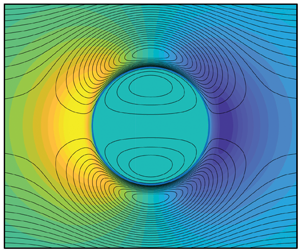
Electrophoretic characterization of nano- and micro-metre scaled bubbles and drops is increasingly important in environmental and health sciences. Despite more than a hundred years of study, the interpretation of bubble electrophoresis data remains an unresolved fundamental problem that bridges fluid mechanics and interfacial science. This paper examines, from a theoretical perspective, how the electrophoretic mobility of small drops and bubbles responds to the interfacial kinetic-exchange rate and interfacial-charge mobility: factors that have been largely overlooked, but which provide new insights on the interpretation of $\zeta$-potentials, which are routinely used to assess surface charge density. A variety of outcomes are demonstrated, each reflecting subtle balances of hydrodynamic and electrical forces, modulated by interfacial thermodynamics and transport. Among the findings is that irreversibly bound charge with low interfacial mobility furnishes rigid-sphere behaviour; whereas interfacial charge with high mobility produces the characteristically high electrophoretic mobilities of non-conducting, uniformly charged fluid spheres. Outcomes are more complex when drops and bubbles have interfacial charge that seeks local equilibrium with the immediately adjacent electrolyte. For example, the present model shows that interfacial-charge mobility regularizes the singular behaviour predicted by theories for fluid spheres bearing high, perfectly uniform surface charge.
In this article, we present a simulation tool for modeling a quasi-optical bench for material characterization. The model uses a Gaussian beam expansion and tracking analysis, together with a modal analysis to enable a comparison of the simulated reflection and transmission S-parameters to the ones measured with a 4-port vector network analyzer. A Thru-Reflect-Line calibration is performed to de-embed the simulated S-parameters of a dielectric slab located between two lens antennas, showing good agreement with the analytical slab model used for experimental permittivity extraction.
We carry out direct numerical simulations (DNS) of fully developed turbulent pipe flow subjected to radial system rotation, examining a broad range of rotational speed and Reynolds number. In response to the imposed system rotation, strong secondary motions arise in the form of streamwise-aligned counter-rotating eddies, which engage significantly with the boundary layer, exerting a notable influence on the turbulent flow. At high rotation numbers, a Taylor–Proudman region appears, marked by a constant mean axial velocity along the rotation axis. As rotation increases, local flow relaminarisation takes place starting at the suction side of the pipe, ultimately resulting in full relaminarisation when the rotation number is higher than unity. In this regime the near-wall region of the flow exhibits the typical hallmark of laminar Ekman layers, whose strength varies with the azimuthal position along the pipe perimeter. A predictive analytical formula for frictional drag is derived for this ultimate high rotation which accurately reproduces the DNS data. The behaviour of friction is more complex to predict at low-to-intermediate rotation numbers owing to concurrent effects of viscosity, turbulence, secondary motions and rotation, which we quantify in an extended version of the Fukagata–Iwamoto–Kasagi identity.
Using an analogy between elastic and magnetic effects, Lin et al. (J. Fluid Mech., vol. 1000, 2024, R3) use viscoelastic Taylor–Couette flow (TCF) to examine the origin of turbulent mixing in accretion disks. Through direct numerical simulations, the authors find that, unlike the Newtonian case with a similar configuration, turbulence is sustained even at the lowest Reynolds numbers examined and that turbulent mixing is provided through elastic and non-hydrodynamic contributions. By comparing the torque scaling laws obtained with those in magnetized TCF, the authors are able to further support the elastic–magnetic analogy. These findings open new avenues for understanding angular momentum transport and instability mechanisms in both laboratory and astrophysical contexts.