To save content items to your account,
please confirm that you agree to abide by our usage policies.
If this is the first time you use this feature, you will be asked to authorise Cambridge Core to connect with your account.
Find out more about saving content to .
To save content items to your Kindle, first ensure no-reply@cambridge.org
is added to your Approved Personal Document E-mail List under your Personal Document Settings
on the Manage Your Content and Devices page of your Amazon account. Then enter the ‘name’ part
of your Kindle email address below.
Find out more about saving to your Kindle.
Note you can select to save to either the @free.kindle.com or @kindle.com variations.
‘@free.kindle.com’ emails are free but can only be saved to your device when it is connected to wi-fi.
‘@kindle.com’ emails can be delivered even when you are not connected to wi-fi, but note that service fees apply.
In this study, measurements and numerical analyses of the temperature distribution of exhaust gas passing through two types of mixers using a micro turbojet engine were performed to investigate the flow mixing performance based on the shape of the mixer, which mixes the bypass air and core air in a gas turbine turbofan engine. To study the mixing characteristics of the mixer, compressed air was supplied through an external duct mounted on a micro turbojet engine to simulate bypass flow, and a system in which hot gas and compressed air were mixed and ejected into the atmosphere was fabricated. A confluent-type mixer and a mixer with 8-lobed mixer channels in the form of a sine wave were used for the experiment. The exhaust gas temperature was measured based on the distance from the nozzle outlet at bypass ratios of 0.5, 1.0 and 1.4. The results showed that the lobed mixer is more effective than the confluent mixer in lowering the exhaust gas temperature as the bypass ratio increased. Numerical analysis results indicated that, in the case of the confluent mixer, flow mixing is primarily performed by shear flow owing to the velocity difference between the core gas and the bypass air. In contrast, in the case of a lobed mixer, flow mixing is achieved through rotational motion and transverse flow. In addition, when the number of lobe channels increased from 8 to 12, the rotational motion increased and the mixing performance improved. Furthermore, infrared signal calculation results confirmed that, as the number of lobe channels increased, improved flow mixing effectively reduced the infrared signal. We conclude that this study helps understand the mixing characteristics of the flow according to the shape of the mixer at various bypass ratios and determine their effect on the characteristics of the infrared signal.
Using high-order simulations, we have shed light on complex chemically reacting flow processes and identified new mechanisms of the supersonic combustion process. We have employed 11th-order accurate implicit large eddy simulation (ILES) in conjunction with a finite-rate (Arrhenius) thermochemistry model using a reduced reaction mechanism for the combustion of hydrogen and air. We compare the coarse-grained computations with available experiments from the German Aerospace Centre (DLR) and discuss the accuracy and uncertainties. A supersonic combustion chamber can be accurately modelled using high-order ILES without a specific turbulence-chemistry model. The simulations reveal that the flame intermittently propagates upstream behind the wedge-shaped flame holder, alternating between the upper and lower turbulent free shear layers at a frequency of ≃ 7,990 Hz. This can be a leading cause of unsteady pressure loadings on the interior surfaces downstream of the combustion chamber and is a crucial structural design parameter. Furthermore, the simulations reveal that high temperatures are sustained long distances downstream of the combustion onset. A barycentric map for the Reynolds stresses is employed to analyze the turbulent anisotropy. The results correlate the axisymmetric contraction and expansion of turbulence with the interaction of the reflected shock waves and the supersonic combustion hydroxyl production regions. The physics insights presented in this study could potentially lead to more efficient supersonic combustion and engineering designs.
This chapter gives an overview of data-driven methods applied to turbulence closure modeling for coarse graining. A non-exhaustive introduction of the various data-driven approaches that have been used in the context of closure modeling is provided which includes a discussion of model consistency, which is the ultimate indicator of a successful model, and other key concepts. More details are then presented for two specific methods, one a neural-network representative of nontransparent black-box approaches and one specific type of evolutionary algorithm representative of transparent approaches yielding explicit mathematical expressions. The importance of satisfying physical constraints is emphasized and methods to choose the most relevant input features are suggested. Several recent applications of data-driven methods to subgrid closure modeling are discussed, both for nonreactive and reactive flow configurations. The chapter is concluded with current trends and an assessment of what can be realistically expected of data-driven methods for coarse graining.
A nuclear detonation’s energy release can be approximately broken up into blast (50%), thermal (35%), and radiation (15%). If a detonation occurs significantly above ground (airburst) and various factors are favorable, for example, few clouds and no snow on the ground, then thermal radiation can ignite surface fires. These fires will first commence within fine fuels, such as paper and leaves on vegetation, but given time, these small-scale fires can upscale to larger fires that burn entire houses, trees, and possibly a city. Depending on weather conditions, the fires may continue to spread within a city and impact first responders or civilians sheltering in place to avoid fallout. This chapter highlights the coarse-graining of turbulence, combustion, and cloud physics associated with ignition, spread, and possible interaction of fires with nuclear fallout plumes. In particular, examples are given to illustrate the complex relationship between fallout and fires, an idealized detonation over Dallas (Texas, USA) and Hiroshima (Japan). For both examples, even though the nuclear airburst was at a fallout-free height of burst, the complex and turbulent interaction of the fires with clouds induced significant fallout on the ground.
With high-speed turbulent combustion applications, we here mean airbreathing engine systems capable of powering aircraft at supersonic and low hypersonic flight speeds between 3 < Ma < 8. Such aircraft are most likely to be designed differently compared to today’s aircraft, being centered around a common engine duct embracing different engine systems activated at different flight speeds. For takeoff and landing, conventional turbojet engines will likely be used, whereas for cruise conditions, a dual-mode ramjet engine, capable of transi-tioning between pure ramjet and scramjet modes is preferred. Such engines do not yet exist, but experimental and computational research is currently generating data and information, paving the way toward further understanding of the aerothermodynamics. This will generate the basis for more advanced experiments that, together with high-fidelity simulations, can lead toward the realization of hypersonic flight vehicles. Here, coarse-grained reacting large eddy simulation and hybrid Reynolds-averaged Navier–Stokes or LES, together with small comprehensive reaction mechanisms, conjugate heat transfer, and thermal radiation modeling, play an important role. In this chapter, the necessary modeling steps and methods, as well as chemical reaction mechanisms, are scrutinized, and results from a few selected cases are presented to illustrate the key physical processes as well as the accuracy of present LES-based prediction methods and the remaining challenges.
We live in a turbulent world observed through coarse-grained lenses. Coarse graining (CG), however, is not only a limit but also a need imposed by the enormous amount of data produced by modern simulations. Target audiences for our survey are graduate students, basic research scientists, and professionals involved in the design and analysis of complex turbulent flows. The ideal readers of this book are researchers with a basic knowledge of fluid mechanics, turbulence, computing, and statistical methods, who are disposed to enlarging their understanding of the fundamentals of CG and are interested in examining different methods applied to managing a chaotic world observed through coarse-grained lenses.
The current emphasis in aerospace component development is on creating safe, reliable and cost-effective technologies. However, the intricate design of stage separation systems renders component reliability a critical factor in determining mission success or failure. One of the technical challenges involves the development of various aerospace mechanisms, such as payload separation, heavy propulsion system separation, ejection of auxiliary components and detachment of rigid components. These stage separation mechanisms commonly employ pyrotechnic devices, which, by their operational nature, impart shock to the spacecraft, potentially causing damage or adverse effects on flight instruments. Therefore, it is imperative to explore multiple viable concepts aimed at reducing shock and experimentally ascertain the impact of shock using diverse shock attenuation techniques. While existing literature primarily addresses shock attenuation with distance from the shock source, limited attention has been given to diminishing shock at the location of the shock-generating element. This study employed various shock-attenuating devices, including dampers, metallic foam structures, viscous materials and dampeners, to assess the effectiveness of shock reduction. Furthermore, the study investigated shock reduction resulting from the elimination of rigid connections, such as bolted joints, from pyro-actuated mechanisms. Through a series of experiments, a conclusive analysis was conducted to determine the approach for achieving a substantial reduction in pyro shock.
We explore the treatment of near-wall turbulence in coarse-grained representations of wall-bounded turbulence. Such representations are complicated by the fact that at high Reynolds number the near-wall effects occur in an asymptotically thin layer. Because of this, many near-wall models are posed as effective boundary conditions, essentially eliminating the thin wall layer that is too thin to resolve. This is commonly referred to as wall-modeled large eddy simulation, and the viability of this approach is supported by the weakness of the interaction between the near-wall turbulence and that further away. Such models are generally informed by known characteristics of near-wall turbulence, such as the log-layer in the mean velocity and the so-called law-of-the-wall. In this chapter, we consider such coarse-grained near-wall models and the approximations implicit in their formulation from the perspective of thin-layer asymptotics.
This work describes the design process of a single-pole double-throw (SPDT) microwave switch operating at Ka-band. It is tailored to a tunable reflective termination design that can be used in tunable power amplifier configurations. A high electron mobility transistor and a resonating network are employed in shunt configuration to enhance the performance in the output port’s active and inactive conditions. The small and large signal measurements showcase a 2 GHz bandwidth with an insertion loss and isolation better than −1.8 dB and −25 dB, respectively, and handling power levels of up to 3 W at 30.5 GHz. The load-pull measurements across the entire Smith chart offer comprehensive insights into the behavior of the SPDT when operating with complex and reactive loads, fulfilling the purpose of tunable reactive termination.
We live in a turbulent world observed through coarse-grained lenses. Coarse graining (CG), however, is not only a limit but also a need imposed by the enormous amount of data produced by modern simulations. Target audiences for our survey are graduate students, basic research scientists, and professionals involved in the design and analysis of complex turbulent flows. The ideal readers of this book are researchers with a basic knowledge of fluid mechanics, turbulence, computing, and statistical methods, who are disposed to enlarging their understanding of the fundamentals of CG and are interested in examining different methods applied to managing a chaotic world observed through coarse-grained lenses.
The present work is intended as a proposition for a new research program for rigorous physical subgrid-scale (SGS) modeling on the combined basis of (i) the Germano identity (ii) and Lie symmetries, which are the axiomatic foundation of classical mechanics. First, new results are presented in this regard. The basic idea here is based on the Germano identity and the fundamental assumption in that the SGS model is just a functional of the resolved scales , that is, in the usual notation , although this can of course also be generalized.
This alone defines a new functional equation of the form for the SGS model, if the residual error in the Germano identity is set exactly to zero. This is in contrast to the usual dynamic procedure, where a given SGS model is introduced into the Germano identity and the residual error is minimized according to a given norm. The resulting functional equation for defines a new class of model equations. The solution of the aforementioned equation for the SGS model using homogenization transform and Fourier transform shows an extremely large variety of potential solutions, that is, SGS models, which at the same time addresses the classical question of how the shape of the test filter as well as the SGS model are related to each other. The analysis quite naturally shows that the proposed analysis focuses solely on the nonlinear term of the Navier–Stokes equations. For physically realizable SGS models, the very large variety of solutions is restricted by means of the classical as well as statistical Lie symmetries of the filtered Navier–Stokes equations. The latter describes the intermittency and non-Gaussian behavior of turbulence. The symmetries can be used decidedly here, that is, it can be selected quite specifically which symmetries are to be fulfilled. A number of models are presented as examples, some of which have similarities to classical models, and also new nonlocal models emerge. As an additional new result we find that the Germano identity can be extended by a divergence-free tensor. The physical meaning of this previously overlooked term needs to be further investigated, but in the classical dynamical procedure the term does not vanish and may be employed profitably, for example, for model optimization. We conclude the presented formulation of a mathematical work program for the development of SGS models based on Lie symmetries and the Germano identity with an extensive outlook for potential further research directions.
Most turbulence theory is derived in a theorized asymptotic state. But real engineering problems almost never reach such a state; in the real world, the route to turbulence leaves its fingerprints on the observed flow. Any coarse-grained simulation must handle this, either by resolving the transition process or modeling some or all of it. Either approach faces significant challenges. If the transition is to be resolved, then a suitable mechanism for turning on and off any turbulence model in the appropriate places is needed. If it is to be modeled, then the model must be capable of handling subfilter fluctuations that may have very different properties than those of fully developed turbulence. All of these approaches have been tried in the literature, and a complete solution is still an active research problem. This chapter reviews the approaches that have been used for coarse-grained simulation of transition.
Numerical investigations of convective flow and heat transfer in two different engineering applications, namely cross-corrugated channels for heat exchangers and rib-roughened channels for gas turbine blade cooling, using wall-modeled large eddy simulations (LES), are presented in this chapter. Mesh resolution requirements for LES, subgrid model dependence, and heat transfer and friction factor characteristics are investigated and compared with previously published experimental data. The LES computations form a coherent suite of monotonically behaving predictions, with all aspects of the results converging toward the predictions obtained on the finest grids. Various subgrid and Reynolds-averaged Navier–Stokes equations (RANS) models are compared to account for their reliability and efficiency in the prediction of hydraulic and thermal performances in the presence of complicated flow physics. Results indicate that subgrid models such as wall-adapting local eddy viscosity model (WALE) and localized dynamic kinetic energy model (LDKM) provide the most accurate results, within 201b of Nusselt number and Darcy’s friction factor, compared to selected RANS models, which presents up to 3501b deviation from experimental data. The conclusion is that both LES and RANS have their strengths and weaknesses, and the choice between them depends on the specific application requirements and available computational resources.
An overview is presented of the filtered density function (FDF) methodology as a closure for large eddy simulation (LES) of turbulent reacting flows. The theoretical basis and the solution strategy of LES/FDF are briefly discussed, with the focus on some of the closure issues. Some of the recent applications of LES/FDF are reviewed, along with some speculations about future prospects for such simulations.
The Kolmogorov scale-by-scale equilibrium cascade and concepts related to it have provided the physical basis for explicit large eddy simulation subgrid models since the mid-twentieth century. However, mounting evidence and theory have been accumulating over the past ten years for scale-by-scale nonequilibrium in a variety of turbulent flows with some new general nonequilibrium laws. One of the resulting challenges now is to translate these new nonequilibrium physics into predictive turbulence modeling.
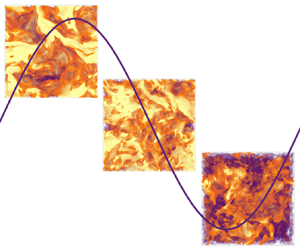
Turbulent flows in three dimensions are characterized by the transport of energy from large to small scales through the energy cascade. Since the small scales are the result of the nonlinear dynamics across the scales, they are often thought of as universal and independent of the large scales. However, as famously remarked by Landau, sufficiently slow variations of the large scales should nonetheless be expected to impact small-scale statistics. Such variations, often termed large-scale intermittency, are pervasive in experiments and even in simulations, while differing from flow to flow. Here, we evaluate the impact of temporal large-scale fluctuations on velocity, vorticity and acceleration statistics by introducing controlled sinusoidal variations of the energy injection rate into direct numerical simulations of turbulence. We find that slow variations can have a strong impact on flow statistics, raising the flatness of the considered quantities. We discern three contributions to the increased flatness, which we model by superpositions of statistically stationary flows. Overall, our work demonstrates how large-scale intermittency needs to be taken into account in order to ensure comparability of statistical results in turbulence.