To save content items to your account,
please confirm that you agree to abide by our usage policies.
If this is the first time you use this feature, you will be asked to authorise Cambridge Core to connect with your account.
Find out more about saving content to .
To save content items to your Kindle, first ensure no-reply@cambridge.org
is added to your Approved Personal Document E-mail List under your Personal Document Settings
on the Manage Your Content and Devices page of your Amazon account. Then enter the ‘name’ part
of your Kindle email address below.
Find out more about saving to your Kindle.
Note you can select to save to either the @free.kindle.com or @kindle.com variations.
‘@free.kindle.com’ emails are free but can only be saved to your device when it is connected to wi-fi.
‘@kindle.com’ emails can be delivered even when you are not connected to wi-fi, but note that service fees apply.
Particle-resolved (PR), Euler–Lagrange (EL), and Euler–Euler (EE) formulations are the three widely used computational approaches in multiphase flow. In PR formulation, the focus is on the flow physics at the microscale and all the details are resolved at the microscale. However, due to computational limitations, the PR approach cannot reach the length and time scales needed to explore the meso and macroscale multiphase phenomenon. In the EL formulation of a dispersed multiphase flow, the continuous phase is averaged (or filtered), and all the microscale details of the flow on the scale of individual particles are coarse-grained. If all the dispersed phase elements (i.e., all the particles, drops, or bubbles) are tracked then there is no averaging of the dispersed phase. In the EE formulation, both the continuous and dispersed phases are averaged/filtered. We will discuss systematic coarse graining to obtain the governing equations of the EL and EE approaches. The coarse-graining process introduces two interesting challenges: (i) the unavoidable closure problem where the Reynolds stress and flux terms must be expressed in terms of filtered meso/macroscale variables, and (ii) the coupling between the continuous and the dispersed phases must be appropriately posed in terms of the filtered variables. Recent innovations on both these fronts are discussed.
Scale-resolving simulation (SRS) methods of practical interest are coarse-graining formulations widely used in science and engineering. These methods aim to efficiently predict complex flows by only resolving the phenomena not amenable to modeling, unleashing the concept of accuracy on demand. This chapter provides an overview of the SRS methods best suited for engineering applications: hybrid and bridging models. It starts by reviewing basic turbulence modeling concepts. Following on from that is an overview of hybrid and bridging models, discussing their main advantages and limitations. The challenges to the predictive application of these models are enumerated, as well as possible strategies to solve or mitigate them. Several examples are provided to illustrate the potential of these classes of SRS methods. Overall, the chapter intends to help new and experienced SRS modelers and users obtain predictive turbulence computations.
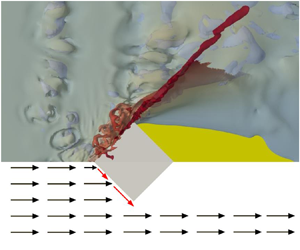
The interaction between planar incident shocks and cylindrical boundary layers is prevalent in missiles equipped with inverted inlets, which typically leads to substantial three-dimensional flow separation and the formation of vortical flow. This study utilizes wind-tunnel experiments and theoretical analysis to elucidate the shock structure, surface topology and pressure distributions induced by a planar shock with finite width impinging on a cylinder wall at Mach 2.0. In the central region, a refraction phenomenon occurs as the transmitted shock bends within the boundary layer, generating a series of compression waves that coalesce into a shock, forming a ‘shock triangle’ structure. As the incident shock propagates backward along both sides, it gradually evolves into a Mach stem, where the transmitted shock refracts the expansion wave. The incident shock interacts with the boundary layer, resulting in the formation of a highly swept separation region that yields a pair of counter-rotating horseshoe-like vortices above the separation lines. These vortices facilitate the accumulation of low-energy fluid on both sides. Although the interaction of the symmetry plane aligns with free-interaction-theory, the separation shock angle away from the centre significantly deviates from the predicted value owing to the accumulation of low-energy fluids. The primary separation line and pressure distribution jointly exhibit an elliptical similarity on the cylindrical surface. Furthermore, the potential unsteady behaviour is assessed, and the Strouhal number of the low-frequency oscillation is found to be 0.0094, which is insufficient to trigger significant alterations in the flow field structure.
Longstanding design and reproducibility challenges in inertial confinement fusion (ICF) capsule implosion experiments involve recognizing the need for appropriately characterized and modeled three-dimensional initial conditions and high-fidelity simulation capabilities to predict transitional flow approaching turbulence, material mixing characteristics, and late-time quantities of interest – for example, fusion yield. We build on previous coarse-graining (CG) simulations of the indirect-drive national ignition facility (NIF) cryogenic capsule N170601 experiment – a precursor of N221205 which resulted in net energy gain. We apply effectively combined initialization aspects and multiphysics coupling in conjunction with newly available hydrodynamics simulation methods, including directional unsplit algorithms and low Mach-number correction – key advances enabling high fidelity coarse-grained simulations of radiation-hydrodynamics driven transition.
The filtering approach is a simple deterministic way to formalize analytically coarse-grained representations of a given turbulent flow. By their own nature, turbulence and coarse graining (CG) are multiscaled, and in this chapter, we discuss the specific question of the relations between turbulence, coarse graining, and filtering in a unified operational form, with particular interest to multiscale properties and aspects. Reynolds averaged Navier–Stokes (RANS) averaging, explicit convolutional large eddy simulation (LES) filtering formulations (Leonard, 1975), implicit LES and scale resolving simulations (SRS) approaches (Grinstein et al., 2010; Grinstein, 2016; Pereira et al., 2021), functional and structural LES modeling procedures (Sagaut, 2006) and hybrid RANS/LES methods (Fr¨ohlich and von Terzi, 2008), are revisited and discussed from the point of view of a multiscale operational filtering approach (OFA) (Germano, 1992) based on the multiscale properties of the generalized central moments (GCM). Some recent results are presented both as regards analysis, modeling, and post-processing of turbulent flows, and finally, some conclusions and some personal recalls are provided.
Accurate predictions with quantifiable uncertainty are essential to many practical turbulent flows in engineering, geophysics, and astrophysics typically comprising extreme geometrical complexity and broad ranges of length and timescales. Dominating effects of the flow instabilities can be captured with coarse-graining (CG) modeling based on the primary conservation equations and effectively codesigned physics and algorithms. The collaborative computational and laboratory experiments unavoidably involve inherently intrusive coarse-grained observations – intimately linked to their subgrid scale and supergrid (initial and boundary conditions) specifics. We discuss turbulence fundamentals and predictability aspects and introduce the CG modified equation analysis. Modeling and predictability issues for underresolved flow and mixing driven by underresolved velocity fields and underresolved initial and boundary conditions are revisited in this context. CG simulations modeling prototypical shock-tube experiments are used to exemplify relevant actual issues, challenges, and strategies.
Originating from irreversible statistical mechanics, the Mori–Zwanzig (M–Z) formalism provides a mathematical procedure for the development of coarse-grained models of complex systems, such as turbulence, that lack scale separation. The M–Z formalism begins with the application of a specialized class of projectors to the governing equations. By leveraging these projectors, the M–Z procedure results in a reduced system, commonly referred to as the generalized Langevin equation (GLE). The GLE encapsulates the system’s behavior on a macroscopic (resolved) scale. The influence of the microscopic (unresolved) scales on resolved scales appears as a convolution integral – often referred to as memory – and an additional noise term. In essence, fully resolved Markovian dynamics is transformed into coarse grained non-Markovian dynamics. The appearance of the memory term in the GLE demonstrates that the coarse-graining procedure leads to nonlocal memory effects, which have to be modeled. This chapter introduces the mathematics behind the projection approach and the derivation of the GLE. Beyond the theoretical developments, the practical application of the M–Z procedure in the construction of subgrid-scale models for large eddy simulations is also presented.
In order to recover the magnetic energy that leaks from an induction cooktop, this study suggests a straightforward and cost-effective magnetic-field energy harvester (MFEH) circuit. With the aid of the intended circuitry, the acquired magnetic energy is transformed into DC electrical energy. We harvested the magnetic-field energy (MFE) from the induction cooktop at various heights and locations of the energy harvesting coil. With a load resister of 46.6 Ω and a capacitance of 1 mF, the developed MFEH circuit, when positioned 2 cm beneath the cooktop, can capture an average DC power of 1936 mW. Placing the energy-harvesting coil 7.5 cm beneath the induction cooktop lowers the power output to 142 mW. For a range of load resister values, the MFE gathered at various locations along the energy harvesting coils is examined. Batteries can be used to store the gathered energy for later use. Additionally, the suggested device is shown to be capable of wirelessly powering low-power Internet of things devices and charging mobile devices. The suggested device differs from the previously published magnetic harvesting circuits due to the induction cooktop’s superior performance and capacity to gather MFE.
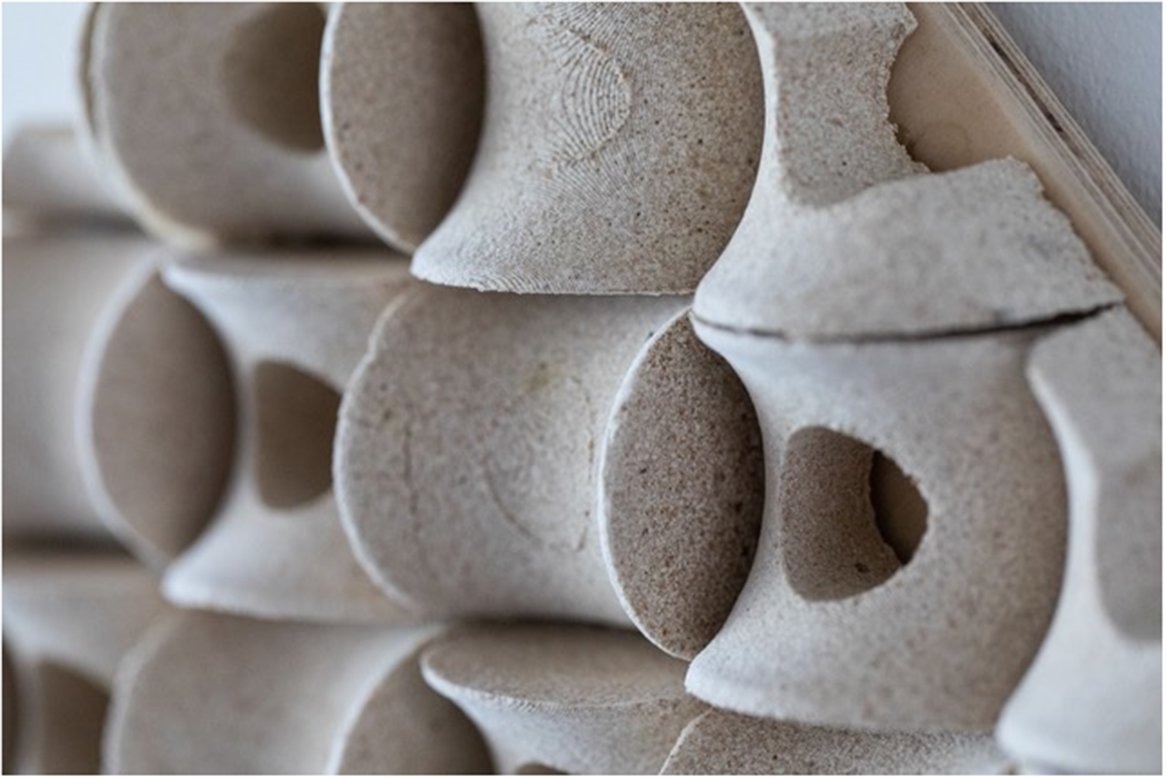
The implementation of a circular bioeconomy in the construction industry is a necessary strategy to tackle our global climate crisis. With any single solution having practical and environmental limitations, it is clear that creating a material palette of renewable biogenic building materials will expands access to bio-based construction. Photosynthetic organisms, including marine biomass such as seaweeds and microalgae, utilise solar energy to sequester CO₂, producing biomolecules that can be harnessed for a variety of biomaterials. Organisms such as mussels and oysters mineralise carbon into shells that are often dis-carded as residues. These second- and third-generation feedstocks present an opportunity to decarbonise the construction industry. However, we need to better understand how to renew our relationship to this resource in a sustainable manner. This question seeks to explore how we can design and fabricate with, and for, blue biomass materials.
Green water loads on prismatic obstacles (representing topside structures) mounted on the raised deck of a simplified vessel are investigated using computational fluid dynamics simulations and physical model testing with emphasis on examining different structure shapes, orientation angles and relative structure size. For each scenario investigated, several flow features are identified that characterize the green water interaction with the structure and influence loads, namely delayed flow diversion, formation of a vertical jet, scattered wave formation and the development of complex wake patterns. Comparing across structures, these interactions are more pronounced for blunt objects, and the associated force impulse is larger. For example, a cube with flow at normal incidence is found to experience approximately twice the force impulse of a circular cylinder of the same projected area. Equally, rotation of the cube leads to reduced run-up height and streamwise force on the structure. To explain these trends, a theoretical model based on Newtonian flow theory is adopted. This model provides an estimate of the streamwise force exerted on obstacles in high-Froude-number flows and shows good agreement with the numerical results when the flow is supercritical, shallow (small water depth relative to structure width) and the structure is tall (large structure height relative to water depth). Despite some limitations, the model should provide an efficient force prediction tool for practical use in design.
Quantum learning models hold the potential to bring computational advantages over the classical realm. As powerful quantum servers become available on the cloud, ensuring the protection of clients’ private data becomes crucial. By incorporating quantum homomorphic encryption schemes, we present a general framework that enables quantum delegated and federated learning with a computation-theoretical data privacy guarantee. We show that learning and inference under this framework feature substantially lower communication complexity compared with schemes based on blind quantum computing. In addition, in the proposed quantum federated learning scenario, there is less computational burden on local quantum devices from the client side, since the server can operate on encrypted quantum data without extracting any information. We further prove that certain quantum speedups in supervised learning carry over to private delegated learning scenarios employing quantum kernel methods. Our results provide a valuable guide toward privacy-guaranteed quantum learning on the cloud, which may benefit future studies and security-related applications.
The magnetostrictive response of a Terfenol-D pellet was measured via a laboratory-based X-ray diffractometer. X-ray diffraction patterns were collected from the pellet sample with and without the presence of an applied magnetic field (~30 mT) generated by placing a large magnet under the pellet. A standard reference material, Silicon 640c, was employed as an internal standard. Magnetostriction values of 323 and 227 ppm Δl/l were determined for the (104) and (110) indexed peaks, respectively, assuming a rhombohedral structure for Terfenol-D. A threshold noise level value of ~20 to 30 ppm Δl/l was suggested based on before/after measurements in the absence of the applied field. No clear evidence of domain wall rotation was detected via changes in relative intensities of diffraction peaks in the presence of the applied magnetic field.
Applications of deep learning to physical simulations such as Computational Fluid Dynamics have recently experienced a surge in interest, and their viability has been demonstrated in different domains. However, due to the highly complex, turbulent, and three-dimensional flows, they have not yet been proven usable for turbomachinery applications. Multistage axial compressors for gas turbine applications represent a remarkably challenging case, due to the high-dimensionality of the regression of the flow field from geometrical and operational variables. This paper demonstrates the development and application of a deep learning framework for predictions of the flow field and aerodynamic performance of multistage axial compressors. A physics-based dimensionality reduction approach unlocks the potential for flow-field predictions, as it re-formulates the regression problem from an unstructured to a structured one, as well as reducing the number of degrees of freedom. Compared to traditional “black-box” surrogate models, it provides explainability to the predictions of the overall performance by identifying the corresponding aerodynamic drivers. The model is applied to manufacturing and build variations, as the associated performance scatter is known to have a significant impact on $ \mathrm{C}{\mathrm{O}}_2 $ emissions, which poses a challenge of great industrial and environmental relevance. The proposed architecture is proven to achieve an accuracy comparable to that of the CFD benchmark, in real-time, for an industrially relevant application. The deployed model is readily integrated within the manufacturing and build process of gas turbines, thus providing the opportunity to analytically assess the impact on performance with actionable and explainable data.
We have developed an interactive system comprising a soft wearable robot hand and a wireless task board, facilitating the interaction between the hand and regular daily objects for task-oriented training in stroke rehabilitation. A ring-reinforced soft actuator (RSA) to accommodate different hand sizes and enable flexion and extension movements was introduced in this paper. Individually controlled finger actuators assist stroke patients during various grasping tasks. A wireless task board was developed to support the training, allowing for the placement of training objects and seamless interaction with the soft robotic hand. Evaluation with seven stroke subjects shows significant improvements in upper limb functions (FMA), hand-motor abilities (ARAT, BBT), and maximum grip strengths after 20 sessions of this task-oriented training. These improvements were observed to persist for at least 3 months post-training. The results demonstrate its potential to enhance stroke rehabilitation and promote hand-motor recovery. This lightweight, user-friendly interactive system facilitates frequent hand practice and easily integrates into regular rehabilitation therapy routines.
Aiming to address the issue of low accuracy in model predictions obtained from fitting frequency domain response curves for small unmanned helicopters during the process of modeling their flight dynamics, this study proposes a system identification algorithm based on the combination of weighted least squares and improved grey wolf optimisation algorithm. The algorithm utilises the weighted least squares method to obtain the initial model structure, optimises the initial model parameters using the improved grey wolf optimisation algorithm, and enhances the local search and global optimisation ability of the grey wolf optimisation algorithm by introducing an improved grey wolf subgrouping rule, nonlinear convergence factor and dynamic cooperative rule. Ultimately, this approach establishes a dynamic model for small, unmanned helicopters. The identified model is validated using flight test data, with findings demonstrating that this method achieves higher accuracy in model identification and better fits to frequency domain response curves, thus providing a more accurate reflection of the flight dynamics of small unmanned helicopters.
A novel microstrip filtering antenna with slot coupling feed is presented in this work. An asymmetric interdigital coupling structure is used for the feed to excite the patch antenna through gap-fed coupling. Introducing a U-shaped slot on the patch surface modifies the current path to attain different resonant modes. The asymmetric coupled fingers in the low-frequency band generate a radiation null of −64 dBi, while additional resonances introduced in the high band broaden the bandwidth from 4.9 to 5.3 GHz. A horizontally shorted microstrip branch produces another null point of −28 dBi between the bands, enabling steeper roll-off and further improvement in frequency selectivity. The proposed filtering antenna provides a flexible filter response without requiring extra filtering circuits, with appreciable peak gains (6.1 dBi and 7.1 dBi) and stable radiation characteristics. This makes it suitable for WLAN (Wireless Local Area Network) and ISM (Industrial Scientific Medical) systems applications.