To save content items to your account,
please confirm that you agree to abide by our usage policies.
If this is the first time you use this feature, you will be asked to authorise Cambridge Core to connect with your account.
Find out more about saving content to .
To save content items to your Kindle, first ensure no-reply@cambridge.org
is added to your Approved Personal Document E-mail List under your Personal Document Settings
on the Manage Your Content and Devices page of your Amazon account. Then enter the ‘name’ part
of your Kindle email address below.
Find out more about saving to your Kindle.
Note you can select to save to either the @free.kindle.com or @kindle.com variations.
‘@free.kindle.com’ emails are free but can only be saved to your device when it is connected to wi-fi.
‘@kindle.com’ emails can be delivered even when you are not connected to wi-fi, but note that service fees apply.
The transmission of bandpass signals and the corresponding channel effects are introduced. Basic single-carrier bandpass modulation schemes – namely, bandpass pulse amplitude modulation, phase-shift keying, and quadrature amplitude modulation – are studied. Lowpass equivalents of bandpass signals are introduced, and the in-phase and quadrature components of a bandpass signal are described. It is shown that bandpass signals and systems can be studied through their lowpass equivalents. The π/4-QPSK and offset QPSK are presented as two practically motivated variations of quadrature phase-shift keying. Coherent, differentially coherent, and non-coherent receivers are described. Differential phase-shift keying is studied in some depth. Finally, carrier phase-synchronization methods, including the use of phase-locked loops, are described.
Deterministic signals and linear time-invariant systems are studied. The Fourier transform is introduced, and its properties are reviewed. The concepts of probability and random variables are developed. Conditional probability is defined, and the total probability theorem and Bayes’ rule are given. Random variables are studied through their cumulative distribution functions and probability density functions, and statistical averages, including the mean and variance, are defined. These concepts are extended to random vectors. In addition, the concept of random processes is covered in depth. The autocorrelation function, stationarity, and power spectral density are studied, along with extensions to multiple random processes. Particular attention is paid to wide-sense stationary processes, and the concept of power spectral density is introduced. Also explored is the filtering of wide-sense stationary random processes, including the essential properties of their autocorrelation function and power spectral density. Due to their significance in modeling noise in a communication system, Gaussian random processes are also covered.
This paper investigates hand grasping, a fundamental activity in daily living, by examining the forces and postures involved in the lift-and-hold phases of grasping. We introduce a novel multi-sensory data glove, integrated with resistive flex sensors and capacitive force sensors, to measure the intricate dynamics of hand movement. The study engaged five subjects to capture a comprehensive dataset that includes contact forces at the fingertips and joint angles, furnishing a detailed portrayal of grasp mechanics. Focusing on grasp synergies, our analysis delved into the quantitative relationships between the correlated forces among the fingers. By manipulating one variable at a time—either the object or the subject—our cross-sectional approach yields rich insights into the nature of grasp forces and angles. The correlation coefficients for finger pairs presented median values ranging from 0.5 to nearly 0.9, indicating varying degrees of inter-finger coordination, with the thumb-index and index-middle pairs exhibiting particularly high synergy. The findings, depicted through spider charts and correlation coefficients, reveal significant patterns of cooperative finger behavior. These insights are crucial for the advancement of hand mechanics understanding and have profound implications for the development of assistive technologies and rehabilitation devices.
Several issues in communication system design are highlighted. Specifically, the effects of transmission losses in a communication system and ways of addressing the related challenges are reviewed. A basic link budget analysis is performed. The effects of non-ideal amplifiers to combat transmission losses are demonstrated, and the loss in the signal-to-noise ratio at the amplifier output is quantified. The use of analog and regenerative repeaters for transmission over long distances is explored. Furthermore, time-division, frequency-division, and code-division multiple-access techniques are described.
A brief coverage of amplitude modulation (AM) and angle modulation techniques is provided. The basic principles of conventional AM, double-sideband suppressed carrier AM, single-sideband AM, and vestigial sideband AM are described both through time-domain and frequency-domain techniques. Frequency and phase modulation are described and their equivalence is argued. A comparison of different analog modulation techniques in terms of complexity, power, and bandwidth requirements is made. Conversion of analog signals into a digital form through sampling and quantization is studied. Proof of the sampling theorem is given. Scalar and vector quantizers are described. Uniform and non-uniform scalar quantizer designs are studied. The Lloyd-Max quantizer design algorithm is detailed. The amount of loss introduced by a quantizer is quantified by computing the mean square distortion, and the resulting signal-to-quantization noise ratio. Pulse code modulation (PCM) as a waveform coding technique, along with its variants – including differential PCM and delta modulation – is also studied.
Broadband frequency-tripling pulses with high energy are attractive for scientific research, such as inertial confinement fusion, but are difficult to scale up. Third-harmonic generation via nonlinear frequency conversion, however, remains a trade-off between bandwidth and conversion efficiency. Based on gradient deuterium deuterated potassium dihydrogen phosphate (KDxH2-xPO4, DKDP) crystal, here we report the generation of frequency-tripling pulses by rapid adiabatic passage with a low-coherence laser driver facility. The efficiency dependence on the phase-matching angle in a Type-II configuration is studied. We attained an output at 352 nm with a bandwidth of 4.4 THz and an efficiency of 36%. These results, to the best of our knowledge, represent the first experimental demonstration of gradient deuterium DKDP crystal in obtaining frequency-tripling pulses. Our research paves a new way for developing high-efficiency, large-bandwidth frequency-tripling technology.
The aeronautical telecommunication network (ATN) aims to provide reliable end-to-end communications even for those including the air-to-ground segment and in particular for data link applications. The existing ATN, known as ATN/OSI, is based on OSI protocols since its first deployment. The OSI model implementation in ATN communicating entities causes great complexity in network management, particularly in terms of Internet network interoperability. Therefore, since 2010, the International Civil Aviation Organization (ICAO) proposed a migration to ATN over Internet protocol suite (IPS), called ATN/IPS. Thus, this research work focuses on specifying the reliability mechanisms required for air ground data link applications in future ATN/IPS. To achieve this, the transport protocols performance is assessed based on simulations using an ATN model developed considering the ICAO standards. The modeled legacy application enables to generate traffic based on real controller-pilot data link communications (CPDLC) log files from French area control centre (ACC). The air-to-ground subnetworks are characterised using time series delay induced from previously modeled VDL Mode 2 data link analysis. As proof-of-concept, CPDLC messages exchange from aircraft to controller and future applications that transmits heavier files from ground-to-board are simulated. Transport protocols performance are evaluated with respect to the most constraining requirements. The simulation results highlighted the limitations of both connection-oriented transport protocol class 4 (COTP4) and TCP. This enabled to provide a preliminary overview of a new QUIC-like reliable protocol that should meet the heterogeneous requirements of the legacy and the eventual future ATN/IPS applications.
In laser systems requiring a flat-top distribution of beam intensity, beam smoothing is a critical technology for enhancing laser energy deposition onto the focal spot. The continuous phase modulator (CPM) is a key component in beam smoothing, as it introduces high-frequency continuous phase modulation across the laser beam profile. However, the presence of the CPM makes it challenging to measure and correct the wavefront aberration of the input laser beam effectively, leading to unwanted beam intensity distribution and bringing difficulty to the design of the CPM. To address this issue, we propose a deep learning enabled robust wavefront sensing (DLWS) method to achieve effective wavefront measurement and active aberration correction, thereby facilitating active beam smoothing using the CPM. The experimental results show that the average wavefront reconstruction error of the DLWS method is 0.04 μm in the root mean square, while the Shack–Hartmann wavefront sensor reconstruction error is 0.17 μm.
Rapid and comprehensive fighter optimisation is an important part of modern combat decision-making. However, due to the numerous influencing factors, it is difficult for decision-makers to consider comprehensively and specify the optimal decision, and it is highly subjective, which leads to different decision conclusions from person to person. Therefore, to solve the above deficiencies in fighter selection, this paper proposes a sequential decision-making framework that comprehensively considers the effectiveness, maintenance, support capability and health status of the fighter aircraft. Based on the multi-dimensional state, it provides comprehensive and credible auxiliary support for commanders. The sequential decision-making framework (called GRA-VIKOR-IFNs) uses the combination of equation and fuzzy multi-criteria decision-making (FMCDM) to evaluate the effectiveness, support capability and health in turn, to complete the step-by-step selection of fighter models, troops and sorties. The evaluation equation is for the effectiveness evaluation and a hybrid method using the extended grey correlation analysis (GRA) and VlseKriterijumska Optimizacija I Kompromisno Resenje (VIKOR) method based on intuitionistic fuzzy numbers (IFNs) is for the support capability and health evaluation. The proposed strategy is in line with the logic and demand of actual combat and training decision-making and takes into account the influence of uncertain factors. Finally, a comparison with some classical methods is carried out, such as the full consistency method (FUCOM), the technique for order of preference by similarity to ideal solution (TOPSIS) and so on. The GRA-VIKOR-IFNs method is consistent with the results of other methods and the result sort resolution is 0.0619 and at least 40% higher than other methods, which can lead the commanders to a more reliable and clear decision.
With the escalating laser peak power, modulating and detecting the intensity, duration, phase and polarization of ultra-intense laser pulses progressively becomes increasingly arduous due to the limited damage thresholds of conventional optical components. In particular, the generation and detection of ultra-intense vortex lasers pose great challenges for current laser technologies, which has limited the widely potential applications of relativistic vortex lasers in various domains. In this study, we propose to reconstruct the vortex phase and generate and amplify the relativistic vortex lasers via surface plasma holograms (SPHs). By interfering with the object laser and reference laser, SPHs are formed on the target and the phase of the interfering laser is imprinted through the modulation of surface plasma density. In particular, using the quadrature phase-shift interference, the vortex phase of the object laser can be well reconstructed. The generated vortex lasers can be focused and enhanced further by one order of magnitude, up to $1.7\times {10}^{21}$ W/cm${}^2$, which has been demonstrated by full three-dimensional particle-in-cell simulations. For the first time, we provide a practical way to detect the phase of relativistic vortex lasers, which can be applied in large 1–10 PW laser facilities. This will promote future experimental research of vortex-laser–plasma interaction and open a new avenue of plasma optics in the ultra-relativistic regime.
Urban air mobility (UAM) utilising novel transportation tools is gradually being recognised as a significant means to alleviate ground transportation pressures, vertiports which serve as pivotal nodes in UAM require efficient methods for assessing its operational capacity to develop an appropriate operational strategy and help to design vertiport ground infrastructure scientifically. This study proposes a multi-dimensional assessment method for the capacity of vertiports considering throughput and quality of service based on genetic algorithm (CEGA). The method comprehensively considers constraints such as unmanned aerial vehicle (UAV) safety separation, battery endurance, number of landing vertipads and UAV speed. The experimental results indicate that the vertiport with the scheduling algorithm proposed by this study has a larger capacity and experiences fewer delay than the vertiport with first-come-first-served (FCFS) algorithm when the vertiport has the same limited number of vertipads. Different proportions of UAVs significantly affect the quality of service and the degree of operation delays. The weights of vertiport throughput and customer satisfaction are the parameters that represent the importance of throughput and customer satisfaction in the objective function of the capacity assessment model. When the weights of throughput and customer satisfaction are set to 0.8 and 0.2 respectively, the performance of this optimisation model is optimal. This study provides a novel solution for capacity assessment and operation scheduling of vertiports, laying the foundation for improving the efficiency of UAM operations.
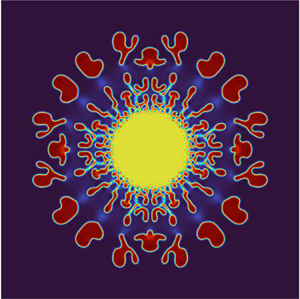
The Hele-Shaw–Cahn–Hilliard model, coupled with phase separation, is numerically simulated to demonstrate the formation of anomalous fingering patterns in a radial displacement of a partially miscible binary-fluid system. The composition of injected fluid is set to be less viscous than the displaced fluid and within the spinodal or metastable phase-separated region, in which the second derivative of the free energy is negative or positive, respectively. Because of phase separation, concentration evolves non-monotonically between the injected and displaced fluids. The simulations reveal four areas of the concentration distribution between the fluids: the inner core; the low-concentration grooves/high-concentration ridges; the isolated fluid fragments or droplets; the mixing zone. The grooves/ridges and the fragments/droplets, which are the unique features of phase separation, form in the spinodal and metastable regions. Four typical types of patterns are categorized: core separation (CS); fingering separation (FS); separation fingering (SF); lollipop fingering, in the order of the dominance of phase separation, respectively. For the patterns of CS and FS, isolated fluid fragments or droplets around the inner core are the main features. Fingering formation is better maintained with droplets in the SF pattern if the phase separation is relatively weaker than viscous fingering (VF). Even continuous fingers are well preserved in the case of dominant VF; phase separation results in lollipop-shaped fingers. The evolving trend of the patterns is in line with the experiments. These patterns are summarized in a pattern diagram, mainly by the magnitude of the second derivative of the free energy profile.
Polarization smoothing can effectively improve the uniformity of focal spots. In this study, we theoretically and experimentally investigated the polarization synthesis of the focal spot under a birefringent wedge (BW) and speckle under the coupling of the BW and continuous phase plate. Polarization distribution was experimentally obtained using rotating quarter-wave plate measurement under a specific wedge angle. The simulated and experimental results are consistent, demonstrating that the focal spot is in a state of coexistence of elliptical and linear polarizations. In addition, the polarization state is determined by the ratio of the amplitudes and the phase difference between the sub-beams. The simulation results showed that the proportion of linear polarization increased with the separation angle of the sub-beam. In contrast, it decreased with the incident light aperture. This research is crucial for accurately describing the polarization distribution and further understanding the laser–plasma interactions.
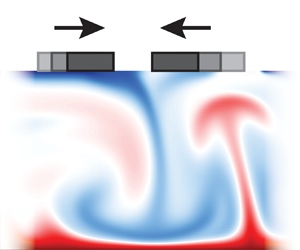
The continental plates of Earth are known to drift over a geophysical time scale, and their interactions have led to some of the most spectacular geoformations of our planet while also causing natural disasters such as earthquakes and volcanic activity. Understanding the dynamics of interacting continental plates is thus significant. In this work, we present a fluid mechanical investigation of the plate motion, interaction and dynamics. Through numerical experiments, we examine the coupling between a convective fluid and plates floating on top of it. With physical modelling, we show the coupling is both mechanical and thermal, leading to the thermal blanket effect: the floating plate is not only transported by the fluid flow beneath, it also prevents the heat from leaving the fluid, leading to a convective flow that further affects the plate motion. By adding several plates to such a coupled fluid–structure interaction, we also investigate how floating plates interact with each other, and show that under proper conditions, small plates can converge into a supercontinent.
In this paper, the design and optimization of a circularly polarized antenna based on two crossed dipoles in phase quadrature for Global Navigation Satellite System (GNSS) wide band application has been investigated. The proposed design is single fed and relies on parasitic structures to achieve wide band coverage on the GPS standard bands L1 (1559–1610 MHz) and L5 (1164–1189 MHz). Full-wave simulations have been used to compute the radiation properties and the impedance of the antenna. A prototype was manufactured, and good agreement has been observed between the simulated results and measurement for both radiation pattern and reflection coefficient.
The antenna achieves a −10 dB impedance bandwidth of $56.97\%$ covering the band 1164–1610 MHz, and an axial ratio that covers the L5 band ranging between 7 dB and 2.8 dB from 1.164 GHz to 1.3 GHz while maintaining a value below 2.7 dB across the entire L1 band. The antenna occupies a volume of $\,99\, \,\times\,99\, \times 50$ mm3. It has been tested in real conditions during the 23rd French National Microwave Days (JNM) student competition. A GNSS signal receiver has been connected to the antenna. The antenna has been evaluated based on the number of connections it could achieve over a duration of 30 s.
Advanced myoelectric prostheses feature multiple degrees of freedom (DoFs) and sophisticated control algorithms that interpret user motor intentions as commands. While enhancing their capability to assist users in a wide range of daily activities, these control solutions still pose challenges. Among them, the need for extensive learning periods and users’ limited control proficiency. To investigate the relationship between these challenges and the limited alignment of such methods with human motor control strategies, we examine motor learning processes in two different control maps testing a synergistic myoelectric system. In particular, this work employs a DoF-wise synergies control algorithm tested in both intuitive and non-intuitive control mappings. Intuitive mapping aligns body movements with control actions to replicate natural limb control, whereas non-intuitive mapping (or non-biomimetic) lacks a direct correlation between aspects, allowing one body movement to influence multiple DoFs. The latter offers increased design flexibility through redundancy, which can be especially advantageous for individuals with motor disabilities. The study evaluates the effectiveness and learning process of both control mappings with 10 able-bodied participants. The results revealed distinct patterns observed while testing the two maps. Furthermore, muscle synergies exhibited greater stability and distinction by the end of the experiment, indicative of varied learning processes.