To save content items to your account,
please confirm that you agree to abide by our usage policies.
If this is the first time you use this feature, you will be asked to authorise Cambridge Core to connect with your account.
Find out more about saving content to .
To save content items to your Kindle, first ensure no-reply@cambridge.org
is added to your Approved Personal Document E-mail List under your Personal Document Settings
on the Manage Your Content and Devices page of your Amazon account. Then enter the ‘name’ part
of your Kindle email address below.
Find out more about saving to your Kindle.
Note you can select to save to either the @free.kindle.com or @kindle.com variations.
‘@free.kindle.com’ emails are free but can only be saved to your device when it is connected to wi-fi.
‘@kindle.com’ emails can be delivered even when you are not connected to wi-fi, but note that service fees apply.
This chapter presents the theory of mixed-integer convex optimization, i.e., minimizing a convex function subject to convex constraints where some of the decision variables have to take integer values. State-of-the-art results on information and algorithmic complexity of mixed-integer convex optimization are established. The basics of continuous convex optimization are presented as the special case where no variable is integer constrained.
Information complexity of classical continuous optimization has been well understood since the 1970s. The information complexity in the presence of integer variables was not well developed until research work done in the past decade and is covered in complete detail here. On the algorithmic side, the best known upper bound of $2^{n\log(n)}$ on the complexity of deterministic algorithms for convex integer optimization is presented, which does not appear outside specialized, technical research articles. Moreover, a general mixed-integer complexity bound allowing for both integer and continuous variables is presented that does not explicitly appear anywhere in the literature. A complete theory of branch-and-cut methods is also covered.
A four-port ultra-wideband (UWB) multiple-input multiple-output (MIMO) antenna with three notch bands is proposed in this work. The antenna uses ultra-thin flexible material liquid crystal polymer (LCP) as the substrate. Four identical monopole radiators are designed in this proposed antenna system. The notch bands of the antenna are generated by adding complementary split ring resonator (CSRR) and ring branch. A cross-shaped stub is set in the center of the four antenna units to enhance the isolation. The measured bandwidth of the antenna is 2.54–10.69 GHz, filtering out three notch frequency bands of 2.81–3.85, 5.11–5.98, and 7.34–8.69 GHz. The isolation in the entire working frequency is better than 22 dB. The bent performances of the MIMO system and the specific absorption rate (SAR) value are analyzed. The low SAR values, low envelope correlation coefficient (<0.05), high diversity gain (>9.999), and stable gain of the proposed antenna indicate that in UWB-MIMO systems and wearable Internet of Things applications, it can be widely used.
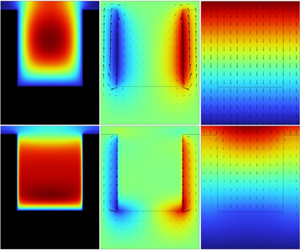
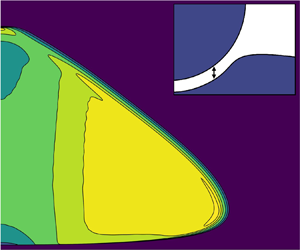
We derive a mathematical model for steady, unidirectional, thermoelectric magnetohydrodynamic (TEMHD) flow of liquid lithium along a solid metal trench, subject to an imposed heat flux. We use a finite-element method implemented in COMSOL Multiphysics to solve the problem numerically, demonstrating how the fluid velocity, induced magnetic field and temperature change depending on the key physical and geometrical parameters. The observed flow structures are elucidated by using the method of matched asymptotic expansions to obtain approximate solutions in the limit where the Hartmann number is large and the trench walls are thin.
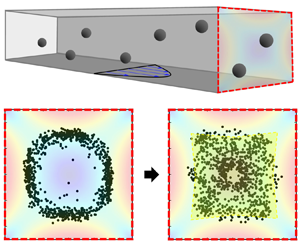
Particle-laden flow through conduits is ubiquitous in both natural and industrial systems. In such flows, particles often migrate across the main fluid stream, resulting in non-uniform spatial distribution owing to particle–fluid and particle–particle interactions. The most relevant lateral particle migration mechanism by particle–fluid interaction is the Segré–Silberberg effect, which is induced by the inertial forces exerted on a particle, as the flow rate increases. However, methods to suppress it have not been suggested yet. Here, we demonstrate that adding a small amount of polymer to the particle-suspending solvent effectively suppresses the Segré–Silberberg effect in a square channel. To accurately determine the position of the particles within the channel cross-sections, we devised a dual-view imaging system applicable to microfluidic systems. Our analyses show that the Segré–Silberberg effect is effectively suppressed in a square microchannel due to the balance between the inertial and elastic forces at an optimal polymer concentration while maintaining nearly constant shear viscosity.
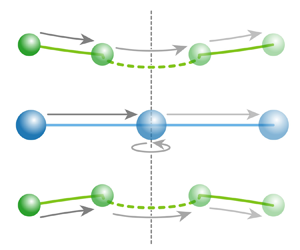
The controllability of passive microparticles that are advected with the fluid flow generated by an actively controlled one is studied. The particles are assumed to be suspended in a viscous fluid and well separated so that the far-field Stokes flow solutions may be used to describe their interactions. Explicit elementary moves parametrized by an amplitude $\varepsilon >0$ are devised for the active particle. Applying concepts from geometric control theory, the leading-order resulting displacements of the passive particles in the limit $\varepsilon \to 0$ are used to propose strategies for moving one active particle and one or two passive particles, proving controllability in such systems. The leading-order (in $\varepsilon$) theoretical predictions of the particle displacements are compared with those obtained numerically and it is found that the discrepancy is small even when $\varepsilon \approx 1$. These results demonstrate the potential for a single actuated particle to perform complex micromanipulations of passive particles in a suspension.
This paper presents a study of the effects of the durability and level of energy storage technology on energy management strategies and the performance of hybrid electric turboprops. The results highlight the key role of battery energy density on the durability of the battery pack and the viability of the concept of hybrid electric aircraft. Additionally, the trade-off between zero-day environmental compatibility and battery lifetime is identified, caused by the size of the pack. The effective energy density would decrease with the aging of the cells, leaving a significant inert mass and increasing fuel consumption. Optimal energy management strategies are suggested in light of this new information. Higher specific energy of the pack would mitigate this aspect, along with a reduction in fuel consumption and ${\rm{N}}{{\rm{O}}_{\rm{x}}}$ emissions. Indeed, the improvement of environmental compatibility was found to be nonlinear with a positive rate, suggesting high returns in investing in great improvements in energy density over a gradual increase. This result relates to the results of the statistical technological forecast presented in this study, which, without an increase in funding, predicts the availability of the specific energy required to match the fuel-only baseline in the 2040–2050 decade.
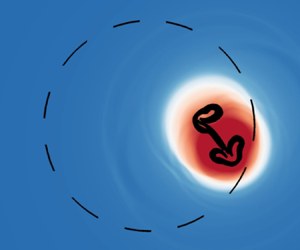
Despite the extensive research on bubble collapse near rigid walls, the bubble collapse dynamics in the presence of shear flow near a rigid wall is poorly understood. We conduct direct simulations of the Navier–Stokes equations to explore the bubble dynamics and pressures during bubble collapse near a rigid, flat wall under linear shear flow conditions. We examine the dependence of the bubble collapse morphology and wall pressures on the initial bubble location and shear rate. We find that shear distorts the bubble, generating two re-entrant jets – one developing from the side opposite to the mean flow and the other from the far end toward the wall. Upon impact of the jet on the opposite side of the bubble, water-hammer shocks are produced, which propagate outward and interact with the convoluted bubble shape. The shock stretches the bubble towards the wall, resulting in a closer impact location for the jet originating from the far end compared with the case with no shear flow. The water-hammer pressure location can be approximated as the theoretical distance travelled by a particle initialised at the bubble centre with the corresponding constant shear flow velocity. The maximum wall pressures can thus be predicted by considering the distance between the far jet impingement location and the wall along the wall-normal direction. As the shear rate is increased, the maximum wall pressure increases, although only marginally. We determine the critical initial stand-off distance from the wall at which the bubble morphology is shear dominated, i.e. characterised by converging re-entrant jets.
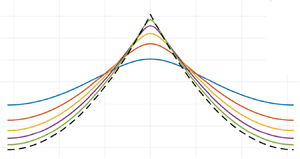
We introduce a new model equation for Stokes gravity waves based on conformal transformations of Euler's equations. The local version of the model equation is relevant for the dynamics of shallow water waves. It allows us to characterize the travelling periodic waves both in the case of smooth and peaked waves and to solve the existence problem exactly, albeit not in elementary functions. Spectral stability of smooth waves with respect to co-periodic perturbations is proven analytically based on the exact count of eigenvalues in a constrained spectral problem.
In this paper, a novel dual-mode spherical resonator is proposed. By rotating the coupling irises, perturbations are generated to split the degenerate modes. The proposed filter is cascaded by a dual-mode resonator and two single-mode resonators, which are placed in a rotary way. Four poles appear in three resonators by only changing the rotation angle (φ) without any additional design. It forms the BSCT, generating a transmission zero (TZ) at the upper stopband. Furthermore, by adjusting φ further, the CT coupling topology can be obtained, resulting in a TZ at the lower stopband. Finally, slots are etched on the surface of the resonators for spurious response suppression. With the above methods, the out-of-band selectivity and suppression are greatly improved. For the fast validation, the filter is 3-D printed and measured. As a result, the measured results match well with the simulated ones.
In this paper, on–off switching digitization of a W-band variable gain power amplifier (VGPA) with above 60 dB dynamic range is introduced for large-scale phased array. Digitization techniques of on–off switching modified stacking transistors with partition are proposed to optimize configuration of control sub-cells. By the proposed techniques, gain control of a radio frequency variable gain amplifier (VGA) could be highly customized for both coarse and fine switching requirements instead of using additional digital-to-analog converters to tune the overall amplifier bias. The designed VGA in 130 nm SiGe has achieved switchable gain range from −46.4 to 20.6 dB and power range from −25.0 to 15.7 dBm at W band. The chip size of the fabricated VGPA is about 0.31 mm × 0.1 mm.
Accurate channel characterization is extremely helpful in channel estimation, channel coding, and many other parts of communication system design and can effectively reduce overhead. Ray tracing (RT) shows accurate channel reconstruction for specific maps, but the multipath propagation in indoor scenes is far more complex than in outdoor scenes leading to a challenge for RT. This work presents and validates an RT tool for a massive multiple-input multiple-output (MIMO) system in the millimeter-wave frequency bands with the associated channel beamforming algorithm and provides ideas for channel estimation algorithm in subsequent MIMO systems. The impact of the order of interactions, e.g. reflections and diffractions on the channel impulse response reconstruction are analyzed in the RT simulation. The comparison between RT simulated and measured results shows a reasonable level of agreement. The presented RT tool that can provide complete and accurate channel information is of high value for the design of reliable communication systems.
The enhancement of jet engine components may result in the expansion of the established design space. In particular, the trend towards short and therefore highly aggressive inter compressor ducts (ICD) extends the traditional design space. The potential for fuel savings resulting from a reduction in engine weight is in contrast to the emergence of a more complex flow field. Many studies consider the secondary flow system of highly aggressive ICDs at the design point, but there is a lack of off-design considerations. To fill this gap, the present study investigates in detail the off-design performance of the new German Aerospace Center (DLR) test case. Firstly, computational fluid dynamics (CFD) simulations of different typical operating points allow detailed considerations of the flow field under off-design conditions. Secondly, a variation of the inlet conditions describes the sensitivity of highly aggressive ICDs to different low-pressure compressor operating points. Finally, the comparison of the CFD stagnation pressure loss with the loss predicted by a preliminary off-design method validates the use of traditional off-design prediction during the preliminary design of highly aggressive ICDs.
Thrust changes near walls and the ground plane are influenced by the rotor’s position in indoor flight environments. This study evaluates variations in rotor thrust near a corner, which includes one wall and the ground plane, as well as a vertex, which involves two walls and the ground plane; these phenomena are referred to as the corner and vertex effects, respectively. Additionally, the rotor wake in the vertex effect was visualised using the laser sheet method, and wake velocity was measured with a hot-wire probe. The thrust change in the corner effect on the ground side was minimal, primarily depending on the ground effect. In the vertex effect, thrust decreased to 93% of the thrust outside the vertex effect when the rotor height above ground was 2.5 times the rotor radius, and the rotor was distanced from the two walls by 1.5 times the rotor radius. Flow visualisation and hot-wire velocimetry results suggest that the thrust decrease was caused by the flow recirculation structure between the fountain flow developed along the vertical corner and rotor inflow. The thrust decreases under conditions where the circulation structure appears, and fountain flow velocity accelerates the recirculation. These findings aid in planning the flight path of small multirotors in indoor flight conditions by providing guidance on distances that do not alter rotor thrust near corners and vertices.
The paper uses the material and conceptual figure of dust and matter out of place to amplify more-than-human perspectives of time, to trace the changing orientations and ethos of a site. Dust contains a complex mixture of inorganic and organic material, made up of an exuberance of microbial life such as Penicillium, Aspergillus and Cladosporium and around 20 other fungal sources. We are interested in dust as a material and metaphorical device to situate and critique temporality and the way we narrate and investigate the past and future, from a non-human, microbial point of view. Dust implies residual matter, a contradiction to order often associated with dirt. It indicates something that needs to be removed, or rearranged, something that is “out of place,” an element that does not fit. Dust also indicates time and space and signals movement and life: dust hosts a medley of non-human particles and microbial communities that engage in their own worldmaking practices. The paper brings together methods of “un-cleaning” with archival research and spatial methods of 3D scanning, modelling and mapping, as an opportunity to decentre human hubris and explore the ways in which non-humans have and continue to inhabit “our” spaces.
Impact dynamics have long fascinated due to their ubiquity in everyday phenomena, from rain droplets splashing on windscreens to stone-skimming on the surface of the ocean. Impacts are characterized by rapid changes over disparate length scales, which make them expensive or sensitive to capture experimentally and computationally. Here, reduced mathematical models come to the fore, offering a way to get significant physical insight at reduced cost. In this volume, Phillips & Milewski (J. Fluid Mech., 2024) develop a mathematical model allowing for air–water interactions in the low-impact speed regime, in which an impactor bounces or rebounds rather than splashes. Their model offers a reliable way to capture air effects in bouncing, with a range of potential applications including hydrodynamic-quantum analogues and biomimetic water walkers.
Unmanned aerial vehicle (UAV) formations for bearing-only passive detection are increasingly important in modern military confrontations, and the array of the formation is one of the decisive factors affecting the detection accuracy of the system. How to plan the optimal geometric array in bearing-only detection is a complex nondeterministic polynomial problem, and this paper proposed the distributed stochastic subgradient projection algorithm (DSSPA) with layered constraints to solve this challenge. Firstly, based on the constraints of safe flight altitude and fixed baseline, the UAV formation is layered, and the system model for bearing-only cooperative localisation is constructed and analysed. Then, the calculation formula for geometric dilution of precision (GDOP) in the observation plane is provided, this nonlinear objective function is appropriately simplified to obtain its quadratic form, ensuring that it can be adapted and used efficiently in the system model. Finally, the proposed distributed stochastic subgradient projection algorithm (DSSPA) combines the idea of stochastic gradient descent with the projection method. By performing a projection operation on each feasible solution, it ensures that the updated parameters can satisfy the constraints while efficiently solving the convex optimisation problem of array planning. In addition to theoretical proof, this paper also conducts three simulation experiments of different scales, validating the effectiveness and superiority of the proposed method for bearing-only detection array planning in UAV formations. This research provides essential guidance and technical reference for the deployment of UAV formations and path planning of detection platforms.
In this article, we delve into the optimal scheduling challenge for many-to-many on-orbit services, taking into account variations in target accessibility. The scenario assumes that each servicing satellite is equipped with singular or multiple service capabilities, tasked with providing on-orbit services to multiple targets, each characterised by distinct service requirements. The mission’s primary objective is to determine the optimal service sequence, orbital transfer duration and on-orbit service time for each servicing satellite, with the ultimate goal of minimising the overall cost. We frame the optimal scheduling dilemma as a time-related colored travelling salesman problem (TRCTSP) and propose an enhanced firefly algorithm (EFA) to address it. Finally, experimental results across various scenarios validate the effectiveness and superiority of the proposed algorithm. The principal contribution of this work lies in the modeling and resolution of the many-to-many on-orbit service challenge, considering accessibility variations — a domain that has, until now, remained unexplored.
This article presents an ultrawide bandpass filter structure developed along a notch band using a small rectangular impedance resonator. The proposed filter structure consists of a coupled rectangular resonator (CRR), open stub, and composited split ring resonator (CSRR) at the bottom of the structure. In-band and out-of-band properties are improved by the CRR and open stub. The notch band is obtained by placing CSRR below the rectangular resonator. A filter with a compact size of 0.15 × 0.10 λg is obtained at a lowered cutoff frequency of 3.0 GHz, where λg is the corresponding guided wavelength. The proposed structure has been constructed on 5880 Rogers substrate with a thickness of 0.787 mm and a dielectric constant of 2.2. Additionally, equivalent lumped parameters were obtained, and a lumped equivalent circuit was created to explain how the suggested filter operated. The Electromagnetic (EM)-simulated results are in good agreement with the circuit-simulated and measured result. The various machine learning approaches such as artificial neural network, K-nearest neighbour, decision tree, random forest (RF), and extreme gradient boosting algorithms are applied to optimize the design, in which RF algorithms achieve more than 90% accuracy for predicting the S parameters of the ultrawideband filter.
In this work, we develop a method for robust single-cycle measurement velocity vector estimation for automotive radar. Building upon our previous work, we introduce a methodology that leverages spatial diversity for accurate estimation of the velocity vector of targets in the medium to close ranges. We extend our initial conceptual framework, addressing limitations from our first approach and proposing necessary enhancements for real-world applicability. Our improved process excels in target separation, identification, and velocity vector estimation, proving effective across various scenarios and minimizing errors. The system, tested on pedestrians and metal targets, presents a promising avenue for exploring its performance with varying target sizes. Simultaneously, our in-depth study on Doppler-multiplex modulation reveals new relevant constraints, prompting a modulation change for improved response separation. Despite the necessity of increasing module numbers for enhanced performance, our structured approach to target itemization and classification positions our methodology as a valuable framework for future systems, offering a comprehensive solution to diverse challenges in target estimation and classification within the automotive landscape.
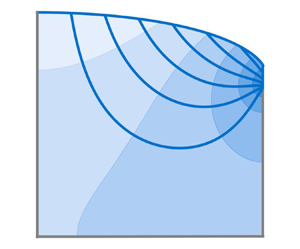
During a rainfall event, water infiltrates into the ground where it accumulates in porous rocks. This accumulation pushes the underlying groundwater towards neighbouring streams, where it runs to the sea. After the rain has stopped, the aquifer gradually releases its excess water, as the water table relaxes, until the next rain. In the absence of recharge, the water table would eventually reach its horizontal equilibrium position. The volume of groundwater stored above this level, which we call the active volume, sustains the river between two rainfall events. In this article, we use an experimental aquifer recharged by artificial rain to investigate how this active volume depends on the rainfall rate. Restricting our analysis to the steady-state regime, wherein the discharge into the stream balances rainfall, we explore a broad range of rainfall rates, for which the water table deforms significantly. We find that the active volume of water stored in the aquifer decreases with its depth. Using conformal mapping, we derive the flow equations and develop a numerical procedure that accounts for the active volume of groundwater in our experiments. In the case of an infinitely deep aquifer, the problem admits a closed-form solution, which provides a satisfying estimate of the active volume when the aquifer's depth is at least half its width. In the general case, a rougher estimate results from the energy balance of the dissipative groundwater flow.