Refine search
Actions for selected content:
212748 results in Engineering
1 - Introduction
-
- Book:
- Radio Frequency Identification Engineering
- Published online:
- 02 January 2025
- Print publication:
- 09 January 2025, pp 1-13
-
- Chapter
- Export citation
Thermal stress-induced depolarization compensation in wide-bandwidth, high-energy, high-repetition-rate multi-slab laser amplifiers
-
- Journal:
- High Power Laser Science and Engineering / Volume 13 / 2025
- Published online by Cambridge University Press:
- 09 January 2025, e10
-
- Article
-
- You have access
- Open access
- HTML
- Export citation

Dynamics of solitary waves on a ferrofluid jet: the Hamiltonian framework
-
- Journal:
- Journal of Fluid Mechanics / Volume 1002 / 10 January 2025
- Published online by Cambridge University Press:
- 09 January 2025, A23
-
- Article
-
- You have access
- Open access
- HTML
- Export citation
Copyright page
-
- Book:
- Radio Frequency Identification Engineering
- Published online:
- 02 January 2025
- Print publication:
- 09 January 2025, pp iv-iv
-
- Chapter
- Export citation
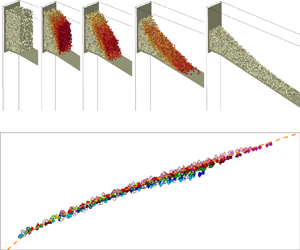
Run-out scaling of granular column collapses on inclined planes
-
- Journal:
- Journal of Fluid Mechanics / Volume 1002 / 10 January 2025
- Published online by Cambridge University Press:
- 09 January 2025, A50
-
- Article
- Export citation
-
Granular column collapse is a simple but important problem to the granular material community, due to its links to dynamics of natural hazards, such as landslides and pyroclastic flows, and many industrial situations, as well as its potential of analysing transient and non-local rheology of granular flows. This article proposes a new dimensionless number to describe the run-out behaviour of granular columns on inclined planes based on both previous experimental data and dimensional analysis. With the assistance of the sphero-polyhedral discrete element method (DEM), we simulate inclined granular column collapses with different initial aspect ratios, particle contact properties and initial solid fractions on inclined planes with different inclination angles ( $2.5^{\circ }\unicode{x2013}20.0^{\circ }$) to verify the proposed dimensional analysis. Detailed analyses are further provided for better understanding of the influence of different initial conditions and boundary conditions, and to help unify the description of the run-out scaling of systems with different inclination angles. This work determines the similarity and unity between granular column collapses on inclined planes and those on horizontal planes, and helps investigate the transient rheological behaviour of granular flows, which has direct relevance to various natural and engineering systems.

Reducing the CO2 footprint at an LNG asset with replicate trains using operational data-driven analysis. A case study on end flash vessels
-
- Journal:
- Data-Centric Engineering / Volume 6 / 2025
- Published online by Cambridge University Press:
- 08 January 2025, e1
-
- Article
-
- You have access
- Open access
- HTML
- Export citation
An environment-adaptive SAC-based HVAC control of single-zone residential and office buildings
- Part of
-
- Journal:
- Data-Centric Engineering / Volume 6 / 2025
- Published online by Cambridge University Press:
- 08 January 2025, e3
-
- Article
-
- You have access
- Open access
- HTML
- Export citation
Compact mmWave measurement system for array antennas in a production environment
-
- Journal:
- International Journal of Microwave and Wireless Technologies / Volume 17 / Issue 2 / March 2025
- Published online by Cambridge University Press:
- 08 January 2025, pp. 269-275
-
- Article
-
- You have access
- Open access
- HTML
- Export citation
Discretization-independent surrogate modeling of physical fields around variable geometries using coordinate-based networks
-
- Journal:
- Data-Centric Engineering / Volume 6 / 2025
- Published online by Cambridge University Press:
- 08 January 2025, e5
-
- Article
-
- You have access
- Open access
- HTML
- Export citation
All-fiber delivery of 100 W single-frequency laser through 100 m anti-resonant hollow-core fiber without stimulated Brillouin scattering
-
- Journal:
- High Power Laser Science and Engineering / Volume 12 / 2024
- Published online by Cambridge University Press:
- 08 January 2025, e99
-
- Article
-
- You have access
- Open access
- HTML
- Export citation
Laser interactions with gas jets: electromagnetic pulse emission and nozzle damage
-
- Journal:
- High Power Laser Science and Engineering / Volume 12 / 2024
- Published online by Cambridge University Press:
- 08 January 2025, e98
-
- Article
-
- You have access
- Open access
- HTML
- Export citation
Metamaterial based stepped microstrip line fed quad-band dual-sense circularly polarized slot antenna for wireless applications
-
- Journal:
- International Journal of Microwave and Wireless Technologies / Volume 17 / Issue 1 / February 2025
- Published online by Cambridge University Press:
- 08 January 2025, pp. 113-131
-
- Article
-
- You have access
- Open access
- HTML
- Export citation
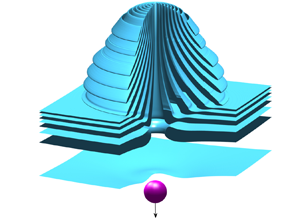
The flow field due to a sphere moving in a viscous, density-stratified fluid
-
- Journal:
- Journal of Fluid Mechanics / Volume 1002 / 10 January 2025
- Published online by Cambridge University Press:
- 08 January 2025, A44
-
- Article
- Export citation
-
In this paper, we study the disturbance velocity and density fields induced by a sphere translating vertically in a viscous density-stratified ambient. Specifically, we consider the limit of a vanishingly small Reynolds number $(Re = \rho U a/\mu \ll 1)$, a small but finite viscous Richardson number $(Ri_v = \gamma a^3g/\mu U\ll 1)$ and large Péclet number $(Pe = Ua/D\gg 1)$. Here, $a$ is the sphere's radius, $U$ its translational velocity, $\rho$ an appropriate reference density within the framework of the Boussinesq approximation, $\mu$ the ambient viscosity, $\gamma$ the absolute value of the background density gradient, g is acceleration due to gravity and $D$ the diffusivity of the stratifying agent. For the scenario where buoyancy forces first become comparable to viscous forces at large distances, corresponding to the Stokes-stratification regime defined by $Re \ll Ri_v^{1/3} \ll 1$ for $Pe \gg 1$, important flow features have been identified by Varanasi & Subramanian (J. Fluid Mech., vol. 949, 2022, A29) – these include a vertically oriented reverse jet, and a horizontal axisymmetric wake, on scales larger than the primary (stratification) screening length of ${O}(aRi_v^{-1/3})$. Here, we study the reverse-jet region in more detail, and show that it is only the central portion of a columnar structure with multiple annular cells concentric about the rear stagnation streamline. In the absence of diffusion, corresponding to $Pe = \infty$ $( \beta _\infty = Ri_v^{1/3}Pe^{-1} = 0)$, this columnar structure extends to downstream infinity with the number of annular cells diverging in this limit. We provide expressions for the boundary of the structure, and the number of cells within, as a function of the downstream distance. For small but finite $\beta _\infty$, two length scales emerge in addition to the primary screening length – a secondary screening length of ${O}(aRi_v^{-1/2}Pe^{1/2})$ where diffusion starts to smear out density variations across cells, leading to exponentially decaying density and velocity fields; and a tertiary screening length, $l_t \sim {O}(aRi_v^{-1/2}Pe^{1/2}[\zeta + \frac {13}{4}\ln {\zeta } + ({13^2}/{4^2})({\ln \zeta }/{\zeta })])$ with $\zeta = \frac {1}{2}\ln ({\sqrt {{\rm \pi} }Ri_v^{-1}Pe^3}/{2160})$, beyond which the columnar structure ceases to exist. The latter causes a transition from a vertical to a predominantly horizontal flow, with the downstream disturbance fields reverting from an exponential to an eventual algebraic decay, analogous to that prevalent at large distances upstream.


Enhancing dynamical system modeling through interpretable machine-learning augmentations: a case study in cathodic electrophoretic deposition
-
- Journal:
- Data-Centric Engineering / Volume 6 / 2025
- Published online by Cambridge University Press:
- 08 January 2025, e4
-
- Article
-
- You have access
- Open access
- HTML
- Export citation
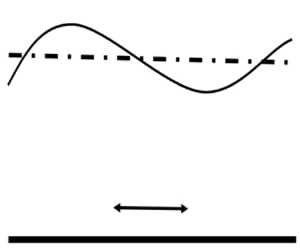
Linear stability analysis of a thin liquid film on a horizontal wall under quasi-periodic oscillation
-
- Journal:
- Journal of Fluid Mechanics / Volume 1002 / 10 January 2025
- Published online by Cambridge University Press:
- 08 January 2025, A39
-
- Article
- Export citation
-
We carry out a linear stability analysis of the flow of a thin layer of Newtonian fluid with a deformable free surface bounded at the bottom by a horizontal wall subjected to quasi-periodic oscillation in its own plane. Or's model (J. Fluid Mech., vol. 335, 1997, pp. 213–232), using a periodic oscillation, is extended to the configuration where oscillation has two incommensurate frequencies, $\omega _1$ and $\omega _2$, with an irrational ratio $\omega ={\omega _2}/{\omega _1}$. Using the long-wave expansion, we derive the asymptotic function involved in the long-wave instability criterion while taking into account the frequency ratio. It turns out that the maximum of this asymptotic function, as well as the frequency parameter at which long-wave instabilities occur, depend strongly on the frequency ratio. For arbitrary wavenumbers, the equations governing the problem under consideration are solved in space using Chebyshev's spectral collocation method, while the temporal resolution is performed using Floquet theory, knowing that an irrational number can be approximated by a rational number. For a large frequency ratio and for a velocity amplitude ratio equal to unity, we obtain, as in Or's work (J. Fluid Mech., vol. 335, 1997, pp. 213–232) considering the same frequency parameter interval, an alternation between the U shape and oblique shape referring respectively to instabilities of long wavelength and finite wavelength appearing in the diagram representing Reynolds number as a function of frequency parameter. By decreasing the frequency ratio towards $1/\sqrt {37}$, the three initial U-shaped and three oblique instabilities merge into a single U-shaped and a single oblique instability. This merging phenomenon also occurs when the ratio of the amplitudes of the superimposed velocities, linked to the introduction of the second frequency, increases from small values to unity. For a fixed frequency parameter, the effect of frequency ratio and velocity amplitude ratio on the marginal stability curves in terms of Reynolds number versus wavenumber is also investigated, focusing on the appearance of long wavelength instability and finite wavelength instability.


Effect of process parameters on the corrosion characteristics of friction stir welded aluminum alloy AA2014-T6
-
- Journal:
- The Aeronautical Journal / Volume 129 / Issue 1334 / April 2025
- Published online by Cambridge University Press:
- 08 January 2025, pp. 960-974
-
- Article
- Export citation
Probing the production of quantum technologies to imagine its legal framework
-
- Journal:
- Research Directions: Quantum Technologies / Volume 3 / 2025
- Published online by Cambridge University Press:
- 08 January 2025, e1
-
- Article
-
- You have access
- Open access
- HTML
- Export citation
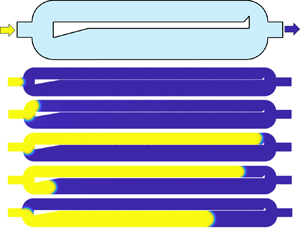
Controlled Haines jumps in a dual-channel multiphase system: inferring fluid properties from the dynamics of interface motion
-
- Journal:
- Journal of Fluid Mechanics / Volume 1002 / 10 January 2025
- Published online by Cambridge University Press:
- 08 January 2025, A40
-
- Article
-
- You have access
- Open access
- HTML
- Export citation
Mode-to-mode nonlinear energy transfer in turbulent channel flows
-
- Journal:
- Journal of Fluid Mechanics / Volume 1002 / 10 January 2025
- Published online by Cambridge University Press:
- 08 January 2025, A42
-
- Article
-
- You have access
- Open access
- HTML
- Export citation
-
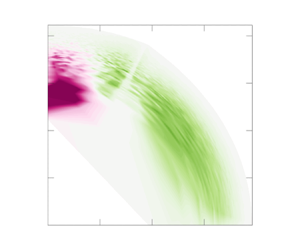
We investigate nonlinear energy transfer for channel flows at friction Reynolds numbers $Re_{\tau }=180$ and $590$. The key feature of the analysis is that we quantify the energy transferred from a source mode to a recipient mode, with each mode characterised by a streamwise wavenumber and a spanwise wavenumber. This is achieved through an explicit examination of the triadic interactions of the nonlinear energy transfer term in the spectral turbulent kinetic energy equation. First, we quantify the nonlinear energy transfer gain and loss for individual Fourier modes. The gain and loss cannot be obtained without expanding the nonlinear triadic interactions. Second, we quantify the nonlinear energy transfer budgets for three types of modes. Each type of mode is characterised by a specific region in streamwise–spanwise wavenumber space. We find that a transverse cascade from streamwise-elongated modes to spanwise-elongated modes exists for all three types of modes. Third, we quantify the forward and inverse cascades between resolved scales and subgrid scales in the spirit of large-eddy simulations. For the cutoff wavelength range that we consider, the forward and inverse cascades between the resolved scales and subgrid scales result in a net forward cascade from the resolved scales to the subgrid scales. The shape of the net forward cascade curve with respect to the cutoff wavelength resembles the net forward cascade predicted by the Smagorinsky eddy viscosity.


Data-driven multifidelity surrogate models for rocket engines injector design
-
- Journal:
- Data-Centric Engineering / Volume 6 / 2025
- Published online by Cambridge University Press:
- 08 January 2025, e2
-
- Article
-
- You have access
- Open access
- HTML
- Export citation
