Refine search
Actions for selected content:
212742 results in Engineering

Clustering of buoyant tracer in quasi-geostrophic coherent structures
-
- Journal:
- Journal of Fluid Mechanics / Volume 1003 / 25 January 2025
- Published online by Cambridge University Press:
- 14 January 2025, A16
-
- Article
-
- You have access
- Open access
- HTML
- Export citation
Time-dependent nonlinear gravity–capillary surface waves with viscous dissipation and wind forcing
-
- Journal:
- Journal of Fluid Mechanics / Volume 1003 / 25 January 2025
- Published online by Cambridge University Press:
- 14 January 2025, A13
-
- Article
-
- You have access
- Open access
- HTML
- Export citation
Thermal-lens-free active-mirror ytterbium-doped yttrium aluminum garnet amplifier
-
- Journal:
- High Power Laser Science and Engineering / Volume 13 / 2025
- Published online by Cambridge University Press:
- 14 January 2025, e20
-
- Article
-
- You have access
- Open access
- HTML
- Export citation
Focussing of concentric free-surface waves
-
- Journal:
- Journal of Fluid Mechanics / Volume 1003 / 25 January 2025
- Published online by Cambridge University Press:
- 14 January 2025, A14
-
- Article
-
- You have access
- Open access
- HTML
- Export citation
A scaling law for the lift of a bio-inspired wing hovering in low-density compressible flows
-
- Journal:
- Journal of Fluid Mechanics / Volume 1003 / 25 January 2025
- Published online by Cambridge University Press:
- 13 January 2025, A10
-
- Article
- Export citation
-
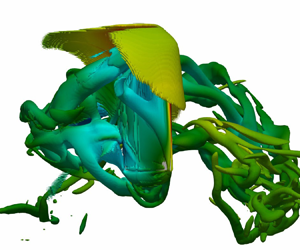
Aircraft with bio-inspired flapping wings that are operated in low-density atmospheric environments encounter unique challenges associated with the low density. The low density results in the requirement of high operating velocities of aircraft to generate sufficient lift resulting in significant compressibility effects. Here, we perform numerical simulations to investigate the compressibility effects on the lift generation of a bio-inspired wing during hovering flight using an immersed boundary method. The aim of this study is to develop a scaling law to understand how the lift is influenced by the Reynolds and Mach numbers, and the associated flow physics. Our simulations have identified a critical Mach number of approximately $0.6$ defined by the average wing-tip velocity. When the Mach number is lower than 0.6, compressibility does not have significant effects on the lift or flow fields, while when the Mach number is greater than $0.6$, the lift coefficient decreases linearly with increasing Mach number, due to the drastic change in the pressure on the wing surface caused by unsteady shock waves. Moreover, the decay rate is dependent on the Reynolds number and the angle of attack. Based on these observations, we propose a scaling law for the lift of a hovering flapping wing by considering compressible and viscous effects, with the scaled lift showing excellent collapse.


Dilatancy and its coupling to the kinematics in sheared granular media
-
- Journal:
- Journal of Fluid Mechanics / Volume 1003 / 25 January 2025
- Published online by Cambridge University Press:
- 13 January 2025, A11
-
- Article
-
- You have access
- Open access
- HTML
- Export citation
Energy thickness in turbulent boundary layer flows
-
- Journal:
- Journal of Fluid Mechanics / Volume 1003 / 25 January 2025
- Published online by Cambridge University Press:
- 13 January 2025, A7
-
- Article
- Export citation
-
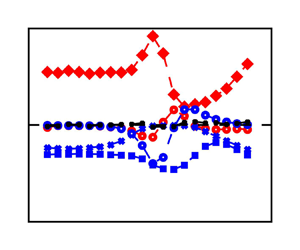
In this study, we investigate the properties of energy thickness $\delta _3$ in turbulent boundary layer (TBL) flows, a parameter derived solely from the mean streamwise velocity ( $U$) profile. Through an analysis of the energy integral equation for zero pressure gradient TBLs, we establish a close relationship between turbulent kinetic energy (TKE) production and $\delta _3$, offering a practical method to estimate TKE production, which is particularly useful in physical experiments where direct measurements are challenging. The significance of $\delta _3$ becomes even more pronounced in TBLs under pressure gradient. Through extensive analysis of numerical and experimental data, we show that the ratio between $\delta _3$ and the momentum thickness $\delta _2$ is a promising criterion for predicting flow separation. Moreover, we derive a new energy integral equation for TBLs under arbitrary pressure gradients, and provide approximations for TKE productions terms by $R_{uv}\,\partial U/\partial y$ and $R_{uu}\,\partial U/\partial x$, and dissipation term by the mean shear. Here, $x, y$ represent the streamwise and wall-normal directions, respectively, and $R_{uu}$ and $R_{uv}$ are the Reynolds normal and shear stresses. The accuracy and robustness of the new energy integral equation and the approximation equations are validated using direct numerical simulations data. Our results show that the TKE production by $R_{uv}\,\partial U/\partial y$ and the overall productions consistently remain positive, reflecting a continuous conversion of mean kinetic energy into TKE across all TBLs. However, under strong favourable pressure gradients, TKE production by $R_{uu}\,\partial U/\partial x$ becomes negative, indicating a reverse energy transfer from TKE to mean kinetic energy.


Predicting burst events in a forced two-dimensional flow: a wavelet-based analysis
-
- Journal:
- Journal of Fluid Mechanics / Volume 1003 / 25 January 2025
- Published online by Cambridge University Press:
- 13 January 2025, A5
-
- Article
-
- You have access
- Open access
- HTML
- Export citation
Three-dimensional stability of natural convection flows in inclined square enclosures
-
- Journal:
- Journal of Fluid Mechanics / Volume 1003 / 25 January 2025
- Published online by Cambridge University Press:
- 13 January 2025, A8
-
- Article
-
- You have access
- Open access
- HTML
- Export citation
-
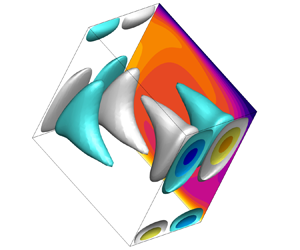
The three-dimensional stability of two-dimensional natural convection flows in a heated, square enclosure inclined to the horizontal is investigated numerically. First, the computational procedure is validated by comparison of base flow solutions to results reported in literature across a range of inclinations. A bi-global linear stability analysis is then conducted to investigate the stability of these two-dimensional base flows to infinitesimal three-dimensional perturbations, and the effect that buoyancy forces (defined by a buoyancy number $R_N$) and enclosure inclination $\theta$ have on these stability characteristics. The flow is first observed to become three-dimensionally unstable at buoyancy number $R_N = 213.8$ when $\theta$ is $180^\circ$; this increases to $R_N = 2.54 \times 10^4$ at inclination $\theta =58^\circ$. It is found that the two-dimensional base flow is more unstable to three-dimensional perturbations with the critical $R_N$ corresponding to three-dimensional instability being significantly lower than its two-dimensional counterpart across all considered inclinations except $83^\circ \leq \theta \leq 88^\circ$, where the most unstable mode is a two-dimensional oscillatory mode that develops in the boundary layers along the conducting walls. Eight different leading three-dimensional instability modes are identified, with inclinations $58^\circ \leq \theta < 88^\circ$ transitioning through an oscillatory mode, and inclinations $88^\circ \leq \theta \leq 180^\circ$ transitioning through a stationary mode. The characteristics of the primary instability modes corresponding to inclinations $88^\circ \leq \theta \leq 179^\circ$ indicate the presence of a Taylor–Görtler instability.


Fracturing behaviour of a shear-thinning fluid in a lubricated Hele-Shaw cell
-
- Journal:
- Journal of Fluid Mechanics / Volume 1003 / 25 January 2025
- Published online by Cambridge University Press:
- 13 January 2025, A6
-
- Article
-
- You have access
- Open access
- HTML
- Export citation
Manipulation of Richtmyer–Meshkov instability on a heavy–light interface via successive shocks
-
- Journal:
- Journal of Fluid Mechanics / Volume 1003 / 25 January 2025
- Published online by Cambridge University Press:
- 13 January 2025, A9
-
- Article
- Export citation
Damping of solitons by coastal vegetation
-
- Journal:
- Journal of Fluid Mechanics / Volume 1002 / 10 January 2025
- Published online by Cambridge University Press:
- 10 January 2025, A45
-
- Article
- Export citation
Drag polar modelling for jet aircraft using 6-DOF model data via cuckoo search algorithm
-
- Journal:
- The Aeronautical Journal / Volume 129 / Issue 1333 / March 2025
- Published online by Cambridge University Press:
- 10 January 2025, pp. 627-650
-
- Article
- Export citation
On the suspension and deposition within turbidity currents
-
- Journal:
- Journal of Fluid Mechanics / Volume 1003 / 25 January 2025
- Published online by Cambridge University Press:
- 10 January 2025, A1
-
- Article
-
- You have access
- Open access
- HTML
- Export citation
Free-surface jetting driven by a cavitating vortex ring
-
- Journal:
- Journal of Fluid Mechanics / Volume 1003 / 25 January 2025
- Published online by Cambridge University Press:
- 10 January 2025, A4
-
- Article
-
- You have access
- Open access
- HTML
- Export citation
-
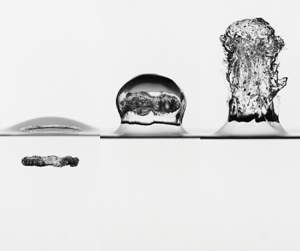
The collapse of an initially spherical cavitation bubble near a free surface leads to the formation of two jets: a downward jet into the liquid, and an upward jet penetrating the free surface. In this study, we examine the surprising interaction of a bubble trapped in a stable cavitating vortex ring approaching a free surface. As a result, a single fast and tall liquid jet forms. We find that this jet is observed only above critical Froude numbers ( $Fr$) and Weber numbers ( $We$) when ${Fr}^2 (1.6-2.73/{We}) > 1$, illustrating the importance of inertia, gravity and surface tension in accelerating this novel jet and thereby reaching heights several hundred times the radius of the vortex ring. Our experimental results are supported by numerical simulations, revealing that the underlying mechanism driving the vortex ring acceleration is the disruption of the equilibrium of high-pressure regions at the front and rear of the vortex ring caused by the free surface. Quantitative analysis based on the energy relationships elucidates that the velocity ratio between the maximum velocity of the free-surface jet and the translational velocity of the vortex ring is relatively stable yet is attenuated by surface tension when the jet is mild.


Ultrafast characterization of plasma critical surface evolution in inertial confinement fusion experiments with chirped laser pulses
-
- Journal:
- High Power Laser Science and Engineering / Volume 13 / 2025
- Published online by Cambridge University Press:
- 10 January 2025, e13
-
- Article
-
- You have access
- Open access
- HTML
- Export citation
Geometrical analysis of naturally grown timber for the design of load-bearing structures – ERRATUM
-
- Journal:
- Research Directions: Biotechnology Design / Volume 3 / 2025
- Published online by Cambridge University Press:
- 10 January 2025, e3
-
- Article
-
- You have access
- Open access
- HTML
- Export citation
Large-eddy simulation of high-Reynolds-number turbulent channel flow controlled using streamwise travelling wave-like wall deformation for drag reduction
-
- Journal:
- Journal of Fluid Mechanics / Volume 1003 / 25 January 2025
- Published online by Cambridge University Press:
- 10 January 2025, A2
-
- Article
- Export citation
-
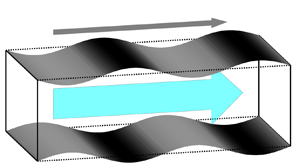
We investigate the drag reduction effect of the streamwise travelling wave-like wall deformation in a high-Reynolds-number turbulent channel flow by large-eddy simulation (LES). First, we assess the validity of subgrid-scale models in uncontrolled and controlled flows. For friction Reynolds numbers $Re_\tau = 360$ and $720$, the Smagorinsky and wall-adapting local eddy-viscosity (WALE) models with a damping function can reproduce well the mean velocity profile obtained by direct numerical simulation (DNS) in both the uncontrolled and controlled flows, leading to a small difference in drag reduction rate between LES and DNS. The LES with finer grid resolution can reproduce well the key structures observed in the DNS of the controlled flow. These results show that the high-fidelity LES is valid for appropriately predicting the drag reduction effect. In addition, a small computational domain is sufficient for reproducing the turbulence statistics, key structures and drag reduction rate obtained by DNS. Subsequently, to investigate the trend of drag reduction rate at higher Reynolds numbers, we utilize the WALE model with the damping function to investigate the control effect at higher Reynolds numbers up to $Re_\tau = 3240$. According to the analyses of turbulence statistics and instantaneous flow fields, the drag reduction at higher Reynolds numbers occurs basically through the same mechanism as that at lower Reynolds numbers. In addition, the drag reduction rate obtained by the present LES approaches that predicted using the semi-empirical formula (Nabae et al., Intl J. Heat Fluid Flow, vol. 82, 2020, 108550) as the friction Reynolds number increases, which supports the high predictability of the semi-empirical formula at significantly high Reynolds numbers.


Broadband dual-polarized antenna with parasitic elements for base-station applications
-
- Journal:
- International Journal of Microwave and Wireless Technologies / Volume 16 / Issue 8 / October 2024
- Published online by Cambridge University Press:
- 10 January 2025, pp. 1272-1282
-
- Article
-
- You have access
- Open access
- HTML
- Export citation
Off-board aerodynamic measurements of small-UAVs in glide flight using motion tracking
-
- Journal:
- The Aeronautical Journal / Volume 129 / Issue 1334 / April 2025
- Published online by Cambridge University Press:
- 10 January 2025, pp. 803-824
-
- Article
-
- You have access
- Open access
- HTML
- Export citation
-
Measuring the aerodynamics and stability characteristics of small unmanned aerial vehicles (sUAVs) operating at Reynolds numbers below $60,000$ is a challenge. Conventional measurement methods can be impractical and costly due to the vehicle’s size and the considerably low forces and moments involved. To overcome these limitations, the current study aims at utilising an existing motion tracking system to conduct off-board aerodynamic measurements of sUAVs. Six sUAVs, with varying wing aspect ratios, are investigated in un-powered, glide flight mode to establish the utility of the motion capture system as an aerodynamic characterisation system and understand the low Reynolds number effects on the flight dynamics. The trajectory tracking system was thoroughly validated through a series of static and dynamic tests to account for uncertainties and errors. Subsequently, flight trajectory data was collected and processed to extract the aircraft’s force and moment characteristics under quasi-steady conditions. The measured lift, drag and moment data compared well with existing literature and theoretical predictions. Longitudinal, lateral and dynamic stability derivatives were also accurately captured. Key findings from the current work included an inverse relationship between the wing aspect ratio and lift curve slope and substantially lower Oswald efficiency factors, both of which were attributed to low Reynolds number effects.

