Refine search
Actions for selected content:
212786 results in Engineering

Parameterized Ekman boundary layers on the tilted f-plane
-
- Journal:
- Journal of Fluid Mechanics / Volume 1000 / 10 December 2024
- Published online by Cambridge University Press:
- 28 November 2024, A61
-
- Article
-
- You have access
- Open access
- HTML
- Export citation
-
Rotating convection is considered on the tilted $f$-plane where gravity and rotation are not aligned. For sufficiently large rotation rates, $\Omega$, the Taylor–Proudman effect results in the gyroscopic alignment of anisotropic columnar structures with the rotation axis giving rise to rapidly varying radial length scales that vanishes as $\Omega ^{-1/3}$ for $\Omega \rightarrow \infty$. Compounding this phenomenon is the existence of viscous (Ekman) layers adjacent to the impenetrable bounding surfaces that scale as $\Omega ^{-1/2}$. In this investigation, these constraints are relaxed upon utilising a non-orthogonal coordinate representation of the fluid equations where the upright coordinate aligns with rotation axis. This exposes the problem to asymptotic perturbation methods that permit: (i) relaxation of the constraints of gyroscopic alignment; (ii) the filtering of Ekman layers through the uncovering of parameterised velocity pumping boundary conditions; and (iii) the development of reduced quasi-geostrophic systems valid in the limit $\Omega \rightarrow \infty$. Linear stability investigations reveal excellent quantitative agreement between results from parameterised or unapproximated mechanical boundary conditions. For no-slip boundaries, it is demonstrated that the associated Ekman pumping alters convective onset through an enhanced destabilisation of large spatial scales. The range of unstable modes at a fixed thermal forcing is thus significantly extended with a direct dependence on $\Omega$. This holds true even for geophysical and astrophysical regimes characterised by extreme values of the non-dimensional Ekman number $E$. The nonlinear regime is explored via the global heat and momentum transport of single-mode solutions to the quasi-geostrophic systems which indicate $O(1)$ changes which do not scale with the size of $E$.
$E$.


Suppressing capillary instability in falling liquid threads
-
- Journal:
- Journal of Fluid Mechanics / Volume 1000 / 10 December 2024
- Published online by Cambridge University Press:
- 28 November 2024, A77
-
- Article
-
- You have access
- Open access
- HTML
- Export citation
-
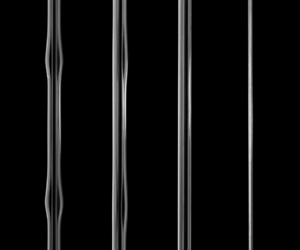
A cylindrical liquid thread readily destabilizes into a series of drops due to capillary instability, which is also responsible for undesirable bead-on-fibre structures observed when coating a thin fibre. In this experimental study, we show how a falling liquid thread can be stabilized by internally distorting the cross-sectional shape using two vertically hung fibres. Below a critical flow rate $Q_c$, the dual-fibre system deforms the falling thread into a smooth column with a non-circular cross-section, thereby suppressing instability. Above $Q_{{c}}$, the cylindrical thread is left undeformed by the fibres and destabilizes into beads connected by a stable, non-cylindrical film. An empirical stability threshold is identified showing that flow delays the onset of capillary instability when compared with a marginally stable quasi-static coating. When the flow is unstable $Q>Q_c$, the bead velocity $v$ obeys a simple scaling law that is well supported by our experiments over a large parameter range. This suppression technique can be extended to other slender geometries, such as a ribbon, which shows similar qualitative results but exhibits a different stability threshold due to spontaneous dewetting about its short edge.


Involving non-equilibrium training dataset in data-driven turbulence modeling for turbomachinery
-
- Journal:
- The Aeronautical Journal / Volume 129 / Issue 1335 / May 2025
- Published online by Cambridge University Press:
- 28 November 2024, pp. 1215-1236
-
- Article
- Export citation
-
In order to improve the performance of $k - \omega $ SST model in turbomachinery, previous studies have used the machine-learning (ML) technique to obtain turbulence models (for example, the ML-RANS EQ model). However, these models do not lead to satisfactory results in complex flows in turbomachinery. In this study, we use non-equilibrium training dataset to obtain a new turbulence model (i.e., the ML-RANS TR-NE-EQ model). Calculations in various cases of turbine cascade flows show that ML-RANS TR-NE-EQ model performs obviously better than ML-RANS EQ model as well as $k - \omega $ SST model.


References
-
- Book:
- Data Management
- Published online:
- 21 November 2024
- Print publication:
- 28 November 2024, pp 270-278
-
- Chapter
- Export citation
Exchange flows and plug cementing
-
- Journal:
- Journal of Fluid Mechanics / Volume 1000 / 10 December 2024
- Published online by Cambridge University Press:
- 28 November 2024, A67
-
- Article
-
- You have access
- Open access
- HTML
- Export citation
-
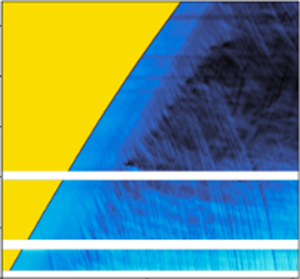
We present the results of an experimental study of buoyancy-driven exchange flows in a vertical pipe, where the lower fluid is Newtonian of low viscosity and the upper fluid has a yield stress. The fluids are initially separated by a gate valve, opened at time $\hat {t}=0$. The fluids are miscible, but away from the diffusive limit. For a sufficiently large ratio $Y$, of the yield stress to the buoyancy stress, no sustained fluid motions arise: the flow is stable. For smaller $Y$ numbers an exchange flow results. Commonly, the less dense fluid penetrates upwards in a central finger, displacing the upper fluid downwards around the walls of the pipe. Three regimes are classified: helical finger, disconnected finger and slug flow. The transition between regimes is governed by increasing relevance of inertial to viscous stresses, in balancing buoyancy. The disconnected finger and slug flow regimes are associated with yielded fluid at the interface and early growth of instabilities. Helical fingers are viscous dominated and evolve slowly until late in the experiments. The scenarios studied represent an idealised set-up for the industrial process of plug cementing. The regimes identified are helpful for industrial process design.


4 - Buffer Replacement Algorithms
-
- Book:
- Data Management
- Published online:
- 21 November 2024
- Print publication:
- 28 November 2024, pp 82-108
-
- Chapter
- Export citation
2 - Data Storage: Physical Allocation and Logical Format
-
- Book:
- Data Management
- Published online:
- 21 November 2024
- Print publication:
- 28 November 2024, pp 17-40
-
- Chapter
- Export citation
Preface
-
- Book:
- Data Management
- Published online:
- 21 November 2024
- Print publication:
- 28 November 2024, pp xi-xvi
-
- Chapter
- Export citation
Nonlinear electrophoresis of a highly charged particle by incorporating electrostatic correlations and ion steric interactions for a finite Debye length
-
- Journal:
- Journal of Fluid Mechanics / Volume 1000 / 10 December 2024
- Published online by Cambridge University Press:
- 28 November 2024, A71
-
- Article
-
- You have access
- Open access
- HTML
- Export citation
Enhancing prosthetic hand control: A synergistic multi-channel electroencephalogram
-
- Journal:
- Wearable Technologies / Volume 5 / 2024
- Published online by Cambridge University Press:
- 28 November 2024, e18
-
- Article
-
- You have access
- Open access
- HTML
- Export citation
-
Electromyogram (EMG) has been a fundamental approach for prosthetic hand control. However it is limited by the functionality of residual muscles and muscle fatigue. Currently, exploring temporal shifts in brain networks and accurately classifying noninvasive electroencephalogram (EEG) for prosthetic hand control remains challenging. In this manuscript, it is hypothesized that the coordinated and synchronized temporal patterns within the brain network, termed as brain synergy, contain valuable information to decode hand movements. 32-channel EEGs were acquired from 10 healthy participants during hand grasp and open. Synergistic spatial distribution pattern and power spectra of brain activity were investigated using independent component analysis of EEG. Out of 32 EEG channels, 15 channels spanning the frontal, central and parietal regions were strategically selected based on the synergy of spatial distribution pattern and power spectrum of independent components. Time-domain and synergistic features were extracted from the selected 15 EEG channels. These features were employed to train a Bayesian optimizer-based support vector machine (SVM). The optimized SVM classifier could achieve an average testing accuracy of 94.39 $ \pm $ .84% using synergistic features. The paired t-test showed that synergistic features yielded significantly higher area under curve values (p < .05) compared to time-domain features in classifying hand movements. The output of the classifier was employed for the control of the prosthetic hand. This synergistic approach for analyzing temporal activities in motor control and control of prosthetic hands have potential contributions to future research. It addresses the limitations of EMG-based approaches and emphasizes the effectiveness of synergy-based control for prostheses.

A 28-nm E-band low noise amplifier with minimum 3.8 dB noise figure
-
- Journal:
- International Journal of Microwave and Wireless Technologies / Volume 16 / Issue 6 / July 2024
- Published online by Cambridge University Press:
- 28 November 2024, pp. 946-954
-
- Article
-
- You have access
- Open access
- HTML
- Export citation
Experimental and numerical investigation of inertial particles in underexpanded jets
-
- Journal:
- Journal of Fluid Mechanics / Volume 1000 / 10 December 2024
- Published online by Cambridge University Press:
- 27 November 2024, A60
-
- Article
-
- You have access
- Open access
- HTML
- Export citation
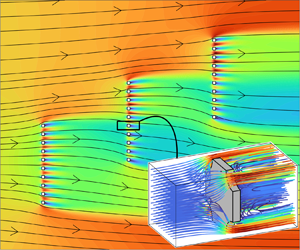
Quasi-linear homogenization for large-inertia laminar transport across permeable membranes
-
- Journal:
- Journal of Fluid Mechanics / Volume 1000 / 10 December 2024
- Published online by Cambridge University Press:
- 27 November 2024, A46
-
- Article
-
- You have access
- Open access
- HTML
- Export citation
Effects of horizontal magnetic fields on flow morphologies and global transports in liquid metal thermal convection
-
- Journal:
- Journal of Fluid Mechanics / Volume 1000 / 10 December 2024
- Published online by Cambridge University Press:
- 27 November 2024, A59
-
- Article
- Export citation
-
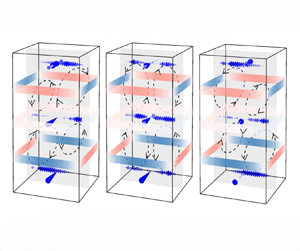
We report an experimental study of Rayleigh–Bénard convection of liquid metal GaInSn in a cuboid cell with an aspect ratio of 0.5 under the effect of a horizontal magnetic field. The Rayleigh number spans a range of $3.8\times 10^5 \leqslant Ra \leqslant 1.1\times 10^7$, while the magnetic field strength reaches up to 0.5 T, corresponding to a maximum Hartmann number to 2041. By combining temperature and velocity measurements, we identify several flow morphologies, including a novel cellular pattern characterized by four stacked vortices that periodically squeeze and induce velocity reversals. Based on the identified flow morphologies, we partition the entire ( $Ra, Ha$) parameter space into five distinct flow regimes and systematically investigate the flow characteristics within each regime. The temperature gradient and oscillation frequency exhibit scaling relationships with the combined parameters $Ra$ and $Ha$. Notably, we observe a coupling between flow regime and global transport efficiencies, particularly in a regime dominated by the double-roll structure, which experiences a maximum 36 % decrease in heat transfer efficiency compared with the single-roll structure. The dependencies of heat and momentum transport on $Ra$ and $Ha$ follow scaling laws as $Nu \sim (Ha^{-2/3}RaPr^{-1})^{3/5}$ and $Re \sim (Ha^{-1}RaPr^{-1})^{4/3}$, respectively.


How wide must Rayleigh–Bénard cells be to prevent finite aspect ratio effects in turbulent flow?
-
- Journal:
- Journal of Fluid Mechanics / Volume 1000 / 10 December 2024
- Published online by Cambridge University Press:
- 27 November 2024, A58
-
- Article
-
- You have access
- Open access
- HTML
- Export citation
-
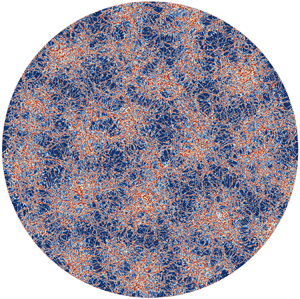
We employ direct numerical simulations to investigate the heat transfer and flow structures in turbulent Rayleigh–Bénard convection in both cylindrical cells and laterally periodic domains, spanning an unprecedentedly wide range of aspect ratios $0.075 \leqslant \varGamma \leqslant 32$. We focus on Prandtl number ${Pr}=1$ and Rayleigh numbers ${{Ra}}=2\times 10^7$ and ${{Ra}}=10^8$. In both cases, with increasing aspect ratio, the heat transfer first increases, then reaches a maximum (which is more pronounced for the cylindrical case due to confinement effects), and then slightly goes down again before it finally saturates at the large aspect ratio limit, which is achieved already at $\varGamma \approx 4$. Already for $\varGamma \gtrsim 0.75$, the heat transfers in both cylindrical and laterally periodic domains become identical. The large- $\varGamma$ limit for the volume-integrated Reynolds number and the boundary layer thicknesses are also reached at $\varGamma \approx 4$. However, while the integral flow properties converge at $\varGamma \approx 4$, the confinement of a cylindrical domain impacts the temperature and velocity variance distributions up to $\varGamma \approx 16$, as thermal superstructures cannot form close to the sidewall.


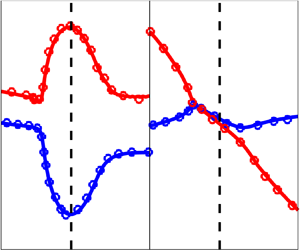
Second-order analysis of hypersonic boundary-layer stability
-
- Journal:
- Journal of Fluid Mechanics / Volume 1000 / 10 December 2024
- Published online by Cambridge University Press:
- 27 November 2024, A56
-
- Article
- Export citation
Energetics of particle-size segregation
-
- Journal:
- Journal of Fluid Mechanics / Volume 1000 / 10 December 2024
- Published online by Cambridge University Press:
- 27 November 2024, A50
-
- Article
-
- You have access
- Open access
- HTML
- Export citation
-
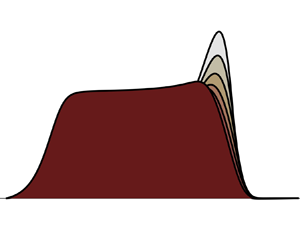
We introduce a continuum framework for the energetics of particle-size segregation in bidisperse granular flows. Building on continuum segregation equations and a recent segregation flux model, the proposed framework offers general analytical expressions to study the physics of granular flows from a mechanical energy perspective. We demonstrate the framework's applicability by examining the energetics of shear-driven granular flows. Numerical experiments with varying frictional coefficients and particle-size ratios reveal two distinct phases in the energetics, marked by the separate onset of particle segregation and diffusive remixing. Furthermore, our numerical simulations alongside previous experimental results show that the bulk Richardson number $Ri$, defined as the potential energy to kinetic energy ratio at steady state, follows the scaling relationship $Ri\equiv \hat {E}^{(s)}_{gp} / \hat {E}^{(s)}_{k} \propto Pe^{-1/2}_{sr}$ for $0.1 \leq Ri\leq ~10^{3}$ and $10^{-4} \leq Pe_{sr} \leq ~300$, the segregation–rheology Péclet number. Finally, we present a Péclet-number-dependent theoretical expression for the degree of mixing (or segregation), validated by the compiled numerical and experimental dataset. Our findings hint that the bulk segregation–mixing state can be predicted and controlled using the segregation Péclet number $Pe$ and $Pe_{sr}$, both determined from known system parameters, providing an instrumental tool for engineering and geophysical applications.


Turbulent flow of non-Newtonian fluid in rough channels
-
- Journal:
- Journal of Fluid Mechanics / Volume 1000 / 10 December 2024
- Published online by Cambridge University Press:
- 27 November 2024, A55
-
- Article
- Export citation
-
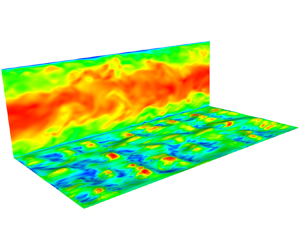
Direct numerical simulations of the turbulence of a Herschel–Bulkley (HB) fluid in a rough channel are performed at a shear Reynolds number $Re_{\tau } \approx 300$ and a Bingham number ${Bn} \approx 0.9$. For the type of rough surface used in this study, the results indicate that Townsend's wall similarity hypothesis also holds for HB fluids. However, there are notable differences compared with the effect of roughness on Newtonian fluids. More specifically, the effect of roughness appears to be slightly stronger for HB fluids, in the sense that the bulk Reynolds number, based on the viscosity at the wall, is reduced further due to the increase in viscosity in the troughs of the roughness surface induced by the low shear. At the same time, for the simulated rough surface, the contribution of form drag to the total pressure drop is reduced from 1/4 to about 1/5 due to the persistence of viscous shear in the boundary layer, reducing its shielding effect. As for the friction factor, due to the nonlinearity of the HB constitutive relation, its use with the wall shear rate from the mean wall shear stress underpredicts the minimum viscosity at the wall by up to 18 %. This inevitably leads to uncertainties in the prediction of the friction factor. Finally, it is observed that the rough surface is unable to break the peculiar near-wall flow structure of HB fluids, which consists of long persistent low-speed streaks occupying the entire domain. This means that the small-scale energy is significantly reduced for HB fluids, even in rough channels, with the energy more concentrated in the lower wavenumber range, implying an increase in the slope of the power spectrum to $-7/2$ in the inertial range, as shown by Mitishita et al. (J. Non-Newtonian Fluid Mech., vol. 293, 2021, 104570).


Four-element LC-baluns for power matching arbitrary impedances
-
- Journal:
- International Journal of Microwave and Wireless Technologies / Volume 16 / Issue 8 / October 2024
- Published online by Cambridge University Press:
- 27 November 2024, pp. 1364-1372
-
- Article
-
- You have access
- Open access
- HTML
- Export citation
Path instabilities of freely falling oblong cylinders
-
- Journal:
- Journal of Fluid Mechanics / Volume 1000 / 10 December 2024
- Published online by Cambridge University Press:
- 27 November 2024, A54
-
- Article
- Export citation
-
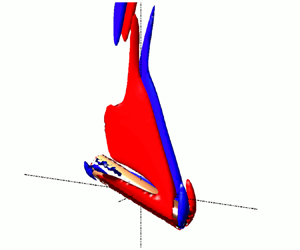
This paper presents numerical simulations of the free fall of homogenous cylinders of length-to-diameter ratios $2$,
$2$,  $3$ and 5 and solid-to-fluid-density ratios $\rho _s/\rho$ going from 0 to 10 in transitional regimes. The path instabilities are shown to be due to two types of transitional states. The well-known fluttering state is a solid mode, characterised by significant oscillations of the cylinder axis due to a strong interaction between the vortex shedding in the wake and the solid degrees of freedom. Weakly oscillating, mostly irregular trajectories, are fluid modes, associated with purely fluid instabilities in the wake. The interplay of solid and fluid modes leads to a varying scenario in which the length-to-diameter and density ratios play an important role. The description is accompanied by the presentation of the identified transitional states in terms of path characteristics and vorticity structure of the wakes and by bifurcation diagrams showing the evolution of asymptotic states with increasing Galileo numbers. There appears to be a strong difference between the behaviour of cylinders of aspect ratio $L/d=3$ and 5. A similar contrast is stated between light cylinders of density ratios $\rho _s/\rho \le 2$ and dense cylinders of density ratios 5 and 10. Finally, the question of the scatter of values of the drag coefficient and of the frequency of oscillations raised in the literature is addressed. It is shown, that in addition to external parameters (Galileo number, density and aspect ratio) the amplitude of oscillations characterising the instability development is to be taken into account to explain this scatter. Fits of the simulation results to simple correlations are proposed. Namely that of the drag coefficient proves to be accurate (better than 1 % of accuracy) but also that of the Strouhal number (a few per cent of accuracy) may be of practical use.


