Refine search
Actions for selected content:
212786 results in Engineering
Slip due to kink propagation at the liquid–solid interface
-
- Journal:
- Journal of Fluid Mechanics / Volume 1000 / 10 December 2024
- Published online by Cambridge University Press:
- 25 November 2024, A19
-
- Article
-
- You have access
- Open access
- HTML
- Export citation
The inconvenient truth of ground truth errors in automotive datasets and DNN-based detection
- Part of
-
- Journal:
- Data-Centric Engineering / Volume 5 / 2024
- Published online by Cambridge University Press:
- 25 November 2024, e34
-
- Article
-
- You have access
- Open access
- HTML
- Export citation
Experimental study on the effect of wall proximity on the flow around a cylinder under an axial magnetic field
-
- Journal:
- Journal of Fluid Mechanics / Volume 1000 / 10 December 2024
- Published online by Cambridge University Press:
- 25 November 2024, A23
-
- Article
- Export citation
Compact and ultra-wideband high-efficiency rectifier using asymmetric coupled-line impedance transformer
-
- Journal:
- International Journal of Microwave and Wireless Technologies / Volume 16 / Issue 6 / July 2024
- Published online by Cambridge University Press:
- 25 November 2024, pp. 966-971
-
- Article
- Export citation
Modelling sea ice in the marginal ice zone as a dense granular flow with rheology inferred from discrete element model data
-
- Journal:
- Journal of Fluid Mechanics / Volume 1000 / 10 December 2024
- Published online by Cambridge University Press:
- 25 November 2024, A22
-
- Article
-
- You have access
- Open access
- HTML
- Export citation
-
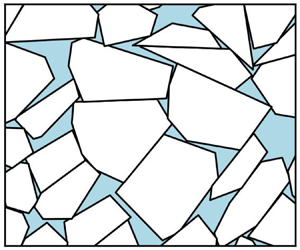
The marginal ice zone represents the periphery of the sea ice cover. In this region, the macroscale behaviour of the sea ice results from collisions and enduring contact between ice floes. This configuration closely resembles that of dense granular flows, which have been modelled successfully with the $\mu (I)$ rheology. Here, we present a continuum model based on the $\mu (I)$ rheology that treats sea ice as a compressible fluid, with the local sea ice concentration given by a dilatancy function $\varPhi (I)$. We infer expressions for $\mu (I)$ and $\varPhi (I)$ by nonlinear regression using data produced with a discrete element method (DEM) that considers polygon-shaped ice floes. We do this by driving the sea ice with a one-dimensional shearing ocean current. The resulting continuum model is a nonlinear system of equations with the sea ice velocity, local concentration and pressure as unknowns. The rheology is given by the sum of a plastic term and a viscous term. In the context of a periodic patch of ocean, which is effectively a one-dimensional problem, and under steady conditions, we prove this system to be well-posed, present a numerical algorithm for solving it, and compare its solutions to those of the DEM. These comparisons demonstrate the continuum model's ability to capture most of the DEM results accurately. The continuum model is particularly accurate for ocean currents faster than 0.25 m s $^{-1}$; however, for low concentrations and slow ocean currents, the continuum model is less effective in capturing the DEM results. In the latter case, the lack of accuracy of the continuum model is found to be accompanied by the breakdown of a balance between the average shear stress and the integrated ocean drag extracted from the DEM. Since this balance is expected to hold independently of our choice of rheology, this finding indicates that continuum models might not be able to describe sea ice dynamics for low concentrations and slow ocean currents.


Electrohydrodynamic flow about a colloidal particle suspended in a non-polar fluid
-
- Journal:
- Journal of Fluid Mechanics / Volume 1000 / 10 December 2024
- Published online by Cambridge University Press:
- 25 November 2024, A15
-
- Article
-
- You have access
- Open access
- HTML
- Export citation
Localization of internal gravity waves in stratified channel flow
-
- Journal:
- Journal of Fluid Mechanics / Volume 1000 / 10 December 2024
- Published online by Cambridge University Press:
- 25 November 2024, A27
-
- Article
-
- You have access
- Open access
- HTML
- Export citation
Natural convection in a vertical channel. Part 1. Wavenumber interaction and Eckhaus instability in a narrow domain
-
- Journal:
- Journal of Fluid Mechanics / Volume 1000 / 10 December 2024
- Published online by Cambridge University Press:
- 25 November 2024, A28
-
- Article
-
- You have access
- Open access
- HTML
- Export citation
-
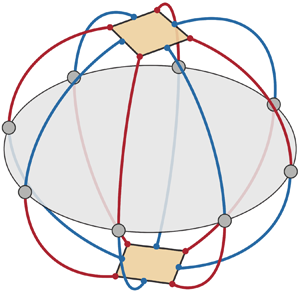
In a vertical channel driven by an imposed horizontal temperature gradient, numerical simulations (Gao et al., Phys. Rev. E, vol. 88, 2013, 023010; Phys. Rev. E, vol. 91, 2015, 013006; Phys. Rev. E, vol. 97, 2018, 053107) have previously shown steady, time-periodic and chaotic dynamics. We explore the observed dynamics by constructing invariant solutions of the three-dimensional Oberbeck–Boussinesq equations, characterizing the stability of these equilibria and periodic orbits, and following the bifurcation structure of the solution branches under parametric continuation in Rayleigh number. We find that in a narrow vertically periodic domain of aspect ratio 10, the flow is dominated by the competition between three and four co-rotating rolls. We demonstrate that branches of three- and four-roll equilibria are connected and can be understood in terms of their discrete symmetries. Specifically, the $D_4$ symmetry of the four-roll branch dictates the existence of qualitatively different intermediate branches that themselves connect to the three-roll branch in a transcritical bifurcation due to $D_3$ symmetry. The physical appearance, disappearance, merging and splitting of rolls along the connecting branch provide a physical and phenomenological illustration of the equivariant theory of $D_3$– $D_4$ mode interaction. We observe other manifestations of the competition between three and four rolls, in which the symmetry in time or in the transverse direction is broken, leading to limit cycles or wavy rolls, respectively. Our work highlights the interest of combining numerical simulations, bifurcation theory and group theory, in order to understand the transitions between and origin of flow patterns.


Richtmyer–Meshkov instability when a shock is reflected for fluids with arbitrary equation of state
-
- Journal:
- Journal of Fluid Mechanics / Volume 1000 / 10 December 2024
- Published online by Cambridge University Press:
- 25 November 2024, A18
-
- Article
-
- You have access
- Open access
- HTML
- Export citation
Direct numerical simulation of turbulent flow and structures in a circular pipe subjected to axial system rotation
-
- Journal:
- Journal of Fluid Mechanics / Volume 1000 / 10 December 2024
- Published online by Cambridge University Press:
- 25 November 2024, A1
-
- Article
-
- You have access
- Open access
- HTML
- Export citation
-
Turbulent circular pipe flows subjected to axial system rotation are studied using direct numerical simulations (DNS) for a wide range of rotation numbers of $Ro_b = 0\unicode{x2013}20$ at a fixed Reynolds number. To ensure that energetic turbulent eddy motions are captured at high rotation numbers, long pipes up to $L_z = 180{\rm \pi} R$ are used in DNS. Two types of energy-containing flow structures have been observed. The first type is hairpin structures that are characteristic of the turbulent boundary layer developing over the pipe wall for both non-rotating and axially rotating flows. The second type is Taylor columns forming at moderate and high rotation numbers. Based on the study of two-point autocorrelation coefficients, it is observed that Taylor columns exhibit quasi-periods in both axial and azimuthal directions. According to the premultiplied spectra, Taylor columns feature one single characteristic axial length scale at the moderate rotation numbers but two at high rotation numbers. It is discovered that the axial system rotation suppresses the sweep events systematically and impedes the formation of hairpin structures. As the rotation number is increased, the turbulence kinetic energy held by Taylor columns enhances rapidly associated with significant increases in their axial length scales.


A deep operator network for Bayesian parameter identification of self-oscillators
-
- Journal:
- Data-Centric Engineering / Volume 5 / 2024
- Published online by Cambridge University Press:
- 25 November 2024, e35
-
- Article
-
- You have access
- Open access
- HTML
- Export citation
Impact of vaporization on drop aerobreakup
-
- Journal:
- Journal of Fluid Mechanics / Volume 1000 / 10 December 2024
- Published online by Cambridge University Press:
- 25 November 2024, A33
-
- Article
-
- You have access
- Open access
- HTML
- Export citation
Modelling turbulence in axisymmetric wakes: an application to wind turbine wakes
-
- Journal:
- Journal of Fluid Mechanics / Volume 1000 / 10 December 2024
- Published online by Cambridge University Press:
- 25 November 2024, A2
-
- Article
-
- You have access
- Open access
- HTML
- Export citation
Natural convection in a vertical channel. Part 2. Oblique solutions and global bifurcations in a spanwise-extended domain
-
- Journal:
- Journal of Fluid Mechanics / Volume 1000 / 10 December 2024
- Published online by Cambridge University Press:
- 25 November 2024, A29
-
- Article
-
- You have access
- Open access
- HTML
- Export citation
-
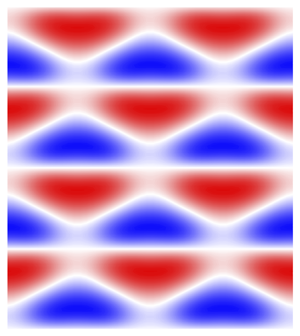
Vertical thermal convection is a non-equilibrium system in which both buoyancy and shear forces play a role in driving the convective flow. Beyond the onset of convection, the driven dissipative system exhibits chaotic dynamics and turbulence. In a three-dimensional domain extended in both the vertical and the transverse dimensions, Gao et al. (Phys. Rev. E, vol. 97, 2018, 053107) have observed a variety of convection patterns which are not described by linear stability analysis. We investigate the fully nonlinear dynamics of vertical convection using a dynamical-systems approach based on the Oberbeck–Boussinesq equations. We compute the invariant solutions of these equations and the bifurcations that are responsible for the creation and termination of various branches. We map out a sequence of local bifurcations from the laminar base state, including simultaneous bifurcations involving patterned steady states with different symmetries. This atypical phenomenon of multiple branches simultaneously bifurcating from a single parent branch is explained by the role of $D_4$ symmetry. In addition, two global bifurcations are identified: first, a homoclinic cycle from modulated transverse rolls and second, a heteroclinic cycle linking two symmetry-related diamond-roll patterns. These are confirmed by phase space projections as well as the functional form of the divergence of the period close to the bifurcation points. The heteroclinic orbit is shown to be robust and to result from a 1:2 mode interaction. The intricacy of this bifurcation diagram highlights the essential role played by dynamical systems theory and computation in hydrodynamic configurations.

Friction drag model for axial turbulent flow along the surface of a circular cylinder based on the universal characteristics of wall turbulence
-
- Journal:
- Journal of Fluid Mechanics / Volume 1000 / 10 December 2024
- Published online by Cambridge University Press:
- 25 November 2024, A35
-
- Article
- Export citation
On the transition in spanwise wake instability characteristics behind oscillating foils
-
- Journal:
- Journal of Fluid Mechanics / Volume 1000 / 10 December 2024
- Published online by Cambridge University Press:
- 25 November 2024, A14
-
- Article
-
- You have access
- Open access
- HTML
- Export citation
-
Spanwise vortex instability and the growth of secondary hairpin-like vortical structures in the wake of an oscillating foil are investigated numerically at Reynolds number 8000 in a range of chord-based Strouhal number ( $0.32 \le St_c \le 0.56$). The phase-offset ( $\phi$) between the heaving and pitching motion is $\phi = 90^\circ$. The wake at the lowest $St_c$ (0.32) is characterized by a single system of streamwise hairpin-like structures that evolve from the core vorticity outflux of the secondary leading edge vortex (LEV) over the foil boundary. The primary LEV features spanwise dislocations, but it does not reveal substantial changes advecting downstream. Increasing $St_c$ beyond 0.32 reveals that the transition in spanwise instability characterizes the deformation of primary LEV cores, which subsequently transforms to hairpin-like secondary structures. At higher $St_c$, stronger trailing edge vortices (TEVs) grow in close proximity to the primary LEVs, which contributes to an enhanced localized vortex compression and tilting near dislocations. This phenomenon amplifies the undulation amplitude of primary LEVs, eventually leading to vortex tearing. The larger circulation of TEVs with increasing $St_c$ provides an additional explanation for an accelerated vortex compression that coincides with a faster transition of spanwise LEV instability to secondary hairpin-like structures in the wake.


Effect of random roughness on Stokes flow
-
- Journal:
- Journal of Fluid Mechanics / Volume 1000 / 10 December 2024
- Published online by Cambridge University Press:
- 25 November 2024, R1
-
- Article
- Export citation
The fluid mechanics of spray cleaning: when the stress amplification at the contact lines of impacting droplets nano-scraps particles
-
- Journal:
- Journal of Fluid Mechanics / Volume 1000 / 10 December 2024
- Published online by Cambridge University Press:
- 25 November 2024, A31
-
- Article
- Export citation
-
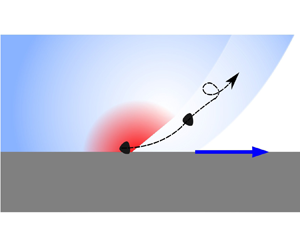
In spray cleaning, a multitude of small drops, violently accelerated by a high-speed gas stream, strike a dirty surface. This process is extremely effective: very little dirt can resist it. This is true even for dirt particles whose characteristic size is less than 100 nm. Spray cleaning is classically modelled by balancing particle adhesion with either inertial stress or viscous shear near the surface, the latter being calculated using droplet size and velocity as the characteristic length and velocity. This results in dimensionless numbers that are often well below one, suggesting that the mechanical stress exerted on the surface by the drop impact that detaches the particle is not well captured. Using quantitative nanoscale measurements, we show that the remarkable efficiency of spray cleaning results from the forced spreading of each droplet on the surface, which generates an unsteady and inhomogeneous shear confined to a boundary layer entrained in the wake of the liquid–solid contact line. In the very first moments of impact, the boundary layer is extremely thin, yielding a gigantic stress: the contact line of the spreading droplets sweeps all the surface particles away. We propose a quantitative model of spray cleaning based on this unsteady surface stress, which agrees well with (i) experimental data obtained with spray droplets of $34\ \mathrm {\mu }$m mean radius impacting the surface to be cleaned at a mean velocity ranging between 30 and 70 m s $^{-1}$ and contamination by nanoparticles of varying nature and shape and (ii) data in the literature on spray cleaning.


Preserving large-scale features in simulations of elastic turbulence
-
- Journal:
- Journal of Fluid Mechanics / Volume 1000 / 10 December 2024
- Published online by Cambridge University Press:
- 25 November 2024, A37
-
- Article
-
- You have access
- Open access
- HTML
- Export citation
Existence of Bolgiano–Obukhov scaling in the bottom ocean?
-
- Journal:
- Journal of Fluid Mechanics / Volume 1000 / 10 December 2024
- Published online by Cambridge University Press:
- 25 November 2024, A38
-
- Article
- Export citation
-
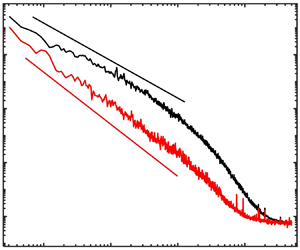
The seminal Bolgiano–Obukhov (BO) theory established the fundamental framework for turbulent mixing and energy transfer in stably stratified fluids. However, the presence of BO scalings remains debatable despite their being observed in stably stratified atmospheric layers and convective turbulence. In this study, we performed precise temperature measurements with 51 high-resolution loggers above the seafloor for 46 h on the continental shelf of the northern South China Sea. The temperature observation exhibits three layers with increasing distance from the seafloor: the bottom mixed layer (BML), the mixing zone and the internal wave zone. A BO-like scaling $\alpha =-1.34\pm 0.10$ is observed in the temperature spectrum when the BML is in a weakly stable stratified ( $N\sim 0.0018$ rad s $^{-1}$) and strongly sheared ( $Ri\sim 0.0027$) condition, whereas in the unstably stratified convective turbulence of the BML, the scaling $\alpha =-1.76\pm 0.10$ clearly deviated from the BO theory but approached the classical $-$5/3 scaling in isotropic turbulence. This suggests that the convective turbulence is not the promise of BO scaling. In the mixing zone, where internal waves alternately interact with the BML, the scaling follows the Kolmogorov scaling. In the internal wave zone, the scaling $\alpha =-2.12 \pm 0.15$ is observed in the turbulence range and possible mechanisms are provided.


