Refine search
Actions for selected content:
212919 results in Engineering
An electro-optic KLTN refractive index gradient deflector implemented in an actively Q-switched Tm:YLF laser
-
- Journal:
- High Power Laser Science and Engineering / Volume 12 / 2024
- Published online by Cambridge University Press:
- 27 August 2024, e52
-
- Article
-
- You have access
- Open access
- HTML
- Export citation
Selective near-infrared laser programming for shape-memory polymer–carbon nanotube composite material 4D printing
- Part of
-
- Journal:
- Programmable Materials / Volume 2 / 2024
- Published online by Cambridge University Press:
- 27 August 2024, e6
-
- Article
-
- You have access
- Open access
- HTML
- Export citation

Non-universality and dissipative anomaly in compressible magnetohydrodynamic turbulence
-
- Journal:
- Journal of Fluid Mechanics / Volume 992 / 10 August 2024
- Published online by Cambridge University Press:
- 27 August 2024, A9
-
- Article
- Export citation
-
We systematically study the dissipative anomaly in compressible magnetohydrodynamic (MHD) turbulence using direct numerical simulations, and show that the total dissipation remains finite as viscosity diminishes. The dimensionless dissipation rate $\mathcal {C}_{\varepsilon }$ fits well with the model $\mathcal {C}_{\varepsilon } = \mathcal {C}_{\varepsilon,\infty } + \mathcal {D}/R_L^-$ for all levels of flow compressibility considered here, where $R_L^-$ is the generalized large-scale Reynolds number. The asymptotic value $\mathcal {C}_{\varepsilon,\infty }$ describes the total energy transfer flux, and decreases with increase of the flow compressibility, indicating non-universality of the dimensionless dissipation rate in compressible MHD turbulence. After introducing an empirically modified dissipation rate, the data from compressible cases collapse to a form similar to the incompressible MHD case depending only on the modified Reynolds number.


One-winged butterflies: mode selection for azimuthal magnetorotational instability by thermal convection
-
- Journal:
- Journal of Fluid Mechanics / Volume 992 / 10 August 2024
- Published online by Cambridge University Press:
- 27 August 2024, R1
-
- Article
-
- You have access
- Open access
- HTML
- Export citation
-
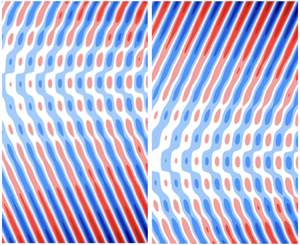
The effects of thermal convection on turbulence in accretion discs, and particularly its interplay with the magnetorotational instability (MRI), are of significant astrophysical interest. Despite extensive theoretical and numerical studies, such an interplay has not been explored experimentally. We conduct linear analysis of the azimuthal version of MRI (AMRI) in the presence of thermal convection and compare the results with our experimental data published before. We show that the critical Hartmann number ( $Ha$) for the onset of AMRI is reduced by convection. Importantly, convection breaks symmetry between $m = \pm 1$ instability modes ( $m$ is the azimuthal wavenumber). This preference for one mode over the other makes the AMRI wave appear as a ‘one-winged butterfly’.


Efficient dual-stage all-solid-state post-compression for 100 W level ultrafast lasers
-
- Journal:
- High Power Laser Science and Engineering / Volume 12 / 2024
- Published online by Cambridge University Press:
- 27 August 2024, e45
-
- Article
-
- You have access
- Open access
- HTML
- Export citation
Trading particle shape with fluid symmetry: on the mobility matrix in 3-D chiral fluids
- Part of
-
- Journal:
- Journal of Fluid Mechanics / Volume 992 / 10 August 2024
- Published online by Cambridge University Press:
- 27 August 2024, A5
-
- Article
-
- You have access
- Open access
- HTML
- Export citation
Dewetting of a corner film wrapping a wall-mounted cylinder
-
- Journal:
- Journal of Fluid Mechanics / Volume 992 / 10 August 2024
- Published online by Cambridge University Press:
- 27 August 2024, A13
-
- Article
-
- You have access
- Open access
- HTML
- Export citation
On the coupling instability of a gas jet impinging on a liquid film
-
- Journal:
- Journal of Fluid Mechanics / Volume 992 / 10 August 2024
- Published online by Cambridge University Press:
- 27 August 2024, A11
-
- Article
-
- You have access
- Open access
- HTML
- Export citation
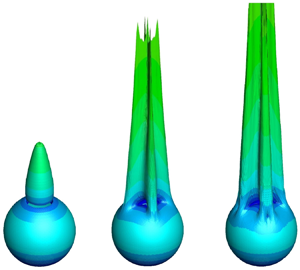
Emergence of lobed wakes during the sedimentation of spheres in viscoelastic fluids
-
- Journal:
- Journal of Fluid Mechanics / Volume 992 / 10 August 2024
- Published online by Cambridge University Press:
- 27 August 2024, A14
-
- Article
-
- You have access
- Open access
- HTML
- Export citation
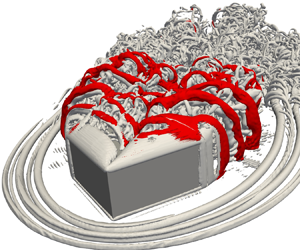
Direct numerical simulation of 45° oblique flow past surface-mounted square cylinder
-
- Journal:
- Journal of Fluid Mechanics / Volume 992 / 10 August 2024
- Published online by Cambridge University Press:
- 27 August 2024, A12
-
- Article
- Export citation
-
Comprehensive coherent structures around a surface-mounted low aspect ratio square cylinder in uniform flow with an oblique angle of $45^{\circ }$ were investigated for cylinder-width-based Reynolds numbers of 3000 and 10 000 by direct numerical simulation based on a topology-confined mesh refinement framework. High-resolution simulations and the critical-point concept were scrutinized to reveal for the first time the reasonable and compatible topologies of flow separation and complete near-wall structures, due to their extensive impact on various engineering applications. Large-scale horseshoe vortices are observed at two notable foci in the viscous sublayer. Within this layer, a wall-parallel jet is formed by downflow intruding into the bottom surface at the half-saddle point, then deflecting in the upstream direction and finally penetrating the bottom surface until the half-saddle point. A pair of conical vortices on the cylinder's top surface switch themselves on two sides of the square cylinder, where the switching frequency is identical with that of the sway of the side shear layer. The undulation of the Kelvin–Helmholtz instability is identified in the instantaneous development of a conical vortex and side shear layer, where the scaling of the ratio of the Kelvin–Helmholtz and von Kármán frequencies follows the power-law relation obtained by Lander et al. (J. Fluid Mech., vol. 849, 2018, pp. 1096–1119). Large-scale arch-shaped vortex is often detected in the intermediate wake region of a square cylinder, involving two interconnected portions, such as the leg portion separated from leeward surfaces and head portion rolled up from the top surface. The leg portion of the arch-shaped vortex was rooted by two foci near the bottom-surface plane.

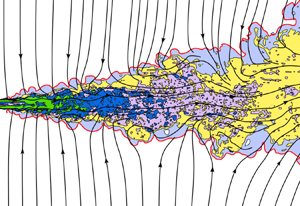
Turbulent jet theory via Lie symmetry analysis: the free plane jet
-
- Journal:
- Journal of Fluid Mechanics / Volume 991 / 25 July 2024
- Published online by Cambridge University Press:
- 22 August 2024, A12
-
- Article
-
- You have access
- Open access
- HTML
- Export citation
-
A theory of incompressible turbulent plane jets (TPJs) is proposed by advancing an improved boundary layer approximation over the limiting classical – retaining more terms in the momentum balance equations. A pressure deficit inside the jet (with respect to the ambient) must exist due to transverse turbulence (Miller & Comings, J. Fluid Mech., vol. 3, 1957, pp. 1–16; Hussain & Clarke, Phys. Fluids, vol. 20, 1977, pp. 1416–1426). Contrary to the universally accepted invariance of the total momentum flux $J_T(x)$ (non-dimensionalized by its inlet value) as a function of the streamwise distance $x$, we prove that $J_T(x) >1$ – a condition that all TPJs must satisfy; surprisingly, prior theories and most experiments do not satisfy this condition. This motivated us to apply Lie symmetry analysis with translational and dilatational transformations of the modified equations (incorporating $J_T>1$), which yields scaling laws for key jet measures: the mean streamwise and transverse velocities $U(x,y)$ and $V(x,y)$, the turbulence intensities, the Reynolds shear stress $-\rho \,\overline {u'v'}(x,y)$, the mean pressure $P(x,y)$, etc. Experiments satisfying $J_T(x)>1$ validate our predictions for all jet measures, including, among others, the profiles of $U$,
$U$,  $V$ and $-\rho \,\overline {u'v'}$. We further predict $U \sim x^{-0.24}$, $V \sim x^{-0.45}$, $-\rho \,\overline {u'v'}\sim x^{-0.69}$, the mass flux $Q_m \sim x^{0.55}$, and $J_T$ increases to approximately 1.5. Contrary to the classical linear jet spread, we find sublinear spread, with the jet half-width growing like $b(x)\sim x^{0.79}$, indicating a narrower jet. Our predictions differ notably from most results reported in the literature. These contradictions demand revisiting jet studies involving carefully designed facilities and boundary conditions, and highly resolved simulations.


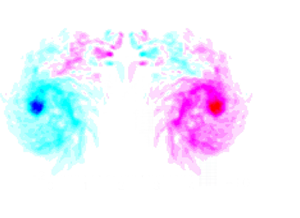
Thermal vortex ring: vortex-dynamics analysis of a high-resolution simulation
-
- Journal:
- Journal of Fluid Mechanics / Volume 991 / 25 July 2024
- Published online by Cambridge University Press:
- 22 August 2024, A18
-
- Article
-
- You have access
- Open access
- HTML
- Export citation
-
A high-resolution simulation of a thermal vortex ring is analysed from the point of view of the vortex dynamics. A power-spectrum analysis of vortex-ring sections suggests that the simulated flows are overall ‘two dimensional’ in the large-scale limit, being dominated by axisymmetric components, but with a substantial contribution from the non-axisymmetric component at small scales. Contribution of the non-axisymmetric components is negligible in budgets of volume integrals of the vorticity and potential vorticity as well as the impulse (moments of the vorticity weighted by $s^n$ with $n=-1$, 0, 1, where $s$ is the distance from the vertical axis of the vortex ring). A concise description of the dynamics is obtained as a function of geometrical factors together with these three integral variables. Analysis shows that the geometrical factors are fairly close to constant with time, and thus, a redundant closed description of the system is obtained in the similarity regime after spin up of the vortex ring. This redundancy leads to a constraint on the geometrical factors, which is reasonably satisfied by the simulation. A closed description is also obtained over the initial spin-up period of the vortex ring by adding a phenomenologically derived prognostic equation for the source for the volume integral of the potential vorticity (with $n=-1$). Analysis of the budget supports this description.


On the low-frequency dynamics of turbulent separation bubbles
-
- Journal:
- Journal of Fluid Mechanics / Volume 991 / 25 July 2024
- Published online by Cambridge University Press:
- 22 August 2024, A11
-
- Article
- Export citation
-
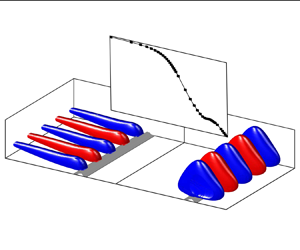
The low-frequency modal and non-modal linear dynamics of an incompressible, pressure-gradient-induced turbulent separation bubble (TSB) are investigated, with the objective of studying the mechanism responsible for the low-frequency contraction and expansion (breathing) commonly observed in experimental studies. The configuration of interest is a TSB generated on a flat test surface by a succession of adverse and favourable pressure gradients. The base flow selected for the analysis is the average TSB from the direct numerical simulation of Coleman et al. (J. Fluid Mech., vol. 847, 2018, pp. 28–70). Global mode analysis reveals that the eigenmodes of the linear operator are damped for all frequencies and wavenumbers. Furthermore, the least damped eigenmode appears to occur at zero frequency and low, non-zero spanwise wavenumber when scaled with the separation length. Resolvent analysis is then employed to examine the forced dynamics of the flow. At low frequency, a region of low, non-zero spanwise wavenumber is also discernible, where the receptivity appears to be driven by the identified weakly damped global mode. The corresponding optimal energy gain is shown to have the shape of a first-order, low-pass filter with a cut-off frequency consistent with the low-frequency unsteadiness in TSBs. The results from resolvent analysis are compared to the unsteady experimental database of Le Floc'h et al. (J. Fluid Mech., vol. 902, 2020, A13) in a similar TSB flow. The alignment between the optimal response and the first spectral proper orthogonal decomposition mode computed from the experiments is shown to be close to $95\,\%$, while the spanwise wavenumber of the optimal response is consistent with that of the low-frequency breathing motion captured experimentally. This indicates that the fluctuations observed experimentally at low frequency closely match the response computed from resolvent analysis. Based on these results, we propose that the forced dynamics of the flow, driven by the weakly damped global mode, serve as a plausible mechanism for the origin of the low-frequency breathing motion commonly observed in experimental studies of TSBs.

The impact of diffusiophoresis on hydrodynamic dispersion and filtration in porous media
-
- Journal:
- Journal of Fluid Mechanics / Volume 991 / 25 July 2024
- Published online by Cambridge University Press:
- 22 August 2024, A8
-
- Article
-
- You have access
- Open access
- HTML
- Export citation
Exact coherent structures in two-dimensional turbulence identified with convolutional autoencoders
-
- Journal:
- Journal of Fluid Mechanics / Volume 991 / 25 July 2024
- Published online by Cambridge University Press:
- 22 August 2024, A10
-
- Article
-
- You have access
- Open access
- HTML
- Export citation
-
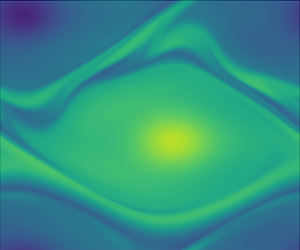
Convolutional autoencoders are used to deconstruct the changing dynamics of two-dimensional Kolmogorov flow as $Re$ is increased from weakly chaotic flow at $Re=40$ to a chaotic state dominated by a domain-filling vortex pair at $Re=400$. ‘Latent Fourier analysis’ (Page et al., Phys. Rev. Fluids 6, 2021, p. 034402) reveals a detached class of bursting dynamics at $Re=40$ which merge with the low-dissipation dynamics as $Re$ is increased to $100$ and provides an efficient representation within which to find unstable periodic orbits (UPOs) using recurrent flow analysis. Focusing on initial guesses with energy in higher latent Fourier wavenumbers allows a significant number of high-dissipation-rate UPOs associated with the bursting events to be found for the first time. At $Re=400$, the UPOs discovered at lower $Re$ move away from the attractor, and an entirely different embedding structure is formed within the network devoid of small-scale vortices. Here latent Fourier projections identify an associated ‘large-scale’ UPO which we believe to be a finite- $Re$ continuation of a solution to the Euler equations.


Prandtl number dependence of flow topology in quasi-two-dimensional turbulent Rayleigh–Bénard convection
-
- Journal:
- Journal of Fluid Mechanics / Volume 991 / 25 July 2024
- Published online by Cambridge University Press:
- 22 August 2024, A14
-
- Article
- Export citation
-
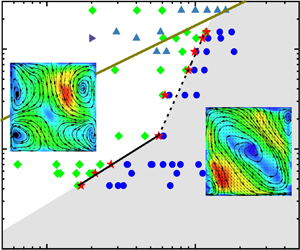
To date, a comprehensive understanding of the influence of the Prandtl number ( $Pr$) on flow topology in turbulent Rayleigh–Bénard convection (RBC) remains elusive. In this study, we present an experimental investigation into the evolution of flow topology in quasi-two-dimensional turbulent RBC with $7.0 \leq Pr \leq 244.2$ and $2.03\times 10^{8} \leq Ra \leq 2.81\times 10^{9}$. Particle image velocimetry (PIV) measurements reveal the flow transitions from multiple-roll state to single-roll state with increasing $Ra$, and the transition is hindered with increasing $Pr$, i.e. the transitional Rayleigh number $Ra_t$ increases with $Pr$. We mapped out a phase diagram on the flow topology change on $Ra$ and $Pr$, and identified the scaling of $Ra_t$ on $Pr$:
$Pr$: 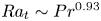 $Ra_t \sim Pr^{0.93}$ in the low $Pr$ range, and $Ra_t \sim Pr^{3.3}$ in the high $Pr$ range. The scaling in the low $Pr$ range is consistent with the model of balance of energy dissipation time and plume travel time that we proposed in our previous study, while the scaling in the high $Pr$ range implies a new governing mechanism. For the first time, the scaling of $Re$ on $Ra$ and $Pr$ is acquired through full-field PIV velocity measurement, $Re \sim Ra^{0.63}\,Pr^{-0.87}$. We also propose that increasing horizontal velocity promotes the formation of the large-scale circulation (LSC), especially for the high $Pr$ case. Our proposal was verified by achieving LSC through introducing horizontal driving force $Ra_H$ by tilting the convection cell with a small angle.


On the flow dynamics around a surface-mounted cube and boundary layer effects
-
- Journal:
- Journal of Fluid Mechanics / Volume 991 / 25 July 2024
- Published online by Cambridge University Press:
- 22 August 2024, A17
-
- Article
-
- You have access
- Open access
- HTML
- Export citation
-
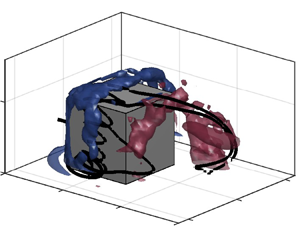
Motivated by contradicting or insufficient information regarding the large-scale flow dynamics around surface-mounted finite-height square prisms of small aspect ratio, the present study investigates the dominant vortex shedding and low-frequency dynamics around a surface-mounted cube. These flow modes were obtained from the spectral proper orthogonal decomposition of large-eddy simulation results, at a Reynolds number of $\textit {Re}=1\times 10^4$ and two different types of boundary layer: a thin and laminar boundary layer with thickness $\delta /D=0.2$ and a thick and turbulent boundary layer with $\delta /D=0.8$. The main antisymmetric mode pair revealed a new flow pattern with the alternate shedding of streamwise flow structures, indicating a transition from the half-loops of taller prisms to only streamwise strands (i.e. no vertical core) for smaller aspect ratio. The formation process of the streamwise structures is due to a reorientation of the vorticity of the arch vortex in the streamwise direction characteristic of the shed structures. The low-frequency drift mode affected the length of the recirculation region, the strength of vortex shedding, and the near-wall flow field and pressure distribution on the cube's faces, leading to low-frequency variations in the fluctuating drag and normal force coefficients. These large-scale flow dynamics were similar for both boundary layers, but minor differences were identified, related mostly to the occurrence of flow attachment and the formation of a headband vortex for the thicker boundary layer.


Asymptotics of the centre-mode instability in viscoelastic channel flow: with and without inertia
-
- Journal:
- Journal of Fluid Mechanics / Volume 991 / 25 July 2024
- Published online by Cambridge University Press:
- 22 August 2024, A13
-
- Article
-
- You have access
- Open access
- HTML
- Export citation
-
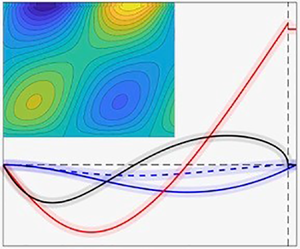
Motivated by the recent numerical results of Khalid et al. (Phys. Rev. Lett., vol. 127, 2021, 134502), we consider the large-Weissenberg-number ( $W$) asymptotics of the centre mode instability in inertialess viscoelastic channel flow. The instability is of the critical layer type in the distinguished ultra-dilute limit where $W(1-\beta )=O(1)$ as $W \rightarrow \infty$ ( $\beta$ is the ratio of solvent-to-total viscosity). In contrast to centre modes in the Orr–Sommerfeld equation, $1-c=O(1)$ as $W \rightarrow \infty$, where $c$ is the phase speed normalised by the centreline speed as a central ‘outer’ region is always needed to adjust the non-zero cross-stream velocity at the critical layer down to zero at the centreline. The critical layer acts as a pair of intense ‘bellows’ which blows the flow streamlines apart locally and then sucks them back together again. This compression/rarefaction amplifies the streamwise-normal polymer stress which in turn drives the streamwise flow through local polymer stresses at the critical layer. The streamwise flow energises the cross-stream flow via continuity which in turn intensifies the critical layer to close the cycle. We also treat the large-Reynolds-number ( $Re$) asymptotic structure of the upper (where $1-c=O(Re^{-2/3})$) and lower branches of the $Re$–
$Re$– $W$ neutral curve, confirming the inferred scalings from previous numerical computations. Finally, we remark that the viscoelastic centre-mode instability was actually first observed in viscoelastic Kolmogorov flow by Boffetta et al. (J. Fluid Mech., vol. 523, 2005, pp. 161–170).


Linear stability of stratified, rotating, viscous plane Couette–Poiseuille flow
-
- Journal:
- Journal of Fluid Mechanics / Volume 991 / 25 July 2024
- Published online by Cambridge University Press:
- 22 August 2024, A16
-
- Article
-
- You have access
- Open access
- HTML
- Export citation
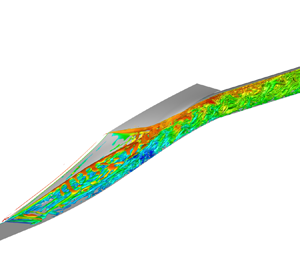
Low-frequency unsteadiness mechanisms of unstart flow in an inlet with rectangular-to-elliptical shape transition under off-design condition at a Mach number of 4
-
- Journal:
- Journal of Fluid Mechanics / Volume 991 / 25 July 2024
- Published online by Cambridge University Press:
- 22 August 2024, A9
-
- Article
- Export citation
