Refine search
Actions for selected content:
212919 results in Engineering
Robust centroid extraction using the hybrid genetic algorithm with applications to planetary optical navigation
-
- Journal:
- The Journal of Navigation / Volume 77 / Issue 5-6 / September 2024
- Published online by Cambridge University Press:
- 11 March 2025, pp. 575-593
- Print publication:
- September 2024
-
- Article
- Export citation
A brain-inspired relative navigation method for collective UAVs based on neurodynamics of social place cells and grid cells
-
- Journal:
- The Journal of Navigation / Volume 77 / Issue 5-6 / September 2024
- Published online by Cambridge University Press:
- 11 March 2025, pp. 559-574
- Print publication:
- September 2024
-
- Article
- Export citation
NAV volume 77 issue 5-6 Cover and Front matter
-
- Journal:
- The Journal of Navigation / Volume 77 / Issue 5-6 / September 2024
- Published online by Cambridge University Press:
- 25 September 2025, pp. f1-f2
- Print publication:
- September 2024
-
- Article
-
- You have access
- Export citation
The plain scale from Warwick (1619)
-
- Journal:
- The Journal of Navigation / Volume 77 / Issue 5-6 / September 2024
- Published online by Cambridge University Press:
- 03 April 2025, pp. 612-623
- Print publication:
- September 2024
-
- Article
-
- You have access
- Open access
- HTML
- Export citation
Grid-based 3DMA GNSS with clustering and Doppler velocity using factor graph optimisation
-
- Journal:
- The Journal of Navigation / Volume 77 / Issue 5-6 / September 2024
- Published online by Cambridge University Press:
- 26 May 2025, pp. 658-676
- Print publication:
- September 2024
-
- Article
-
- You have access
- Open access
- HTML
- Export citation
Decision-making and risk-taking under uncertainty in safety-critical systems: a study among aviation employees
-
- Journal:
- The Journal of Navigation / Volume 77 / Issue 5-6 / September 2024
- Published online by Cambridge University Press:
- 13 June 2025, pp. 723-735
- Print publication:
- September 2024
-
- Article
- Export citation
A fuzzy-hybrid SHELL framework for predicting air traffic conflict detection and resolution performance: a human-factors perspective
-
- Journal:
- The Journal of Navigation / Volume 77 / Issue 5-6 / September 2024
- Published online by Cambridge University Press:
- 27 March 2025, pp. 594-611
- Print publication:
- September 2024
-
- Article
- Export citation
Ship domain-based traffic capacity of Singapore Strait
-
- Journal:
- The Journal of Navigation / Volume 77 / Issue 5-6 / September 2024
- Published online by Cambridge University Press:
- 28 May 2025, pp. 709-722
- Print publication:
- September 2024
-
- Article
- Export citation
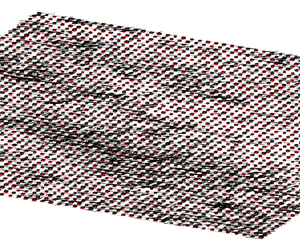
Simulation and scaling analysis of periodic surfaces with small-scale roughness in turbulent Ekman flow
-
- Journal:
- Journal of Fluid Mechanics / Volume 992 / 10 August 2024
- Published online by Cambridge University Press:
- 30 August 2024, A8
-
- Article
-
- You have access
- Open access
- HTML
- Export citation
-
Roughness of the surface underlying the atmospheric boundary layer causes departures of the near-surface scalar and momentum transport in comparison with aerodynamically smooth surfaces. Here, we investigate the effect of $56\times 56$ homogeneously distributed roughness elements on bulk properties of a turbulent Ekman flow. Direct numerical simulation in combination with an immersed boundary method is performed for fully resolved, three-dimensional roughness elements. The packing density is approximately $10\,\%$ and the roughness elements have a mean height in wall units of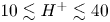 $10 \lesssim H^+ \lesssim 40$. According to their roughness Reynolds numbers, the cases are transitionally rough, although the roughest case is on the verge of being fully rough. We derive the friction of velocity and of the passive scalar through vertical integration of the respective balances. Thereby, we quantify the enhancement of turbulent activity with increasing roughness height and find a scaling for the friction Reynolds number that is verified up to $Re_\tau \approx 2700$. The higher level of turbulent activity results in a deeper logarithmic layer for the rough cases and an increase of the near-surface wind veer in spite of higher $Re_\tau$. We estimate the von Kármán constant for the horizontal velocity $\kappa _{m}=0.42$ (offset $A=5.44$) and for the passive scalar $\kappa _{h}=0.35$ (offset $\mathbb {A}=4.2$). We find an accurate collapse of the data under the rough-wall scaling in the logarithmic layer, which also yields a scaling for the roughness parameters $z$-nought for momentum ( $z_{0{m}}$) and the passive scalar ( $z_{0{h}}$).



Signals, Systems, and Signal Processing
-
- Published online:
- 29 August 2024
- Print publication:
- 13 June 2024
-
- Textbook
- Export citation
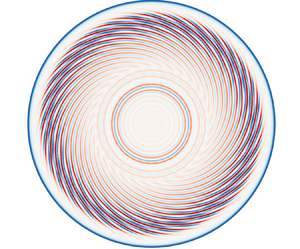
Onset of turbulence in rotor–stator cavity flows
-
- Journal:
- Journal of Fluid Mechanics / Volume 991 / 25 July 2024
- Published online by Cambridge University Press:
- 28 August 2024, A3
-
- Article
- Export citation
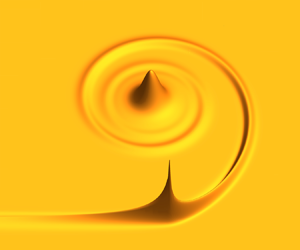
The starting vortices generated by bodies with sharp and straight edges in a viscous fluid
-
- Journal:
- Journal of Fluid Mechanics / Volume 992 / 10 August 2024
- Published online by Cambridge University Press:
- 28 August 2024, A15
-
- Article
- Export citation
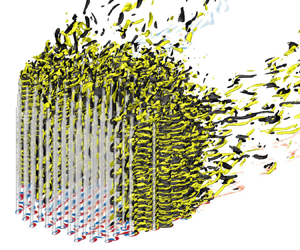
Obstacle arrangement can control flows through porous obstructions
-
- Journal:
- Journal of Fluid Mechanics / Volume 992 / 10 August 2024
- Published online by Cambridge University Press:
- 28 August 2024, A3
-
- Article
-
- You have access
- Open access
- HTML
- Export citation
-
Previous work suggests that the arrangement of elements in an obstruction may influence the bulk flow velocity through the obstruction, but the physical mechanisms for this influence are not yet clear. This is the motivation for this study, where direct numerical simulation is used to investigate flow through an array of cylinders at a resolution sufficient to observe interactions between wakes of individual elements. The arrangement is altered by varying the gap ratio $G/d$ (1.2 – 18, G is the distance between two adjacent cylinders, d is the cylinder diameter), array-to-element diameter ratio $D/d$ (3.6 – 200, D is the array diameter), and incident flow angle ( $0^{\circ} - 30^{\circ}$). Depending on the element arrangement, it is found that the average root-mean-square lift and drag coefficients can vary by an order of magnitude, whilst the average time-mean drag coefficient of individual cylinders ( $\overline{C_{d}}$), and the bulk velocity are found to vary by up to $50\,\%$ and a factor of 2, respectively. These arrangement effects are a consequence of the variation in flow and drag characteristics of individual cylinders within the array. The arrangement effects become most critical in the intermediate range of flow blockage parameter $\mathit{\Gamma_{D}^{\prime}} = 0.5-1.5$ ( $\mathit{\Gamma_{D}^{\prime}}=\overline{C_{d}}aD/(1-\phi)$, where a is frontal element area per unit volume, and $\phi$ is solid volume fraction), due to the high variability in element-scale flow characteristics. Across the full range of arrangements modelled, it is confirmed that the bulk velocity is governed by flow blockage parameter but only if the drag coefficient incorporates arrangement effects. Using these results, this paper proposes a framework for describing and predicting flow through an array across a variety of arrangements.


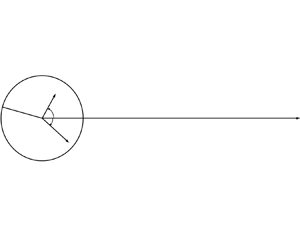
Non-local gravity wave turbulence in presence of condensate
-
- Journal:
- Journal of Fluid Mechanics / Volume 992 / 10 August 2024
- Published online by Cambridge University Press:
- 27 August 2024, A1
-
- Article
-
- You have access
- Open access
- HTML
- Export citation
-
The $k^{-23/6}$ wave action spectrum with an inverse cascade is one of the fundamental Kolmogorov–Zakharov solutions for gravity wave turbulence, which is part of the citation for the Dirac Medal in 2003. Instead of confirming this solution, however, several existing simulations and experiments suggest a spectrum of $k^{-3}$ in set-ups corresponding to the inverse cascade. We provide a theoretical explanation for the latter, considering the condensate that naturally forms in finite domains of experiments/simulations. Our new theory hinges on: (1) derivation of a spectral diffusion equation when non-local interactions with the condensate become dominant, for the first time systematically formulated for quartet-interaction systems; and (2) careful analysis of the asymptotics of interaction coefficient with a remarkable cancellation of all leading-order terms.


Virtual laboratories: transforming research with AI
-
- Journal:
- Data-Centric Engineering / Volume 5 / 2024
- Published online by Cambridge University Press:
- 27 August 2024, e19
-
- Article
-
- You have access
- Open access
- HTML
- Export citation
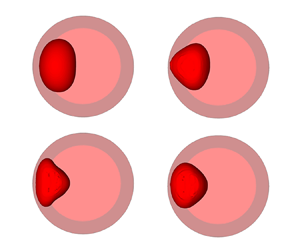
Vibration-induced wall–bubble interactions under zero-gravity conditions
-
- Journal:
- Journal of Fluid Mechanics / Volume 992 / 10 August 2024
- Published online by Cambridge University Press:
- 27 August 2024, A7
-
- Article
- Export citation
-
This work is devoted to a theoretical and numerical study of the dynamics of a two-phase system vapour bubble in equilibrium with its liquid phase under translational vibrations in the absence of gravity. The bubble is initially located in the container centre. The liquid and vapour phases are considered as viscous and incompressible. Analysis focuses on the vibrational conditions used in experiments with the two-phase system SF $_6$ in the MIR space station and with the two-phase system para-Hydrogen (p-H $_2$) under magnetic compensation of Earth's gravity. These conditions correspond to small-amplitude high-frequency vibrations. Under vibrations, additionally to the forced oscillations, an average displacement of the bubble to the wall is observed due to an average vibrational attraction force related to the Bernoulli effect. Vibrational conditions for SF $_6$ correspond to much smaller average vibrational force (weak vibrations) than for p-H $_2$ (strong vibrations). For weak vibrations, the role of the initial vibration phase is crucial. The difference in the behaviour at different initial phases is explained using a simple mechanical model. For strong vibrations, the average displacement to the wall stops when the bubble reaches a quasi-equilibrium position where the resulting average force is zero. At large vibration velocity amplitudes this position is near the wall where the bubble performs only forced oscillations. At moderate vibration velocity amplitudes the bubble average displacement stops at a finite distance from the wall, then large-scale damped oscillations around this position accompanied by forced oscillations are observed. Bubble shape oscillations and the parametric resonance of forced oscillations are also studied.


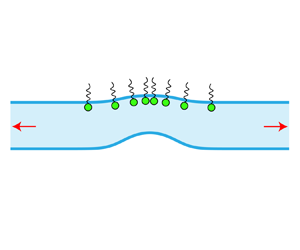
Thin-film flow due to an asymmetric distribution of surface tension and applications to surfactant deposition
-
- Journal:
- Journal of Fluid Mechanics / Volume 992 / 10 August 2024
- Published online by Cambridge University Press:
- 27 August 2024, A2
-
- Article
-
- You have access
- Open access
- HTML
- Export citation
-
Thin-film equations are utilised in many different areas of fluid dynamics when there exists a direction in which the aspect ratio can be considered small. We consider thin free films with Marangoni effects in the extensional flow regime, where velocity gradients occur predominantly along the film. In practice, because of the local deposition of surfactants or input of energy, asymmetric distributions of surfactants or surface tension more generally, are possible. Such examples include the surface of bubbles and the rupture of thin films. In this study, we consider the asymmetric thin-film equations for extensional flow with Marangoni effects. Concentrating on the case of small Reynolds number $ Re $, we study the deposition of insoluble surfactants on one side of a liquid sheet otherwise at rest and the resulting thinning and rupture of the sheet. The analogous problem with a uniformly thinning liquid sheet is also considered. In addition, the centreline deformation is discussed. In particular, we show analytically that if the surface tension isotherm $\sigma = \sigma (\varGamma )$ is nonlinear (surface tension $\sigma$ varies with surfactant concentration $\varGamma$), then accounting for top–bottom asymmetry leads to slower (faster) thinning and pinching if $\sigma = \sigma (\varGamma )$ is convex (concave). The analytical progress reported in this paper allows us to discuss the production of satellite drops from rupture via Marangoni effects, which, if relevant to surface bubbles, would be an aerosol production mechanism that is distinct from jet drops and film drops.


Turbulence effect on disk settling dynamics
-
- Journal:
- Journal of Fluid Mechanics / Volume 992 / 10 August 2024
- Published online by Cambridge University Press:
- 27 August 2024, A4
-
- Article
-
- You have access
- Open access
- HTML
- Export citation
-
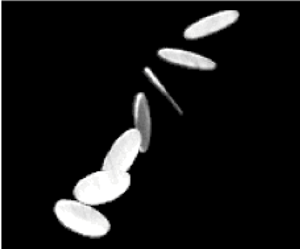
Turbulence can have a strong effect on the fall speed of snowflakes and ice crystals. In this experimental study, the behaviour of thin disks falling in homogeneous turbulence is investigated, in a range of parameters relevant to plate crystals. Disks ranging in diameter from 0.3 to 3 mm, and in Reynolds number $Re = 10\unicode{x2013}435$, are dispersed in two air turbulence levels, with velocity fluctuations comparable to the terminal velocity. For each case, thousands of trajectories are captured and reconstructed by high-speed laser imaging, allowing for statistical analysis of the translational and rotational dynamics. Air turbulence reduces the disk terminal velocities by up to 35 %, with the largest diameters influenced most significantly, which is primarily attributed to drag nonlinearity. This is evidenced by large lateral excursions of the trajectories, which correlate with cross-flow-induced drag enhancement as reported previously for falling spheres and rising bubbles. As the turbulence intensity is increased, flat-falling behaviour is progressively eliminated and tumbling becomes prevalent. The rotation rates of the tumbling disks, however, remain similar to those displayed in still air. This is due to their large moment of inertia compared to the surrounding fluid, in stark contrast with studies conducted in water. In fact, the observed reduction of settling velocity is opposite to previous findings on disks falling in turbulent water. This emphasizes the importance of the solid-to-fluid density ratio in analogous experiments that aim to mimic the behaviour of frozen hydrometeors.

Mixing as a correlated aggregation process
-
- Journal:
- Journal of Fluid Mechanics / Volume 992 / 10 August 2024
- Published online by Cambridge University Press:
- 27 August 2024, A6
-
- Article
-
- You have access
- Open access
- HTML
- Export citation
Understanding the effect of Prandtl number on momentum and scalar mixing rates in neutral and stably stratified flows using gradient field dynamics
-
- Journal:
- Journal of Fluid Mechanics / Volume 992 / 10 August 2024
- Published online by Cambridge University Press:
- 27 August 2024, A10
-
- Article
-
- You have access
- Open access
- HTML
- Export citation
-
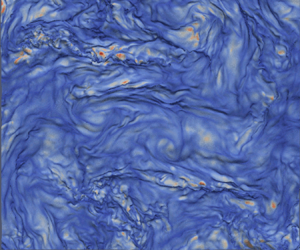
Recently, direct numerical simulations (DNS) of stably stratified turbulence have shown that as the Prandtl number ( $Pr$) is increased from 1 to 7, the mean turbulent potential energy dissipation rate (TPE-DR) drops dramatically, while the mean turbulent kinetic energy dissipation rate (TKE-DR) increases significantly. Through an analysis of the equations governing the fluctuating velocity and density gradients we provide a mechanistic explanation for this surprising behaviour and test the predictions using DNS. We show that the mean density gradient gives rise to a mechanism that opposes the production of fluctuating density gradients, and this is connected to the emergence of ramp cliffs. The same term appears in the velocity gradient equation but with the opposite sign, and is the contribution from buoyancy. This term is ultimately the reason why the TPE-DR reduces while the TKE-DR increases with increasing $Pr$. Our analysis also predicts that the effects of buoyancy on the smallest scales of the flow become stronger as $Pr$ is increased, and this is confirmed by our DNS data. A consequence of this is that the standard buoyancy Reynolds number does not correctly estimate the impact of buoyancy at the smallest scales when $Pr$ deviates from 1, and we derive a suitable alternative parameter. Finally, an analysis of the filtered gradient equations reveals that the mean density gradient term changes sign at sufficiently large scales, such that buoyancy acts as a source for velocity gradients at small scales, but as a sink at large scales.


