To save content items to your account,
please confirm that you agree to abide by our usage policies.
If this is the first time you use this feature, you will be asked to authorise Cambridge Core to connect with your account.
Find out more about saving content to .
To save content items to your Kindle, first ensure no-reply@cambridge.org
is added to your Approved Personal Document E-mail List under your Personal Document Settings
on the Manage Your Content and Devices page of your Amazon account. Then enter the ‘name’ part
of your Kindle email address below.
Find out more about saving to your Kindle.
Note you can select to save to either the @free.kindle.com or @kindle.com variations.
‘@free.kindle.com’ emails are free but can only be saved to your device when it is connected to wi-fi.
‘@kindle.com’ emails can be delivered even when you are not connected to wi-fi, but note that service fees apply.
In 2023, the UK government announced a Major Conditions Strategy, publishing ‘The case for change and our strategic framework’, which set out the focus on cancers, diabetes, dementia, mental ill health, musculoskeletal disorders, CVD and chronic respiratory diseases. Together, these conditions account for 60% of total disability-adjusted life years lost to early death or ill health in England, and one in four adults has at least two (multimorbidity). This review considers some of the key dietary risks for these major conditions and population policies that may improve diets and reduce risks. UK Government dietary recommendations, based on independent risk assessment and advice from the Scientific Advisory Committee on Nutrition, are encapsulated in the national food model, the Eatwell Guide. Based on key sources of dietary data – chiefly consumption data from the National Diet and Nutrition Survey and consumer purchase data from Kantar – most people do not meet dietary recommendations. This review considers how science and evidence inform health improvement policy. This includes policies that encourage healthier food choices, such as labelling and public procurement standards to those that minimise the impact of the less healthy choice such as sugar and salt reduction and reformulation. The review also considers nutritional approaches to managing some non-communicable diseases. Given the role nutrition and excess weight play in the onset, prognosis and quality of life for those living with one or more of the major conditions, there are huge potential gains from even small dietary improvements across population groups.
A positive association has been demonstrated between consumption of sucrose-sweetened beverages and the prevalence of metabolic dysfunction-associated steatotic liver disease (MASLD). Since the administration of 30 % sucrose in the drinking water (sucrose-rich diet (SRD)) to rats has proven to be a good model of systemic insulin resistance, the aim of our study was to analyse the effect of caloric restriction applied on SRD-treated rats by switching back to a standard diet, on liver morphology, function and metabolism. Consumption of an SRD causes a metabolic shift towards gluconeogenesis and fatty acid synthesis leading to an increase in TAG levels in plasma and in the liver that were associated with a decrease in insulin sensitivity. Moreover, our results show that animals fed an SRD develop steatohepatitis characterised by the generation of oxidative stress, endoplasmic reticulum (ER) stress, inflammation and apoptosis. Although no histological changes were observed after a 2-week caloric restriction, key pathways associated with the progression of MASLD as inflammation, ER stress and apoptosis were slowed down. Notably, this 2-week intervention also increased liver insulin sensitivity (evaluated by AKT activity in this tissue) and drove the lipid metabolic profile towards oxidation, thus lowering circulating TAG levels. In summary, the present study uncovers underlying mechanisms affected, and their metabolic consequences, during the first stages of the phenotypic reversal of steatohepatitis by switching back to a standard diet after receiving sucrose-sweetened water for several weeks.
Technological innovations in the online food delivery sector include the use of autonomous delivery vehicles. The aim of the present study was to investigate consumers’ intentions to use these services once they are widely available and their motivations for using them to access unhealthy food.
Design:
Online survey including a vignette describing a future world where autonomous food deliveries are in common use in both metropolitan and non-metropolitan areas.
Setting:
Australia.
Participants:
1078 Australians aged 18 years and older, nationally representative by sex, age and location (metropolitan v. non-metropolitan residence).
Results:
Around half of the sample reported intending to use an autonomous food delivery service at least once per week for fast food (53 %) and/or healthy pre-prepared food (50 %). Almost two-thirds (60 %) intended using autonomous vehicle deliveries to receive groceries. Around one in five (17 %) anticipated an increase in their fast-food intake as a result of access to autonomous delivery services compared with one in two (46 %) expecting others’ total fast-food intake to increase. The most common reason provided for using autonomous food deliveries was increased convenience. More frequent current fast-food ordering, higher socio-economic status, younger age and regional location were significantly associated with an anticipated increase in fast-food consumption.
Conclusions:
The emergence of autonomous food delivery systems may bring both benefits and adverse consequences that in combination are likely to constitute a substantial regulatory challenge. Proactive efforts will be required to avoid negative public health nutrition outcomes of this transport evolution.
The objective of our study was to determine the prevalence of anaemia among 14–19 years school going girls, risk factors for it and profile of micronutrient status among rural girls from western state of India.
Design:
Using a cross-sectional design, we obtained information on socio-demography, menstruation, dietary habits, knowledge and daily consumption of the government recommended iron and folic acid (IFA) tablets, and anthropometry. Blood was collected to assess Hb, red blood cell indices, serumFe, folate and vitamin B12 levels.
Settings:
Nagpur district, Maharashtra, India.
Participants:
A total of 221 girls aged 14–19 years studying in twenty-four government institutes included.
Results:
57 % girls were anaemic, 84 % had deficiency of one or more micronutrients and 60 % were malnourished based on body mass index (BMI). The prevalence of Fe, vitamin B12 and folate deficiency was 37·7 %, 69·8 % and 1·4 %, respectively. Among anaemic girls, Fe and vitamin B12 deficiency was observed in 45·5 % and 67·5 %, respectively, v. among non-anaemic girls it was 27 % and 73 %, respectively. Fe deficiency was a predictor of anaemia and its severity. Girls residing in non-nuclear family were more likely to have anaemia. The consumption of daily non-vegetarian food and green leafy vegetables was 3 % and 3·6 %, respectively. Only 9 % consumed IFA tablets in the past 2 weeks.
Conclusions:
Anaemia is common in adolescent girls, particularly associated with Fe and vitamin B12 deficiency. There is need to reconsider the approach to prevention of anaemia in adolescent girls, particularly before they become pregnant.
To determine the associations among iron status, depressive/anxiety symptoms, and quality of life (QoL) throughout pregnancy.
Design:
This longitudinal study recruited participants in their 1st trimester (< 13 weeks; n=116) and followed in their 2nd (n=71) and 3rd (n=71) trimesters. Sociodemographic, food security, anxiety, depressive symptoms, and QoL questions were collected. Hemoglobin (Hb), ferritin (Ft), and transferrin saturation (TSAT) were determined. Women were categorized as iron improvers or non-improvers based on changes in iron status. Associations were assessed using difference-in-difference analyses.
Setting:
Cape Coast, Ghana between October 2017 to September 2018.
Participants:
Pregnant women, 18-38 years.
Results:
Improvement in Ft levels from the 1st to 2nd trimester were associated with reduced depressive symptoms (-2.96 vs -0.58, p=0.028), and higher overall QoL (13.99 vs 1.92, p=0.006) particularly role physical (23.32 vs -2.55, p=0.025) and role emotional (27.50 vs 10.06, p=0.025) subscales. Improvement in Hb levels during the same period were linked to less anxiety, particularly fear factor (-2.62 vs -0.51, p=0.020); and worsened physical health aspect of QoL (-21.80 vs -3.75, p=0.005). Improvement in TSAT levels from 2nd to 3rd trimester were associated with increased total anxiety (1.56 vs -0.64, p=0.030) and panic factor (0.45 vs -0.26, p=0.004) and decreased total QoL (-1.08 vs 7.94, p=0.017), specifically role physical (-10.98 vs 11.93, p=0.018).
Conclusion:
Increases in iron status from first to second trimester were related to improvements in psychosocial wellbeing, implying potential benefit of iron supplementation on affect in early pregnancy. Larger studies are needed to confirm these findings.
Temporal energy intake (EI) and physical activity (PA) patterns may be associated with obesity. We aimed to derive and characterise temporal EI and PA patterns, and assess their cross-sectional association with weight status, in 6-to-14-year-old Portuguese participants of the National Food, Nutrition and Physical Activity Survey 2015–2016. We extracted times and EI of all eating occasions from two 1-d food diaries/24-h recalls, while types and times of PA from 4-d PA diaries. We derived EI patterns (n 714) and PA patterns (n 595), using, respectively, a hierarchical and K-means cluster analysis, considering the average proportion of total daily EI (%TEI) and PA intensity (%TPA), within each 2-h interval across the 24-h day. Patterns were labelled based on the 2-h intervals of %TEI/TPA peaks. We assessed the association between patterns and overweight or obesity (BMI z-score ≥ +1 sd) using adjusted logistic regressions (OR (95 % CI)). Three EI patterns emerged: 1 – ‘Early afternoon and early evening’; 2 – ‘Early afternoon and late evening’; and 3 – ‘Late morning, early and mid-afternoon and late evening’. EI Pattern 3 v. Pattern 1 was negatively associated with overweight or obesity (0·49 (0·26, 0·92)). PA Pattern 1 – ‘Late morning, mid-afternoon and early evening’ v. Pattern 2 – ‘Late afternoon’, was not associated with weight status (0·95 (0·65, 1·38)). A daily EI pattern with more and even %TEI peaks at earlier daytime periods, rather than fewer and higher, may be negatively associated with overweight or obesity amongst this population whereas the identified PA patterns might have no relationship.
Several novel anthropometric indices, including paediatric body adiposity index (BAIp) and triponderal mass index (TMI), have emerged as potential tools for estimating body fat in preschool children. However, their comparative validity and accuracy, particularly when compared with established indicators such as BMI, have not been thoroughly investigated. This cross-sectional study enrolled 2869 preschoolers aged 3–6 years in Wuhan, China. The non-parametric Bland–Altman analysis was employed to evaluate the agreement between BMI, BAIp and TMI with percentage of body fat (PBF), determined by bioelectrical impedance analysis (BIA), serving as the reference measure of adiposity. Additionally, receiver operating characteristic curve analysis was conducted to assess the effectiveness of BMI, BAIp and TMI in screening for obesity. BAIp demonstrated the least bias in estimating PBF, showing discrepancies of 3·64 % (95 % CI 3·40 %, 4·12 %) in boys and 3·95 % (95 % CI 3·79 %, 4·23 %) in girls. Conversely, BMI underestimated PBF by 3·89 % (95 % CI 3·70 %, 4·37 %) in boys and 4·81 % (95 % CI 4·59 %, 5·09 %) in girls, while TMI also underestimated PBF by 5·15 % (95 % CI 4·90 %, 5·52 %) in boys and 5·68 % (95 % CI 5·30 %, 5·91 %) in girls. BAIp exhibited the highest AUC values (AUC = 0·867–0·996) in boys, whereas in girls, there was no statistically significant difference between BMI (AUC = 0·936, 95 % CI 0·921, 0·948) and BAIp (AUC = 0·901, 95 % CI 0·883, 0·916) in girls (P = 0·054). In summary, when considering the identification of obesity, BAIp shows promise as a screening tool for both boys and girls.
To assess the potential contribution of large-scale food fortification (LSFF) towards meeting dietary micronutrient requirements in Tanzania.
Design:
We used household food consumption data from the National Panel Survey 2014–15 to estimate fortifiable food vehicle coverage and consumption (standardised using the adult female equivalent approach) and the prevalence at risk of inadequate apparent intake of five micronutrients included in Tanzania’s fortification legislation. We modelled four LSFF scenarios: no fortification, status quo (i.e. compliance with current fortification contents) and full fortification with and without maize flour fortification.
Setting:
Tanzania.
Participants:
A nationally representative sample of 3290 Tanzanian households.
Results:
The coverage of edible oils and maize and wheat flours (including products of wheat flour and oil such as bread and cakes) was high, with 91 percent, 88 percent and 53 percent of households consuming these commodities, respectively. We estimated that vitamin A-fortified oil could reduce the prevalence of inadequate apparent intake of vitamin A (retinol activity equivalent) from 92 percent without LSFF to 80 percent with LSFF at current fortification levels. Low industry LSFF compliance of flour fortification limits the contribution of other micronutrients, but a hypothetical full fortification scenario shows that LSFF of cereal flours could substantially reduce the prevalence at risk of inadequate intakes of iron, zinc, folate and vitamin B12.
Conclusions:
The current Tanzania LSFF programme likely contributes to reducing vitamin A inadequacy. Policies that support increased compliance could improve the supply of multiple nutrients, but the prominence of small-scale maize mills restricts this theoretical benefit.
We aimed to evaluate the association of coffee consumption with different additives, including milk and/or sweetener (sugar and/or artificial sweetener), and different coffee types, with new-onset acute kidney injury (AKI), and examine the modifying effects of genetic variation in caffeine metabolism. 194 324 participants without AKI at baseline in the UK Biobank were included. The study outcome was new-onset AKI. During a median follow-up of 11·6 years, 5864 participants developed new-onset AKI. Compared with coffee non-consumers, a significantly lower risk of new-onset AKI was found in coffee consumers adding neither milk nor sugar to coffee (hazard ratio (HR), 0·86; 95 % CI, 0·78, 0·94) and adding only milk to coffee (HR,0·83; 95 % CI, 0·78, 0·89), but not in coffee consumers adding only sweetener (HR,1·14; 95 % CI, 0·99, 1·31) and both milk and sweetener to coffee (HR,0·96; 95 % CI, 0·89, 1·03). Moreover, there was a U-shaped association of coffee consumption with new-onset AKI, with the lowest risk at 2–3 drinks/d, in unsweetened coffee (no additives or milk only to coffee), but no association was found in sweetened coffee (sweetener only or both milk and sweetener to coffee). Genetic variation in caffeine metabolism did not significantly modify the association. A similar U-shaped association was found for instant, ground and decaffeinated coffee consumption in unsweetened coffee consumers, but not in sweetened coffee consumers. In conclusion, moderate consumption (2–3 drinks/d) of unsweetened coffee with or without milk was associated with a lower risk of new-onset AKI, irrespective of coffee type and genetic variation in caffeine metabolism.
n-6 PUFA, especially linoleic acid (LA) but also arachidonic acid (AA), have been inversely associated with CHD. However, mechanisms underlying these associations are not fully known. We investigated the associations of the serum concentrations of total n-6 PUFA, LA, AA, γ-linolenic acid (GLA) and dihomo-γ-linolenic acid (DGLA), with the odds of myocardial ischaemia during exercise, a predictor of future cardiac events. A total of 1871 men without a history of CHD from the Kuopio Ischaemic Heart Disease Risk Factor Study (KIHD) aged 42–60 years were included. All participants performed a maximal symptom-limited exercise stress test, using an electrically braked bicycle ergometer. Multivariable-adjusted logistic regression was used to assess the OR for exercise-induced myocardial ischaemia in quartiles of the serum n-6 PUFA concentrations. After multivariable adjustment, men in the highest v. the lowest serum AA concentration had 50 % lower odds for exercise-induced myocardial ischaemia (OR 0·50, 95 % CI 0·34, 0·76; P-trend across quartiles < 0·001). For the other PUFA, the OR (95 % CI) were 1·00 (0·69, 1·46; P-trend = 0·89) for LA, 1·07 (0·75, 1·53; P-trend = 0·40) for GLA and 0·74 (0·51, 1·07; P-trend = 0·16) for DGLA. Among the n-6 PUFA, higher serum concentration of AA was associated with lower odds for myocardial ischaemia during an exercise test in middle-aged and older men. This may provide one mechanism for the previously observed possible cardioprotective properties of AA. Our findings also suggest that n-6 PUFA should not be considered as one homogenous group.
Increased intestinal leakiness and associated systemic inflammation are potential contributors to osteoarthritis (OA) and postural imbalance in the geriatric population. To date, no successful treatment to correct postural imbalance in OA is known. We aimed to explore the effects of a multistrain probiotic upon postural imbalance in OA-affected patients. In this randomised, double-blind trial with a placebo group, 147 patients suffering from knee OA (age span = 64–75 years) were divided into placebo (n 75) and probiotics (n 72) study groups. Vivomix 112 billion, multistrain probiotic was given once a day for 12 weeks. The outcomes of study variables were determined first at baseline and later after 12 weeks of intervention. These were Western Ontario and McMaster Universities Osteoarthritis Index (WOMAC), knee flexion range of motion (ROM), pain intensity by visual analogue scale, handgrip strength (HGS), gait speed and balance control assessed in standing, semi-tandem and tandem stances. We determined plasma zonulin to determine intestinal leak along with c-reactive protein and 8-isoprostanes levels. A total of 136 OA patients taking placebo (n 71) and probiotics (n 65) were analysed. The probiotics group exhibited a reduction in pain intensity, disease severity and WOMAC scores along with improvement in balance scores, HGS and walking speed (P < 0·05 for all), no change in ROM, resting pain and 8-isoprostanes levels. The correlation analysis revealed a robust association of balance scores with plasma markers of intestinal leakiness and inflammation in probiotics but not in the placebo group. Probiotics reduce postural imbalance in OA patients partly due to a reduction in intestinal leakiness.
The prevalence of poor linear growth among African children with perinatally acquired HIV remains high. There is concern that poor linear growth may to lead to later total and central fat deposition and associated non-communicable disease risks. We investigated associations between height-for-age Z score (HAZ) and total and regional fat and lean mass measured by dual-energy X-ray absorptiometry, expressed as internal population Z scores, among 839 Zimbabwean and Zambian perinatally HIV-infected male and female adolescents aged 11–19 years. Stunting (HAZ < –2) was present in 37 % of males and 23 % of females. HAZ was strongly positively associated with total, trunk, arm and leg fat mass and lean mass Z scores, in analyses controlling for pubertal stage, socio-economic status and HIV viral load. Associations of linear growth with lean mass were stronger than those with fat outcomes; associations with total and regional fat were similar, indicating no preferential central fat deposition. There was no evidence that age of starting antiretroviral therapy was associated with HAZ or body composition. Non-suppressed HIV viral load was associated with lower lean but not fat mass. The results do not support the hypothesis that poor linear growth or stunting are risk factors for later total or central fat deposition. Rather, increased linear growth primarily benefits lean mass but also promotes fat mass, both consistent with larger body size. Nutritional and/or HIV infection control programmes need to address the high prevalence of stunting among perinatally HIV-infected children in order to mitigate constraints on the accretion of lean and fat mass.
The long-term impact of eating duration on the risk of all-cause mortality remains unclear, with limited exploration of how different levels of energy intake and physical activity might influence this impact. To investigate, 24 484 American adults from the National Health and Nutrition Examination Survey spanning 1999–2018 were included. Eating duration was assessed via 24-h dietary recall, and all-cause mortality data were sourced from the National Death Index. The relationship between eating duration and all-cause mortality was analysed using Cox proportional hazards regression models, restricted cubic splines and stratification analysis with complex weighted designs. The median (IQR) of eating duration for participants was 12·5 (11·0, 14·0) h. In this study, 2896 death events were observed, and the median follow-up time (IQR) was 125 (77, 177) months. After multivariable adjustment, compared with Q1, Q2, Q3 and Q4 had reduced risks of all-cause mortality by 17, 15 and 13 %, respectively. Furthermore, each additional hour of eating duration was correlated with a 2 % decrease in the risk of all-cause mortality. Additionally, a non-linear dose–response relationship was observed between eating duration and the risk of all-cause mortality, showing a U-shaped relationship from 8·9 h to 15·3 h (P for non-linearity < 0·05). Interestingly, the non-linear dose–response relationship was observed exclusively among individuals with high energy intake or a lightly active physical activity level. These findings suggest potential health benefits from adjusting eating duration, though further prospective studies are needed for validation.
Musculoskeletal disorders and age-related musculoskeletal decline are major contributors to the burden of ill health seen in older subjects. Despite this increased burden, these chronic disorders of old age receive a relatively small proportion of national research funds. Much has been learned about fundamental processes involved in ageing from basic science research and this is leading to identification of key pathways that mediate ageing which may help the search for interventions to reduce age-related musculoskeletal decline. This short review will focus on the role of reactive oxygen species in age-related skeletal muscle decline and on the implications of this work for potential nutritional interventions in sarcopenia. The key physiological role of reactive oxygen species is now known to be in mediating redox signalling in muscle and other tissues and ageing leads to disruption of such pathways. In muscle, this is reflected in an age-related attenuation of specific adaptations and responses to contractile activity that impacts the ability of skeletal muscle from ageing individuals to respond to exercise. These pathways provides potential targets for identification of logical interventions that may help maintain muscle mass and function during ageing.
Bariatric surgery has significantly increased globally as an effective treatment for severe obesity. Nutritional deficits are common among candidates for bariatric surgery, and follow-up of nutritional status is critically needed for post-surgery healthcare management. This observational prospective study was conducted at King Khalid University Hospital in Riyadh. Samples were collected pre- and post-laparoscopic sleeve gastrectomy (LSG), with the visit intervals divided into four visits: pre-surgery (0M), 3 months (3M), 6 months (6M) and 12 months (12M). Food intake and eating patterns significantly changed during the first year (P < 0·001). The mean energy intake at 3M post-surgery was 738·3 kcal, significantly lower than the pre-surgery energy intake of 2059 kcal. Then, it increased gradually at 6M and 12M to reach 1069 kcal (P < 0·00). The intake of Fe, vitamin B12 and vitamin D was below the dietary reference intake recommendations, as indicated by the 24-hour dietary recall. The prevalence of 25 (OH) vitamin D deficiency improved significantly from pre- to post-surgery (P < 0·001). Vitamin B12 deficiency was less reported pre-LSG and improved steadily towards a sufficient post-surgery status. However, 35·7 % of participants were deficient in Fe status, with 28·6% being female at higher levels than males. While protein supplementation decreased significantly over the 12M follow-up, the use of vitamin supplements dramatically increased at 3 and 6M before declining at 12M. Fe and vitamin B12 were the most popular supplements after vitamin D. This study confirms the necessity for individualised dietary plans and close monitoring of candidates’ nutritional status before and after bariatric surgery.
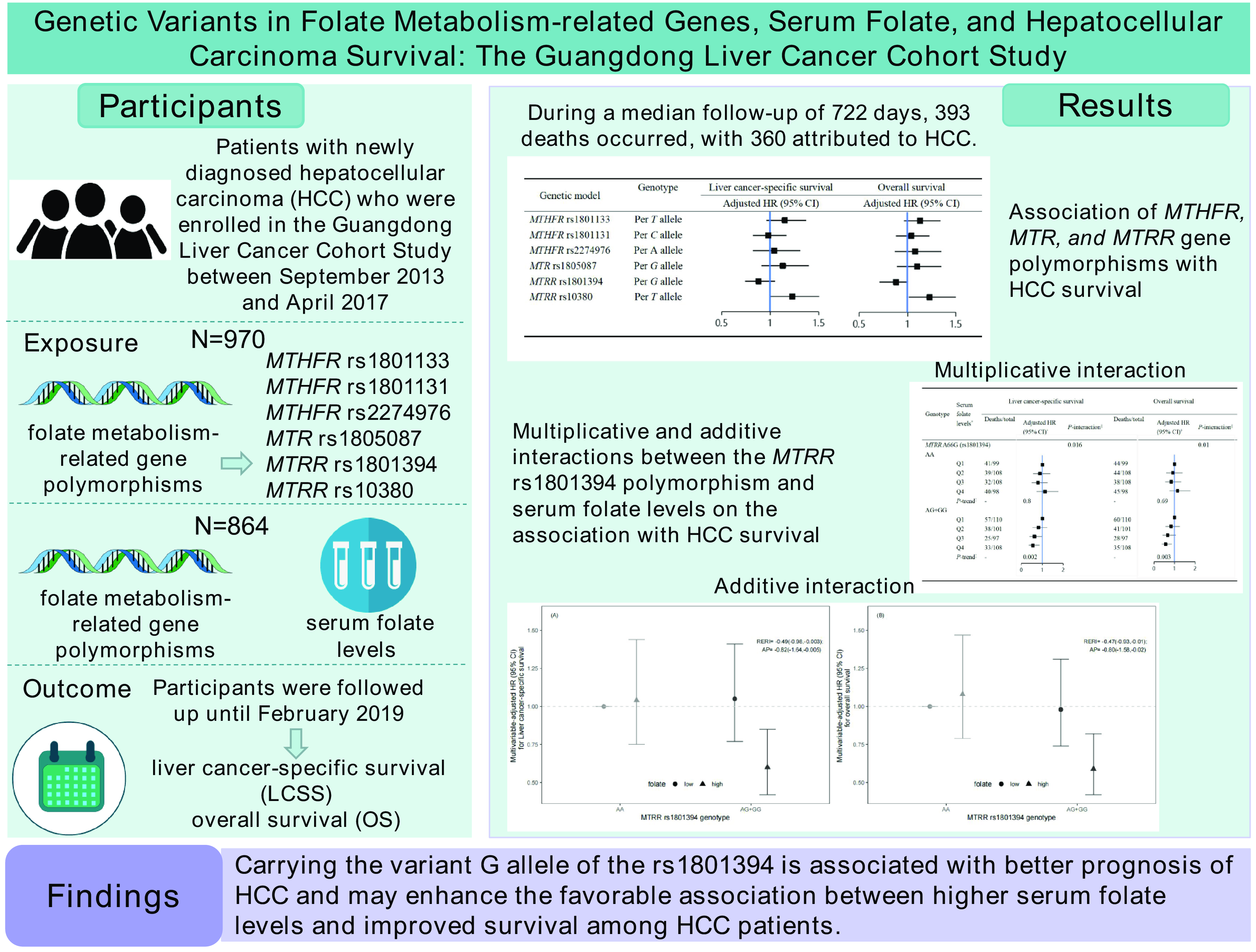
Folate metabolism is involved in the development and progression of various cancers. We investigated the association of single nucleotide polymorphisms (SNP) in folate-metabolising genes and their interactions with serum folate concentrations with overall survival (OS) and liver cancer-specific survival (LCSS) of newly diagnosed hepatocellular carcinoma (HCC) patients. We detected the genotypes of six SNP in three genes related to folate metabolism: methylenetetrahydrofolate reductase (MTHFR), 5-methyltetrahydrofolate-homocysteine methyltransferase reductase (MTRR) and 5-methyltetrahydrofolate-homocysteine methyltransferase (MTR). Cox proportional hazard models were used to calculate multivariable-adjusted hazard ratios (HR) and 95 % CI. This analysis included 970 HCC patients with genotypes of six SNP, and 864 of them had serum folate measurements. During a median follow-up of 722 d, 393 deaths occurred, with 360 attributed to HCC. In the fully-adjusted models, the MTRR rs1801394 polymorphism was significantly associated with OS in additive (per G allele: HR = 0·84, 95 % CI: 0·71, 0·99), co-dominant (AG v. AA: HR = 0·77; 95 % CI: 0·62, 0·96) and dominant (AG + GG v. AA: HR = 0·78; 95 % CI: 0·63, 0·96) models. Carrying increasing numbers of protective alleles was linked to better LCSS (HR10–12 v. 2–6 = 0·70; 95 % CI: 0·49, 1·00) and OS (HR10–12 v. 2–6 = 0·67; 95 % CI: 0·47, 0·95). Furthermore, we observed significant interactions on both multiplicative and additive scales between serum folate levels and MTRR rs1801394 polymorphism. Carrying the variant G allele of the MTRR rs1801394 is associated with better HCC prognosis and may enhance the favourable association between higher serum folate levels and improved survival among HCC patients.
Overweight and obesity now impact one-third of the entire adult population globally, and play a role in the development of 3 of the 4 more common causes of death. Accountability systems for obesity prevention centring on food environment policies and health system strengthening have been vital for raising awareness to the lack of progress in prevention. However, health systems have struggled to prevent and treat obesity – in part because critical food systems reforms largely lay outside the mandate of health sectors and with government agencies for agriculture, industry, infrastructure, trade and investment, and finance. In this commentary we highlight aspects of food systems that are driving poor diets and obesity, and demonstrate a powerful but largely overlooked opportunity for accountability mechanisms for obesity that better address food systems as a main driver. We draw on lessons generated in the Pacific Islands Region where they have demonstrated remarkable commitment to obesity prevention through food system reforms, and the adoption of accountability systems that bring leaders to account on these. We make recommendations for accountability mechanisms that facilitate greater cooperation of food systems sectors on obesity and NCD prevention.
Lipids play an important role in human nutrition. Although adequate lipid consumption is necessary for an optimal functioning of the human body, overconsumption of saturated fatty acids can lead to postprandial hypertriglyceridaemia, which triggers the development of atherosclerosis. Important parameters that impact postprandial lipaemia and inflammation are related to the matrix structure and the fat-soluble micronutrient profile of ingested foods/lipids, but the specific effect of these parameters should be further studied, as most of the available studies evaluate their effect at fasting state. This review specifically explores the effects of food structure and fat-soluble micronutrients, from either micronutrient-rich foods or supplements, on postprandial hypertriglyceridaemia and inflammation. The review also highlights the potential of emerging biomarkers such as miRNAs or circulating microvesicles, as an alternative to the widely use biomarkers (e.g. low-density lipoproteins or blood concentration of pro-inflammatory cytokines), to identify inflammation associated with postprandial hypertriglyceridaemia at early stages.
To determine the prevalence of overweight and obesity in patients with severe mental disorders (SMD) and the factors associated with their socio-demographic and disease characteristics in a cross-sectional population-based study.
Design:
This analysis examined the prevalence of overweight and obesity in 14 868 managed SMD patients in an urban area of Shenzhen city based on data from the health information monitoring system in 2021. Multivariate logistic regression were used to identify the factors associated with the prevalence of overweight and obesity in patients with SMD.
Setting:
China.
Participants:
14 868 patients with SMD.
Results:
The prevalence of overweight and obesity in patients with SMD in this study was 32·6 % and 16·1 %, respectively. In multivariate analysis, married status, Shenzhen household registration, management durations of 5–10 years and >10 years, participation in family physician services, taking clozapine or aripiprazole, FPG > 6·1 mmol/l, hypertension, TC ≥ 5·2 mmol/l, TG ≥ 1·7 mmol/l, and more frequent follow-ups in the past year were associated with higher odds of overweight and obesity. Compared to their respective reference categories, living with parents, spouse and children, taking risperidone, aripiprazole, amisulpride and perphenazine, FPG > 6·1 mmol/l, hypertension, TC ≥ 5·2 mmol/l, TG ≥ 1·7 mmol/l, and more frequent follow-ups in the past year were associated with higher odds of obesity.
Conclusion:
We observed a high prevalence of overweight and obesity in patients with SMD in this study. The findings highlight the need for integrated management of overweight and obesity risk factors among patients with SMD.