To save content items to your account,
please confirm that you agree to abide by our usage policies.
If this is the first time you use this feature, you will be asked to authorise Cambridge Core to connect with your account.
Find out more about saving content to .
To save content items to your Kindle, first ensure no-reply@cambridge.org
is added to your Approved Personal Document E-mail List under your Personal Document Settings
on the Manage Your Content and Devices page of your Amazon account. Then enter the ‘name’ part
of your Kindle email address below.
Find out more about saving to your Kindle.
Note you can select to save to either the @free.kindle.com or @kindle.com variations.
‘@free.kindle.com’ emails are free but can only be saved to your device when it is connected to wi-fi.
‘@kindle.com’ emails can be delivered even when you are not connected to wi-fi, but note that service fees apply.
Texture-engineered ceramics enable access to a vast array of novel texture-property relations leading to property values ranging between those of single crystals and isotropic bulk ceramics. Recently developed templated grain growth and magnetic alignment texturing methods yield high quality crystallographic texture, and thus significant advances in achievable texture-engineered properties in magnetic, piezoelectric, electronic, optical, thermoelectric, and structural ceramics. In this paper, we outline the fundamental basis for these texture-engineered properties and review recent contributions to the field of texture-engineered ceramics with an update on the properties of textured lead-free and lead-based piezoelectrics. We propose that further property improvements can be realized through development of processes that improve crystallographic alignment of the grain structure, create biaxial texture, and explore a wider array of crystallographic orientations. There is a critical need to model the physics of texture-engineered ceramics, and more comprehensively characterize texture, thus enabling testing of texture orientation-property relations and materials performance. We believe that in situ measurements of texture evolution can lead to a more fundamental and comprehensive understanding of the mechanisms of texture development.
A series of self-assembled WO3–BiVO4 nanostructured thin films with 17, 25, 50, 67, and 100 mol% WO3 were grown on the (001) yttria-stabilized zirconia (YSZ) substrate by pulsed laser deposition method. The microstructures including crystalline phases, epitaxial relationship, interface structures, and chemical composition distributions were investigated by a combination of various electron microscopy techniques including scanning electron microscopy, transmission electron microscopy, and X-ray energy dispersive spectroscopy. The monoclinic BiVO4 formed the matrix, in which WO3 nanopillars were embedded with specific epitaxial relationships. In BiVO4-rich sample, orthorhombic Bi2WO6 was formed. However, metastable hexagonal WO3 phase and orthorhombic WO3 phase coexisted in other composite samples. The thin amorphous layer at the film/substrate interface indicated that the mismatch strain between films and substrate is released. The hydrostatic tensile strain due to thermal expansion mismatch between BiVO4 and WO3 as well as the diffusion of Bi into the WO3 stabilized the metastable h-WO3. A WO3–BiVO4 pseudobinary phase diagram was proposed based on the magnitude of the thermal expansion mismatch and the distance of Bi diffusion, which can be applied to design the microstructures of WO3–BiVO4 heterojunctions and optimize their photoelectrochemical properties.
The effects of retrogression and re-aging (RRA) treatment on intergranular corrosion (IGC), exfoliation corrosion (EXCO), stress corrosion cracking (SCC) behavior and microstructure of spray formed Al-7075 were investigated by a scanning electron microscope, a transmission electron microscope, slow strain rate test, and EXCO and IGC test. The results show that the precipitates are redissolved in the matrix of the alloy after retrogression at 200 °C for a suitable time (8 min), and the grain boundary precipitates are discrete and the obvious precipitate free zones are left at the grain boundaries. After RRA with suitable retrogressed time, thin homogeneous dispersive precipitates are separated out again in the matrix. After retrogression at 200 °C for 8 min and re-aging, the ultimate tensile strength, elongation, IGC depth, EXCO rating, and SCC index of spray formed Al-7075 are 791 MPa, 8.5%, 29.8 μm, EA, and 0.155, respectively.
To improve the quality of horizontal continuous casting bronze thin slab, especially the end quality of the thin slab, three methods were proposed; (i) using silicon steel sheet at the ends of the traveling magnetic field (TMF), (ii) change in the length of TMF, and (iii) reduction in the ends current intensity of TMF. Then, the effect of these methods on the magnetic field, flow and solidification of thin slab was studied both numerically and experimentally. Results show that the use of silicon steel sheet is the best method to modify the magnetic field intensity distribution. Due to the electromagnetic field shielding effect of silicon steel sheet, when the silicon steel sheet with 150 mm length and 0.5 mm thickness was applied, the magnetic field intensity at the ends of TMF was reduced to about half of the original. However, the magnetic field intensity in the middle of TMF did not change, which assists the elimination of the strong flow of the melt at the ends of the mold and uniform the solidification shell of the melt. Then, the bronze thin slab can be successfully cast without any crack defects at the ends.
Ce3+ ions in ceria nanoparticles (NPs) play a role as reactive sites in the adsorption of silicate anions. However, the limited concentration of Ce3+ ions in ceria NPs remains a major challenge in this regard. Herein, we report a simple strategy to synthesize Ce3+-enriched core–shell ceria NPs for enhanced adsorption of silicate anions. To increase the overall Ce3+ concentration, a shell layer is composed of Ce3+-rich ultrasmall ceria NPs approximately 5 nm in size. The Ce3+ concentration of such core–shell ceria NPs is increased by 12.7–17.1% relative to that of the pristine ceria NPs, resulting in increased adsorption of silicate anions. The Freundlich model fits the observed adsorption isotherm well and the constants of adsorption capacity (KF) and adsorption intensity (1/n) indicate higher adsorption affinity of the core–shell ceria NPs for silicate anions. We attribute these improvements to the increased Ce3+ concentration contributed by the ultrasmall ceria coating. This strategy can be used for enhancing the reactivity of ceria materials.
Nanocrystalline boehmite (gamma-aluminium-oxyhydroxide) is a material of industrial importance, the functionality of which follows from its crystalline microstructure. A procedure for preparing boehmite nanoparticles, comprising the formation of a precipitate by the alkalization of an aqueous solution of aluminium nitrate and subsequent hydrothermal aging, was previously elaborated. The application of an additive (maltitol or tartaric acid) to control the sizes and shapes of crystallites in the produced polycrystalline powder of boehmite was developed. The aim of this work is a study of the effect of the hydrothermal treatment time on nanocrystalline characteristics of boehmite, both in absence and in presence of the additive. The obtained materials were investigated by using X-ray diffraction (XRD) as principal technique and additionally by scanning and transmission electron microscopy. The multi-peak analysis of powder XRD patterns was applied to determine the prevalent crystallite shape, volume-weighted crystallite size distribution, and second-order crystalline lattice strain distribution being principal quantitative characteristics of the crystalline microstructure. Based on these characteristics, three types of the microstructure correlated with the production procedures were observed and discussed in detail. The nanoparticles of boehmites were found to be monocrystalline grains with characteristic habits and sizes of order of ten nanometers weakly dependent on the hydrothermal treatment time.
Learn about the most recent advances in 2D materials with this comprehensive and accessible text. Providing all the necessary materials science and physics background, leading experts discuss the fundamental properties of a wide range of 2D materials, and their potential applications in electronic, optoelectronic and photonic devices. Several important classes of materials are covered, from more established ones such as graphene, hexagonal boron nitride, and transition metal dichalcogenides, to new and emerging materials such as black phosphorus, silicene, and germanene. Readers will gain an in-depth understanding of the electronic structure and optical, thermal, mechanical, vibrational, spin and plasmonic properties of each material, as well as the different techniques that can be used for their synthesis. Presenting a unified perspective on 2D materials, this is an excellent resource for graduate students, researchers and practitioners working in nanotechnology, nanoelectronics, nanophotonics, condensed matter physics, and chemistry.
The present study addressed the weldability of Hastelloy C-276 and Type 321 austenitic stainless steel (ASS) dissimilar combination used for manufacturing of high-temperature equipments in nuclear power plants. Investigation of the microstructural evolutions across the different welding passes and their subsequent effect on the mechanical properties and corrosion resistance would be helpful in better understanding and pave way for the frequent application of such dissimilar joints in the industrial applications. The problem of segregation associated with the multi-pass gas tungsten arc welding process was also investigated systematically. The fusion zone microstructures exhibited a transition from columnar to an equiaxed dendritic structure with varying passes. The topologically closed packed (TCP) phases (such as P and μ) were observed in the fusion zone as well as at the weld interface of Hastelloy C-276. Polarization test was performed to evaluate the corrosion resistance and results indicated that the Cr and Mo depleted zones formed around the TCP phases might be responsible for decreased Epit value for fusion zone. The novelty of this work is to explore the possibilities of substitution of an expensive Hastelloy C-276 with a cost-effective Ti-stabilized Type 321 ASS.
In this study, we propose a Se-incorporated Ge10Sb90 as a phase-change material for phase-change memory (PCM) with high reliability and low operation power. We investigated the effect of the Se concentration on the thermal and electrical properties of Se-doped Ge10Sb90 films by varying the Se concentration from 0 to 20 at.%. The crystallization temperature, crystallization activation energy, and maximum ten-year data retention temperature increased with the increasing Se, thus demonstrating the improved thermal stability of Se-doped Ge10Sb90 films with higher Se contents. More Se also increased the rate factor, band gap, threshold voltage, and load resistance. In addition, the crystallization speed, programming window, and resistances of both the amorphous and crystalline states increased with the increasing Se concentration. In contrast, the reset current decreased with the increasing Se concentration. These results demonstrate that Se-doped Ge10Sb90 is a highly promising material for PCM applications.
Ambroperuvin is a new pseudoguaianolide isolated from Ambrosia peruviana Willd., a plant used in traditional medicine in Venezuela. The analysis of the X-ray powder pattern being reported led to an orthorhombic unit cell with space group P212121 and cell parameters a = 15.999(6) Å, b = 11.263(2) Å, c = 9.112(2) Å. No detectable impurities were observed.
In the present work, various Mn amounts (up to 2 wt%) have been added into Al–Mn–Mg 3004 alloy to study their effect on the evolution of microstructure and elevated-temperature properties. Results showed that the dominant intermetallics are interdendritical Al6(MnFe) until to 1.5 wt% Mn. With further addition of Mn to 2 wt%, the blocky primary Al6Mn/Al6(MnFe) and high volume of fine Al6(MnFe) intermetallics form in the matrix, leading to the rapid increase on the volume fraction of intermetallics. After the precipitation heat treatment (375 °C/48 h), the precipitation of dispersoids increased with increasing Mn contents and reached the peak condition in the alloy with 1.5 wt% Mn, resulting in the highest yield strength and creep resistance at 300 °C. However, the elevated-temperature properties became worse in the alloy with 2 wt% Mn due to the lowest volume fraction of dispersoids and highest volume of dispersoid free zone.
The size and strain-rate dependence of plastic deformation in Au microspheres of diameter ranging from 0.8 to 6.0 µm was investigated at room-temperature using flat-punch micro-compression testing. The contact yield stress was observed to increase with decreasing microsphere diameter. The apparent activation volume, V*, associated with the rate dependent plastic deformation remained essentially constant between 4 and 6b3 for 0.8 and 1.0 µm spheres over strains up to 20% whereas it increased from 12 to 42b3 for the larger 3.0 and 6.0 µm diameter specimens. The initiation of plastic deformation within the microspheres was also found to be highly dependent upon sphere diameter and strain rate with associated V*, and apparent activation energy, Q*, values of 0.4b3 and 0.02 eV for 0.8 µm diameter spheres increasing to 4.1b3 and 0.16 eV for 6.0 µm diameter spheres. These values indicate that initial plasticity is controlled by heterogeneous nucleation events that are consistent with a surface self-diffusion mechanism.
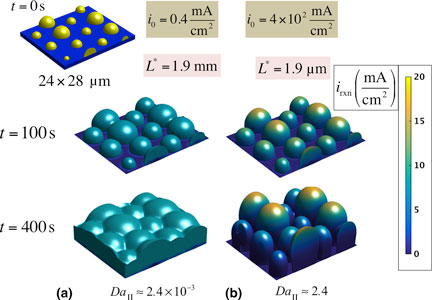
The uniform electrodeposition of certain materials, such as Li metal, remains elusive because the mechanisms controlling growth instability are not fully understood. To determine the conditions that lead to either stable or unstable deposition, we develop a phase-field model for the growth of multiple deposits in a binary electrolyte and examine the behavior as the kinetic parameters are varied. We find that the second Damköhler number, defined as the ratio between the reaction and the mass transfer fluxes, is an indicator of deposition instability. Our results suggest that controlling reaction kinetics and initial roughness are essential in achieving stable electrodeposition.
The authors present here the superior result of synchrotron X-ray diffraction indexing of the 8 × 8 × 8 fluorite supercell, murataite, M8 (formula Ca66.37Mn29.33Ti186.76Zr83.35Al46.30Fe74.09O817, a = 39.277(3) Å, Z = 4). The authors present evidence that Fd$\bar 3$m (227) is the most likely space group.
X-ray powder diffraction data, unit-cell parameters, and space group for S-2-(methylamino)-2-phenylcyclohexan-1-one hydrochloride, C13H18ClNO, are reported [a = 6.578 (1) Å, b = 13.250 (2) Å, c = 15.096 (2) Å, β = 91.619 (3)°, unit-cell volume V = 1315(1) Å3, Z = 4, and space group P21]. All measured lines were indexed and are consistent with the P21 space group. No detectable impurities were observed.
Over the past 20 years, many designer drugs derived from controlled substances have been widely distributed as easily available psychoactive substances and have become a serious problem in Japan. In order to determine the absolute structures of four new designer drugs derived from medicines (methylphenidate and phenmetrazine) X-ray single-crystal structure analyses were performed using the BL26B1 beamline of synchrotron radiation facility SPring-8. The results show that the molecular configuration of these designer drugs (having two asymmetric carbons), which were distributed in the illegal drug market had threo-forms as found for methylphenidate and phenmetrazine.