To save content items to your account,
please confirm that you agree to abide by our usage policies.
If this is the first time you use this feature, you will be asked to authorise Cambridge Core to connect with your account.
Find out more about saving content to .
To save content items to your Kindle, first ensure no-reply@cambridge.org
is added to your Approved Personal Document E-mail List under your Personal Document Settings
on the Manage Your Content and Devices page of your Amazon account. Then enter the ‘name’ part
of your Kindle email address below.
Find out more about saving to your Kindle.
Note you can select to save to either the @free.kindle.com or @kindle.com variations.
‘@free.kindle.com’ emails are free but can only be saved to your device when it is connected to wi-fi.
‘@kindle.com’ emails can be delivered even when you are not connected to wi-fi, but note that service fees apply.
Regarding the significance of cement paste in construction materials, the present paper aims to use nanoindentation to measure and map mechanical properties of hardened cement pastes. The mechanical properties of involved phases were extracted from grid nanoindentation on the cement paste. The results suggested that nanoindentation can be used as a tool to measure and map mechanical properties of hardened cement pastes, and can identify the phases, including outer product, inner product, calcium hydroxide (or interface of residual cement clinker), and residual cement clinker.
Fullerite derivatives synthesized with a catalytic polymerization reaction at a relatively low-pressure range of 0.5–4 GPa show unique mechanical properties: elastic recovery is 98% and hardness possibly approaches 100 GPa. Structure of the samples is also unique: one composes from fragments of C60 molecules linked by the covalent bonds. To obtain the homogeneous crack-free samples, we synthesized B4C–fullerite derivatives composite which show a 550 MPa flexural stress, a 2250 MPa compressive strength, and a 28 GPa hardness and have density of 2.2 g/cm3.
Polymer precursors for Si(N)OC ceramics have been synthesized by hydrosilylation reaction of polyhydridomethylsiloxane (PHMS) with three different nitrogen containing compounds. The results obtained by combining characterization techniques such as FTIR, 13C- and 29Si-NMR confirm the occurrence of the cross-linking reaction between Si–H and vinyl groups. The structural characterization of the corresponding ceramic phase shows that the type of N-containing compounds strongly influences the pyrolytic transformation as well as the crystallization behavior of the final ceramics. Elemental analysis clearly indicates that N is present in the Si(N)OC matrix and the degree of N retention after pyrolysis is related to the type of N-containing starting compound. XPS data show that N–C bonds are present in the Si(N)OC ceramic samples even if only N–Si bonds are present in the starting N-containing precursors. However, if nitrogen atoms form bonds with sp2 carbon atoms in the preceramic polymer then a larger fraction of C–N bonds is retained in the final Si(N)OC ceramic.
The laser cladding Co–Cr–W coating has coarse dendritic and network carbides, which can lead to crack and exfoliation easily, limiting the application of Co–Cr–W coating. In this work, friction stir processing (FSP) was carried out on a laser cladding Co–Cr–W alloy coating to modify its microstructure. FSP transforms the laser clad coarse dendritic grains (grain size: 2–4 μm) into nanograins (grain size: 50–200 nm) and crushes the network carbides into nanoparticles dispersed in Co-base solution. The microstructure and thickness of plastic surface layer are controllable by the condition of FSP. Moreover, a WCx reinforced Co–Cr–W thin layer was formed because the WC particles of stir tool were squeezed into the Co–Cr–W coating surface layer. More interestingly, when the FSP rotary speed was 1500 rpm, an interlocking bonding between Co–Cr–W coating and steel substrate was formed, which was favorable for the connection with substrate. The surface nanocrystallization significantly strengthened the laser clad Co–Cr–W alloy after FSP.
Effect of combined electromagnetic fields (EMFs) on the structures of a 3004 aluminum alloy ingot produced by horizontal direct chill casting was crystallographically investigated. The results showed that the structure was transformed from a mixture of equiaxed and fine columnar grains to coarse columnar grains with switching off the EMFs. With the EMFs the grain size is small and shows a uniform distribution, whereas without the EMFs it is increased and reveals inhomogeneous distribution on the cross section. Besides, a transition region composed of fine equiaxed grains appeared at the moment the EMFs were switched off (between the mixture and coarse columnar grains). Furthermore, the microstructure transformation is accompanied by a crystallographic orientation change from a preferred <100> orientation to a random orientation, and then to an intense <100> fiber texture. The structural and crystallographic transformations are mainly related to the forced convection in the melt due to the induced Lorentz force by the EMFs.
While planar graphene has revolutionized science and engineering in many different areas, one of its close relatives, vertical graphene (VG), also known as carbon nanowalls, has not been investigated as extensively. Compared to planar graphene that is grown parallel to the substrate, VG can grow almost vertically on a wide variety of substrates. In this study, we report the fabrication and characterization of VG-based nanocomposite thin films, where the graphene sheets are uniformly distributed in the host polymer. A novel fabrication method was developed and the properties of the fabricated nanocomposites were characterized. The results showed that in our method graphene sheets are much more uniformly dispersed and common issues in graphene nanocomposites, such as agglomeration and breaking of the sheets during dispersion, are avoided. The increase in the Young's modulus and tensile strength of the fabricated nanocomposites is much higher than that of the samples fabricated using the traditional methods of randomly dispersing graphene using a sonicator or high-speed stirrer.
X-ray powder diffraction data, unit-cell parameters and space group for gemcitabine, C9H11F2N3O4, are reported [a = 17.641(8) Å, b = 6.985(1) Å, c = 18.653(2) Å, α = β = γ = 90°, unit-cell volume V = 2298.61 Å3, Z = 8 and space group Pmna]. All measured lines were indexed and are consistent with the Pmna space group. No detectable impurities were observed.
Progress toward combining time-resolved experiments with periodic three-dimensional analysis of the evolved microstructural state has been made recently. In situ electron microscopy is used to observe in real time the development of irradiation defects and the influence of these defects on dislocation behavior. Three-dimensional characterization provides information on the true spatial distribution of defects and clarifies effects of the free surfaces in thin films. This quasi-four dimensional analysis approach has been applied to understand the formation of channels in irradiated alloys, the depth distribution of ion damage in an electron transparent foil, and the dislocation channel interactions with grain boundaries. The new insight obtained from these experiments is highlighted and contrasted with findings from simulations.
The crystal structure of new Tb3CuAl3Ge2 quaternary compound was studied by the Rietveld method from powder X-ray diffraction (XRD) data. The Tb3CuAl3Ge2 compound crystallized in the hexagonal Y3NiAl3Ge2-type structure with space group P-62m (no. 189) and lattice parameters a = 7.0041(2) Å, c = 4.1775(1) Å, V = 177.48 Å3. There is only one formula in each unit cell, Z = 1, and the density of Tb3CuAl3Ge2 is ρx = 7.1696 g cm−3. The reliability factors characterizing the Rietveld refinement results are Rp = 6.43%, Rwp = 8.65%, RB = 4.81%, and RF = 4.09%, respectively. The powder XRD data of Tb3CuAl3Ge2 were presented and the reliability of indexation is F30 = 120.9(0.0073, 34).
Two novel series of cathode materials LiFe1−xMxPO4/C (x ≈ 0.0040; M = Mn, Fe, Co, Ni, Cu, and Zn) composites based on metal phthalocyanines (MPc) and metal tetrasulfophthalocyanines (MPcTs) to modify lithium iron phosphate (LiFePO4) for lithium-ion batteries (LIBs) are in situ prepared by solvothermal and calcination techniques. Structures and morphologies of all the composites are characterized by normal methods. To evaluate the electrochemical performance of the composites, the charge/discharge capabilities, rate performance, cycling stabilities, cyclic voltammetry profiles, and electrochemical impedance spectroscopy plots of the LIBs using them as cathode materials are measured carefully. The results indicate that most of the composites deliver highly improved initial discharge capacity and show remarkable reversibility and cycling stabilities. Especially, composites using MPcTs as additives are more efficient for the improvement of specific capacity, rate capability, reversibility, and cycling stability.
The uniform Ag@AgBr core–shell microspheres were synthesized by a very facile wet-chemical route in aqueous solution, including a reduction process to prepare sphere-like Ag core and a deposition process to synthesize AgBr shell. X-ray diffraction, x-ray photoelectron spectroscopy, field emission scanning electron microscopy, and high-resolution transmission electron microscopy results confirmed the formation of Ag@AgBr core–shell heterostructures which had been achieved by this simple method. Field emission scanning and high-resolution transmission electron microscopy results of the as-synthesized Ag@AgBr composite revealed that AgBr particles were deposited on the surface of sphere-like Ag core. Under visible-light (λ > 420 nm) and real sunlight irradiation, the as-synthesized Ag@AgBr samples exhibit high activity and good stability for the photodegradation of Rhodamine 6G (R6G) in water. The present work suggests that the as-synthesized Ag@AgBr core–shell microsphere can be applied as a visible light-activated photocatalyst in efficient utilization of solar energy for treating water polluted by some chemically stable azo dyes in environment. The enhanced photocatalytic performance of the as-synthesized Ag@AgBr composite might be attributed to accelerated separation efficiency of electron–hole pairs on the interface of the Ag@AgBr hybrids and improved visible-light absorption abilities when AgBr is coupled with Ag.
Recent studies have shown that chemical immiscibility is important to achieve enhanced radiation tolerance in metallic multilayers as immiscible layer interfaces are more stable against radiation induced mixing than miscible interfaces. However, as most of these immiscible systems have incoherent interfaces, the influence of coherency on radiation resistance of immiscible systems remains poorly understood. Here, we report on radiation response of immiscible Cu/Fe multilayers, with individual layer thickness h varying from 0.75 to 100 nm, subjected to He ion irradiation. When interface is incoherent, the peak bubble density decreases with decreasing h and reaches a minimum when h is 5 nm. At even smaller h when interface is increasingly coherent, the peak bubble density increases again. However, void swelling in coherent multilayers with smaller h remains less than those in incoherent multilayers. Our study suggests that the coherent immiscible interface is also effective to alleviate radiation induced damage.
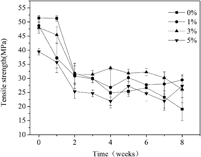
Poly(L-lactide)/poly(para-dioxanone) (PLLA/PPDO) (85/15 w/w) blends with 0, 1, 3, and 5 wt% poly(para-dioxanone-co-L-lactide) (PDOLLA) as a compatibilizer were prepared by solution coprecipitation. The in vitro hydrolytic degradation (HD) of blend bars with different contents of PDOLLA was studied by immersing the bars in a phosphate buffer solution (PBS) at pH 7.49. To estimate the degradation of blend bars, the weight loss, water absorption, thermal properties, surface morphology, and mechanical properties of blend bars, as well as the pH value changes of the PBS, were studied for 8 wk of HD. By adding 1 and 3 wt% PDOLLA, the weight loss of PLLA/PPDO (85/15 w/w) blends increased from 6.4 to 6.8 and 7.4% after 8 wk of HD, 6.2 and 15.6% increment, respectively, while, the average tensile strength of PLLA/PPDO (85/15 w/w) blends for 2–8 wk of HD increased from 25.8 to 29.0 MPa and 31.0 MPa, 12.4 and 20.2% increment, respectively. Considering their good mechanical properties and HD rate, the PLLA/PPDO (85/15 w/w) blends with 1 and 3 wt% PDOLLA are potential to be used as a medical implant material.
Four epitaxial ScN(001) thin films were successfully deposited on MgO(001) substrates by dc reactive magnetron sputtering at 2, 5, 10, and 20 mTorr in an Ar/N2 ambient atmosphere at 650 °C. The microstructure of the resultant films was analyzed by x-ray diffraction, scanning electron microscopy, and transmission electron microscopy. Electrical resistivity, electron mobility and concentration were measured using the room temperature Hall technique, and temperature dependent in-plain measurements of the thermoelectric properties of the ScN thin films were performed. The surface morphology and film crystallinity significantly degrade with increasing deposition pressure. The ScN thin film deposited at 20 mTorr exhibits the presence of <221> oriented secondary grains resulting in decreased electric properties and a low thermoelectric power factor of 0.5 W/mK2 at 800 K. The ScN thin films grown at 5 and 10 mTorr are single crystalline, yielding the power factor of approximately 2.5 W/mK2 at 800 K. The deposition performed at 2 mTorr produces the highest quality ScN thin film with the electron mobility of 98 cm2 V−1 s−1 and the power factor of 3.3 W/mK2 at 800 K.
Candidate materials for actinide immobilization are subject to alpha-decay event doses that accumulate to values of more than 1020 alpha-decays per gram (tens displacements per atom, dpa) over the extended periods of geologic disposal. To evaluate the radiation-response of actinide-bearing materials, two experimental techniques have been used to accelerate the damage accumulation process: ion-beam irradiations and 244Cm-doping experiments. Based on modern characterization techniques, such as high-resolution transmission electron microscopy, and experimental results that involve ion-beam irradiation and chemical doping with highly active actinides, crystalline ceramics for the immobilization of actinides can be divided into three groups on the basis of their critical doses, Dc, i.e., the dose required for amorphization at 300 K: (i) low resistance to radiation damage accumulation (Dc ∼ 0.2 dpa) – murataite, Ti-perovskite, Fe-garnet; (ii) resistant (0.4 < Dc < 0.6 dpa) – Al-garnet, Ti–Zr-pyrochlore, Al-perovskite; and (iii) highly resistant (Dc > 0.8 dpa) – Zr-, Zr–Ti-, and Sn-pyrochlores. Phases with low critical temperatures (Tc below 600 K) will not become amorphous in a deep geologic repository, as long as the temperature remains between 300 and 550 K, but rather, they will remain crystalline. Only Zr-rich pyrochlore is fully resistant to radiation damage and will remain crystalline over the entire period of its disposal.