To save content items to your account,
please confirm that you agree to abide by our usage policies.
If this is the first time you use this feature, you will be asked to authorise Cambridge Core to connect with your account.
Find out more about saving content to .
To save content items to your Kindle, first ensure no-reply@cambridge.org
is added to your Approved Personal Document E-mail List under your Personal Document Settings
on the Manage Your Content and Devices page of your Amazon account. Then enter the ‘name’ part
of your Kindle email address below.
Find out more about saving to your Kindle.
Note you can select to save to either the @free.kindle.com or @kindle.com variations.
‘@free.kindle.com’ emails are free but can only be saved to your device when it is connected to wi-fi.
‘@kindle.com’ emails can be delivered even when you are not connected to wi-fi, but note that service fees apply.
Owing to the development of new ion source technology, users of focused ion beams (FIBs) have access to superior performance when compared with the industry standard Ga+ liquid metal ion source. FIBs equipped with an inductively coupled plasma (ICP) ion source are better able to carry out large volume milling applications by providing up to 2 µA of Xe+ ions focused into a sub-5 µm spot. However, ICP FIBs are presently limited to 25 nm imaging resolution at 1 pA.The gas field ionization source (GFIS) relies upon an ion source that is the size of a single atom and correspondingly gains high brightness through its very small source size. The high brightness allows the GFIS to produce a very small focused probe size (<0.35 nm for helium), but with comparatively small beam currents (less than 2 pA). The Cs+ low temperature ion source, still being developed, has a projected sub-nm focal spot size at 1 pA, a maximum current of several nanoamps, and has the potential to offer integrated secondary ion mass spectrometry capabilities.
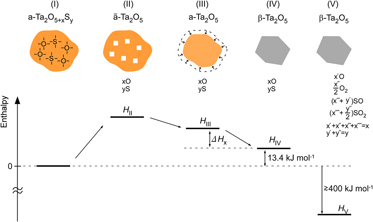
Amorphous Ta–O nanotubes (NTs) prepared by anodization in a sulfuric-acid-based solution have been found to contain considerable amounts of extra oxygen and sulfur. Their structural and thermal stability has been studied by combining x-ray diffractometry, transmission electron microscopy, and thermal analysis. The amorphous Ta–O, whose composition was estimated to be Ta2O6.6S0.7, crystallizes into orthorhombic β-Ta2O5 at temperatures around 1073 K by an endothermic reaction, at which excess oxygen and impurity sulfur are released. The amorphous NTs were found to be thermally more stable than stoichiometric amorphous Ta2O5, whose crystallization temperature is around 973 K. Excess oxygen and impurity sulfur, which form chemical bonds with Ta atoms in the amorphous solid, must be the origin of the stability. The crystallization follows the out-diffusion of oxygen and sulfur from the solid at temperatures where the mobility of atoms is high enough, indicating that the crystallization is kinetically arrested.
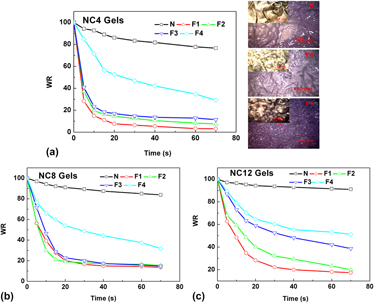
To prepare hydrogels with ultrarapid response rate and excellent mechanical properties, the poly(N-isopropylacrylamide)/clay nanocomposite hydrogels were synthesized by freezing polymerization technique. The start freezing time, as an important parameter determining the properties of gels, was designed and investigated. The results showed that the properties of gels including mechanical properties, swelling ratio, and swelling/deswelling rate were closely dependent on the freezing polymerization time. Comparably, the gels synthesized with earlier freezing time exhibit a faster swelling rate and an ultrarapid deswelling rate due to the integral interconnecting porous structure, while the swelling ratio, tensile strength and modulus decrease considerably. With the delay of start freezing time, the response rate decreases while the mechanical properties improve. Through the analysis of scanning electron microscope, differential scanning calorimetry, x-ray diffraction, dynamic rheological tests, and mechanical tests, the relevance of gels' structure with the freezing time was explored. It is reasonably presumed that freezing process impacts the effective crosslink of polymer chains by clay significantly, the earlier the freezing started, the more chains with free end existed in gels.
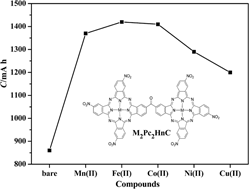
A novel series of binuclear transition metal phthalocyanines M2Pc2HnC (M = Mn(II), Fe(II), Co(II), Ni(II), and Cu(II)) were developed for highly efficient electrocatalysts to lithium/thionyl chloride (Li/SOCl2) battery. The capacity of the battery can increase approximately by 40–65% when the binuclear compounds are present in the electrolyte of the battery. To investigate the effect of the binuclear metal phthalocyanines on Li/SOCl2 battery further, this work studied the electrocatalytic reaction of the binuclear compounds to the battery by electrochemical methods (cyclic voltammetry) and other characterization means. The results demonstrate that the order of the electrocatalytic activity of the binuclear compounds with diverse center metal ions is: Fe(II) > Co(II) > Mn(II) > Ni(II) > Cu(II).
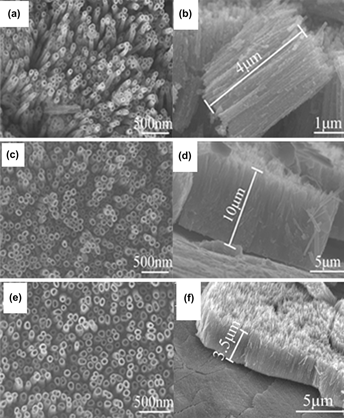
The well-ordered TiO2 nanotube arrays with controlled aspect ratio arefabricated via potentiostatic anodization. The aspect ratio of TiO2nanotube array can be tuned conveniently by changing the water content inelectrolyte and anodization time. The formation of well-ordered TiO2nanotube array is good for the photogenerated electron transfer. So, thewell-ordered TiO2 nanotube array photoelectrodes have been used tofabricate dye-sensitized solar cells (DSSCs). It is found that, with the optimumnanotube length and aspect ratio, DSSCs with TiO2 nanotube arrayphotoelectrodes show better photoelectric conversion efficiency (2.60%) thanthat with TiO2 nanoparticles on Ti foil photoelectrode. It iselucidated by the interfacial electron transport of DSSCs, which arecharacterized quantitatively, using the electrochemical impedance spectra. TheDSSC with optimal nanotube length and aspect ratio displays the fastestinterfacial electron transfer and longer electron lifetime.
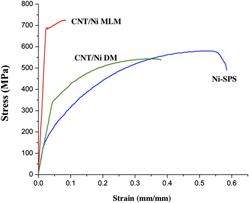
Two types of carbon nanotube reinforced nickel (CNT/Ni) nanocomposites were processed, both involving spark plasma sintering (SPS) of precursor powders consisting of nickel and carbon nanotubes. The first type involved simple mechanical dry milling of nickel and CNT powders, followed by sintering using SPS, resulting in nanocomposites exhibiting a tensile yield strength of 350 MPa (about two times that of SPS processed monolithic nickel with a strength of 160 MPa) and about 30% elongation to failure. In contrast, the nanocomposites processed by SPS of powders prepared by molecular-level mixing (MLM) exhibited substantially higher tensile yield strength of 690 MPa but limited ductility with an 8% elongation to failure. While the former type of processing involving dry-milling is expected to be lower in cost as well as easy to scale-up, the latter type of processing technique involving MLM leads to a more homogeneous distribution of nanotubes, leading to extraordinarily high strength levels.
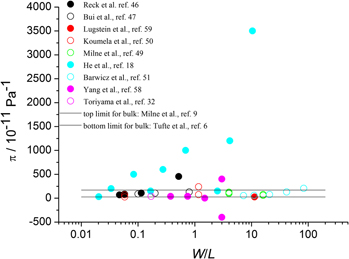
Piezoresistance (PZR) is the change in the electrical resistivity of a solid induced by an applied mechanical stress. Its origin in bulk crystalline materials like silicon is principally a change in the electronic structure which leads to a modification of the effective mass of charge carriers. The past few years have seen a rising interest in the PZR properties of semiconductor nanostructures, motivated in part by claims of a giant PZR (GPZR) in silicon nanowires more than two orders of magnitude bigger than the known bulk effect. This review aims to present the controversy surrounding claims and counterclaims of GPZR in silicon nanostructures by summarizing the major works carried out over the past 10 years. The main conclusions to be drawn from the literature are that (i) reproducible evidence for a GPZR in ungated nanowires is limited; (ii) in gated nanowires, GPZR has been reproduced by several authors; (iii) the giant effect is fundamentally different from either the bulk silicon PZR or that resulting from quantum confinement, the evidence pointing to an electrostatic origin; (iv) released nanowires tend to have slightly larger PZR than unreleased nanowires; and (v) insufficient work has been performed on bottom-up grown nanowires to be able to rule out a fundamental difference in their properties when compared with top-down nanowires. On the basis of this, future possible research directions are suggested.
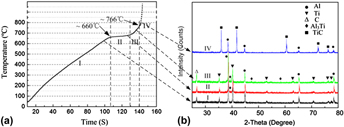
This research discussed how to synthesize submicrometer-sized TiC particulate reinforcement in the molten aluminum melt at low temperature via combustion synthesis by using in situ casting technique. A high temperature preheating treatment of Al–Ti–C pellets was carried out, by which the thermal explosion reaction of the pellets could take place in the pure aluminum melt at 750 °C. The synthesizing temperature of TiC particles was reduced by at least 150 °C compared with the conventional methods. In situ formed TiC particles were spherical in shape and were smaller than 1 µm in size due to the low melting temperature. The emergence of liquid aluminum phase led to the generation and accumulation of plenty of heat in the pellet in a short time due to the reactive diffusion of Al(l)–Ti(s). The formation mechanism of the submicrometer-sized TiC particles in the molten aluminum at low temperature was discussed in this research.
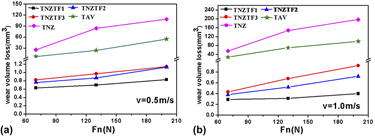
Tribological behavior of biomedical ultrafine-grained (UFGed) TiNbZrTaFe (TNZTF) composites fabricated by powder metallurgy was investigated under dry wear condition. Results show that compared with two kinds of conventional biomedical Ti–6Al–4V (TAV) and Ti–13Nb–13Zr (TNZ) alloys, the wear loss of the TNZTF samples is only 3.5% and 1% of that of the TAV and TNZ samples, respectively. Unusual tribological behavior is that the wear loss of the TNZTF samples decreases with the increase in sliding speed at the same load. This is attributed to the formation of a large amount of hard Nb2O5 particles on the contact surface of the material during rubbing and more severe plastic deformation in the material layers adjacent to the contact surfaces. The wear mechanism of the three kinds of alloys was also investigated. The outstanding tribological property proves that the UFGed TNZTF alloys should be an excellent candidate material to be used for biomedical application in the future.
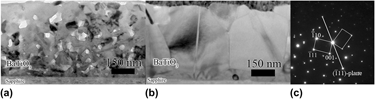
A low-temperature thin-film processing method for BaTiO3 is studied to understand microstructure development in the presence of a liquid-forming phase. The addition of a eutectic barium borate flux is found to prevent nucleation of BaTiO3 during pulsed-laser deposition on sapphire substrates at 400 °C. Subsequent thermal annealing above the flux's eutectic temperature dramatically enhances the film's microstructural development and crystallinity. A secondary reaction phase of barium aluminate is identified at the substrate interface in both unfluxed and fluxed films, although it is more pronounced in the fluxed films. This barium aluminate phase in conjunction with the liquid flux serves to nucleate {111} twins in the barium titanate, which subsequently lead to enhanced grain growth. The resulting large-grained and dense thin films result in markedly improved dielectric properties.
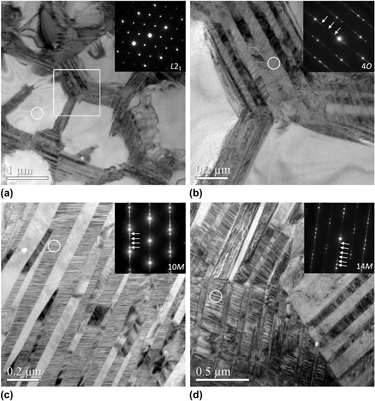
Heusler Ni–Mn–(Ga, In, Sn, Sb) materials can provide large magnetic-field-induced strain, giant magnetocaloric and magnetoresistance effects based on their first-order solid-state martensitic transformation. In the present work, effects of Co doping on martensitic transformation behavior in melt-spun Ni–Mn–Sn ribbons were studied by x-ray diffraction, scanning/transmission electron microscopy, and thermal analysis. Experimental results showed that both martensitic transition and austenite Curie temperatures increased linearly with Co addition to Ni49Mn39Sn12; and meanwhile, crystal structures of the martensite evolved from four-layered orthorhombic (4O) to five-layered orthorhombic (10M), and then seven-layered monoclinic (14M). The compositional dependence of the martensitic transition temperatures was well correlated with changes of valence electron concentration (e/a) and unit-cell volume of high-temperature austenite. It was proposed that both increase of valence electron concentration and shrinkage of austenite unit-cell volume with Co addition are favorable to the occurrence of martensitic transformation. In addition, the Curie temperature of austenite increases with Co addition, which was ascribed to the enhancement of ferromagnetic exchange interaction.
The optoelectronic and thermal properties of conjugated polymers are frequently tuned via direct synthetic modification of the conjugated repeat unit. It is also well known that these properties are inherently tied to the crystal structure, a factor which is difficult to predict upon slight chemical modification. We show that the crystal structure of random copolymers of 3-alkylthiophenes can be controlled, which in turn affects the optoelectronic properties. Furthermore, we show that the melting transitions smoothly vary between that of the two homopolymers. As such, the composition of copolymers is a convenient handle to predictably control the thermal properties, crystalline morphology, and optoelectronic properties simultaneously.
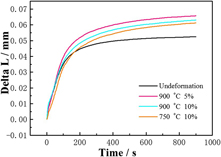
Various heat treatments and thermal simulation with different austenitizing temperatures and austenite deformation were applied on a bearing steel to obtain various austenitic state. The effect of austenitic state on microstructure of martensite/bainite (M/B) dual phase steel and its mechanical property has been investigated via microstructure observation and kinetic analysis. The results show that the M/B steels austenitized at 900 and 950 °C have better comprehensive performance compared with the steels austenitized at 850 and 1050 °C. The refined microstructure can be obtained after deformation, and the heavy deformation and low deformation temperature are useful for refining the microstructure. The bainite lath is longer and has well-directional arrangement at high austenitizing temperature with the same deformation. Furthermore, austenite deformation can improve the nucleation ratio, reduce incubation process, and affect the kinetics of bainite transformation significantly.
A simple method was used to electrodeposit a metallic coating on vertically aligned carbon nanotube (CNT) arrays, herein referred to as turfs, creating an open cell, core–shell foam. The foam exhibited highly elastic behavior, approaching the amount of elastic recovery in compression of a pure CNT turf. The turfs were pre-treated with an acid bath, and were electroplated at low voltages with nickel and copper. This simple method can be expanded to prepare a large variety of nanostructured foams (e.g., the carbon support can be changed, the metal deposited selected and its thickness controlled) while maintaining their mechanical robustness.