Refine search
Actions for selected content:
26077 results in Abstract analysis
RECURSION FOR MASUR-VEECH VOLUMES OF MODULI SPACES OF QUADRATIC DIFFERENTIALS
- Part of
-
- Journal:
- Journal of the Institute of Mathematics of Jussieu / Volume 21 / Issue 4 / July 2022
- Published online by Cambridge University Press:
- 08 January 2021, pp. 1471-1476
- Print publication:
- July 2022
-
- Article
- Export citation
-
We derive a quadratic recursion relation for the linear Hodge integrals of the form $\langle \tau _{2}^{n}\lambda _{k}\rangle $. These numbers are used in a formula for Masur-Veech volumes of moduli spaces of quadratic differentials discovered by Chen, Möller and Sauvaget. Therefore, our recursion provides an efficient way of computing these volumes.

VARIATION ON A THEME BY KISELEV AND NAZAROV: HÖLDER ESTIMATES FOR NONLOCAL TRANSPORT-DIFFUSION, ALONG A NON-DIVERGENCE-FREE BMO FIELD
- Part of
-
- Journal:
- Journal of the Institute of Mathematics of Jussieu / Volume 21 / Issue 5 / September 2022
- Published online by Cambridge University Press:
- 08 January 2021, pp. 1651-1675
- Print publication:
- September 2022
-
- Article
- Export citation
The length of an s-increasing sequence of r-tuples
- Part of
-
- Journal:
- Combinatorics, Probability and Computing / Volume 30 / Issue 5 / September 2021
- Published online by Cambridge University Press:
- 08 January 2021, pp. 686-721
-
- Article
- Export citation
ATIYAH CLASS AND CHERN CHARACTER FOR GLOBAL MATRIX FACTORISATIONS
- Part of
-
- Journal:
- Journal of the Institute of Mathematics of Jussieu / Volume 21 / Issue 4 / July 2022
- Published online by Cambridge University Press:
- 08 January 2021, pp. 1445-1470
- Print publication:
- July 2022
-
- Article
- Export citation
Bohr phenomenon for operator-valued functions
- Part of
-
- Journal:
- Proceedings of the Edinburgh Mathematical Society / Volume 64 / Issue 1 / February 2021
- Published online by Cambridge University Press:
- 08 January 2021, pp. 72-86
-
- Article
- Export citation
LOSIK CLASSES FOR CODIMENSION-ONE FOLIATIONS
- Part of
-
- Journal:
- Journal of the Institute of Mathematics of Jussieu / Volume 21 / Issue 4 / July 2022
- Published online by Cambridge University Press:
- 08 January 2021, pp. 1391-1419
- Print publication:
- July 2022
-
- Article
- Export citation
Large deviations for a class of tempered subordinators and their inverse processes
- Part of
-
- Journal:
- Proceedings of the Royal Society of Edinburgh. Section A: Mathematics / Volume 151 / Issue 6 / December 2021
- Published online by Cambridge University Press:
- 08 January 2021, pp. 2030-2050
- Print publication:
- December 2021
-
- Article
- Export citation
Asymptotic stability of spatial homogeneity in a haptotaxis model for oncolytic virotherapy
- Part of
-
- Journal:
- Proceedings of the Royal Society of Edinburgh. Section A: Mathematics / Volume 152 / Issue 1 / February 2022
- Published online by Cambridge University Press:
- 08 January 2021, pp. 81-101
- Print publication:
- February 2022
-
- Article
- Export citation
-
This study considers a model for oncolytic virotherapy, as given by the reaction–diffusion–taxis system
in a smoothly bounded domain Ω ⊂ ℝ2, with parameters Dw > 0, Dz > 0, β > 0 and ρ ⩾ 0.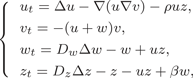 \[\begin{eqnarray*} \left\{ \begin{array}{l} u_t = \Delta u - \nabla (u\nabla v)-\rho uz, \\ v_t = - (u+w)v, \\ w_t = D_w \Delta w - w + uz, \\ z_t = D_z \Delta z - z - uz + \beta w, \end{array} \right. \end{eqnarray*}\]
Previous analysis has asserted that for all reasonably regular initial data, an associated no-flux type initial-boundary value problem admits a global classical solution, and that this solution is bounded if β < 1, whereas whenever β > 1 and $({1}/{|\Omega |})\int _\Omega u(\cdot ,0) > 1/(\beta -1)$, infinite-time blow-up occurs at least in the particular case when ρ = 0.
In order to provide an appropriate complement to this, the current study reveals that for any ρ ⩾ 0 and arbitrary β > 0, at each prescribed level γ ∈ (0, 1/(β − 1)+) one can identify an L∞-neighbourhood of the homogeneous distribution (u, v, w, z) ≡ (γ, 0, 0, 0) within which all initial data lead to globally bounded solutions that stabilize towards the constant equilibrium (u∞, 0, 0, 0) with some u∞ > 0.
ON A CERTAIN LOCAL IDENTITY FOR LAPID–MAO’S CONJECTURE AND FORMAL DEGREE CONJECTURE : EVEN UNITARY GROUP CASE
- Part of
-
- Journal:
- Journal of the Institute of Mathematics of Jussieu / Volume 21 / Issue 4 / July 2022
- Published online by Cambridge University Press:
- 08 January 2021, pp. 1107-1161
- Print publication:
- July 2022
-
- Article
- Export citation
PEM series 2 volume 63 issue 4 Cover and Front matter
-
- Journal:
- Proceedings of the Edinburgh Mathematical Society / Volume 63 / Issue 4 / November 2020
- Published online by Cambridge University Press:
- 07 January 2021, pp. f1-f2
-
- Article
-
- You have access
- Export citation
PEM series 2 volume 63 issue 4 Cover and Back matter
-
- Journal:
- Proceedings of the Edinburgh Mathematical Society / Volume 63 / Issue 4 / November 2020
- Published online by Cambridge University Press:
- 07 January 2021, pp. b1-b2
-
- Article
-
- You have access
- Export citation
JMJ volume 20 Issue 1 Cover and Front matter
-
- Journal:
- Journal of the Institute of Mathematics of Jussieu / Volume 20 / Issue 1 / January 2021
- Published online by Cambridge University Press:
- 26 January 2021, pp. f1-f2
- Print publication:
- January 2021
-
- Article
-
- You have access
- Export citation
JMJ volume 20 Issue 1 Cover and Back matter
-
- Journal:
- Journal of the Institute of Mathematics of Jussieu / Volume 20 / Issue 1 / January 2021
- Published online by Cambridge University Press:
- 26 January 2021, pp. b1-b2
- Print publication:
- January 2021
-
- Article
-
- You have access
- Export citation
Graph interpolating activation improves both natural and robust accuracies in data-efficient deep learning
- Part of
-
- Journal:
- European Journal of Applied Mathematics / Volume 32 / Issue 3 / June 2021
- Published online by Cambridge University Press:
- 28 December 2020, pp. 540-569
-
- Article
- Export citation
A derivation of the Liouville equation for hard particle dynamics with non-conservative interactions
- Part of
-
- Journal:
- Proceedings of the Royal Society of Edinburgh. Section A: Mathematics / Volume 151 / Issue 3 / June 2021
- Published online by Cambridge University Press:
- 28 December 2020, pp. 1040-1074
- Print publication:
- June 2021
-
- Article
- Export citation
Existence and monotonicity of nonlocal boundary value problems: the one-dimensional case
- Part of
-
- Journal:
- Proceedings of the Royal Society of Edinburgh. Section A: Mathematics / Volume 152 / Issue 1 / February 2022
- Published online by Cambridge University Press:
- 23 December 2020, pp. 1-27
- Print publication:
- February 2022
-
- Article
- Export citation
-
We consider nonlocal equations of the general form
By developing a Green's function representation for the solution of the boundary value problem we study existence, uniqueness, and qualitative properties (e.g., positivity or monotonicity) of solutions to these problems. We apply our methods to fractional order differential equations. We also demonstrate an application of our methodology both to convolution equations with nonlocal boundary conditions as well as those with a nonlocal term in the convolution equation itself. \begin{equation} \left(a*u''\right)(\cdot)+\lambda f\big(\cdot,u(\cdot)\big)=0.\nonumber \end{equation}
The convergence rate of the fast signal diffusion limit for a Keller–Segel–Stokes system with large initial data
- Part of
-
- Journal:
- Proceedings of the Royal Society of Edinburgh. Section A: Mathematics / Volume 151 / Issue 6 / December 2021
- Published online by Cambridge University Press:
- 23 December 2020, pp. 1972-2012
- Print publication:
- December 2021
-
- Article
- Export citation
A proposed screening algorithm for bone remodelling
- Part of
-
- Journal:
- European Journal of Applied Mathematics / Volume 32 / Issue 5 / October 2021
- Published online by Cambridge University Press:
- 23 December 2020, pp. 806-819
-
- Article
-
- You have access
- Open access
- Export citation
Mean-field models for segregation dynamics
- Part of
-
- Journal:
- European Journal of Applied Mathematics / Volume 33 / Issue 1 / February 2022
- Published online by Cambridge University Press:
- 23 December 2020, pp. 111-132
-
- Article
- Export citation
LOCALIZATION BY $2$-PERIODIC COMPLEXES AND VIRTUAL STRUCTURE SHEAVES
- Part of
-
- Journal:
- Journal of the Institute of Mathematics of Jussieu / Volume 21 / Issue 5 / September 2022
- Published online by Cambridge University Press:
- 22 December 2020, pp. 1477-1506
- Print publication:
- September 2022
-
- Article
- Export citation
-
In [12], Kim and the first author proved a result comparing the virtual fundamental classes of the moduli spaces of $\varepsilon $-stable quasimaps and $\varepsilon $-stable $LG$-quasimaps by studying localized Chern characters for $2$-periodic complexes.
In this paper, we study a K-theoretic analogue of the localized Chern character map and show that for a Koszul $2$-periodic complex it coincides with the cosection-localized Gysin map of Kiem and Li [11]. As an application, we compare the virtual structure sheaves of the moduli space of $\varepsilon $-stable quasimaps and $\varepsilon $-stable $LG$-quasimaps.


