Refine search
Actions for selected content:
26076 results in Abstract analysis
7 - Zel’manov approach
-
- Book:
- Non-Associative Normed Algebras
- Published online:
- 20 April 2018
- Print publication:
- 12 April 2018, pp 437-476
-
- Chapter
- Export citation
5 - Non-commutative JBW∗-algebras, JB∗-triples revisited, and a unit-free Vidav–Palmer type non-associative theorem
-
- Book:
- Non-Associative Normed Algebras
- Published online:
- 20 April 2018
- Print publication:
- 12 April 2018, pp 1-346
-
- Chapter
- Export citation
Assouad dimensions of complementary sets
- Part of
-
- Journal:
- Proceedings of the Royal Society of Edinburgh. Section A: Mathematics / Volume 148 / Issue 3 / June 2018
- Published online by Cambridge University Press:
- 12 April 2018, pp. 517-540
- Print publication:
- June 2018
-
- Article
- Export citation
References
-
- Book:
- Non-Associative Normed Algebras
- Published online:
- 20 April 2018
- Print publication:
- 12 April 2018, pp 664-714
-
- Chapter
- Export citation
Symbol index for Volume 1
-
- Book:
- Non-Associative Normed Algebras
- Published online:
- 20 April 2018
- Print publication:
- 12 April 2018, pp 715-718
-
- Chapter
- Export citation
Contents for Volume 2
-
- Book:
- Non-Associative Normed Algebras
- Published online:
- 20 April 2018
- Print publication:
- 12 April 2018, pp vii-x
-
- Chapter
- Export citation
Ewens Sampling and Invariable Generation
-
- Journal:
- Combinatorics, Probability and Computing / Volume 27 / Issue 6 / November 2018
- Published online by Cambridge University Press:
- 12 April 2018, pp. 853-891
-
- Article
- Export citation
A Remark on Configuration Spaces of Two Points
- Part of
-
- Journal:
- Proceedings of the Edinburgh Mathematical Society / Volume 61 / Issue 2 / May 2018
- Published online by Cambridge University Press:
- 11 April 2018, pp. 599-605
-
- Article
- Export citation
Ulam stability for some classes of C*-algebras
- Part of
-
- Journal:
- Proceedings of the Royal Society of Edinburgh. Section A: Mathematics / Volume 149 / Issue 1 / February 2019
- Published online by Cambridge University Press:
- 10 April 2018, pp. 45-59
- Print publication:
- February 2019
-
- Article
- Export citation
An Inductive Julia-Carathéodory Theorem for Pick Functions in Two Variables
- Part of
-
- Journal:
- Proceedings of the Edinburgh Mathematical Society / Volume 61 / Issue 3 / August 2018
- Published online by Cambridge University Press:
- 10 April 2018, pp. 647-660
-
- Article
- Export citation
GMJ volume 60 issue 2 Cover and Back matter
-
- Journal:
- Glasgow Mathematical Journal / Volume 60 / Issue 2 / May 2018
- Published online by Cambridge University Press:
- 10 April 2018, pp. b1-b2
-
- Article
-
- You have access
- Export citation
On The Uniqueness of Solutions for Kawahara Type Equations
- Part of
-
- Journal:
- Proceedings of the Edinburgh Mathematical Society / Volume 61 / Issue 3 / August 2018
- Published online by Cambridge University Press:
- 10 April 2018, pp. 623-646
-
- Article
- Export citation
Rational Cup Product and Algebraic K0-Groups of Rings of Continuous Functions
- Part of
-
- Journal:
- Proceedings of the Edinburgh Mathematical Society / Volume 61 / Issue 3 / August 2018
- Published online by Cambridge University Press:
- 10 April 2018, pp. 607-622
-
- Article
- Export citation
Lifespan of solutions to wave equations in de Sitter spacetime
- Part of
-
- Journal:
- Proceedings of the Royal Society of Edinburgh. Section A: Mathematics / Volume 148 / Issue 6 / December 2018
- Published online by Cambridge University Press:
- 10 April 2018, pp. 1313-1330
- Print publication:
- December 2018
-
- Article
- Export citation
-
We consider the finite-time blow-up of solutions for the following two kinds of nonlinear wave equation in de Sitter spacetime:
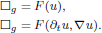
This proof is based on a new blow-up criterion, which generalizes that by Sideris. Furthermore, we give the lifespan estimate of solutions for the problems.
 $L^{p}$ ESTIMATES FOR THE HOMOGENIZATION OF STOKES PROBLEM IN A PERFORATED DOMAIN
- Part of
-
- Journal:
- Journal of the Institute of Mathematics of Jussieu / Volume 19 / Issue 1 / January 2020
- Published online by Cambridge University Press:
- 10 April 2018, pp. 231-258
- Print publication:
- January 2020
-
- Article
- Export citation
-
In this paper, we consider the Stokes equations in a perforated domain. When the number of holes increases while their radius tends to 0, it is proven in Desvillettes et al. [J. Stat. Phys. 131 (2008) 941–967], under suitable dilution assumptions, that the solution is well approximated asymptotically by solving a Stokes–Brinkman equation. We provide here quantitative estimates in $L^{p}$-norms of this convergence.


GMJ volume 60 issue 2 Cover and Front matter
-
- Journal:
- Glasgow Mathematical Journal / Volume 60 / Issue 2 / May 2018
- Published online by Cambridge University Press:
- 10 April 2018, pp. f1-f2
-
- Article
-
- You have access
- Export citation
A COMPACTNESS THEOREM FOR SURFACES WITH BOUNDED INTEGRAL CURVATURE
- Part of
-
- Journal:
- Journal of the Institute of Mathematics of Jussieu / Volume 19 / Issue 2 / March 2020
- Published online by Cambridge University Press:
- 10 April 2018, pp. 597-645
- Print publication:
- March 2020
-
- Article
- Export citation
-
We prove a compactness theorem for metrics with bounded integral curvature on a fixed closed surface $\unicode[STIX]{x1D6F4}$. As a corollary we obtain a new convergence result for sequences of metrics with conical singularities, where an accumulation of singularities is allowed.

Twisted Brauer monoids
- Part of
-
- Journal:
- Proceedings of the Royal Society of Edinburgh. Section A: Mathematics / Volume 148 / Issue 4 / August 2018
- Published online by Cambridge University Press:
- 10 April 2018, pp. 731-750
- Print publication:
- August 2018
-
- Article
- Export citation
-
We investigate the structure of the twisted Brauer monoid
 , comparing and contrasting it with the structure of the (untwisted) Brauer monoid
  . We characterize Green's relations and pre-orders on , describe the lattice of ideals and give necessary and sufficient conditions for an ideal to be idempotent generated. We obtain formulae for the rank (smallest size of a generating set) and (where applicable) the idempotent rank (smallest size of an idempotent generating set) of each principal ideal; in particular, when an ideal is idempotent generated, its rank and idempotent rank are equal. As an application of our results, we describe the idempotent generated subsemigroup of (which is not an ideal), as well as the singular ideal of (which is neither principal nor idempotent generated), and we deduce that the singular part of the Brauer monoid is idempotent generated, a result previously proved by Maltcev and Mazorchuk.
 , comparing and contrasting it with the structure of the (untwisted) Brauer monoid
  . We characterize Green's relations and pre-orders on
 Invasion moving boundary problem for a biofilm reactor model
-
- Journal:
- European Journal of Applied Mathematics / Volume 29 / Issue 6 / December 2018
- Published online by Cambridge University Press:
- 05 April 2018, pp. 1079-1109
-
- Article
-
- You have access
- Export citation
Non-smooth homoclinic bifurcation in a conceptual climate model
-
- Journal:
- European Journal of Applied Mathematics / Volume 29 / Issue 5 / October 2018
- Published online by Cambridge University Press:
- 05 April 2018, pp. 891-904
-
- Article
-
- You have access
- Export citation
