Refine search
Actions for selected content:
26076 results in Abstract analysis
UNIVERSAL COVERS OF COMMUTATIVE FINITE MORLEY RANK GROUPS
- Part of
-
- Journal:
- Journal of the Institute of Mathematics of Jussieu / Volume 19 / Issue 3 / May 2020
- Published online by Cambridge University Press:
- 26 April 2018, pp. 767-799
- Print publication:
- May 2020
-
- Article
- Export citation
Sharp decay estimates in a bioconvection model with quadratic degradation in bounded domains
- Part of
-
- Journal:
- Proceedings of the Royal Society of Edinburgh. Section A: Mathematics / Volume 148 / Issue 5 / October 2018
- Published online by Cambridge University Press:
- 25 April 2018, pp. 939-955
- Print publication:
- October 2018
-
- Article
- Export citation
-
The paper studies large time behaviour of solutions to the Keller–Segel system with quadratic degradation in a liquid environment, as given by

under Neumann boundary conditions in a bounded domain Ω ⊂ ℝn, where n ≥ 1 is arbitrary. It is shown that whenever U : Ω × (0,∞) → ℝn is a bounded and sufficiently regular solenoidal vector field any non-trivial global bounded solution of (⋆) approaches the trivial equilibrium at a rate that, with respect to the norm in either of the spaces L1(Ω) and L∞(Ω), can be controlled from above and below by appropriate multiples of 1/(t + 1). This underlines that, even up to this quantitative level of accuracy, the large time behaviour in (⋆) is essentially independent not only of the particular fluid flow, but also of any effect originating from chemotactic cross-diffusion. The latter is in contrast to the corresponding Cauchy problem, for which known results show that in the n = 2 case the presence of chemotaxis can significantly enhance biomixing by reducing the respective spatial L1 norms of solutions.
JMJ volume 17 Issue 3 Cover and Back matter
-
- Journal:
- Journal of the Institute of Mathematics of Jussieu / Volume 17 / Issue 3 / June 2018
- Published online by Cambridge University Press:
- 23 April 2018, pp. b1-b5
- Print publication:
- June 2018
-
- Article
-
- You have access
- Export citation
JMJ volume 17 Issue 3 Cover and Front matter
-
- Journal:
- Journal of the Institute of Mathematics of Jussieu / Volume 17 / Issue 3 / June 2018
- Published online by Cambridge University Press:
- 23 April 2018, pp. f1-f2
- Print publication:
- June 2018
-
- Article
-
- You have access
- Export citation
UNRAMIFIEDNESS OF GALOIS REPRESENTATIONS ATTACHED TO HILBERT MODULAR FORMS MOD $p$ OF WEIGHT 1
- Part of
-
- Journal:
- Journal of the Institute of Mathematics of Jussieu / Volume 19 / Issue 2 / March 2020
- Published online by Cambridge University Press:
- 23 April 2018, pp. 281-306
- Print publication:
- March 2020
-
- Article
- Export citation
-
The main result of this article states that the Galois representation attached to a Hilbert modular eigenform defined over $\overline{\mathbb{F}}_{p}$ of parallel weight 1 and level prime to $p$ is unramified above $p$. This includes the important case of eigenforms that do not lift to Hilbert modular forms in characteristic 0 of parallel weight 1. The proof is based on the observation that parallel weight 1 forms in characteristic $p$ embed into the ordinary part of parallel weight $p$ forms in two different ways per prime dividing $p$, namely via ‘partial’ Frobenius operators.


Systematic derivation of a surface polarisation model for planar perovskite solar cells
-
- Journal:
- European Journal of Applied Mathematics / Volume 30 / Issue 3 / June 2019
- Published online by Cambridge University Press:
- 22 April 2018, pp. 427-457
-
- Article
-
- You have access
- Open access
- Export citation
A weighted weak-type bound for Haar multipliers
- Part of
-
- Journal:
- Proceedings of the Royal Society of Edinburgh. Section A: Mathematics / Volume 148 / Issue 3 / June 2018
- Published online by Cambridge University Press:
- 22 April 2018, pp. 643-658
- Print publication:
- June 2018
-
- Article
- Export citation
-
We study a weighted maximal weak-type inequality for Haar multipliers that can be regarded as a dual problem of Muckenhoupt and Wheeden. More precisely, if Tε is the Haar multiplier associated with the sequence ε with values in [−1, 1], and
 is the r-maximal operator, then for any weight w and any function f on [0, 1) we have
for some constant Cr depending only on r. We also show that the analogous result does not hold if we replace
by the dyadic maximal operator Md. The proof rests on the Bellman function method; using this technique we establish related weighted Lp estimates for p close to 1, and then deduce the main result by extrapolation arguments.
 is the r-maximal operator, then for any weight w and any function f on [0, 1) we have
KOSZUL CALCULUS – ADDENDUM
-
- Journal:
- Glasgow Mathematical Journal / Volume 61 / Issue 1 / January 2019
- Published online by Cambridge University Press:
- 22 April 2018, p. 249
-
- Article
-
- You have access
- Export citation
Classification of extinction profiles for a one-dimensional diffusive Hamilton–Jacobi equation with critical absorption
- Part of
-
- Journal:
- Proceedings of the Royal Society of Edinburgh. Section A: Mathematics / Volume 148 / Issue 3 / June 2018
- Published online by Cambridge University Press:
- 22 April 2018, pp. 559-574
- Print publication:
- June 2018
-
- Article
- Export citation
Poincaré inequalities for Sobolev spaces with matrix-valued weights and applications to degenerate partial differential equations
- Part of
-
- Journal:
- Proceedings of the Royal Society of Edinburgh. Section A: Mathematics / Volume 149 / Issue 1 / February 2019
- Published online by Cambridge University Press:
- 22 April 2018, pp. 61-100
- Print publication:
- February 2019
-
- Article
- Export citation
Density of Chromatic Roots in Minor-Closed Graph Families
- Part of
-
- Journal:
- Combinatorics, Probability and Computing / Volume 27 / Issue 6 / November 2018
- Published online by Cambridge University Press:
- 22 April 2018, pp. 988-998
-
- Article
- Export citation
Multicolour Sunflowers
- Part of
-
- Journal:
- Combinatorics, Probability and Computing / Volume 27 / Issue 6 / November 2018
- Published online by Cambridge University Press:
- 22 April 2018, pp. 974-987
-
- Article
- Export citation
-
A sunflower is a collection of distinct sets such that the intersection of any two of them is the same as the common intersection C of all of them, and |C| is smaller than each of the sets. A longstanding conjecture due to Erdős and Szemerédi (solved recently in [7, 9]; see also [22]) was that the maximum size of a family of subsets of [n] that contains no sunflower of fixed size k > 2 is exponentially smaller than 2n as n → ∞. We consider the problems of determining the maximum sum and product of k families of subsets of [n] that contain no sunflower of size k with one set from each family. For the sum, we prove that the maximum is
for all n ⩾ k ⩾ 3, and for the k = 3 case of the product, we prove that the maximum is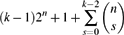 $$(k-1)2^n+1+\sum_{s=0}^{k-2}\binom{n}{s}$$We conjecture that for all fixed k ⩾ 3, the maximum product is (1/8+o(1))2kn.
 $$\biggl(\ffrac{1}{8}+o(1)\biggr)2^{3n}.$$

New relaxation theorems with applications to strong materials
- Part of
-
- Journal:
- Proceedings of the Royal Society of Edinburgh. Section A: Mathematics / Volume 148 / Issue 5 / October 2018
- Published online by Cambridge University Press:
- 22 April 2018, pp. 1029-1047
- Print publication:
- October 2018
-
- Article
- Export citation
Twisted Alexander invariants of complex hypersurface complements
- Part of
-
- Journal:
- Proceedings of the Royal Society of Edinburgh. Section A: Mathematics / Volume 148 / Issue 5 / October 2018
- Published online by Cambridge University Press:
- 22 April 2018, pp. 1049-1073
- Print publication:
- October 2018
-
- Article
- Export citation
On the existence of harmonic mappings between doubly connected domains
- Part of
-
- Journal:
- Proceedings of the Royal Society of Edinburgh. Section A: Mathematics / Volume 148 / Issue 3 / June 2018
- Published online by Cambridge University Press:
- 22 April 2018, pp. 619-628
- Print publication:
- June 2018
-
- Article
- Export citation
Affine focal sets of codimension-2 submanifolds contained in hypersurfaces
- Part of
-
- Journal:
- Proceedings of the Royal Society of Edinburgh. Section A: Mathematics / Volume 148 / Issue 5 / October 2018
- Published online by Cambridge University Press:
- 22 April 2018, pp. 995-1016
- Print publication:
- October 2018
-
- Article
- Export citation
-
In this paper we study the affine focal set, which is the bifurcation set of the affine distance to submanifolds Nn contained in hypersurfaces Mn+1 of the (n + 2)-space. We give conditions under which this affine focal set is a regular hypersurface and, for curves in 3-space, we describe its stable singularities. For a given Darboux vector field ξ of the immersion N ⊂ M, one can define the affine metric g and the affine normal plane bundle
 . We prove that the g-Laplacian of the position vector belongs to if and only if ξ is parallel. For umbilic and normally flat immersions, the affine focal set reduces to a single line. Submanifolds contained in hyperplanes or hyperquadrics are always normally flat. For N contained in a hyperplane L, we show that N ⊂ M is umbilic if and only if N ⊂ L is an affine sphere and the envelope of tangent spaces is a cone. For M hyperquadric, we prove that N ⊂ M is umbilic if and only if N is contained in a hyperplane. The main result of the paper is a general description of the umbilic and normally flat immersions: given a hypersurface f and a point O in the (n + 1)-space, the immersion (ν, ν · (f − O)), where ν is the co-normal of f, is umbilic and normally flat, and conversely, any umbilic and normally flat immersion is of this type.
 . We prove that the g-Laplacian of the position vector belongs to
 Time-dependent attractors for non-autonomous non-local reaction–diffusion equations
- Part of
-
- Journal:
- Proceedings of the Royal Society of Edinburgh. Section A: Mathematics / Volume 148 / Issue 5 / October 2018
- Published online by Cambridge University Press:
- 22 April 2018, pp. 957-981
- Print publication:
- October 2018
-
- Article
- Export citation

Non-Associative Normed Algebras
-
- Published online:
- 20 April 2018
- Print publication:
- 12 April 2018
Perforation conditions and almost algebraic order in Cuntz semigroups
- Part of
-
- Journal:
- Proceedings of the Royal Society of Edinburgh. Section A: Mathematics / Volume 148 / Issue 4 / August 2018
- Published online by Cambridge University Press:
- 18 April 2018, pp. 669-702
- Print publication:
- August 2018
-
- Article
- Export citation
-
For a C*-algebra A, determining the Cuntz semigroup Cu(A ⊗
 ) in terms of Cu(A) is an important problem, which we approach from the point of view of semigroup tensor products in the category of abstract Cuntz semigroups by analysing the passage of significant properties from Cu(A) to Cu(A)⊗Cu Cu(). We describe the effect of the natural map Cu(A) → Cu(A)⊗Cu Cu() in the order of Cu(A), and show that if A has real rank 0 and no elementary subquotients, Cu(A)⊗Cu Cu() enjoys the corresponding property of having a dense set of (equivalence classes of) projections. In the simple, non-elementary, real rank 0 and stable rank 1 situation, our investigations lead us to identify almost unperforation for projections with the fact that tensoring with is inert at the level of the Cuntz semigroup.
 ) in terms of Cu(A) is an important problem, which we approach from the point of view of semigroup tensor products in the category of abstract Cuntz semigroups by analysing the passage of significant properties from Cu(A) to Cu(A)⊗
Deforming an є-close-to-hyperbolic metric to a hyperbolic metric
- Part of
-
- Journal:
- Proceedings of the Royal Society of Edinburgh. Section A: Mathematics / Volume 148 / Issue 3 / June 2018
- Published online by Cambridge University Press:
- 18 April 2018, pp. 629-641
- Print publication:
- June 2018
-
- Article
- Export citation
-
We show how to deform a metric of the form g = gr + dr2 to a metric
 = Hr + dr2, which is a hyperbolic metric for r less than some fixed λ, and coincides with g for r large. Here by hyperbolic metric we mean a metric of constant sectional curvature equal to -1. We study the extent to which is close to hyperbolic everywhere, if we assume g is close to hyperbolic. A precise definition of the close to hyperbolic concept is given. We also deal with a one-parameter version of this problem. The results in this paper are used in the problem of smoothing Charney–Davis strict hyperbolizations.
 = H
= H