Refine search
Actions for selected content:
26076 results in Abstract analysis
INTEGRAL AND ADELIC ASPECTS OF THE MUMFORD–TATE CONJECTURE
- Part of
-
- Journal:
- Journal of the Institute of Mathematics of Jussieu / Volume 19 / Issue 3 / May 2020
- Published online by Cambridge University Press:
- 07 June 2018, pp. 869-890
- Print publication:
- May 2020
-
- Article
- Export citation
-
Let $Y$ be an abelian variety over a subfield $k\subset \mathbb{C}$ that is of finite type over $\mathbb{Q}$. We prove that if the Mumford–Tate conjecture for $Y$ is true, then also some refined integral and adelic conjectures due to Serre are true for $Y$. In particular, if a certain Hodge-maximality condition is satisfied, we obtain an adelic open image theorem for the Galois representation on the (full) Tate module of $Y$. We also obtain an (unconditional) adelic open image theorem for K3 surfaces. These results are special cases of a more general statement for the image of a natural adelic representation of the fundamental group of a Shimura variety.


Asymptotic models for transport in large aspect ratio nanopores
-
- Journal:
- European Journal of Applied Mathematics / Volume 30 / Issue 3 / June 2019
- Published online by Cambridge University Press:
- 06 June 2018, pp. 557-584
-
- Article
-
- You have access
- Export citation
Macroscopic models for calcium carbonate corrosion due to sulfation. Variation of diffusion and volume expansion
-
- Journal:
- European Journal of Applied Mathematics / Volume 30 / Issue 3 / June 2019
- Published online by Cambridge University Press:
- 06 June 2018, pp. 529-556
-
- Article
- Export citation
Mathematical model of biofilm-mediated pathogen persistence in a water distribution network with time-constant flows
-
- Journal:
- European Journal of Applied Mathematics / Volume 29 / Issue 6 / December 2018
- Published online by Cambridge University Press:
- 06 June 2018, pp. 991-1019
-
- Article
-
- You have access
- Export citation
Indistinguishable Sceneries on the Boolean Hypercube
- Part of
-
- Journal:
- Combinatorics, Probability and Computing / Volume 28 / Issue 1 / January 2019
- Published online by Cambridge University Press:
- 05 June 2018, pp. 46-60
-
- Article
- Export citation
Models for the two-phase flow of concentrated suspensions
-
- Journal:
- European Journal of Applied Mathematics / Volume 30 / Issue 3 / June 2019
- Published online by Cambridge University Press:
- 04 June 2018, pp. 585-617
-
- Article
- Export citation
SYMMETRIC OPERADS IN ABSTRACT SYMMETRIC SPECTRA
- Part of
-
- Journal:
- Journal of the Institute of Mathematics of Jussieu / Volume 18 / Issue 4 / July 2019
- Published online by Cambridge University Press:
- 25 May 2018, pp. 707-758
- Print publication:
- July 2019
-
- Article
- Export citation
-
This paper sets up the foundations for derived algebraic geometry, Goerss–Hopkins obstruction theory, and the construction of commutative ring spectra in the abstract setting of operadic algebras in symmetric spectra in an (essentially) arbitrary model category. We show that one can do derived algebraic geometry a la Toën–Vezzosi in an abstract category of spectra. We also answer in the affirmative a question of Goerss and Hopkins by showing that the obstruction theory for operadic algebras in spectra can be done in the generality of spectra in an (essentially) arbitrary model category. We construct strictly commutative simplicial ring spectra representing a given cohomology theory and illustrate this with a strictly commutative motivic ring spectrum representing higher order products on Deligne cohomology. These results are obtained by first establishing Smith’s stable positive model structure for abstract spectra and then showing that this category of spectra possesses excellent model-theoretic properties: we show that all colored symmetric operads in symmetric spectra valued in a symmetric monoidal model category are admissible, i.e., algebras over such operads carry a model structure. This generalizes the known model structures on commutative ring spectra and $\text{E}_{\infty }$-ring spectra in simplicial sets or motivic spaces. We also show that any weak equivalence of operads in spectra gives rise to a Quillen equivalence of their categories of algebras. For example, this extends the familiar strictification of $\text{E}_{\infty }$-rings to commutative rings in a broad class of spectra, including motivic spectra. We finally show that operadic algebras in Quillen equivalent categories of spectra are again Quillen equivalent. This paper is also available at arXiv:1410.5699v2.


Fast Property Testing and Metrics for Permutations
- Part of
-
- Journal:
- Combinatorics, Probability and Computing / Volume 27 / Issue 4 / July 2018
- Published online by Cambridge University Press:
- 24 May 2018, pp. 539-579
-
- Article
- Export citation
Eigenvalue Ratios of Non-Negatively Curved Graphs
- Part of
-
- Journal:
- Combinatorics, Probability and Computing / Volume 27 / Issue 5 / September 2018
- Published online by Cambridge University Press:
- 23 May 2018, pp. 829-850
-
- Article
- Export citation
Generating Infinite Random Graphs
- Part of
-
- Journal:
- Proceedings of the Edinburgh Mathematical Society / Volume 61 / Issue 3 / August 2018
- Published online by Cambridge University Press:
- 22 May 2018, pp. 847-868
-
- Article
- Export citation
Cohomology of Flat Principal Bundles
- Part of
-
- Journal:
- Proceedings of the Edinburgh Mathematical Society / Volume 61 / Issue 3 / August 2018
- Published online by Cambridge University Press:
- 22 May 2018, pp. 869-877
-
- Article
- Export citation
Model Completeness for the Real Field with the Weierstrass ℘ Function
- Part of
-
- Journal:
- Proceedings of the Edinburgh Mathematical Society / Volume 61 / Issue 3 / August 2018
- Published online by Cambridge University Press:
- 21 May 2018, pp. 811-823
-
- Article
- Export citation
Phase Coexistence for the Hard-Core Model on ℤ2
- Part of
-
- Journal:
- Combinatorics, Probability and Computing / Volume 28 / Issue 1 / January 2019
- Published online by Cambridge University Press:
- 21 May 2018, pp. 1-22
-
- Article
- Export citation
Existence of a Solution for a Non-Local Problem in ℝN via Bifurcation Theory
- Part of
-
- Journal:
- Proceedings of the Edinburgh Mathematical Society / Volume 61 / Issue 3 / August 2018
- Published online by Cambridge University Press:
- 21 May 2018, pp. 825-845
-
- Article
- Export citation
-
In this paper, we study the existence of a solution for the following class of non-local problems:P
where N ≥ 3, λ > 0, γ ∈ [1, 2), f : ℝ → ℝ is a positive continuous function and K : ℝN × ℝN → ℝ is a non-negative function. The functions f and K satisfy some conditions that permit us to use bifurcation theory to prove the existence of a solution for (P).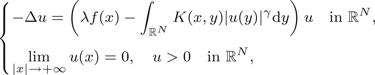 $$\eqalign{\big\{&-\Delta u=\left(\lambda f(x)-\int_{{open R}^N}K(x,y)\vert u(y)\vert ^{\gamma}\hbox{d}y\right)u\quad \mbox{in } \R^{N}, \cr &\lim_{\vert x\vert \to +\infty}u(x)=0,\quad u \gt 0 \quad \text{in } {open R}^{N},}$$
On the Number of Solutions in Random Graph k-Colouring
- Part of
-
- Journal:
- Combinatorics, Probability and Computing / Volume 28 / Issue 1 / January 2019
- Published online by Cambridge University Press:
- 21 May 2018, pp. 130-158
-
- Article
- Export citation
Volumes in the Uniform Infinite Planar Triangulation: From Skeletons to Generating Functions
- Part of
-
- Journal:
- Combinatorics, Probability and Computing / Volume 27 / Issue 6 / November 2018
- Published online by Cambridge University Press:
- 21 May 2018, pp. 946-973
-
- Article
- Export citation
Variable Hardy Spaces Associated with Operators Satisfying Davies–Gaffney Estimates
- Part of
-
- Journal:
- Proceedings of the Edinburgh Mathematical Society / Volume 61 / Issue 3 / August 2018
- Published online by Cambridge University Press:
- 21 May 2018, pp. 759-810
-
- Article
- Export citation
-
Let L be a one-to-one operator of type ω in L2(ℝn), with ω∈[0, π/2), which has a bounded holomorphic functional calculus and satisfies the Davies–Gaffney estimates. Let p(·): ℝn→(0, 1] be a variable exponent function satisfying the globally log-Hölder continuous condition. In this article, the authors introduce the variable Hardy space $H_L^{p(\cdot )} ({\open R}^n)$ associated with L. By means of variable tent spaces, the authors establish the molecular characterization of $H_L^{p(\cdot )} ({\open R}^n)$. Then the authors show that the dual space of $H_L^{p(\cdot )} ({\open R}^n)$ is the bounded mean oscillation (BMO)-type space ${\rm BM}{\rm O}_{p(\cdot ),{\kern 1pt} L^ * }({\open R}^n)$, where L* denotes the adjoint operator of L. In particular, when L is the second-order divergence form elliptic operator with complex bounded measurable coefficients, the authors obtain the non-tangential maximal function characterization of $H_L^{p(\cdot )} ({\open R}^n)$ and show that the fractional integral L−α for α∈(0, (1/2)] is bounded from $H_L^{p(\cdot )} ({\open R}^n)$ to $H_L^{q(\cdot )} ({\open R}^n)$ with (1/p(·))−(1/q(·))=2α/n, and the Riesz transform ∇ L−1/2 is bounded from $H_L^{p(\cdot )} ({\open R}^n)$ to the variable Hardy space Hp(·)(ℝn).


Random Recursive Trees and Preferential Attachment Trees are Random Split Trees
- Part of
-
- Journal:
- Combinatorics, Probability and Computing / Volume 28 / Issue 1 / January 2019
- Published online by Cambridge University Press:
- 21 May 2018, pp. 81-99
-
- Article
- Export citation
Suppression of drill-string stick–slip vibration by sliding mode control: Numerical and experimental studies
-
- Journal:
- European Journal of Applied Mathematics / Volume 29 / Issue 5 / October 2018
- Published online by Cambridge University Press:
- 18 May 2018, pp. 805-825
-
- Article
-
- You have access
- Export citation
Numerical determination of anomalies in multifrequency electrical impedance tomography
-
- Journal:
- European Journal of Applied Mathematics / Volume 30 / Issue 3 / June 2019
- Published online by Cambridge University Press:
- 17 May 2018, pp. 481-504
-
- Article
- Export citation
