Refine search
Actions for selected content:
26077 results in Abstract analysis
ON THE RESIDUE OF EISENSTEIN CLASSES OF SIEGEL VARIETIES
- Part of
-
- Journal:
- Glasgow Mathematical Journal / Volume 60 / Issue 3 / September 2018
- Published online by Cambridge University Press:
- 30 October 2017, pp. 539-553
-
- Article
-
- You have access
- Export citation
ON POWERS OF HALF-TWISTS IN M(0, 2n)
- Part of
-
- Journal:
- Glasgow Mathematical Journal / Volume 60 / Issue 2 / May 2018
- Published online by Cambridge University Press:
- 30 October 2017, pp. 333-338
-
- Article
-
- You have access
- Export citation
MODULI OF CURVES WITH NONSPECIAL DIVISORS AND RELATIVE MODULI OF $A_{\infty }$-STRUCTURES
- Part of
-
- Journal:
- Journal of the Institute of Mathematics of Jussieu / Volume 18 / Issue 6 / November 2019
- Published online by Cambridge University Press:
- 30 October 2017, pp. 1295-1329
- Print publication:
- November 2019
-
- Article
- Export citation
-
Inthis paper, for each $n\geqslant g\geqslant 0$ we consider the moduli stack $\widetilde{{\mathcal{U}}}_{g,n}^{ns}$ of curves $(C,p_{1},\ldots ,p_{n},v_{1},\ldots ,v_{n})$ of arithmetic genus $g$ with $n$ smooth marked points $p_{i}$ and nonzero tangent vectors $v_{i}$ at them, such that the divisor $p_{1}+\cdots +p_{n}$ is nonspecial (has $h^{1}=0$) and ample. With some mild restrictions on the characteristic we show that it is a scheme, affine over the Grassmannian $G(n-g,n)$. We also construct an isomorphism of $\widetilde{{\mathcal{U}}}_{g,n}^{ns}$ with a certain relative moduli of $A_{\infty }$-structures (up to an equivalence) over a family of graded associative algebras parametrized by $G(n-g,n)$.


A MODULI INTERPRETATION FOR THE NON-SPLIT CARTAN MODULAR CURVE
- Part of
-
- Journal:
- Glasgow Mathematical Journal / Volume 60 / Issue 2 / May 2018
- Published online by Cambridge University Press:
- 30 October 2017, pp. 411-434
-
- Article
-
- You have access
- Export citation
THREE-DIMENSIONAL ISOLATED QUOTIENT SINGULARITIES IN EVEN CHARACTERISTIC
- Part of
-
- Journal:
- Glasgow Mathematical Journal / Volume 60 / Issue 2 / May 2018
- Published online by Cambridge University Press:
- 30 October 2017, pp. 435-445
-
- Article
-
- You have access
- Export citation
ROOTS OF DEHN TWISTS ABOUT MULTICURVES
- Part of
-
- Journal:
- Glasgow Mathematical Journal / Volume 60 / Issue 3 / September 2018
- Published online by Cambridge University Press:
- 30 October 2017, pp. 555-583
-
- Article
-
- You have access
- Export citation
-
A multicurve ${\mathcal{C}}$ in a closed orientable surface Sg of genus g is defined to be a finite collection of disjoint non-isotopic essential simple closed curves. A left-handed Dehn twist $t_{\mathcal{C}}$ about ${\mathcal{C}}$ is the product of left-handed Dehn twists about the individual curves in ${\mathcal{C}}$. In this paper, we derive necessary and sufficient conditions for the existence of a root of $t_{\mathcal{C}}$ in the mapping class group Mod(Sg). Using these conditions, we obtain combinatorial data that correspond to roots, and use it to determine upper bounds on the degree of a root. As an application of our theory, we classify all such roots up to conjugacy in Mod(S4). Finally, we establish that no such root can lie in the level m congruence subgroup of Mod(Sg), for m ≥ 3.


FACTORIZATION IN PRÜFER DOMAINS
- Part of
-
- Journal:
- Glasgow Mathematical Journal / Volume 60 / Issue 2 / May 2018
- Published online by Cambridge University Press:
- 30 October 2017, pp. 401-409
-
- Article
-
- You have access
- Export citation
NONNOETHERIAN HOMOTOPY DIMER ALGEBRAS AND NONCOMMUTATIVE CREPANT RESOLUTIONS
- Part of
-
- Journal:
- Glasgow Mathematical Journal / Volume 60 / Issue 2 / May 2018
- Published online by Cambridge University Press:
- 30 October 2017, pp. 447-479
-
- Article
-
- You have access
- Export citation
MAXIMUM GENUS EMBEDDINGS OF LATIN SQUARES
- Part of
-
- Journal:
- Glasgow Mathematical Journal / Volume 60 / Issue 2 / May 2018
- Published online by Cambridge University Press:
- 30 October 2017, pp. 495-504
-
- Article
-
- You have access
- Export citation
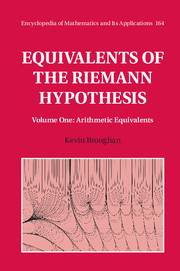
Equivalents of the Riemann Hypothesis
-
- Published online:
- 27 October 2017
- Print publication:
- 02 November 2017
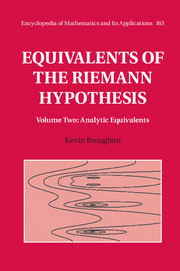
Equivalents of the Riemann Hypothesis
-
- Published online:
- 27 October 2017
- Print publication:
- 02 November 2017
Introduction to Banach Spaces: Analysis and Probability
-
- Published online:
- 26 October 2017
- Print publication:
- 02 November 2017
Lectures on the Poisson Process
-
- Published online:
- 26 October 2017
- Print publication:
- 26 October 2017
Introduction to Banach Spaces: Analysis and Probability
-
- Published online:
- 26 October 2017
- Print publication:
- 02 November 2017
19 - Perturbation Analysis
-
- Book:
- Lectures on the Poisson Process
- Published online:
- 26 October 2017
- Print publication:
- 26 October 2017, pp 197-210
-
- Chapter
- Export citation
List of Symbols
-
- Book:
- Lectures on the Poisson Process
- Published online:
- 26 October 2017
- Print publication:
- 26 October 2017, pp xix-xx
-
- Chapter
- Export citation
10 - Extra Heads and Balanced Allocations
-
- Book:
- Lectures on the Poisson Process
- Published online:
- 26 October 2017
- Print publication:
- 26 October 2017, pp 92-102
-
- Chapter
- Export citation
6 - Characterisations of the Poisson Process
-
- Book:
- Lectures on the Poisson Process
- Published online:
- 26 October 2017
- Print publication:
- 26 October 2017, pp 46-57
-
- Chapter
- Export citation
8 - Stationary Point Processes
-
- Book:
- Lectures on the Poisson Process
- Published online:
- 26 October 2017
- Print publication:
- 26 October 2017, pp 69-81
-
- Chapter
- Export citation
14 - Permanental Processes
-
- Book:
- Lectures on the Poisson Process
- Published online:
- 26 October 2017
- Print publication:
- 26 October 2017, pp 136-152
-
- Chapter
- Export citation
