Refine search
Actions for selected content:
26078 results in Abstract analysis
Whitney regularity of the image of the Chevalley mapping
- Part of
-
- Journal:
- Proceedings of the Royal Society of Edinburgh. Section A: Mathematics / Volume 146 / Issue 5 / October 2016
- Published online by Cambridge University Press:
- 13 July 2016, pp. 895-904
- Print publication:
- October 2016
-
- Article
- Export citation
Liouvillian first integrals for a class of generalized Liénard polynomial differential systems
- Part of
-
- Journal:
- Proceedings of the Royal Society of Edinburgh. Section A: Mathematics / Volume 146 / Issue 6 / December 2016
- Published online by Cambridge University Press:
- 13 July 2016, pp. 1195-1210
- Print publication:
- December 2016
-
- Article
- Export citation
Characterizations of bounded mean oscillation through commutators of bilinear singular integral operators
- Part of
-
- Journal:
- Proceedings of the Royal Society of Edinburgh. Section A: Mathematics / Volume 146 / Issue 6 / December 2016
- Published online by Cambridge University Press:
- 13 July 2016, pp. 1159-1166
- Print publication:
- December 2016
-
- Article
- Export citation
CENTRAL LIMIT THEOREM FOR THE MODULUS OF CONTINUITY OF AVERAGES OF OBSERVABLES ON TRANSVERSAL FAMILIES OF PIECEWISE EXPANDING UNIMODAL MAPS
- Part of
-
- Journal:
- Journal of the Institute of Mathematics of Jussieu / Volume 17 / Issue 3 / June 2018
- Published online by Cambridge University Press:
- 13 July 2016, pp. 673-733
- Print publication:
- June 2018
-
- Article
- Export citation
-
Consider a $C^{2}$ family of mixing $C^{4}$ piecewise expanding unimodal maps $t\in [a,b]\mapsto f_{t}$ , with a critical point $c$ , that is transversal to the topological classes of such maps. Given a Lipchitz observable $\unicode[STIX]{x1D719}$ consider the function where
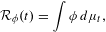 $$\begin{eqnarray}{\mathcal{R}}_{\unicode[STIX]{x1D719}}(t)=\int \unicode[STIX]{x1D719}\,d\unicode[STIX]{x1D707}_{t},\end{eqnarray}$$ $\unicode[STIX]{x1D707}_{t}$ is the unique absolutely continuous invariant probability of $f_{t}$ . Suppose that $\unicode[STIX]{x1D70E}_{t}>0$ for every $t\in [a,b]$ , where
  $$\begin{eqnarray}\unicode[STIX]{x1D70E}_{t}^{2}=\unicode[STIX]{x1D70E}_{t}^{2}(\unicode[STIX]{x1D719})=\lim _{n\rightarrow \infty }\int \left(\frac{\mathop{\sum }_{j=0}^{n-1}\left(\unicode[STIX]{x1D719}\circ f_{t}^{j}-\int \unicode[STIX]{x1D719}\,d\unicode[STIX]{x1D707}_{t}\right)}{\sqrt{n}}\right)^{2}\,d\unicode[STIX]{x1D707}_{t}.\end{eqnarray}$$
We show that
converges to $$\begin{eqnarray}m\left\{t\in [a,b]:t+h\in [a,b]\text{ and }\frac{1}{\unicode[STIX]{x1D6F9}(t)\sqrt{-\log |h|}}\left(\frac{{\mathcal{R}}_{\unicode[STIX]{x1D719}}(t+h)-{\mathcal{R}}_{\unicode[STIX]{x1D719}}(t)}{h}\right)\leqslant y\right\}\end{eqnarray}$$where
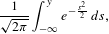 $$\begin{eqnarray}\frac{1}{\sqrt{2\unicode[STIX]{x1D70B}}}\int _{-\infty }^{y}e^{-\frac{s^{2}}{2}}\,ds,\end{eqnarray}$$ $\unicode[STIX]{x1D6F9}(t)$ is a dynamically defined function and $m$ is the Lebesgue measure on $[a,b]$ , normalized in such way that $m([a,b])=1$ . As a consequence, we show that ${\mathcal{R}}_{\unicode[STIX]{x1D719}}$ is not a Lipchitz function on any subset of $[a,b]$ with positive Lebesgue measure.


Rate effects on the growth of centres
-
- Journal:
- European Journal of Applied Mathematics / Volume 28 / Issue 2 / April 2017
- Published online by Cambridge University Press:
- 07 July 2016, pp. 221-242
-
- Article
-
- You have access
- Open access
- Export citation
David B. Ellis and Robert Ellis Automorphisms and equivalence relations in topological dynamics (Cambridge University Press, 2014), 281 pp, 978-1-107-63322-3 (paperback), £45/$70.
-
- Journal:
- Proceedings of the Edinburgh Mathematical Society / Volume 58 / Issue 3 / October 2015
- Published online by Cambridge University Press:
- 06 July 2016, pp. 807-808
-
- Article
-
- You have access
- Export citation

Convergence of One-Parameter Operator Semigroups
- In Models of Mathematical Biology and Elsewhere
-
- Published online:
- 05 July 2016
- Print publication:
- 14 July 2016
Impact of spatially constrained sampling of temporal contact networks on the evaluation of the epidemic risk
-
- Journal:
- European Journal of Applied Mathematics / Volume 27 / Issue 6 / December 2016
- Published online by Cambridge University Press:
- 04 July 2016, pp. 941-957
-
- Article
- Export citation
Seeded PageRank solution paths
-
- Journal:
- European Journal of Applied Mathematics / Volume 27 / Issue 6 / December 2016
- Published online by Cambridge University Press:
- 01 July 2016, pp. 812-845
-
- Article
- Export citation
Nodal vector solutions with clustered peaks for nonlinear elliptic equations in ℝ3
- Part of
-
- Journal:
- Proceedings of the Royal Society of Edinburgh. Section A: Mathematics / Volume 146 / Issue 5 / October 2016
- Published online by Cambridge University Press:
- 01 July 2016, pp. 947-982
- Print publication:
- October 2016
-
- Article
- Export citation
-
We study the following coupled nonlinear Schr¨odinger system in ℝ3:

where μ 1 > 0, μ 2 > 0 and β ∈ ℝ is a coupling constant. Irrespective of whether the system is repulsive or attractive, we prove that it has nodal semi-classical segregated or synchronized bound states with clustered spikes for sufficiently small ε under some additional conditions on P(x), Q(x) and β. Moreover, the number of this type of solutions will go to infinity as ε → 0+.
Separation of variables in equations of mean-curvature type
- Part of
-
- Journal:
- Proceedings of the Royal Society of Edinburgh. Section A: Mathematics / Volume 146 / Issue 5 / October 2016
- Published online by Cambridge University Press:
- 01 July 2016, pp. 1017-1035
- Print publication:
- October 2016
-
- Article
- Export citation
Riemannian surfaces with torsion as homogenization limits of locally Euclidean surfaces with dislocation-type singularities
- Part of
-
- Journal:
- Proceedings of the Royal Society of Edinburgh. Section A: Mathematics / Volume 146 / Issue 4 / August 2016
- Published online by Cambridge University Press:
- 01 July 2016, pp. 741-768
- Print publication:
- August 2016
-
- Article
- Export citation
Contents
-
- Book:
- Harmonic and Subharmonic Function Theory on the Hyperbolic Ball
- Published online:
- 05 June 2016
- Print publication:
- 30 June 2016, pp vii-x
-
- Chapter
- Export citation
7 - Hardy-Type Spaces of H-Subharmonic Functions
-
- Book:
- Harmonic and Subharmonic Function Theory on the Hyperbolic Ball
- Published online:
- 05 June 2016
- Print publication:
- 30 June 2016, pp 96-113
-
- Chapter
- Export citation
3 - The Invariant Laplacian, Gradient, and Measure
-
- Book:
- Harmonic and Subharmonic Function Theory on the Hyperbolic Ball
- Published online:
- 05 June 2016
- Print publication:
- 30 June 2016, pp 17-30
-
- Chapter
- Export citation
ADJOINT FUNCTORS BETWEEN CATEGORIES OF HILBERT $C^{\ast }$ -MODULES
- Part of
-
- Journal:
- Journal of the Institute of Mathematics of Jussieu / Volume 17 / Issue 2 / April 2018
- Published online by Cambridge University Press:
- 30 June 2016, pp. 453-488
- Print publication:
- April 2018
-
- Article
- Export citation
-
Let $E$ be a (right) Hilbert module over a $C^{\ast }$ -algebra $A$ . If $E$ is equipped with a left action of a second $C^{\ast }$ -algebra $B$ , then tensor product with $E$ gives rise to a functor from the category of Hilbert $B$ -modules to the category of Hilbert $A$ -modules. The purpose of this paper is to study adjunctions between functors of this sort. We shall introduce a new kind of adjunction relation, called a local adjunction, that is weaker than the standard concept from category theory. We shall give several examples, the most important of which is the functor of parabolic induction in the tempered representation theory of real reductive groups. Each local adjunction gives rise to an ordinary adjunction of functors between categories of Hilbert space representations. In this way we shall show that the parabolic induction functor has a simultaneous left and right adjoint, namely the parabolic restriction functor constructed in Clare et al. [Parabolic induction and restriction via $C^{\ast }$ -algebras and Hilbert $C^{\ast }$ -modules, Compos. Math.FirstView (2016), 1–33, 2].


Index of Symbols
-
- Book:
- Harmonic and Subharmonic Function Theory on the Hyperbolic Ball
- Published online:
- 05 June 2016
- Print publication:
- 30 June 2016, pp 221-222
-
- Chapter
- Export citation
FRAMED CORRESPONDENCES AND THE MILNOR–WITT $K$-THEORY
- Part of
-
- Journal:
- Journal of the Institute of Mathematics of Jussieu / Volume 17 / Issue 4 / September 2018
- Published online by Cambridge University Press:
- 30 June 2016, pp. 823-852
- Print publication:
- September 2018
-
- Article
- Export citation
-
Given a field $k$ of characteristic zero and $n\geqslant 0$, we prove that $H_{0}(\mathbb{Z}F(\unicode[STIX]{x1D6E5}_{k}^{\bullet },\mathbb{G}_{m}^{\wedge n}))=K_{n}^{MW}(k)$, where $\mathbb{Z}F_{\ast }(k)$ is the category of linear framed correspondences of algebraic $k$-varieties, introduced by Garkusha and Panin [The triangulated category of linear framed motives $DM_{fr}^{eff}(k)$, in preparation] (see [Garkusha and Panin, Framed motives of algebraic varieties (after V. Voevodsky), Preprint, 2014, arXiv:1409.4372], § 7 as well), and $K_{\ast }^{MW}(k)$ is the Milnor–Witt $K$-theory of the base field $k$.
$k$.


6 - Spherical Harmonic Expansions
-
- Book:
- Harmonic and Subharmonic Function Theory on the Hyperbolic Ball
- Published online:
- 05 June 2016
- Print publication:
- 30 June 2016, pp 82-95
-
- Chapter
- Export citation
8 - Boundary Behavior of Poisson Integrals
-
- Book:
- Harmonic and Subharmonic Function Theory on the Hyperbolic Ball
- Published online:
- 05 June 2016
- Print publication:
- 30 June 2016, pp 114-138
-
- Chapter
- Export citation
