Refine search
Actions for selected content:
26080 results in Abstract analysis
2 - Preliminaries
-
- Book:
- Quantum Stochastic Processes and Noncommutative Geometry
- Published online:
- 19 January 2010
- Print publication:
- 25 January 2007, pp 7-32
-
- Chapter
- Export citation
Bifurcation and stability of equilibria with asymptotically linear boundary conditions at infinity
-
- Journal:
- Proceedings of the Royal Society of Edinburgh. Section A: Mathematics / Volume 137 / Issue 2 / 2007
- Published online by Cambridge University Press:
- 12 July 2007, pp. 225-252
- Print publication:
- 2007
-
- Article
- Export citation
LINEAR ASYMPTOTIC BEHAVIOUR OF SECOND ORDER ORDINARY DIFFERENTIAL EQUATIONS
-
- Journal:
- Glasgow Mathematical Journal / Volume 49 / Issue 1 / January 2007
- Published online by Cambridge University Press:
- 01 January 2007, pp. 105-120
-
- Article
-
- You have access
- Export citation
THE GENERALIZED HOMOLOGY OF PRODUCTS
-
- Journal:
- Glasgow Mathematical Journal / Volume 49 / Issue 1 / January 2007
- Published online by Cambridge University Press:
- 01 January 2007, pp. 1-10
-
- Article
-
- You have access
- Export citation
GROUP EXTENSIONS AND THE PRIMITIVE IDEAL SPACES OF TOEPLITZ ALGEBRAS
-
- Journal:
- Glasgow Mathematical Journal / Volume 49 / Issue 1 / January 2007
- Published online by Cambridge University Press:
- 01 January 2007, pp. 81-92
-
- Article
-
- You have access
- Export citation
A multiplicity result including a sign-changing solution for an inhomogeneous Neumann problem with critical exponent
-
- Journal:
- Proceedings of the Royal Society of Edinburgh. Section A: Mathematics / Volume 137 / Issue 2 / 2007
- Published online by Cambridge University Press:
- 26 March 2007, pp. 333-347
- Print publication:
- 2007
-
- Article
- Export citation
-
We study the existence of multiple solutions for the problem

and we show that at least one of them is sign changing. Here Ω is a bounded domain in ℝN with N ⩾ 5 whose boundary is of class C 2, ∂/∂ ν is the outward normal derivative, and f ∈ L N/2(Ω) whose L 2N/(N+2)(Ω) norm is sufficiently small.
NONHOLONOMIC SIMPLE D-MODULES FROM SIMPLE DERIVATIONS
-
- Journal:
- Glasgow Mathematical Journal / Volume 49 / Issue 1 / January 2007
- Published online by Cambridge University Press:
- 01 January 2007, pp. 11-21
-
- Article
-
- You have access
- Export citation
MODULES OVER PRÜFER DOMAINS WHICH SATISFY THE RADICAL FORMULA
-
- Journal:
- Glasgow Mathematical Journal / Volume 49 / Issue 1 / January 2007
- Published online by Cambridge University Press:
- 01 January 2007, pp. 127-131
-
- Article
-
- You have access
- Export citation
ON BRANNAN'S COEFFICIENT CONJECTURE AND APPLICATIONS
-
- Journal:
- Glasgow Mathematical Journal / Volume 49 / Issue 1 / January 2007
- Published online by Cambridge University Press:
- 01 January 2007, pp. 45-52
-
- Article
-
- You have access
- Export citation
-
D. Brannan's conjecture says that for 0 <α,β≤1, |x|=1, and n∈N one has |A2n−1(α,β,x)|≤|A2n−1(α,β,1)|, where
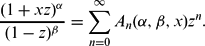 We prove this for the case α=β, and also prove a differentiated version of the Brannan conjecture. This has applications to estimates for Gegenbauer polynomials and also to coefficient estimates for univalent functions in the unit disk that are ‘starlike with respect to a boundary point’. The latter application has previously been conjectured by H. Silverman and E. Silvia. The proofs make use of various properties of the Gauss hypergeometric function.
BOUNDED LINEAR OPERATORS ON SPACES IN NORMED DUALITY
-
- Journal:
- Glasgow Mathematical Journal / Volume 49 / Issue 1 / January 2007
- Published online by Cambridge University Press:
- 01 January 2007, pp. 145-154
-
- Article
-
- You have access
- Export citation
Time-periodic solutions to the one-dimensional wave equation with periodic or anti-periodic boundary conditions
-
- Journal:
- Proceedings of the Royal Society of Edinburgh. Section A: Mathematics / Volume 137 / Issue 2 / 2007
- Published online by Cambridge University Press:
- 26 March 2007, pp. 349-371
- Print publication:
- 2007
-
- Article
- Export citation
RECURRENCE RELATIONS, DYNKIN DIAGRAMS AND PLÜCKER FORMULAE
-
- Journal:
- Glasgow Mathematical Journal / Volume 49 / Issue 1 / January 2007
- Published online by Cambridge University Press:
- 01 January 2007, pp. 53-59
-
- Article
-
- You have access
- Export citation
Singularities of smooth mappings with patterns*
-
- Journal:
- Proceedings of the Royal Society of Edinburgh. Section A: Mathematics / Volume 137 / Issue 2 / 2007
- Published online by Cambridge University Press:
- 26 March 2007, pp. 415-430
- Print publication:
- 2007
-
- Article
- Export citation
Quasi-static crack growth for a cohesive zone model with prescribed crack path
-
- Journal:
- Proceedings of the Royal Society of Edinburgh. Section A: Mathematics / Volume 137 / Issue 2 / 2007
- Published online by Cambridge University Press:
- 26 March 2007, pp. 253-279
- Print publication:
- 2007
-
- Article
- Export citation
HN stability of the Vlasov–Poisson–Boltzmann system near Maxwellians
-
- Journal:
- Proceedings of the Royal Society of Edinburgh. Section A: Mathematics / Volume 137 / Issue 2 / 2007
- Published online by Cambridge University Press:
- 26 March 2007, pp. 431-446
- Print publication:
- 2007
-
- Article
- Export citation
Interaction between degenerate diffusion and shape of domain
-
- Journal:
- Proceedings of the Royal Society of Edinburgh. Section A: Mathematics / Volume 137 / Issue 2 / 2007
- Published online by Cambridge University Press:
- 26 March 2007, pp. 373-388
- Print publication:
- 2007
-
- Article
- Export citation
Eigenvalue asymptotics for an elliptic boundary problem
-
- Journal:
- Proceedings of the Royal Society of Edinburgh. Section A: Mathematics / Volume 137 / Issue 2 / 2007
- Published online by Cambridge University Press:
- 26 March 2007, pp. 281-302
- Print publication:
- 2007
-
- Article
- Export citation
ISOPERIMETRIC FUNCTIONS OF GROUPS ACTING ON Lδ-SPACES
-
- Journal:
- Glasgow Mathematical Journal / Volume 49 / Issue 1 / January 2007
- Published online by Cambridge University Press:
- 01 January 2007, pp. 23-28
-
- Article
-
- You have access
- Export citation
BLOCKS WITH A QUATERNION DEFECT GROUP OVER A 2-ADIC RING: THE CASE Ã4
-
- Journal:
- Glasgow Mathematical Journal / Volume 49 / Issue 1 / January 2007
- Published online by Cambridge University Press:
- 01 January 2007, pp. 29-43
-
- Article
-
- You have access
- Export citation
PRM volume 137 issue 2 Cover and Front matter
-
- Journal:
- Proceedings of the Royal Society of Edinburgh. Section A: Mathematics / Volume 137 / Issue 2 / 2007
- Published online by Cambridge University Press:
- 21 February 2017, pp. f1-f2
- Print publication:
- 2007
-
- Article
-
- You have access
- Export citation
