Refine search
Actions for selected content:
26076 results in Abstract analysis
A homogenised model for the motion of evaporating fronts in porous media
- Part of
-
- Journal:
- European Journal of Applied Mathematics / Volume 34 / Issue 4 / August 2023
- Published online by Cambridge University Press:
- 23 January 2023, pp. 806-837
-
- Article
-
- You have access
- Open access
- HTML
- Export citation
-
Evaporation within porous media is both a multiscale and interface-driven process, since the phase change at the evaporating interfaces within the pores generates a vapour flow and depends on the transport of vapour through the porous medium. While homogenised models of flow and chemical transport in porous media allow multiscale processes to be modelled efficiently, it is not clear how the multiscale effects impact the interface conditions required for these homogenised models. In this paper, we derive a homogenised model, including effective interface conditions, for the motion of an evaporation front through a porous medium, using a combined homogenisation and boundary layer analysis. This analysis extends previous work for a purely diffusive problem to include both gas flow and the advective–diffusive transport of material. We investigate the effect that different microscale models describing the chemistry of the evaporation have on the homogenised interface conditions. In particular, we identify a new effective parameter, $\mathcal{L}$, the average microscale interface length, which modifies the effective evaporation rate in the homogenised model. Like the effective diffusivity and permeability of a porous medium, $\mathcal{L}$ may be found by solving a periodic cell problem on the microscale. We also show that the different microscale models of the interface chemistry result in fundamentally different fine-scale behaviour at, and near, the interface.


Conjugacy growth in the higher Heisenberg groups
- Part of
-
- Journal:
- Glasgow Mathematical Journal / Volume 65 / Issue S1 / May 2023
- Published online by Cambridge University Press:
- 23 January 2023, pp. S148-S169
-
- Article
-
- You have access
- Open access
- HTML
- Export citation
Slope equality of non-hyperelliptic Eisenbud–Harris special fibrations of genus 4
- Part of
-
- Journal:
- Glasgow Mathematical Journal / Volume 65 / Issue 2 / May 2023
- Published online by Cambridge University Press:
- 20 January 2023, pp. 284-287
-
- Article
-
- You have access
- Open access
- HTML
- Export citation
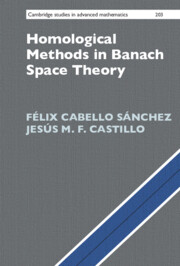
Homological Methods in Banach Space Theory
-
- Published online:
- 19 January 2023
- Print publication:
- 26 January 2023
Weakly concave operators
- Part of
-
- Journal:
- Proceedings of the Royal Society of Edinburgh. Section A: Mathematics / Volume 154 / Issue 1 / February 2024
- Published online by Cambridge University Press:
- 18 January 2023, pp. 1-32
- Print publication:
- February 2024
-
- Article
-
- You have access
- Open access
- HTML
- Export citation
-
We study a class of left-invertible operators which we call weakly concave operators. It includes the class of concave operators and some subclasses of expansive strict $m$
 -isometries with $m > 2$
 . We prove a Wold-type decomposition for weakly concave operators. We also obtain a Berger–Shaw-type theorem for analytic finitely cyclic weakly concave operators. The proofs of these results rely heavily on a spectral dichotomy for left-invertible operators. It provides a fairly close relationship, written in terms of the reciprocal automorphism of the Riemann sphere, between the spectra of a left-invertible operator and any of its left inverses. We further place the class of weakly concave operators, as the term $\mathcal {A}_1$
 , in the chain $\mathcal {A}_0 \subseteq \mathcal {A}_1 \subseteq \ldots \subseteq \mathcal {A}_{\infty }$
 of collections of left-invertible operators. We show that most of the aforementioned results can be proved for members of these classes. Subtleties arise depending on whether the index $k$
 of the class $\mathcal {A}_k$
 is finite or not. In particular, a Berger–Shaw-type theorem fails to be true for members of $\mathcal {A}_{\infty }$
 . This discrepancy is better revealed in the context of $C^*$
 - and $W^*$
 -algebras.


The family signature theorem
-
- Journal:
- Proceedings of the Royal Society of Edinburgh. Section A: Mathematics / Volume 154 / Issue 6 / December 2024
- Published online by Cambridge University Press:
- 18 January 2023, pp. 2024-2067
- Print publication:
- December 2024
-
- Article
-
- You have access
- Open access
- HTML
- Export citation
-
We discuss several versions of the Family Signature Theorem: in rational cohomology using ideas of Meyer, in $KO[\tfrac {1}{2}]$
 -theory using ideas of Sullivan, and finally in symmetric $L$
 -theory using ideas of Ranicki. Employing recent developments in Grothendieck–Witt theory, we give a quite complete analysis of the resulting invariants. As an application we prove that the signature is multiplicative modulo 4 for fibrations of oriented Poincaré complexes, generalizing a result of Hambleton, Korzeniewski and Ranicki, and discuss the multiplicativity of the de Rham invariant.


Battleship, tomography and quantum annealing
- Part of
-
- Journal:
- European Journal of Applied Mathematics / Volume 34 / Issue 4 / August 2023
- Published online by Cambridge University Press:
- 16 January 2023, pp. 758-773
-
- Article
-
- You have access
- Open access
- HTML
- Export citation
-
The classic game of Battleship involves two players taking turns attempting to guess the positions of a fleet of vertically or horizontally positioned enemy ships hidden on a $10\times 10$ grid. One variant of this game, also referred to as Battleship Solitaire, Bimaru or Yubotu, considers the game with the inclusion of X-ray data, represented by knowledge of how many spots are occupied in each row and column in the enemy board. This paper considers the Battleship puzzle problem: the problem of reconstructing an enemy fleet from its X-ray data. We generate non-unique solutions to Battleship puzzles via certain reflection transformations akin to Ryser interchanges. Furthermore, we demonstrate that solutions of Battleship puzzles may be reliably obtained by searching for solutions of the associated classical binary discrete tomography problem which minimise the discrete Laplacian. We reformulate this optimisation problem as a quadratic unconstrained binary optimisation problem and approximate solutions via a simulated annealer, emphasising the future practical applicability of quantum annealers to solving discrete tomography problems with predefined structure.

Connected sums of codimension two locally flat submanifolds
-
- Journal:
- Proceedings of the Royal Society of Edinburgh. Section A: Mathematics / Volume 154 / Issue 6 / December 2024
- Published online by Cambridge University Press:
- 16 January 2023, pp. 1937-1944
- Print publication:
- December 2024
-
- Article
-
- You have access
- Open access
- HTML
- Export citation
-
Let $X$
 and $Y$
 be oriented topological manifolds of dimension $n\!+\!2$
 , and let $K\! \subset \! X$
 and $J \! \subset \! Y$
 be connected, locally-flat, oriented, $n$
 –dimensional submanifolds. We show that up to orientation preserving homeomorphism there is a well-defined connected sum $(X,K)\! \mathbin {\#}\! (Y,J)$
 . For $n = 1$
 , the proof is classical, relying on results of Rado and Moise. For dimensions $n=3$
 and $n \ge 6$
 , results of Edwards-Kirby, Kirby, and Kirby-Siebenmann concerning higher dimensional topological manifolds are required. For $n = 2, 4,$
 and $5$
 , Freedman and Quinn's work on topological four-manifolds is required along with the higher dimensional theory.


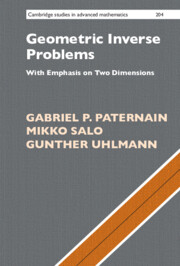
Geometric Inverse Problems
- With Emphasis on Two Dimensions
-
- Published online:
- 15 January 2023
- Print publication:
- 05 January 2023
On parabolic subgroups of symplectic reflection groups
- Part of
-
- Journal:
- Glasgow Mathematical Journal / Volume 65 / Issue 2 / May 2023
- Published online by Cambridge University Press:
- 10 January 2023, pp. 401-413
-
- Article
- Export citation
Convergence of blanket times for sequences of random walks on critical random graphs
- Part of
-
- Journal:
- Combinatorics, Probability and Computing / Volume 32 / Issue 3 / May 2023
- Published online by Cambridge University Press:
- 09 January 2023, pp. 478-515
-
- Article
- Export citation
-
Under the assumption that sequences of graphs equipped with resistances, associated measures, walks and local times converge in a suitable Gromov-Hausdorff topology, we establish asymptotic bounds on the distribution of the $\varepsilon$-blanket times of the random walks in the sequence. The precise nature of these bounds ensures convergence of the $\varepsilon$-blanket times of the random walks if the $\varepsilon$-blanket time of the limiting diffusion is continuous at $\varepsilon$ with probability 1. This result enables us to prove annealed convergence in various examples of critical random graphs, including critical Galton-Watson trees and the Erdős-Rényi random graph in the critical window. We highlight that proving continuity of the $\varepsilon$-blanket time of the limiting diffusion relies on the scale invariance of a finite measure that gives rise to realizations of the limiting compact random metric space, and therefore we expect our results to hold for other examples of random graphs with a similar scale invariance property.


On the global existence of solutions to chemotaxis system for two populations in dimension two
- Part of
-
- Journal:
- Proceedings of the Royal Society of Edinburgh. Section A: Mathematics / Volume 153 / Issue 6 / December 2023
- Published online by Cambridge University Press:
- 09 January 2023, pp. 2106-2128
- Print publication:
- December 2023
-
- Article
- Export citation
-
We consider the global existence for the following fully parabolic chemotaxis system with two populations
\[\left\{ \begin{array}{@{}ll} \partial_tu_i=\kappa_i\Delta u_i-\chi_i\nabla\cdot(u_i\nabla v),\quad i\in\{1,2\}, & x\in\Omega,\ t>0, \\ v_t=\Delta v-v+u_1+u_2, & x\in\Omega,\ t>0,\\ u_i(x,t=0)=u_{i0}(x),\quad v(x,t=0)=v_0(x), & x\in\Omega, \end{array} \right. \]where $\Omega =\mathbb {R}^2$
 or $\Omega =B_R(0)\subset \mathbb {R}^2$
 supplemented with homogeneous Neumann boundary conditions, $\kappa _i,\chi _i>0,$ $i=1,2$
 . The global existence remains open for the fully parabolic case as far as the author knows, while the existence of global solution was known for the parabolic-elliptic reduction with the second equation replaced by $0=\Delta v-v+u_1+u_2$
 or $0=\Delta v+u_1+u_2$
 . In this paper, we prove that there exists a global solution if the initial masses satisfy the certain sub-criticality condition. The proof is based on a version of the Moser–Trudinger type inequality for system in two dimensions.


Off-diagonal book Ramsey numbers
- Part of
-
- Journal:
- Combinatorics, Probability and Computing / Volume 32 / Issue 3 / May 2023
- Published online by Cambridge University Press:
- 09 January 2023, pp. 516-545
-
- Article
-
- You have access
- Open access
- HTML
- Export citation
-
The book graph $B_n ^{(k)}$ consists of $n$ copies of $K_{k+1}$ joined along a common $K_k$. In the prequel to this paper, we studied the diagonal Ramsey number $r(B_n ^{(k)}, B_n ^{(k)})$. Here we consider the natural off-diagonal variant $r(B_{cn} ^{(k)}, B_n^{(k)})$ for fixed $c \in (0,1]$. In this more general setting, we show that an interesting dichotomy emerges: for very small $c$, a simple $k$-partite construction dictates the Ramsey function and all nearly-extremal colourings are close to being $k$-partite, while, for $c$ bounded away from $0$, random colourings of an appropriate density are asymptotically optimal and all nearly-extremal colourings are quasirandom. Our investigations also open up a range of questions about what happens for intermediate values of $c$.
$c$.


15 - Open Problems and Related Topics
-
- Book:
- Geometric Inverse Problems
- Published online:
- 15 January 2023
- Print publication:
- 05 January 2023, pp 326-331
-
- Chapter
- Export citation
Foreword
-
-
- Book:
- Geometric Inverse Problems
- Published online:
- 15 January 2023
- Print publication:
- 05 January 2023, pp xi-xiv
-
- Chapter
- Export citation
Solving two-dimensional H(curl)-elliptic interface systems with optimal convergence on unfitted meshes
- Part of
-
- Journal:
- European Journal of Applied Mathematics / Volume 34 / Issue 4 / August 2023
- Published online by Cambridge University Press:
- 05 January 2023, pp. 774-805
-
- Article
- Export citation
-
Finite element methods developed for unfitted meshes have been widely applied to various interface problems. However, many of them resort to non-conforming spaces for approximation, which is a critical obstacle for the extension to $\textbf{H}(\text{curl})$ equations. This essential issue stems from the underlying Sobolev space $\textbf{H}^s(\text{curl};\,\Omega)$, and even the widely used penalty methodology may not yield the optimal convergence rate. One promising approach to circumvent this issue is to use a conforming test function space, which motivates us to develop a Petrov–Galerkin immersed finite element (PG-IFE) method for $\textbf{H}(\text{curl})$-elliptic interface problems. We establish the Nédélec-type IFE spaces and develop some important properties including their edge degrees of freedom, an exact sequence relating to the $H^1$ IFE space and optimal approximation capabilities. We analyse the inf-sup condition under certain assumptions and show the optimal convergence rate, which is also validated by numerical experiments.


12 - The Attenuated Geodesic X-ray Transform
-
- Book:
- Geometric Inverse Problems
- Published online:
- 15 January 2023
- Print publication:
- 05 January 2023, pp 269-276
-
- Chapter
- Export citation
Index
-
- Book:
- Geometric Inverse Problems
- Published online:
- 15 January 2023
- Print publication:
- 05 January 2023, pp 342-344
-
- Chapter
- Export citation
10 - Tensor Tomography
-
- Book:
- Geometric Inverse Problems
- Published online:
- 15 January 2023
- Print publication:
- 05 January 2023, pp 233-240
-
- Chapter
- Export citation
4 - The Geodesic X-ray Transform
-
- Book:
- Geometric Inverse Problems
- Published online:
- 15 January 2023
- Print publication:
- 05 January 2023, pp 107-129
-
- Chapter
- Export citation
