Refine search
Actions for selected content:
26063 results in Abstract analysis
Hypergraph Packing and Graph Embedding
-
- Journal:
- Combinatorics, Probability and Computing / Volume 8 / Issue 4 / July 1999
- Published online by Cambridge University Press:
- 01 July 1999, pp. 363-376
-
- Article
- Export citation
On congruence compact monoids
- Part of
-
- Journal:
- Mathematika / Volume 46 / Issue 1 / June 1999
- Published online by Cambridge University Press:
- 26 February 2010, pp. 205-224
- Print publication:
- June 1999
-
- Article
- Export citation
On smooth gaps between consecutive prime numbers
- Part of
-
- Journal:
- Mathematika / Volume 46 / Issue 1 / June 1999
- Published online by Cambridge University Press:
- 26 February 2010, pp. 57-75
- Print publication:
- June 1999
-
- Article
- Export citation
A density bound for efficient packings of 3-space with centrally symmetric convex bodies
- Part of
-
- Journal:
- Mathematika / Volume 46 / Issue 1 / June 1999
- Published online by Cambridge University Press:
- 26 February 2010, pp. 137-144
- Print publication:
- June 1999
-
- Article
- Export citation
-
It is shown that every compact convex set K which is centrally symmetric and has a non-empty interior admits a packing of Euclidean 3-space with density at least 0.46421 … The best such bound previously known is 0.30051 … due to the theorem of Minkowski-Hlawka. It is probable that there is such a lower bound which is significantly greater than the one shown in this note, since there is a packing of congruent spheres which has density

A generalized fundamental principle
- Part of
-
- Journal:
- Mathematika / Volume 46 / Issue 1 / June 1999
- Published online by Cambridge University Press:
- 26 February 2010, pp. 83-92
- Print publication:
- June 1999
-
- Article
- Export citation
-
Let ν be a rank 1 henselian valuation of a field K having unique extension ῡ to an algebraic closure
 of K. For any subextension L/K of /K, let G (L), Res (L) denote respectively the value group and the residue field of the valuation obtained by restricting ῡ to L. If a∈\K define
 of K. For any subextension L/K of
Invariant solutions of two models of evolution of turbulent bursts
-
- Journal:
- European Journal of Applied Mathematics / Volume 10 / Issue 3 / June 1999
- Published online by Cambridge University Press:
- 01 June 1999, pp. 237-249
-
- Article
- Export citation
Isotropic surface area measures
- Part of
-
- Journal:
- Mathematika / Volume 46 / Issue 1 / June 1999
- Published online by Cambridge University Press:
- 26 February 2010, pp. 1-13
- Print publication:
- June 1999
-
- Article
- Export citation
On the motion of particles in non-uniformly vibrating liquid
-
- Journal:
- European Journal of Applied Mathematics / Volume 10 / Issue 3 / June 1999
- Published online by Cambridge University Press:
- 01 June 1999, pp. 251-263
-
- Article
- Export citation
Asymptotic approximation of smooth convex bodies by general polytopes
- Part of
-
- Journal:
- Mathematika / Volume 46 / Issue 1 / June 1999
- Published online by Cambridge University Press:
- 26 February 2010, pp. 103-125
- Print publication:
- June 1999
-
- Article
- Export citation
Bruce Blackadar. K-Theory for Operator Algebras (2nd edition). MSRI Publications 5. Cambridge University Press, 1998; 300 pp. ISBN 0 521 63532 2 (paperback), £19.95. - D. A. Brannan, M. E. Esplen and J. J. Gray. Geometry. Cambridge University Press, 1999; 497 pp. ISBN 0 521 59193 7 (hardback), £50; 0 521 59787 0 (paperback), £18.95. - W. Bruns and J. Herzog. Cohen-Macaulay Rings. Cambridge Studies in Advanced Mathematics 39. Cambridge University Press, 1998; 453 pp. ISBN 0 521 41068 1 (hardback), £55; 0 521 56674 6 (paperback), £24.95. - A. Bultheel, P. González-Vera, E. Hendriksen and O. Njåstad. Orthogonal Rational Functions. Cambridge University Press, 1999; 407 pp. ISBN 0 521 65006 2 (hardback), £37.50. - J. R. García Rozas. Covers and Envelopes in the Category of Complexes of Modules. CRC Research Notes in Mathematics 407. Chapman and Hall (Baton Rouge), 1999; 137 pp. ISBN 1 58488 004 X (paperback), £29.99. - Mariano Giaquinta and Stefan Hildebrandt. Calculus of Variations, I: the Lagrangian Formalism. Grundlehren der Mathematischen Wissenschaften 310. Springer-Verlag (Berlin), 1996; 475 pp. ISBN 3 540 50625 X (hardback), DM 188. Calculus of Variations, II: the Hamiltonian Formalism. Grundlehren der Mathematischen Wissenschaften 311. Springer-Verlag (Berlin), 1996; 652 pp. ISBN 3 540 57961 3 (hardback), DM 198. - C. G. Gibson. Elementary Geometry of Algebraic Curves: An Undergraduate Introduction. Cambridge University Press, 1998; 250 pp. ISBN 0 521 64140 3 (hardback), £42.50; ISBN 0 521 64641 3 (paperback), £15.95. - Niccolo Guicciardini. Reading the Principia: The Debate on Newton's Mathematical Methods for Natural Philosophy from 1687 to 1736. Cambridge University Press, 1999; 285 pp. ISBN 0 521 64066 0 (hardback), £50. - Yoshiyuki Kitaoka. Arithmetic of Quadratic Forms. Cambridge Tracts in Mathematics 106. Cambridge University Press, 1999; 343 pp. ISBN 0 521 40475 4 (hardback), £50; 0 521 64996 X (paperback), £18.95. - Paul Koosis. Introduction to Hρ Spaces (2nd edition). Cambridge University Press, 1998; 287 pp. ISBN 0 521 45521 9 (hardback), £45. - S. Levy (Editor). The Eightfold Way: the Beauty of Klein's Quartic Curve. MSRI Publications 35. Cambridge University Press, 1999; 330 pp. ISBN 0 521 66066 1 (hardback), £35. - Pertti Mattila. Geometry of Sets and Measures in Euclidean Spaces: Fractals and Rectifiability. Cambridge University Press, 1999; 344 pp. ISBN 0 521 46576 1 (hardback), £40; 0 521 65595 1 (paperback), £18.95. - Juan C. Migliore. Introduction to Liaison Theory and Deficiency Modules. Progress in Mathematics, Vol. 165. Birkhauser Verlag (Basel), 1998: 215 pp. ISBN 3 7643 4027 4 (hardback), £44. - Michael Monastyrsky. Modern Mathematics in the Light of the Fields Medals. A. K. Peters (Wellesley, Mass.), 1998; 160pp. ISBN 1 56881 083 0 (paperback), £12.50. - Mario Petrich and Norman R. Reilly. Completely Regular Semi-groups. Wiley (New York), 1999; 481pp. ISBN 0 471 19571 5 (hardback), £74.50. - Nigel P. Smart. The Algorithmic Resolution of Diophantine Equations. London Mathematical Society Student Texts 41. Cambridge University Press, 1998; 243 pp. ISBN 0 521 64156 X (hardback), £45; 0 52164633 2 (paperback), £16.95. - R. P. Stanley. Enumerative Combinatorics, Vol. 2. Cambridge University Press, 1999; 581 pp. ISBN 0 521 56069 1 (hardback), £45. - Paul Taylor. Practical Foundations of Mathematics. Cambridge Studies in Advanced Mathematics 59. Cambridge University Press, 1999; 572 pp. ISBN 0 521 63107 6 (hardback), £50. - Wang Yuan (Transl. Peter Shiu). Hua Loo-Keng: a Biography. Springer-Verlag (Singapore), 1999; 423 pp. ISBN 7 8077 415 5 (paperback), £22.50.
-
- Journal:
- Mathematika / Volume 46 / Issue 1 / June 1999
- Published online by Cambridge University Press:
- 26 February 2010, pp. 225-229
- Print publication:
- June 1999
-
- Article
- Export citation
A further generalization of Hilbert's inequality
- Part of
-
- Journal:
- Mathematika / Volume 46 / Issue 1 / June 1999
- Published online by Cambridge University Press:
- 26 February 2010, pp. 35-39
- Print publication:
- June 1999
-
- Article
- Export citation
-
Hilbert's inequality asserts that
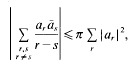
for arbitrary complex numbers ar. The constant π was first obtained by Schur [5], and is best possible. Following a suggestion of Selberg, Montgomery and Vaughan [4] showed that

where the γr are distinct real numbers and

On the approximation of the eigenvalues of an annulus using complex rays
-
- Journal:
- European Journal of Applied Mathematics / Volume 10 / Issue 3 / June 1999
- Published online by Cambridge University Press:
- 01 June 1999, pp. 225-236
-
- Article
- Export citation
Kahane-Khinchine type inequalities for negative exponent
- Part of
-
- Journal:
- Mathematika / Volume 46 / Issue 1 / June 1999
- Published online by Cambridge University Press:
- 26 February 2010, pp. 165-173
- Print publication:
- June 1999
-
- Article
- Export citation
Uniqueness of solutions to certain hyperbolic boundary value problems in a semi-infinite strip
- Part of
-
- Journal:
- Mathematika / Volume 46 / Issue 1 / June 1999
- Published online by Cambridge University Press:
- 26 February 2010, pp. 155-163
- Print publication:
- June 1999
-
- Article
- Export citation
Periodic solutions to the self-dual Ginzburg–Landau equations
-
- Journal:
- European Journal of Applied Mathematics / Volume 10 / Issue 3 / June 1999
- Published online by Cambridge University Press:
- 01 June 1999, pp. 285-295
-
- Article
- Export citation
A Bernstein-type theorem in hyperbolic spaces
- Part of
-
- Journal:
- Mathematika / Volume 46 / Issue 1 / June 1999
- Published online by Cambridge University Press:
- 26 February 2010, pp. 77-81
- Print publication:
- June 1999
-
- Article
- Export citation
Maximal hyperplane sections of convex bodies
- Part of
-
- Journal:
- Mathematika / Volume 46 / Issue 1 / June 1999
- Published online by Cambridge University Press:
- 26 February 2010, pp. 131-136
- Print publication:
- June 1999
-
- Article
- Export citation
On similar short sums
- Part of
-
- Journal:
- Mathematika / Volume 46 / Issue 1 / June 1999
- Published online by Cambridge University Press:
- 26 February 2010, pp. 193-204
- Print publication:
- June 1999
-
- Article
- Export citation
-
In the paper [5] bounds are found for the sum,

for a suitable Dirichlet character χ mod r, and real functionf(x). The proofs in that paper use Bombieri and Iwaniec's method [1], one formulation of which has as part of its first step the estimation of S in terms of a sum of many shorter sums of the form,

where e(x) = exp (2πix), mi∈ [M, 2M], and each mi, lies in its own interval, of length N ≥ M/4, that is disjoint from those of the others. This paper addresses a problem springing from above: to bound the numbers of ‘similar’ pairs, Si+, Si+, satisfying both

and

where ‖x‖ = min{|x − n|: n ∈ ℤ}. Lemma 5.2.1 of [3] (partial summation) shows that each sum in a similar pair is a bounded multiple of the other.
Flatness properties of acts over commutative, cancellative monoids
- Part of
-
- Journal:
- Mathematika / Volume 46 / Issue 1 / June 1999
- Published online by Cambridge University Press:
- 26 February 2010, pp. 93-102
- Print publication:
- June 1999
-
- Article
- Export citation
Intersection bodies and polytopes
- Part of
-
- Journal:
- Mathematika / Volume 46 / Issue 1 / June 1999
- Published online by Cambridge University Press:
- 26 February 2010, pp. 29-34
- Print publication:
- June 1999
-
- Article
- Export citation
