Refine search
Actions for selected content:
6997 results in Mathematical modeling and methods
Linearized planing-surface theory with surface tension. Part I: Smooth detachment
-
- Journal:
- Journal of the Australian Mathematical Society. Series B. Applied Mathematics / Volume 23 / Issue 3 / January 1982
- Published online by Cambridge University Press:
- 17 February 2009, pp. 241-258
-
- Article
-
- You have access
- Export citation
ANZ volume 34 issue 3 Cover and Back matter
-
- Journal:
- Journal of the Australian Mathematical Society. Series B. Applied Mathematics / Volume 34 / Issue 3 / January 1993
- Published online by Cambridge University Press:
- 17 February 2009, pp. b1-b2
-
- Article
-
- You have access
- Export citation
Solution of a Schrödinger equation by iterative refinement
-
- Journal:
- Journal of the Australian Mathematical Society. Series B. Applied Mathematics / Volume 32 / Issue 1 / July 1990
- Published online by Cambridge University Press:
- 17 February 2009, pp. 115-131
-
- Article
-
- You have access
- Export citation
On a periodic mutualism model
-
- Journal:
- The ANZIAM Journal / Volume 42 / Issue 4 / April 2001
- Published online by Cambridge University Press:
- 17 February 2009, pp. 569-580
-
- Article
-
- You have access
- Export citation
-
Sufficient conditions are obtained for the existence of a globally attracting positive periodic solution of the mutualism model
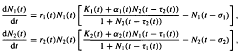
where ri, Ki, αi ∈ C(R, R+) and αi > Ki, i = 1, 2, τi, σi ∈ C(R, R+), i = 1, 2, and ri, Ki, αi, τi, σi (i = 1, 2) and functions of period ω > 0.
A nonmonotonic trust region method for constrained optimization problems
-
- Journal:
- Journal of the Australian Mathematical Society. Series B. Applied Mathematics / Volume 40 / Issue 4 / April 1999
- Published online by Cambridge University Press:
- 17 February 2009, pp. 542-567
-
- Article
-
- You have access
- Export citation
A quasi-Newton approach to identification of a parabolic system
-
- Journal:
- Journal of the Australian Mathematical Society. Series B. Applied Mathematics / Volume 40 / Issue 1 / July 1998
- Published online by Cambridge University Press:
- 17 February 2009, pp. 1-22
-
- Article
-
- You have access
- Export citation
The generation of surface waves by an intense cyclone
-
- Journal:
- Journal of the Australian Mathematical Society. Series B. Applied Mathematics / Volume 25 / Issue 1 / July 1983
- Published online by Cambridge University Press:
- 17 February 2009, pp. 64-83
-
- Article
-
- You have access
- Export citation
A uniform description of an oscillator's resonant transition
-
- Journal:
- Journal of the Australian Mathematical Society. Series B. Applied Mathematics / Volume 32 / Issue 2 / October 1990
- Published online by Cambridge University Press:
- 17 February 2009, pp. 193-206
-
- Article
-
- You have access
- Export citation
Some problems about the representation of monotone operators by convex functions
-
- Journal:
- The ANZIAM Journal / Volume 47 / Issue 1 / July 2005
- Published online by Cambridge University Press:
- 17 February 2009, pp. 1-20
-
- Article
-
- You have access
- Export citation
Improved model of water cresting
-
- Journal:
- Journal of the Australian Mathematical Society. Series B. Applied Mathematics / Volume 35 / Issue 2 / October 1993
- Published online by Cambridge University Press:
- 17 February 2009, pp. 207-222
-
- Article
-
- You have access
- Export citation
A Bäcklund transformation and nonlinear superposition formula for the Lotka-Volterra hierarchy
-
- Journal:
- The ANZIAM Journal / Volume 44 / Issue 1 / July 2002
- Published online by Cambridge University Press:
- 17 February 2009, pp. 121-128
-
- Article
-
- You have access
- Export citation
Aspects of laser Lorenz dynamics
-
- Journal:
- Journal of the Australian Mathematical Society. Series B. Applied Mathematics / Volume 36 / Issue 2 / October 1994
- Published online by Cambridge University Press:
- 17 February 2009, pp. 152-174
-
- Article
-
- You have access
- Export citation
One-dimensional pattern formation in a model of burning
-
- Journal:
- Journal of the Australian Mathematical Society. Series B. Applied Mathematics / Volume 35 / Issue 2 / October 1993
- Published online by Cambridge University Press:
- 17 February 2009, pp. 145-173
-
- Article
-
- You have access
- Export citation
On the variational stability of a class of nonlinear parabolic optimal control problems
-
- Journal:
- Journal of the Australian Mathematical Society. Series B. Applied Mathematics / Volume 39 / Issue 1 / July 1997
- Published online by Cambridge University Press:
- 17 February 2009, pp. 77-92
-
- Article
-
- You have access
- Export citation
Scattering of water waves by a submerged nearly circular cylinder
-
- Journal:
- Journal of the Australian Mathematical Society. Series B. Applied Mathematics / Volume 36 / Issue 3 / January 1995
- Published online by Cambridge University Press:
- 17 February 2009, pp. 372-380
-
- Article
-
- You have access
- Export citation
ANZ volume 45 issue 1 Cover and Front matter
-
- Journal:
- The ANZIAM Journal / Volume 45 / Issue 1 / July 2003
- Published online by Cambridge University Press:
- 17 February 2009, pp. f1-f4
-
- Article
-
- You have access
- Export citation
An open-channel flow meeting a barrier and forming one or two jets
-
- Journal:
- Journal of the Australian Mathematical Society. Series B. Applied Mathematics / Volume 41 / Issue 4 / April 2000
- Published online by Cambridge University Press:
- 17 February 2009, pp. 458-472
-
- Article
-
- You have access
- Export citation
A transformation to linearity of some non-linear differential-difference equations
-
- Journal:
- Journal of the Australian Mathematical Society. Series B. Applied Mathematics / Volume 23 / Issue 4 / April 1982
- Published online by Cambridge University Press:
- 17 February 2009, pp. 416-419
-
- Article
-
- You have access
- Export citation
Two-point formulae of Euler type
-
- Journal:
- The ANZIAM Journal / Volume 44 / Issue 2 / October 2002
- Published online by Cambridge University Press:
- 17 February 2009, pp. 221-245
-
- Article
-
- You have access
- Export citation
The properties of solutions of weakly singular integral equations
-
- Journal:
- Journal of the Australian Mathematical Society. Series B. Applied Mathematics / Volume 22 / Issue 4 / April 1981
- Published online by Cambridge University Press:
- 17 February 2009, pp. 419-430
-
- Article
-
- You have access
- Export citation
