Refine listing
Actions for selected content:
220 results in 14Exx
Elliptic singularities and threefold flops in positive characteristic
- Part of
-
- Journal:
- Proceedings of the Edinburgh Mathematical Society / Volume 68 / Issue 4 / November 2025
- Published online by Cambridge University Press:
- 27 May 2025, pp. 1188-1244
-
- Article
- Export citation
ON THE DEGREE OF IRRATIONALITY OF LOW GENUS $K3$ SURFACES
- Part of
-
- Journal:
- Journal of the Institute of Mathematics of Jussieu / Volume 24 / Issue 3 / May 2025
- Published online by Cambridge University Press:
- 19 March 2025, pp. 627-662
- Print publication:
- May 2025
-
- Article
-
- You have access
- Open access
- HTML
- Export citation
-
Given a general polarized $K3$ surface $S\subset \mathbb P^g$ of genus $g\le 14$, we study projections
  of minimal degree and their variational structure. In particular, we prove that the degree of irrationality of all such surfaces is at most $4$, and that for $g=7,8,9,11$ there are no rational maps
  of degree $3$ induced by the primitive linear system. Our methods combine vector bundle techniques à la Lazarsfeld with derived category tools and also make use of the rich theory of singular curves on $K3$ surfaces.


 of minimal degree and their variational structure. In particular, we prove that the degree of irrationality of all such surfaces is at most
 of degree

PROJECTIVELY FLAT FOLIATIONS
- Part of
-
- Journal:
- Journal of the Institute of Mathematics of Jussieu / Volume 24 / Issue 3 / May 2025
- Published online by Cambridge University Press:
- 18 March 2025, pp. 763-812
- Print publication:
- May 2025
-
- Article
- Export citation
-
We describe the structure of regular codimension $1$ foliations with numerically projectively flat tangent bundle on complex projective manifolds of dimension at least $4$. Along the way, we prove that either the normal bundle of a regular codimension $1$ foliation is pseudo-effective, or its conormal bundle is nef.


TRIANGULATED CHARACTERIZATIONS OF SINGULARITIES
- Part of
-
- Journal:
- Nagoya Mathematical Journal / Volume 261 / 2026
- Published online by Cambridge University Press:
- 24 February 2025, e3
-
- Article
-
- You have access
- Open access
- HTML
- Export citation
Local Normal Forms of Noncommutative Functions
- Part of
-
- Journal:
- Forum of Mathematics, Pi / Volume 13 / 2025
- Published online by Cambridge University Press:
- 18 February 2025, e8
-
- Article
-
- You have access
- Open access
- HTML
- Export citation
Complements and coregularity of Fano varieties
- Part of
-
- Journal:
- Forum of Mathematics, Sigma / Volume 13 / 2025
- Published online by Cambridge University Press:
- 07 February 2025, e39
-
- Article
-
- You have access
- Open access
- HTML
- Export citation
-
We study the relation between the coregularity, the index of log Calabi–Yau pairs and the complements of Fano varieties. We show that the index of a log Calabi–Yau pair $(X,B)$ of coregularity $1$ is at most $120\lambda ^2$, where $\lambda $ is the Weil index of $K_X+B$. This extends a recent result due to Filipazzi, Mauri and Moraga. We prove that a Fano variety of absolute coregularity $0$ admits either a $1$-complement or a $2$-complement. In the case of Fano varieties of absolute coregularity $1$, we show that they admit an N-complement with N at most 6. Applying the previous results, we prove that a klt singularity of absolute coregularity $0$ admits either a $1$-complement or $2$-complement. Furthermore, a klt singularity of absolute coregularity $1$ admits an N-complement with N at most 6. This extends the classic classification of $A,D,E$-type klt surface singularities to arbitrary dimensions. Similar results are proved in the case of coregularity $2$. In the course of the proof, we prove a novel canonical bundle formula for pairs with bounded relative coregularity. In the case of coregularity at least $3$, we establish analogous statements under the assumption of the index conjecture and the boundedness of B-representations.


Covering gonality of symmetric products of curves and Cayley–Bacharach condition on Grassmannians
- Part of
-
- Journal:
- Forum of Mathematics, Sigma / Volume 13 / 2025
- Published online by Cambridge University Press:
- 24 January 2025, e13
-
- Article
-
- You have access
- Open access
- HTML
- Export citation
-
Given an irreducible projective variety X, the covering gonality of X is the least gonality of an irreducible curve $E\subset X$ passing through a general point of X. In this paper, we study the covering gonality of the k-fold symmetric product $C^{(k)}$ of a smooth complex projective curve C of genus $g\geq k+1$. It follows from a previous work of the first author that the covering gonality of the second symmetric product of C equals the gonality of C. Using a similar approach, we prove the same for the $3$-fold and the $4$-fold symmetric product of C.
A crucial point in the proof is the study of the Cayley–Bacharach condition on Grassmannians. In particular, we describe the geometry of linear subspaces of $\mathbb {P}^n$ satisfying this condition, and we prove a result bounding the dimension of their linear span.


Equivariant geometry of singular cubic threefolds
- Part of
-
- Journal:
- Forum of Mathematics, Sigma / Volume 13 / 2025
- Published online by Cambridge University Press:
- 24 January 2025, e9
-
- Article
-
- You have access
- Open access
- HTML
- Export citation
FANO FOURFOLDS WITH LARGE ANTICANONICAL BASE LOCUS
- Part of
-
- Journal:
- Journal of the Institute of Mathematics of Jussieu / Volume 24 / Issue 3 / May 2025
- Published online by Cambridge University Press:
- 20 January 2025, pp. 1021-1051
- Print publication:
- May 2025
-
- Article
-
- You have access
- Open access
- HTML
- Export citation
TWO NON-VANISHING RESULTS CONCERNING THE ANTI-CANONICAL BUNDLE
- Part of
-
- Journal:
- Nagoya Mathematical Journal / Volume 258 / June 2025
- Published online by Cambridge University Press:
- 20 January 2025, pp. 201-218
-
- Article
-
- You have access
- Open access
- HTML
- Export citation
-
Let $(X, \Delta )$ be a klt threefold pair with nef anti-log canonical divisor $-(K_X+\Delta )$. We show that $\kappa (X, -(K_X+\Delta ))\geq 0$. To do so, we prove a more general equivariant non-vanishing result for anti-log canonical bundles, which is valid in any dimension.


BIGNESS OF THE TANGENT BUNDLE OF A FANO THREEFOLD WITH PICARD NUMBER TWO
- Part of
-
- Journal:
- Nagoya Mathematical Journal / Volume 257 / March 2025
- Published online by Cambridge University Press:
- 27 December 2024, pp. 104-133
-
- Article
- Export citation
-
In this paper, we study the positivity property of the tangent bundle $T_X$ of a Fano threefold X with Picard number $2$. We determine the bigness of the tangent bundle of the whole $36$ deformation types. Our result shows that $T_X$ is big if and only if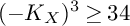 $(-K_X)^3\ge 34$. As a corollary, we prove that the tangent bundle is not big when X has a standard conic bundle structure with non-empty discriminant. Our main methods are to produce irreducible effective divisors on ${\mathbb {P}}(T_X)$ constructed from the total dual VMRT associated to a family of rational curves. Additionally, we present some criteria to determine the bigness of $T_X$.


A McKay Correspondence in Positive Characteristic
- Part of
-
- Journal:
- Forum of Mathematics, Sigma / Volume 12 / 2024
- Published online by Cambridge University Press:
- 10 December 2024, e116
-
- Article
-
- You have access
- Open access
- HTML
- Export citation
-
We establish a McKay correspondence for finite and linearly reductive subgroup schemes of ${\mathbf {SL}}_2$ in positive characteristic. As an application, we obtain a McKay correspondence for all rational double point singularities in characteristic $p\geq 7$. We discuss linearly reductive quotient singularities and canonical lifts over the ring of Witt vectors. In dimension 2, we establish simultaneous resolutions of singularities of these canonical lifts via G-Hilbert schemes. In the appendix, we discuss several approaches towards the notion of conjugacy classes for finite group schemes: This is an ingredient in McKay correspondences, but also of independent interest.


A REMARK ON FUJINO’S WORK ON THE CANONICAL BUNDLE FORMULA VIA PERIOD MAPS
- Part of
-
- Journal:
- Nagoya Mathematical Journal / Volume 257 / March 2025
- Published online by Cambridge University Press:
- 02 December 2024, pp. 79-92
-
- Article
- Export citation
On the properness of the moduli space of stable surfaces over $\mathbb{Z}$[1/30]
- Part of
-
- Article
-
- You have access
- Open access
- HTML
- Export citation
-
We show the properness of the moduli stack of stable surfaces over $\mathbb{Z}\left[ {1/30} \right]$, assuming the locally-stable reduction conjecture for stable surfaces. This relies on a local Kawamata–Viehweg vanishing theorem for 3-dimensional log canonical singularities at closed point of characteristic $p \ne 2,3$ and $5$, which are not log canonical centres.


Poncelet’s closure theorem and the embedded topology of conic-line arrangements
- Part of
-
- Journal:
- Canadian Mathematical Bulletin / Volume 68 / Issue 1 / March 2025
- Published online by Cambridge University Press:
- 25 November 2024, pp. 109-123
- Print publication:
- March 2025
-
- Article
- Export citation
-
In the study of plane curves, one of the problems is to classify the embedded topology of plane curves in the complex projective plane that have a given fixed combinatorial type, where the combinatorial type of a plane curve is data equivalent to the embedded topology in its tubular neighborhood. A pair of plane curves with the same combinatorial type but distinct embedded topology is called a Zariski pair. In this paper, we consider Zariski pairs consisting of conic-line arrangements that arise from Poncelet’s closure theorem. We study unramified double covers of the union of two conics that are induced by a $2m$-sided Poncelet transverse. As an application, we show the existence of families of Zariski pairs of degree $2m+6$ for $m\geq 2$ that consist of reducible curves having two conics and $2m+2$ lines as irreducible components.


Birationally rigid Fano-Mori fibre spaces
- Part of
-
- Journal:
- Forum of Mathematics, Sigma / Volume 12 / 2024
- Published online by Cambridge University Press:
- 21 October 2024, e84
-
- Article
-
- You have access
- Open access
- HTML
- Export citation
-
In this paper, we prove the birational rigidity of Fano-Mori fibre spaces $\pi \colon V\to S$, every fibre of which is a Fano complete intersection of index 1 and codimension $k\geqslant 3$ in the projective space ${\mathbb P}^{M+k}$ for M sufficiently high, satisfying certain natural conditions of general position, in the assumption that the fibre space $V/S$ is sufficiently twisted over the base. The dimension of the base S is bounded from above by a constant, depending only on the dimension M of the fibre (as the dimension of the fibre M grows, this constant grows as $\frac 12 M^2$).


On the embedded Nash problem
- Part of
-
- Journal:
- Forum of Mathematics, Pi / Volume 12 / 2024
- Published online by Cambridge University Press:
- 16 October 2024, e15
-
- Article
-
- You have access
- Open access
- HTML
- Export citation
Bounding geometrically integral del Pezzo surfaces
- Part of
-
- Journal:
- Forum of Mathematics, Sigma / Volume 12 / 2024
- Published online by Cambridge University Press:
- 14 October 2024, e81
-
- Article
-
- You have access
- Open access
- HTML
- Export citation
-
We prove several boundedness statements for geometrically integral normal del Pezzo surfaces X over arbitrary fields. We give an explicit sharp bound on the irregularity if X is canonical or regular. In particular, we show that wild canonical del Pezzo surfaces exist only in characteristic $2$. As an application, we deduce that canonical del Pezzo surfaces form a bounded family over $\mathbb {Z}$, generalising work of Tanaka. More generally, we prove the BAB conjecture on the boundedness of $\varepsilon $-klt del Pezzo surfaces over arbitrary fields of characteristic different from $2, 3$ and $5$.
$5$.


BIRATIONAL GEOMETRY OF SEXTIC DOUBLE SOLIDS WITH A COMPOUND $A_n$ SINGULARITY
- Part of
-
- Journal:
- Nagoya Mathematical Journal / Volume 256 / December 2024
- Published online by Cambridge University Press:
- 18 September 2024, pp. 970-1021
-
- Article
- Export citation
-
Sextic double solids, double covers of $\mathbb P^3$ branched along a sextic surface, are the lowest degree Gorenstein terminal Fano 3-folds, hence are expected to behave very rigidly in terms of birational geometry. Smooth sextic double solids, and those which are $\mathbb Q$-factorial with ordinary double points, are known to be birationally rigid. In this paper, we study sextic double solids with an isolated compound $A_n$ singularity. We prove a sharp bound $n \leq 8$, describe models for each n explicitly, and prove that sextic double solids with $n> 3$ are birationally nonrigid.


Low-degree Hurwitz stacks in the Grothendieck ring
- Part of
-
- Journal:
- Compositio Mathematica / Volume 160 / Issue 8 / August 2024
- Published online by Cambridge University Press:
- 11 September 2024, pp. 1784-1849
- Print publication:
- August 2024
-
- Article
- Export citation
-
For $2 \leq d \leq 5$, we show that the class of the Hurwitz space of smooth degree $d$, genus $g$ covers of $\mathbb {P}^1$ stabilizes in the Grothendieck ring of stacks as $g \to \infty$, and we give a formula for the limit. We also verify this stabilization when one imposes ramification conditions on the covers, and obtain a particularly simple answer for this limit when one restricts to simply branched covers.


