Refine listing
Actions for selected content:
220 results in 14Exx
The construction problem for Hodge numbers modulo an integer in positive characteristic
- Part of
-
- Journal:
- Forum of Mathematics, Sigma / Volume 8 / 2020
- Published online by Cambridge University Press:
- 09 November 2020, e45
-
- Article
-
- You have access
- Open access
- Export citation
-
Let k be an algebraically closed field of positive characteristic. For any integer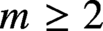 $m\ge 2$, we show that the Hodge numbers of a smooth projective k-variety can take on any combination of values modulo m, subject only to Serre duality. In particular, there are no non-trivial polynomial relations between the Hodge numbers.
SPACE OF INITIAL VALUES OF A MAP WITH A QUARTIC INVARIANT
- Part of
-
- Journal:
- Bulletin of the Australian Mathematical Society / Volume 103 / Issue 3 / June 2021
- Published online by Cambridge University Press:
- 05 October 2020, pp. 438-449
- Print publication:
- June 2021
-
- Article
- Export citation
-
We compactify and regularise the space of initial values of a planar map with a quartic invariant and use this construction to prove its integrability in the sense of algebraic entropy. The system has certain unusual properties, including a sequence of points of indeterminacy in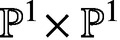 $\mathbb {P}^{1}\!\times \mathbb {P}^{1}$. These indeterminacy points lie on a singular fibre of the mapping to a corresponding QRT system and provide the existence of a one-parameter family of special solutions.
On a rationality problem for fields of cross-ratios II
- Part of
-
- Journal:
- Canadian Mathematical Bulletin / Volume 64 / Issue 3 / September 2021
- Published online by Cambridge University Press:
- 04 September 2020, pp. 667-677
- Print publication:
- September 2021
-
- Article
- Export citation
-
Let k be a field, $x_1, \dots , x_n$ be independent variables and let $L_n = k(x_1, \dots , x_n)$. The symmetric group $\operatorname {\Sigma }_n$ acts on $L_n$ by permuting the variables, and the projective linear group $\operatorname {PGL}_2$ acts by $$ \begin{align*} \begin{pmatrix} a & b \\ c & d \end{pmatrix}\, \colon x_i \longmapsto \frac{a x_i + b}{c x_i + d} \end{align*} $$for each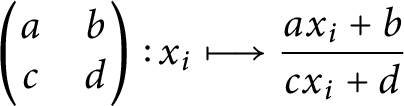 $i = 1, \dots , n$. The fixed field $L_n^{\operatorname {PGL}_2}$ is called “the field of cross-ratios”. Given a subgroup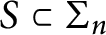 $S \subset \operatorname {\Sigma }_n$, H. Tsunogai asked whether $L_n^S$ rational over $K_n^S$. When $n \geqslant 5,$ the second author has shown that $L_n^S$ is rational over $K_n^S$ if and only if S has an orbit of odd order in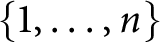 $\{ 1, \dots , n \}$. In this paper, we answer Tsunogai’s question for $n \leqslant 4$.


INVARIANT HYPERSURFACES
- Part of
-
- Journal:
- Journal of the Institute of Mathematics of Jussieu / Volume 21 / Issue 2 / March 2022
- Published online by Cambridge University Press:
- 17 August 2020, pp. 713-739
- Print publication:
- March 2022
-
- Article
- Export citation
-
The following theorem, which includes as very special cases results of Jouanolou and Hrushovski on algebraic $D$-varieties on the one hand, and of Cantat on rational dynamics on the other, is established: Working over a field of characteristic zero, suppose $\unicode[STIX]{x1D719}_{1},\unicode[STIX]{x1D719}_{2}:Z\rightarrow X$ are dominant rational maps from an (possibly nonreduced) irreducible scheme $Z$ of finite type to an algebraic variety $X$, with the property that there are infinitely many hypersurfaces on $X$ whose scheme-theoretic inverse images under $\unicode[STIX]{x1D719}_{1}$ and $\unicode[STIX]{x1D719}_{2}$ agree. Then there is a nonconstant rational function $g$ on $X$ such that $g\unicode[STIX]{x1D719}_{1}=g\unicode[STIX]{x1D719}_{2}$. In the case where $Z$ is also reduced, the scheme-theoretic inverse image can be replaced by the proper transform. A partial result is obtained in positive characteristic. Applications include an extension of the Jouanolou–Hrushovski theorem to generalised algebraic ${\mathcal{D}}$-varieties and of Cantat’s theorem to self-correspondences.


WAVE FRONT HOLONOMICITY OF $\text{C}^{\text{exp}}$-CLASS DISTRIBUTIONS ON NON-ARCHIMEDEAN LOCAL FIELDS
- Part of
-
- Journal:
- Forum of Mathematics, Sigma / Volume 8 / 2020
- Published online by Cambridge University Press:
- 30 June 2020, e35
-
- Article
-
- You have access
- Open access
- Export citation
-
Many phenomena in geometry and analysis can be explained via the theory of $D$-modules, but this theory explains close to nothing in the non-archimedean case, by the absence of integration by parts. Hence there is a need to look for alternatives. A central example of a notion based on the theory of $D$-modules is the notion of holonomic distributions. We study two recent alternatives of this notion in the context of distributions on non-archimedean local fields, namely $\mathscr{C}^{\text{exp}}$-class distributions from Cluckers et al. [‘Distributions and wave front sets in the uniform nonarchimedean setting’, Trans. Lond. Math. Soc.5(1) (2018), 97–131] and WF-holonomicity from Aizenbud and Drinfeld [‘The wave front set of the Fourier transform of algebraic measures’, Israel J. Math.207(2) (2015), 527–580 (English)]. We answer a question from Aizenbud and Drinfeld [‘The wave front set of the Fourier transform of algebraic measures’, Israel J. Math.207(2) (2015), 527–580 (English)] by showing that each distribution of the $\mathscr{C}^{\text{exp}}$-class is WF-holonomic and thus provides a framework of WF-holonomic distributions, which is stable under taking Fourier transforms. This is interesting because the $\mathscr{C}^{\text{exp}}$-class contains many natural distributions, in particular, the distributions studied by Aizenbud and Drinfeld [‘The wave front set of the Fourier transform of algebraic measures’, Israel J. Math.207(2) (2015), 527–580 (English)]. We show also another stability result of this class, namely, one can regularize distributions without leaving the $\mathscr{C}^{\text{exp}}$-class. We strengthen a link from Cluckers et al. [‘Distributions and wave front sets in the uniform nonarchimedean setting’, Trans. Lond. Math. Soc.5(1) (2018), 97–131] between zero loci and smooth loci for functions and distributions of the $\mathscr{C}^{\text{exp}}$-class. A key ingredient is a new resolution result for subanalytic functions (by alterations), based on embedded resolution for analytic functions and model theory.


The Nef Cone of the Hilbert Scheme of Points on Rational Elliptic Surfaces and the Cone Conjecture
- Part of
-
- Journal:
- Canadian Mathematical Bulletin / Volume 64 / Issue 1 / March 2021
- Published online by Cambridge University Press:
- 08 June 2020, pp. 216-227
- Print publication:
- March 2021
-
- Article
-
- You have access
- Export citation
MINIMAL MODEL THEORY FOR LOG SURFACES IN FUJIKI’S CLASS ${\mathcal{C}}$
- Part of
-
- Journal:
- Nagoya Mathematical Journal / Volume 244 / December 2021
- Published online by Cambridge University Press:
- 05 June 2020, pp. 256-282
-
- Article
-
- You have access
- Open access
- HTML
- Export citation
-
We establish the minimal model theory for $\mathbb{Q}$ -factorial log surfaces and log canonical surfaces in Fujiki’s class ${\mathcal{C}}$ .


FANO HYPERSURFACES WITH ARBITRARILY LARGE DEGREES OF IRRATIONALITY
- Part of
-
- Journal:
- Forum of Mathematics, Sigma / Volume 8 / 2020
- Published online by Cambridge University Press:
- 08 May 2020, e24
-
- Article
-
- You have access
- Open access
- Export citation
-
We show that complex Fano hypersurfaces can have arbitrarily large degrees of irrationality. More precisely, if we fix a Fano index $e$, then the degree of irrationality of a very general complex Fano hypersurface of index $e$ and dimension n is bounded from below by a constant times $\sqrt{n}$. To our knowledge, this gives the first examples of rationally connected varieties with degrees of irrationality greater than 3. The proof follows a degeneration to characteristic $p$ argument, which Kollár used to prove nonrationality of Fano hypersurfaces. Along the way, we show that in a family of varieties, the invariant ‘the minimal degree of a dominant rational map to a ruled variety’ can only drop on special fibers. As a consequence, we show that for certain low-dimensional families of varieties, the degree of irrationality also behaves well under specialization.


ON DEL PEZZO FIBRATIONS IN POSITIVE CHARACTERISTIC
- Part of
-
- Journal:
- Journal of the Institute of Mathematics of Jussieu / Volume 21 / Issue 1 / January 2022
- Published online by Cambridge University Press:
- 30 March 2020, pp. 197-239
- Print publication:
- January 2022
-
- Article
- Export citation
Two polarised K3 surfaces associated to the same cubic fourfold
- Part of
-
- Journal:
- Mathematical Proceedings of the Cambridge Philosophical Society / Volume 171 / Issue 1 / July 2021
- Published online by Cambridge University Press:
- 16 March 2020, pp. 51-64
- Print publication:
- July 2021
-
- Article
-
- You have access
- Open access
- Export citation
INVARIANCE OF CERTAIN PLURIGENERA FOR SURFACES IN MIXED CHARACTERISTICS
- Part of
-
- Journal:
- Nagoya Mathematical Journal / Volume 243 / September 2021
- Published online by Cambridge University Press:
- 16 January 2020, pp. 1-10
-
- Article
- Export citation
-
We prove the deformation invariance of Kodaira dimension and of certain plurigenera and the existence of canonical models for log surfaces which are smooth over an integral Noetherian scheme $S$.
$S$.

A Witt Nadel vanishing theorem for threefolds
- Part of
-
- Journal:
- Compositio Mathematica / Volume 156 / Issue 3 / March 2020
- Published online by Cambridge University Press:
- 13 January 2020, pp. 435-475
- Print publication:
- March 2020
-
- Article
- Export citation
-
In this paper, we establish a vanishing theorem of Nadel type for the Witt multiplier ideals on threefolds over perfect fields of characteristic larger than five. As an application, if a projective normal threefold over $\mathbb{F}_{q}$ is not klt and its canonical divisor is anti-ample, then the number of the rational points on the klt-locus is divisible by $q$.
$q$.


Some remarks on the volume of log varieties
- Part of
-
- Journal:
- Proceedings of the Edinburgh Mathematical Society / Volume 63 / Issue 2 / May 2020
- Published online by Cambridge University Press:
- 18 December 2019, pp. 314-322
-
- Article
- Export citation
Higher-dimensional foliated Mori theory
- Part of
-
- Journal:
- Compositio Mathematica / Volume 156 / Issue 1 / January 2020
- Published online by Cambridge University Press:
- 14 November 2019, pp. 1-38
- Print publication:
- January 2020
-
- Article
- Export citation
-
We develop some foundational results in a higher-dimensional foliated Mori theory, and show how these results can be used to prove a structure theorem for the Kleiman–Mori cone of curves in terms of the numerical properties of $K_{{\mathcal{F}}}$ for rank 2 foliations on threefolds. We also make progress toward realizing a minimal model program (MMP) for rank 2 foliations on threefolds.

Projective Reconstruction in Algebraic Vision
- Part of
-
- Journal:
- Canadian Mathematical Bulletin / Volume 63 / Issue 3 / September 2020
- Published online by Cambridge University Press:
- 13 November 2019, pp. 592-609
- Print publication:
- September 2020
-
- Article
-
- You have access
- Export citation
DENSITY RESULTS FOR SPECIALIZATION SETS OF GALOIS COVERS
- Part of
-
- Journal:
- Journal of the Institute of Mathematics of Jussieu / Volume 20 / Issue 5 / September 2021
- Published online by Cambridge University Press:
- 25 October 2019, pp. 1455-1496
- Print publication:
- September 2021
-
- Article
-
- You have access
- Open access
- Export citation
-
We provide evidence for this conclusion: given a finite Galois cover $f:X\rightarrow \mathbb{P}_{\mathbb{Q}}^{1}$ of group $G$, almost all (in a density sense) realizations of $G$ over $\mathbb{Q}$ do not occur as specializations of $f$. We show that this holds if the number of branch points of $f$ is sufficiently large, under the abc-conjecture and, possibly, the lower bound predicted by the Malle conjecture for the number of Galois extensions of $\mathbb{Q}$ of given group and bounded discriminant. This widely extends a result of Granville on the lack of $\mathbb{Q}$-rational points on quadratic twists of hyperelliptic curves over $\mathbb{Q}$ with large genus, under the abc-conjecture (a diophantine reformulation of the case $G=\mathbb{Z}/2\mathbb{Z}$ of our result). As a further evidence, we exhibit a few finite groups $G$ for which the above conclusion holds unconditionally for almost all covers of $\mathbb{P}_{\mathbb{Q}}^{1}$ of group $G$. We also introduce a local–global principle for specializations of Galois covers $f:X\rightarrow \mathbb{P}_{\mathbb{Q}}^{1}$ and show that it often fails if $f$ has abelian Galois group and sufficiently many branch points, under the abc-conjecture. On the one hand, such a local–global conclusion underscores the ‘smallness’ of the specialization set of a Galois cover of $\mathbb{P}_{\mathbb{Q}}^{1}$. On the other hand, it allows to generate conditionally ‘many’ curves over $\mathbb{Q}$ failing the Hasse principle, thus generalizing a recent result of Clark and Watson devoted to the hyperelliptic case.


JET SCHEMES OF QUASI-ORDINARY SURFACE SINGULARITIES
- Part of
-
- Journal:
- Nagoya Mathematical Journal / Volume 242 / June 2021
- Published online by Cambridge University Press:
- 20 September 2019, pp. 77-164
-
- Article
- Export citation
-
We describe the irreducible components of the jet schemes with origin in the singular locus of a two-dimensional quasi-ordinary hypersurface singularity. A weighted graph is associated with these components and with their embedding dimensions and their codimensions in the jet schemes of the ambient space. We prove that the data of this weighted graph is equivalent to the data of the topological type of the singularity. We also determine a component of the jet schemes (equivalent to a divisorial valuation on $\mathbb{A}^{3}$), that computes the log-canonical threshold of the singularity embedded in $\mathbb{A}^{3}$. This provides us with pairs $X\subset \mathbb{A}^{3}$ whose log-canonical thresholds are not computed by monomial divisorial valuations. Note that for a pair $C\subset \mathbb{A}^{2}$, where $C$ is a plane curve, the log-canonical threshold is always computed by a monomial divisorial valuation (in suitable coordinates of $\mathbb{A}^{2}$).


K-stability of birationally superrigid Fano varieties
- Part of
-
- Journal:
- Compositio Mathematica / Volume 155 / Issue 9 / September 2019
- Published online by Cambridge University Press:
- 07 August 2019, pp. 1845-1852
- Print publication:
- September 2019
-
- Article
- Export citation
-
We prove that every birationally superrigid Fano variety whose alpha invariant is greater than (respectively no smaller than) $\frac{1}{2}$ is K-stable (respectively K-semistable). We also prove that the alpha invariant of a birationally superrigid Fano variety of dimension $n$ is at least $1/(n+1)$ (under mild assumptions) and that the moduli space (if it exists) of birationally superrigid Fano varieties is separated.


IGUSA’S CONJECTURE FOR EXPONENTIAL SUMS: OPTIMAL ESTIMATES FOR NONRATIONAL SINGULARITIES
- Part of
-
- Journal:
- Forum of Mathematics, Pi / Volume 7 / 2019
- Published online by Cambridge University Press:
- 31 July 2019, e3
-
- Article
-
- You have access
- Open access
- Export citation
Retract Rationality and Algebraic Tori
- Part of
-
- Journal:
- Canadian Mathematical Bulletin / Volume 63 / Issue 1 / March 2020
- Published online by Cambridge University Press:
- 18 July 2019, pp. 173-186
- Print publication:
- March 2020
-
- Article
-
- You have access
- Export citation
-
For any prime number $p$ and field $k$, we characterize the $p$-retract rationality of an algebraic $k$-torus in terms of its character lattice. We show that a $k$-torus is retract rational if and only if it is $p$-retract rational for every prime $p$, and that the Noether problem for retract rationality for a group of multiplicative type $G$ has an affirmative answer for $G$ if and only if the Noether problem for $p$-retract rationality for $G$ has a positive answer for all $p$. For every finite set of primes $S$ we give examples of tori that are $p$-retract rational if and only if $p\notin S$.


