Refine listing
Actions for selected content:
1073 results in 05Cxx
TOPOLOGY OF INTERCONNECTION NETWORKS WITH GIVEN DEGREE AND DIAMETER
- Part of
-
- Journal:
- Bulletin of the Australian Mathematical Society / Volume 81 / Issue 2 / April 2010
- Published online by Cambridge University Press:
- 13 January 2010, pp. 350-352
- Print publication:
- April 2010
-
- Article
-
- You have access
- Export citation
On some modular representations of the Borel subgroup of GL2(Qp)
- Part of
-
- Journal:
- Compositio Mathematica / Volume 146 / Issue 1 / January 2010
- Published online by Cambridge University Press:
- 11 December 2009, pp. 58-80
- Print publication:
- January 2010
-
- Article
-
- You have access
- Export citation
-
Colmez has given a recipe to associate a smooth modular representation Ω(W) of the Borel subgroup of GL2(Qp) to a
 -representation W of
  by using Fontaine’s theory of (φ,Γ)-modules. We compute Ω(W) explicitly and we prove that if W is irreducible and dim (W)=2, then Ω(W) is the restriction to the Borel subgroup of GL2(Qp) of the supersingular representation associated to W by Breuil’s correspondence.
 -representation
  by using Fontaine’s theory of (φ,Γ)-modules. We compute Ω(
ON EMBEDDINGS OF FINITE METRIC SPACES IN ln∞
- Part of
-
- Journal:
- Mathematika / Volume 56 / Issue 1 / January 2010
- Published online by Cambridge University Press:
- 10 December 2009, pp. 135-139
- Print publication:
- January 2010
-
- Article
- Export citation
DIRECTED SIMPLICES IN HIGHER ORDER TOURNAMENTS
- Part of
-
- Journal:
- Mathematika / Volume 56 / Issue 1 / January 2010
- Published online by Cambridge University Press:
- 10 December 2009, pp. 173-181
- Print publication:
- January 2010
-
- Article
- Export citation
-
It is well known that a tournament (complete oriented graph) on n vertices has at most
 directed triangles, and that the constant
  is best possible. Motivated by some geometric considerations, our aim in this paper is to consider some “higher order” versions of this statement. For example, if we give each 3-set from an n-set a cyclic ordering, then what is the greatest number of “directed 4-sets” we can have? We give an asymptotically best possible answer to this question, and give bounds in the general case when we orient each d-set from an n-set.
 directed triangles, and that the constant
  is best possible. Motivated by some geometric considerations, our aim in this paper is to consider some “higher order” versions of this statement. For example, if we give each 3-set from an
 On the number of allelic types for samples taken from exchangeable coalescents with mutation
- Part of
-
- Journal:
- Advances in Applied Probability / Volume 41 / Issue 4 / December 2009
- Published online by Cambridge University Press:
- 01 July 2016, pp. 1082-1101
- Print publication:
- December 2009
-
- Article
-
- You have access
- Export citation
On the Degree Sequence of an Evolving Random Graph Process and Its Critical Phenomenon
- Part of
-
- Journal:
- Journal of Applied Probability / Volume 46 / Issue 4 / December 2009
- Published online by Cambridge University Press:
- 14 July 2016, pp. 1213-1220
- Print publication:
- December 2009
-
- Article
-
- You have access
- Export citation
DECOMPOSITIONS OF GENERALIZED COMPLETE GRAPHS
- Part of
-
- Journal:
- Bulletin of the Australian Mathematical Society / Volume 80 / Issue 3 / December 2009
- Published online by Cambridge University Press:
- 02 October 2009, pp. 523-525
- Print publication:
- December 2009
-
- Article
-
- You have access
- Export citation
ON THE ORDER OF ARC-STABILIZERS IN ARC-TRANSITIVE GRAPHS
- Part of
-
- Journal:
- Bulletin of the Australian Mathematical Society / Volume 80 / Issue 3 / December 2009
- Published online by Cambridge University Press:
- 02 October 2009, pp. 498-505
- Print publication:
- December 2009
-
- Article
-
- You have access
- Export citation
Threshold behaviour and final outcome of an epidemic on a random network with household structure
- Part of
-
- Journal:
- Advances in Applied Probability / Volume 41 / Issue 3 / September 2009
- Published online by Cambridge University Press:
- 01 July 2016, pp. 765-796
- Print publication:
- September 2009
-
- Article
-
- You have access
- Export citation
Large deviations for the leaves in some random trees
- Part of
-
- Journal:
- Advances in Applied Probability / Volume 41 / Issue 3 / September 2009
- Published online by Cambridge University Press:
- 01 July 2016, pp. 845-873
- Print publication:
- September 2009
-
- Article
-
- You have access
- Export citation
ON MAXIMAL ENERGY AND HOSOYA INDEX OF TREES WITHOUT PERFECT MATCHING
- Part of
-
- Journal:
- Bulletin of the Australian Mathematical Society / Volume 81 / Issue 1 / February 2010
- Published online by Cambridge University Press:
- 27 July 2009, pp. 47-57
- Print publication:
- February 2010
-
- Article
-
- You have access
- Export citation
A NEW CHARACTERIZATION OF WIMAN SURFACES
- Part of
-
- Journal:
- Bulletin of the Australian Mathematical Society / Volume 80 / Issue 3 / December 2009
- Published online by Cambridge University Press:
- 27 July 2009, pp. 360-368
- Print publication:
- December 2009
-
- Article
-
- You have access
- Export citation
Random hypergraphs in pseudofinite fields
- Part of
-
- Journal:
- Journal of the Institute of Mathematics of Jussieu / Volume 9 / Issue 1 / January 2010
- Published online by Cambridge University Press:
- 03 June 2009, pp. 29-47
- Print publication:
- January 2010
-
- Article
- Export citation
THE DEPRIORITISED APPROACH TO PRIORITISED ALGORITHMS
- Part of
-
- Journal:
- Bulletin of the Australian Mathematical Society / Volume 79 / Issue 3 / June 2009
- Published online by Cambridge University Press:
- 14 May 2009, pp. 523-524
- Print publication:
- June 2009
-
- Article
-
- You have access
- Export citation
One-regular cubic graphs of order a small number times a prime or a prime square
- Part of
-
- Journal:
- Journal of the Australian Mathematical Society / Volume 76 / Issue 3 / June 2004
- Published online by Cambridge University Press:
- 09 April 2009, pp. 345-356
-
- Article
-
- You have access
- Export citation
An extremal problem in graph theory II
- Part of
-
- Journal:
- Journal of the Australian Mathematical Society. Series A. Pure Mathematics and Statistics / Volume 29 / Issue 4 / June 1980
- Published online by Cambridge University Press:
- 09 April 2009, pp. 417-424
-
- Article
-
- You have access
- Export citation
Decompositions of complete symmetric digraphs into the oriented pentagons
- Part of
-
- Journal:
- Journal of the Australian Mathematical Society. Series A. Pure Mathematics / Volume 28 / Issue 3 / November 1979
- Published online by Cambridge University Press:
- 09 April 2009, pp. 353-361
-
- Article
-
- You have access
- Export citation
Almost all chordal graphs split
- Part of
-
- Journal:
- Journal of the Australian Mathematical Society. Series A. Pure Mathematics and Statistics / Volume 38 / Issue 2 / April 1985
- Published online by Cambridge University Press:
- 09 April 2009, pp. 214-221
-
- Article
-
- You have access
- Export citation
Cubic symmetric graphs of order twice an odd prime-power
- Part of
-
- Journal:
- Journal of the Australian Mathematical Society / Volume 81 / Issue 2 / October 2006
- Published online by Cambridge University Press:
- 09 April 2009, pp. 153-164
-
- Article
-
- You have access
- Export citation
Twenty-step algorithm for determining the asymptotic number of trees of various species: corrigenda
- Part of
-
- Journal:
- Journal of the Australian Mathematical Society. Series A. Pure Mathematics and Statistics / Volume 41 / Issue 3 / December 1986
- Published online by Cambridge University Press:
- 09 April 2009, p. 325
-
- Article
-
- You have access
- Export citation
-
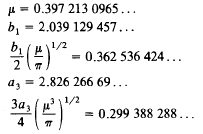
John W. Moon has discovered several computational errors in our article above (J. Austral. Math. Soc. (Series A) 20 (1975), 483–503). The five constants reported for identity trees below Table 1 at the bottom of page 502 are all wrong. The correct values are