Refine listing
Actions for selected content:
1073 results in 05Cxx
Critical epidemics, random graphs, and Brownian motion with a parabolic drift
- Part of
-
- Journal:
- Advances in Applied Probability / Volume 42 / Issue 4 / December 2010
- Published online by Cambridge University Press:
- 01 July 2016, pp. 1187-1206
- Print publication:
- December 2010
-
- Article
-
- You have access
- Export citation
Random Networks with Preferential Growth and Vertex Death
- Part of
-
- Journal:
- Journal of Applied Probability / Volume 47 / Issue 4 / December 2010
- Published online by Cambridge University Press:
- 14 July 2016, pp. 1150-1163
- Print publication:
- December 2010
-
- Article
-
- You have access
- Export citation
NONEXISTENCE OF A CIRCULANT EXPANDER FAMILY
- Part of
-
- Journal:
- Bulletin of the Australian Mathematical Society / Volume 83 / Issue 1 / February 2011
- Published online by Cambridge University Press:
- 17 November 2010, pp. 87-95
- Print publication:
- February 2011
-
- Article
-
- You have access
- Export citation
-
The expansion constant of a simple graph G of order n is defined as
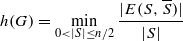 where
where  denotes the set of edges in G between the vertex subset S and its complement
  . An expander family is a sequence {Gi} of d-regular graphs of increasing order such that h(Gi)>ϵ for some fixed ϵ>0. Existence of such families is known in the literature, but explicit construction is nontrivial. A folklore theorem states that there is no expander family of circulant graphs only. In this note, we provide an elementary proof of this fact by first estimating the second largest eigenvalue of a circulant graph, and then employing Cheeger’s inequalities
  where G is a d-regular graph and λ2(G) denotes the second largest eigenvalue of G. Moreover, the associated equality cases are discussed.
 denotes the set of edges in
  . An expander family is a sequence {
Criticality of the exponential rate of decay for the largest nearest-neighbor link in random geometric graphs
- Part of
-
- Journal:
- Advances in Applied Probability / Volume 42 / Issue 3 / September 2010
- Published online by Cambridge University Press:
- 01 July 2016, pp. 631-658
- Print publication:
- September 2010
-
- Article
-
- You have access
- Export citation
Extreme value theory, Poisson-Dirichlet distributions, and first passage percolation on random networks
- Part of
-
- Journal:
- Advances in Applied Probability / Volume 42 / Issue 3 / September 2010
- Published online by Cambridge University Press:
- 01 July 2016, pp. 706-738
- Print publication:
- September 2010
-
- Article
-
- You have access
- Export citation
Poisson Approximation of the Number of Cliques in Random Intersection Graphs
- Part of
-
- Journal:
- Journal of Applied Probability / Volume 47 / Issue 3 / September 2010
- Published online by Cambridge University Press:
- 14 July 2016, pp. 826-840
- Print publication:
- September 2010
-
- Article
-
- You have access
- Export citation
Gibbs Random Fields with Unbounded Spins on Unbounded Degree Graphs
- Part of
-
- Journal:
- Journal of Applied Probability / Volume 47 / Issue 3 / September 2010
- Published online by Cambridge University Press:
- 14 July 2016, pp. 856-875
- Print publication:
- September 2010
-
- Article
-
- You have access
- Export citation
Limit theorems for random spatial drainage networks
- Part of
-
- Journal:
- Advances in Applied Probability / Volume 42 / Issue 3 / September 2010
- Published online by Cambridge University Press:
- 01 July 2016, pp. 659-688
- Print publication:
- September 2010
-
- Article
-
- You have access
- Export citation
RESIDUAL PROPERTIES OF SIMPLE GRAPHS
- Part of
-
- Journal:
- Bulletin of the Australian Mathematical Society / Volume 82 / Issue 3 / December 2010
- Published online by Cambridge University Press:
- 18 August 2010, pp. 488-504
- Print publication:
- December 2010
-
- Article
-
- You have access
- Export citation
The minimal density of triangles in tripartite graphs
- Part of
-
- Journal:
- LMS Journal of Computation and Mathematics / Volume 13 / January 2010
- Published online by Cambridge University Press:
- 01 August 2010, pp. 388-413
-
- Article
-
- You have access
- Export citation
SEMIREGULAR FACTORIZATIONS OF REGULAR MULTIGRAPHS
- Part of
-
- Journal:
- Mathematika / Volume 56 / Issue 2 / July 2010
- Published online by Cambridge University Press:
- 13 July 2010, pp. 357-362
- Print publication:
- July 2010
-
- Article
- Export citation
-
An (r,r+1)-factor of a graph G is a spanning subgraph H such that dH(v)∈{r,r+1} for all vertices v∈𝒱(G). If G is expressed as the union of edge-disjoint (r,r+1)-factors, then this expression is an (r,r+1)-factorization of G. Let μ(r) be the smallest integer with the property that if G is a regular loopless multigraph of degree d with d≥μ(r), then G has an (r,r+1)-factorization. It is shown that
 if r is even. The proof employs a novel list-coloring approach. Together with known results, this shows that μ(r)=r2+1 if r is odd and
  if r is even.
 if
if  if
if SOLUTION TO A QUESTION ON A FAMILY OF IMPRIMITIVE SYMMETRIC GRAPHS
- Part of
-
- Journal:
- Bulletin of the Australian Mathematical Society / Volume 82 / Issue 1 / August 2010
- Published online by Cambridge University Press:
- 18 June 2010, pp. 79-83
- Print publication:
- August 2010
-
- Article
-
- You have access
- Export citation
Preferential duplication graphs
- Part of
-
- Journal:
- Journal of Applied Probability / Volume 47 / Issue 2 / June 2010
- Published online by Cambridge University Press:
- 14 July 2016, pp. 572-585
- Print publication:
- June 2010
-
- Article
-
- You have access
- Export citation
Degree sequences of geometric preferential attachment graphs
- Part of
-
- Journal:
- Advances in Applied Probability / Volume 42 / Issue 2 / June 2010
- Published online by Cambridge University Press:
- 01 July 2016, pp. 319-330
- Print publication:
- June 2010
-
- Article
-
- You have access
- Export citation
Random subgraph counts and U-statistics: multivariate normal approximation via exchangeable pairs and embedding
- Part of
-
- Journal:
- Journal of Applied Probability / Volume 47 / Issue 2 / June 2010
- Published online by Cambridge University Press:
- 14 July 2016, pp. 378-393
- Print publication:
- June 2010
-
- Article
-
- You have access
- Export citation
TETRAVALENT s-TRANSITIVE GRAPHS OF ORDER TWICE A PRIME POWER
- Part of
-
- Journal:
- Journal of the Australian Mathematical Society / Volume 88 / Issue 2 / April 2010
- Published online by Cambridge University Press:
- 08 April 2010, pp. 277-288
-
- Article
-
- You have access
- Export citation
On the Variety of Shapes on the Fringe of a Random Recursive Tree
- Part of
-
- Journal:
- Journal of Applied Probability / Volume 47 / Issue 1 / March 2010
- Published online by Cambridge University Press:
- 14 July 2016, pp. 191-200
- Print publication:
- March 2010
-
- Article
-
- You have access
- Export citation
Optimal Multicommodity Flow Through the Complete Graph with Random Edge Capacities
- Part of
-
- Journal:
- Journal of Applied Probability / Volume 47 / Issue 1 / March 2010
- Published online by Cambridge University Press:
- 14 July 2016, pp. 201-215
- Print publication:
- March 2010
-
- Article
-
- You have access
- Export citation
Sentry Selection in Wireless Networks
- Part of
-
- Journal:
- Advances in Applied Probability / Volume 42 / Issue 1 / March 2010
- Published online by Cambridge University Press:
- 01 July 2016, pp. 1-25
- Print publication:
- March 2010
-
- Article
-
- You have access
- Export citation
-
Let
 be a Poisson process of intensity one in the infinite plane ℝ2. We surround each point x of by the open disc of radius r centred at x. Now let S n be a fixed disc of area n, and let C r (S n ) be the set of discs which intersect S n . Write E r k for the event that C r (S n ) is a k-cover of S n , and F r k for the event that C r (S n ) may be partitioned into k disjoint single covers of S n . We prove that P(E r k ∖ F r k ) ≤ c k / logn, and that this result is best possible. We also give improved estimates for P(E r k ). Finally, we study the obstructions to k-partitionability in more detail. As part of this study, we prove a classification theorem for (deterministic) covers of ℝ2 with half-planes that cannot be partitioned into two single covers.
 be a Poisson process of intensity one in the infinite plane ℝ
NEIGHBOURHOOD AND THE EXISTENCE OF FRACTIONAL k-FACTORS OF GRAPHS
- Part of
-
- Journal:
- Bulletin of the Australian Mathematical Society / Volume 81 / Issue 3 / June 2010
- Published online by Cambridge University Press:
- 13 January 2010, pp. 473-480
- Print publication:
- June 2010
-
- Article
-
- You have access
- Export citation
