Refine listing
Actions for selected content:
1073 results in 05Cxx
Satisfiability thresholds for regular occupation problems
- Part of
-
- Journal:
- Combinatorics, Probability and Computing / Volume 34 / Issue 4 / July 2025
- Published online by Cambridge University Press:
- 04 February 2025, pp. 491-527
-
- Article
-
- You have access
- Open access
- HTML
- Export citation
-
In the last two decades the study of random instances of constraint satisfaction problems (CSPs) has flourished across several disciplines, including computer science, mathematics and physics. The diversity of the developed methods, on the rigorous and non-rigorous side, has led to major advances regarding both the theoretical as well as the applied viewpoints. Based on a ceteris paribus approach in terms of the density evolution equations known from statistical physics, we focus on a specific prominent class of regular CSPs, the so-called occupation problems, and in particular on $r$-in- $k$ occupation problems. By now, out of these CSPs only the satisfiability threshold – the largest degree for which the problem admits asymptotically a solution – for the $1$-in- $k$ occupation problem has been rigorously established. Here we determine the satisfiability threshold of the $2$-in- $k$ occupation problem for all $k$. In the proof we exploit the connection of an associated optimization problem regarding the overlap of satisfying assignments to a fixed point problem inspired by belief propagation, a message passing algorithm developed for solving such CSPs.


Right-angled Artin groups and the cohomology basis graph
- Part of
-
- Journal:
- Proceedings of the Edinburgh Mathematical Society / Volume 68 / Issue 2 / May 2025
- Published online by Cambridge University Press:
- 03 February 2025, pp. 634-654
-
- Article
- Export citation
-
Let Γ be a finite graph and let $A(\Gamma)$ be the corresponding right-angled Artin group. From an arbitrary basis $\mathcal B$ of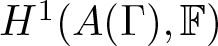 $H^1(A(\Gamma),\mathbb F)$ over an arbitrary field, we construct a natural graph $\Gamma_{\mathcal B}$ from the cup product, called the cohomology basis graph. We show that $\Gamma_{\mathcal B}$ always contains Γ as a subgraph. This provides an effective way to reconstruct the defining graph Γ from the cohomology of $A(\Gamma)$, to characterize the planarity of the defining graph from the algebra of $A(\Gamma)$ and to recover many other natural graph-theoretic invariants. We also investigate the behaviour of the cohomology basis graph under passage to elementary subminors and show that it is not well-behaved under edge contraction.


On perfect subdivision tilings
- Part of
-
- Journal:
- Combinatorics, Probability and Computing / Volume 34 / Issue 3 / May 2025
- Published online by Cambridge University Press:
- 27 January 2025, pp. 421-444
-
- Article
- Export citation
-
For a given graph $H$, we say that a graph $G$ has a perfect $H$-subdivision tiling if $G$ contains a collection of vertex-disjoint subdivisions of $H$ covering all vertices of $G.$ Let $\delta _{\mathrm {sub}}(n, H)$ be the smallest integer $k$ such that any $n$-vertex graph $G$ with minimum degree at least $k$ has a perfect $H$-subdivision tiling. For every graph $H$, we asymptotically determined the value of $\delta _{\mathrm {sub}}(n, H)$. More precisely, for every graph $H$ with at least one edge, there is an integer $\mathrm {hcf}_{\xi }(H)$ and a constant $1 \lt \xi ^*(H)\leq 2$ that can be explicitly determined by structural properties of $H$ such that $\delta _{\mathrm {sub}}(n, H) = \left (1 - \frac {1}{\xi ^*(H)} + o(1) \right )n$ holds for all $n$ and $H$ unless $\mathrm {hcf}_{\xi }(H) = 2$ and $n$ is odd. When $\mathrm {hcf}_{\xi }(H) = 2$ and $n$ is odd, then we show that $\delta _{\mathrm {sub}}(n, H) = \left (\frac {1}{2} + o(1) \right )n$.


Hypergraph independence polynomials with a zero close to the origin
- Part of
-
- Journal:
- Combinatorics, Probability and Computing / Volume 34 / Issue 4 / July 2025
- Published online by Cambridge University Press:
- 22 January 2025, pp. 486-490
-
- Article
- Export citation
-
For each uniformity $k \geq 3$, we construct $k$ uniform linear hypergraphs $G$ with arbitrarily large maximum degree $\Delta$ whose independence polynomial $Z_G$ has a zero $\lambda$ with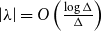 $\left \vert \lambda \right \vert = O\left (\frac {\log \Delta }{\Delta }\right )$. This disproves a recent conjecture of Galvin, McKinley, Perkins, Sarantis, and Tetali.


Rigidity of symmetric simplicial complexes and the lower bound theorem
- Part of
-
- Journal:
- Forum of Mathematics, Sigma / Volume 13 / 2025
- Published online by Cambridge University Press:
- 20 January 2025, e4
-
- Article
-
- You have access
- Open access
- HTML
- Export citation
-
We show that if $\Gamma $ is a point group of $\mathbb {R}^{k+1}$ of order two for some $k\geq 2$ and $\mathcal {S}$ is a k-pseudomanifold which has a free automorphism of order two, then either $\mathcal {S}$ has a $\Gamma $-symmetric infinitesimally rigid realisation in ${\mathbb R}^{k+1}$ or $k=2$ and $\Gamma $ is a half-turn rotation group. This verifies a conjecture made by Klee, Nevo, Novik and Zheng for the case when $\Gamma $ is a point-inversion group. Our result implies that Stanley’s lower bound theorem for centrally symmetric polytopes extends to pseudomanifolds with a free simplicial automorphism of order 2, thus verifying (the inequality part of) another conjecture of Klee, Nevo, Novik and Zheng. Both results actually apply to a much larger class of simplicial complexes – namely, the circuits of the simplicial matroid. The proof of our rigidity result adapts earlier ideas of Fogelsanger to the setting of symmetric simplicial complexes.


On several dynamical properties of shifts acting on directed trees
- Part of
-
- Journal:
- Canadian Journal of Mathematics / Volume 78 / Issue 2 / April 2026
- Published online by Cambridge University Press:
- 09 January 2025, pp. 375-404
- Print publication:
- April 2026
-
- Article
- Export citation
-
This article explores the notions of $\mathcal {F}$-transitivity and topological $\mathcal {F}$-recurrence for backward shift operators on weighted $\ell ^p$-spaces and $c_0$-spaces on directed trees, where $\mathcal {F}$ represents a Furstenberg family of subsets of $\mathbb {N}_0$. In particular, we establish the equivalence between recurrence and hypercyclicity of these operators on unrooted directed trees. For rooted directed trees, a backward shift operator is hypercyclic if and only if it possesses an orbit of a bounded subset that is weakly dense.


Restricted sumsets in multiplicative subgroups
- Part of
-
- Journal:
- Canadian Journal of Mathematics / Volume 78 / Issue 2 / April 2026
- Published online by Cambridge University Press:
- 09 January 2025, pp. 594-618
- Print publication:
- April 2026
-
- Article
-
- You have access
- Open access
- HTML
- Export citation
-
We establish the restricted sumset analog of the celebrated conjecture of Sárközy on additive decompositions of the set of nonzero squares over a finite field. More precisely, we show that if $q>13$ is an odd prime power, then the set of nonzero squares in $\mathbb {F}_q$ cannot be written as a restricted sumset $A \hat {+} A$, extending a result of Shkredov. More generally, we study restricted sumsets in multiplicative subgroups over finite fields as well as restricted sumsets in perfect powers (over integers) motivated by a question of Erdős and Moser. We also prove an analog of van Lint–MacWilliams’ conjecture for restricted sumsets, which appears to be the first analogue of Erdős--Ko–Rado theorem in a family of Cayley sum graphs.


On the ( $k + \text{2}, k$)-problem of Brown, Erdős, and Sós for $k =$ 5,6,7
- Part of
-
- Journal:
- Canadian Journal of Mathematics , First View
- Published online by Cambridge University Press:
- 06 January 2025, pp. 1-43
-
- Article
-
- You have access
- Open access
- HTML
- Export citation
-
Let $f^{(r)}(n;s,k)$ denote the maximum number of edges in an n-vertex r-uniform hypergraph containing no subgraph with k edges and at most s vertices. Brown, Erdős, and Sós [New directions in the theory of graphs (Proc. Third Ann Arbor Conf., Univ. Michigan 1971), pp. 53–63, Academic Press 1973] conjectured that the limit $\lim _{n\rightarrow \infty }n^{-2}f^{(3)}(n;k+2,k)$ exists for all k. The value of the limit was previously determined for $k=2$ in the original paper of Brown, Erdős, and Sós, for $k=3$ by Glock [Bull. Lond. Math. Soc., 51 (2019) 230–236] and for $k=4$ by Glock, Joos, Kim, Kühn, Lichev, and Pikhurko [Proc. Amer. Math. Soc., Series B, 11 (2024) 173–186] while Delcourt and Postle [Proc. Amer. Math. Soc., 152 (2024), 1881–1891] proved the conjecture (without determining the limiting value).
In this article, we determine the value of the limit in the Brown–Erdős–Sós problem for $k\in \{5,6,7\}$. More generally, we obtain the value of $\lim _{n\rightarrow \infty }n^{-2}f^{(r)}(n;rk-2k+2,k)$ for all $r\geqslant 3$ and $k\in \{5,6,7\}$. In addition, by combining these new values with recent results of Bennett, Cushman, and Dudek [arxiv:2309.00182, 2023] we obtain new asymptotic values for several generalized Ramsey numbers.


Minimum non-chromatic-choosable graphs with given chromatic number
- Part of
-
- Journal:
- Canadian Journal of Mathematics , First View
- Published online by Cambridge University Press:
- 27 December 2024, pp. 1-32
-
- Article
- Export citation
-
A graph G is called chromatic-choosable if $\chi (G)=ch(G)$. A natural problem is to determine the minimum number of vertices in a non-chromatic-choosable graph with given chromatic number. It was conjectured by Ohba, and proved by Noel, Reed, and Wu that k-chromatic graphs G with $|V(G)| \le 2k+1$ are chromatic-choosable. This upper bound on $|V(G)|$ is tight. It is known that if k is even, then $G=K_{3 \star (k/2+1), 1 \star (k/2-1)}$ and $G=K_{4, 2 \star (k-1)}$ are non-chromatic-choosable k-chromatic graphs with $|V(G)| =2 k+2$. Some subgraphs of these two graphs are also non-chromatic-choosable. The main result of this paper is that all other k-chromatic graphs G with $|V(G)| =2 k+2$ are chromatic-choosable. In particular, if $\chi (G)$ is odd and $|V(G)| \le 2\chi (G)+2$, then G is chromatic-choosable, which was conjectured by Noel.


Structural convergence and algebraic roots
- Part of
-
- Journal:
- Combinatorics, Probability and Computing / Volume 34 / Issue 3 / May 2025
- Published online by Cambridge University Press:
- 23 December 2024, pp. 392-400
-
- Article
- Export citation
-
Structural convergence is a framework for the convergence of graphs by Nešetřil and Ossona de Mendez that unifies the dense (left) graph convergence and Benjamini-Schramm convergence. They posed a problem asking whether for a given sequence of graphs $(G_n)$ converging to a limit $L$ and a vertex $r$ of $L$, it is possible to find a sequence of vertices $(r_n)$ such that $L$ rooted at $r$ is the limit of the graphs $G_n$ rooted at $r_n$. A counterexample was found by Christofides and Král’, but they showed that the statement holds for almost all vertices $r$ of $L$. We offer another perspective on the original problem by considering the size of definable sets to which the root $r$ belongs. We prove that if $r$ is an algebraic vertex (i.e. belongs to a finite definable set), the sequence of roots $(r_n)$ always exists.


Vines and MAT-labeled graphs
- Part of
-
- Journal:
- Forum of Mathematics, Sigma / Volume 12 / 2024
- Published online by Cambridge University Press:
- 20 December 2024, e128
-
- Article
-
- You have access
- Open access
- HTML
- Export citation
A SUFFICIENT CONDITION FOR PANCYCLIC GRAPHS
- Part of
-
- Journal:
- Bulletin of the Australian Mathematical Society / Volume 112 / Issue 2 / October 2025
- Published online by Cambridge University Press:
- 20 December 2024, pp. 220-226
- Print publication:
- October 2025
-
- Article
- Export citation
-
A graph G is called an $[s,t]$-graph if any induced subgraph of G of order s has size at least $t.$ We prove that every $2$-connected $[4,2]$-graph of order at least $7$ is pancyclic. This strengthens existing results. There are $2$-connected $[4,2]$-graphs which do not satisfy the Chvátal–Erdős condition on Hamiltonicity. We also determine the triangle-free graphs among $[p+2,p]$-graphs for a general $p.$
$p.$


Tree universality in positional games
- Part of
-
- Journal:
- Combinatorics, Probability and Computing / Volume 34 / Issue 3 / May 2025
- Published online by Cambridge University Press:
- 13 December 2024, pp. 338-358
-
- Article
- Export citation
-
In this paper we consider positional games where the winning sets are edge sets of tree-universal graphs. Specifically, we show that in the unbiased Maker-Breaker game on the edges of the complete graph $K_n$, Maker has a strategy to claim a graph which contains copies of all spanning trees with maximum degree at most $cn/\log (n)$, for a suitable constant $c$ and $n$ being large enough. We also prove an analogous result for Waiter-Client games. Both of our results show that the building player can play at least as good as suggested by the random graph intuition. Moreover, they improve on a special case of earlier results by Johannsen, Krivelevich, and Samotij as well as Han and Yang for Maker-Breaker games.


Twin-width of sparse random graphs
- Part of
-
- Journal:
- Combinatorics, Probability and Computing / Volume 34 / Issue 3 / May 2025
- Published online by Cambridge University Press:
- 11 December 2024, pp. 401-420
-
- Article
- Export citation
-
We show that the twin-width of every $n$-vertex $d$-regular graph is at most $n^{\frac{d-2}{2d-2}+o(1)}$ for any fixed integer $d \geq 2$ and that almost all $d$-regular graphs attain this bound. More generally, we obtain bounds on the twin-width of sparse Erdős–Renyi and regular random graphs, complementing the bounds in the denser regime due to Ahn, Chakraborti, Hendrey, Kim, and Oum.


Tight bound for the Erdős–Pósa property of tree minors
- Part of
-
- Journal:
- Combinatorics, Probability and Computing / Volume 34 / Issue 2 / March 2025
- Published online by Cambridge University Press:
- 11 December 2024, pp. 321-325
-
- Article
- Export citation
-
Let $T$ be a tree on $t$ vertices. We prove that for every positive integer $k$ and every graph $G$, either $G$ contains $k$ pairwise vertex-disjoint subgraphs each having a $T$ minor, or there exists a set $X$ of at most $t(k-1)$ vertices of $G$ such that $G-X$ has no $T$ minor. The bound on the size of $X$ is best possible and improves on an earlier $f(t)k$ bound proved by Fiorini, Joret, and Wood (2013) with some fast-growing function $f(t)$. Moreover, our proof is short and simple.


The power of many colours
- Part of
-
- Journal:
- Forum of Mathematics, Sigma / Volume 12 / 2024
- Published online by Cambridge University Press:
- 10 December 2024, e118
-
- Article
-
- You have access
- Open access
- HTML
- Export citation
-
A classical problem, due to Gerencsér and Gyárfás from 1967, asks how large a monochromatic connected component can we guarantee in any r-edge colouring of $K_n$? We consider how big a connected component we can guarantee in any r-edge colouring of $K_n$ if we allow ourselves to use up to s colours. This is actually an instance of a more general question of Bollobás from about 20 years ago which asks for a k-connected subgraph in the same setting. We complete the picture in terms of the approximate behaviour of the answer by determining it up to a logarithmic term, provided n is large enough. We obtain more precise results for certain regimes which solve a problem of Liu, Morris and Prince from 2007, as well as disprove a conjecture they pose in a strong form.
We also consider a generalisation in a similar direction of a question first considered by Erdős and Rényi in 1956, who considered given n and m, what is the smallest number of m-cliques which can cover all edges of $K_n$? This problem is essentially equivalent to the question of what is the minimum number of vertices that are certain to be incident to at least one edge of some colour in any r-edge colouring of $K_n$. We consider what happens if we allow ourselves to use up to s colours. We obtain a more complete understanding of the answer to this question for large n, in particular, determining it up to a constant factor for all $1\le s \le r$, as well as obtaining much more precise results for various ranges including the correct asymptotics for essentially the whole range.


Average distance in a general class of scale-free networks
- Part of
-
- Journal:
- Advances in Applied Probability / Volume 57 / Issue 2 / June 2025
- Published online by Cambridge University Press:
- 09 December 2024, pp. 371-406
- Print publication:
- June 2025
-
- Article
-
- You have access
- Open access
- HTML
- Export citation
-
In Chung–Lu random graphs, a classic model for real-world networks, each vertex is equipped with a weight drawn from a power-law distribution, and two vertices form an edge independently with probability proportional to the product of their weights. Chung–Lu graphs have average distance $O(\log\log n)$ and thus reproduce the small-world phenomenon, a key property of real-world networks. Modern, more realistic variants of this model also equip each vertex with a random position in a specific underlying geometry. The edge probability of two vertices then depends, say, inversely polynomially on their distance.
In this paper we study a generic augmented version of Chung–Lu random graphs. We analyze a model where the edge probability of two vertices can depend arbitrarily on their positions, as long as the marginal probability of forming an edge (for two vertices with fixed weights, one fixed position, and one random position) is as in a Chung–Lu random graph. The resulting class contains Chung–Lu random graphs, hyperbolic random graphs, and geometric inhomogeneous random graphs as special cases.
Our main result is that every random graph model in this general class has the same average distance as a Chung–Lu random graph, up to a factor of $1+o(1)$. This shows in particular that specific choices, such as taking the underlying geometry to be Euclidean, do not significantly influence the average distance. The proof also shows that every random graph model in our class has a giant component and polylogarithmic diameter with high probability.


Continuum limit for interacting systems on adaptive networks
- Part of
-
- Journal:
- European Journal of Applied Mathematics , First View
- Published online by Cambridge University Press:
- 06 December 2024, pp. 1-15
-
- Article
-
- You have access
- Open access
- HTML
- Export citation
Ramsey simplicity of random graphs
- Part of
-
- Journal:
- Combinatorics, Probability and Computing / Volume 34 / Issue 2 / March 2025
- Published online by Cambridge University Press:
- 03 December 2024, pp. 298-320
-
- Article
-
- You have access
- Open access
- HTML
- Export citation
-
A graph $G$ is $q$-Ramsey for another graph $H$ if in any $q$-edge-colouring of $G$ there is a monochromatic copy of $H$, and the classic Ramsey problem asks for the minimum number of vertices in such a graph. This was broadened in the seminal work of Burr, Erdős, and Lovász to the investigation of other extremal parameters of Ramsey graphs, including the minimum degree.
It is not hard to see that if $G$ is minimally $q$-Ramsey for $H$ we must have $\delta (G) \ge q(\delta (H) - 1) + 1$, and we say that a graph $H$ is $q$-Ramsey simple if this bound can be attained. Grinshpun showed that this is typical of rather sparse graphs, proving that the random graph $G(n,p)$ is almost surely $2$-Ramsey simple when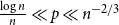 $\frac{\log n}{n} \ll p \ll n^{-2/3}$. In this paper, we explore this question further, asking for which pairs $p = p(n)$ and $q = q(n,p)$ we can expect $G(n,p)$ to be $q$-Ramsey simple.
We first extend Grinshpun’s result by showing that $G(n,p)$ is not just $2$-Ramsey simple, but is in fact $q$-Ramsey simple for any $q = q(n)$, provided $p \ll n^{-1}$ or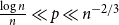 $\frac{\log n}{n} \ll p \ll n^{-2/3}$. Next, when $p \gg \left ( \frac{\log n}{n} \right )^{1/2}$, we find that $G(n,p)$ is not $q$-Ramsey simple for any $q \ge 2$. Finally, we uncover some interesting behaviour for intermediate edge probabilities. When $n^{-2/3} \ll p \ll n^{-1/2}$, we find that there is some finite threshold $\tilde{q} = \tilde{q}(H)$, depending on the structure of the instance $H \sim G(n,p)$ of the random graph, such that $H$ is $q$-Ramsey simple if and only if $q \le \tilde{q}$. Aside from a couple of logarithmic factors, this resolves the qualitative nature of the Ramsey simplicity of the random graph over the full spectrum of edge probabilities.


ON NEIGHBOURHOODS IN THE ENHANCED POWER GRAPH ASSOCIATED WITH A FINITE GROUP
- Part of
-
- Journal:
- Bulletin of the Australian Mathematical Society / Volume 112 / Issue 1 / August 2025
- Published online by Cambridge University Press:
- 02 December 2024, pp. 149-154
- Print publication:
- August 2025
-
- Article
-
- You have access
- Open access
- HTML
- Export citation
