Refine search
Actions for selected content:
238141 results in Physics and Astronomy
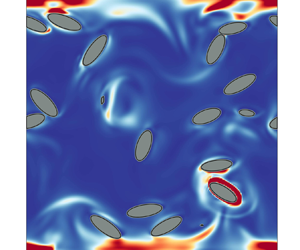
Numerical study on turbulence modulation of finite-size particles in plane-Couette flow
-
- Journal:
- Journal of Fluid Mechanics / Volume 970 / 10 September 2023
- Published online by Cambridge University Press:
- 29 August 2023, A7
-
- Article
- Export citation
-
Turbulent plane-Couette flow suspended with finite-size spheroidal particles is studied using fully particle-resolved direct numerical simulations. The effects of particle aspect ratio on turbulent arguments and particle statistics are explored, leading to the same conclusions as the previous experimental findings (Wang et al., J. Fluid Mech., vol. 937, 2022, A15). By performing stress analysis, we find that the presence of particles introduces extra stresses to the system and accounts for the global drag increases. The particle-laden flow cases exhibit spectra that are consistent with the scalings $k^{-5/3}$ and $k^{-3}$ in the large and small scales, respectively. While the $k^{-3}$ scaling observed in the particle-laden flow is reminiscent of bubbly flow, an examination of the particle Reynolds number suggests that the mechanism responsible may not be attributable to the pseudo-turbulence induced by particles as in the case of bubbles. In the view of particle statistics, we observe that spherical and non-spherical particles cluster preferentially in the near-wall and the bulk region, respectively, and that the orientations of non-spherical particles are affected by their aspect ratios, especially in the near-wall region. The present numerical results, combined with previous experimental findings in Wang et al. (J. Fluid Mech., vol. 937, 2022, A15), provide in-depth information on both the fluid and the particle phase, contributing to a better understanding of particle suspension in shear flows.


Competition among the two-plasmon decay of backscattered light, filamentation of the electron-plasma wave and side stimulated Raman scattering
-
- Journal:
- High Power Laser Science and Engineering / Volume 11 / 2023
- Published online by Cambridge University Press:
- 29 August 2023, e76
-
- Article
-
- You have access
- Open access
- HTML
- Export citation
-
Competition among the two-plasmon decay (TPD) of backscattered light of stimulated Raman scattering (SRS), filamentation of the electron-plasma wave (EPW) and forward side SRS is investigated by two-dimensional particle-in-cell simulations. Our previous work [K. Q. Pan et al., Nucl. Fusion 58, 096035 (2018)] showed that in a plasma with the density near 1/10 of the critical density, the backscattered light would excite the TPD, which results in suppression of the backward SRS. However, this work further shows that when the laser intensity is so high ( $>{10}^{16}$ W/cm2) that the backward SRS cannot be totally suppressed, filamentation of the EPW and forward side SRS will be excited. Then the TPD of the backscattered light only occurs in the early stage and is suppressed in the latter stage. Electron distribution functions further show that trapped-particle-modulation instability should be responsible for filamentation of the EPW. This research can promote the understanding of hot-electron generation and SRS saturation in inertial confinement fusion experiments.

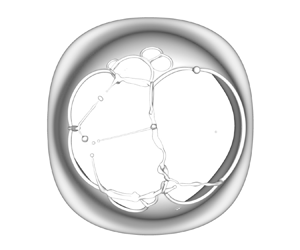
Bag film breakup of droplets in uniform airflows
-
- Journal:
- Journal of Fluid Mechanics / Volume 970 / 10 September 2023
- Published online by Cambridge University Press:
- 29 August 2023, A9
-
- Article
-
- You have access
- Open access
- HTML
- Export citation
-
We present novel numerical simulations investigating the bag breakup of liquid droplets. We first examine the viscous effect on the early-time drop deformation, comparing with theory and experiment. Next, a bag film forms at late time and is susceptible to spurious mesh-induced breakup in numerical simulations, which has prevented previous studies from reaching grid convergence of fragment statistics. We therefore adopt the manifold death (MD) algorithm which artificially perforates thin films once they reach a prescribed critical thickness independent of the grid size, controlled by a numerical parameter $L_{sig}$. We show grid convergence of fragment statistics when utilising the MD algorithm, and analyse the fragment behaviour and bag film disintegration mechanisms including ligament breakup, node detachment and rim destabilisation. Our choice of the critical thickness parameter $L_{sig}$ is limited by numerical constraints and thus has not been matched to experiment or theory; consequently, the current simulations yield critical bag film perforation thicknesses larger than experimentally observed. The influence of the MD algorithm configuration on the bag breakup phenomena and statistics will be investigated in future work. We also study the effects of moderate liquid Ohnesorge number ( $0.005 \leqslant Oh \leqslant 0.05$) on the bag breakup process and fragment statistics, where a non-monotonic dependency of the average diameter of bag film fragments on $Oh$ is found. These results highlight the utility of the MD algorithm in multiphase simulations involving topological changes, and pave the way for physics-based numerical investigations into spume generation at the air–sea interface.


Kilowatt-level supercontinuum generation in a single-stage random fiber laser with a half-open cavity
-
- Journal:
- High Power Laser Science and Engineering / Volume 11 / 2023
- Published online by Cambridge University Press:
- 29 August 2023, e80
-
- Article
-
- You have access
- Open access
- HTML
- Export citation
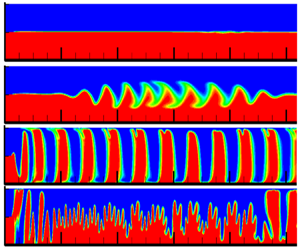
Waves and instability at the interface of two flows of miscible magnetic and non-magnetic fluids
-
- Journal:
- Journal of Fluid Mechanics / Volume 970 / 10 September 2023
- Published online by Cambridge University Press:
- 29 August 2023, A11
-
- Article
- Export citation
A 115 ps, 100 Hz high-beam-quality laser based on transient stimulated Brillouin scattering pulse compression
-
- Journal:
- High Power Laser Science and Engineering / Volume 11 / 2023
- Published online by Cambridge University Press:
- 29 August 2023, e70
-
- Article
-
- You have access
- Open access
- HTML
- Export citation
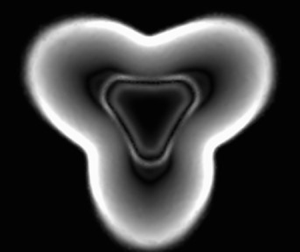
Gas-dynamic and mixing analysis of under-expanded hydrogen jets: effect of the cross section shape
-
- Journal:
- Journal of Fluid Mechanics / Volume 970 / 10 September 2023
- Published online by Cambridge University Press:
- 29 August 2023, A8
-
- Article
- Export citation

Mid-Infrared and Terahertz Quantum Cascade Lasers
-
- Published online:
- 25 August 2023
- Print publication:
- 14 September 2023
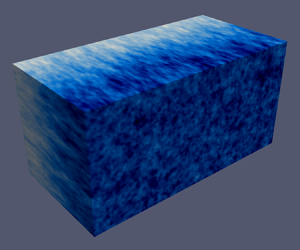
An efficient and low-divergence method for generating inhomogeneous and anisotropic turbulence with arbitrary spectra
-
- Journal:
- Journal of Fluid Mechanics / Volume 970 / 10 September 2023
- Published online by Cambridge University Press:
- 25 August 2023, A2
-
- Article
- Export citation
Pressure anisotropy and viscous heating in weakly collisional plasma turbulence
-
- Journal:
- Journal of Plasma Physics / Volume 89 / Issue 4 / August 2023
- Published online by Cambridge University Press:
- 25 August 2023, 905890417
-
- Article
-
- You have access
- Open access
- HTML
- Export citation
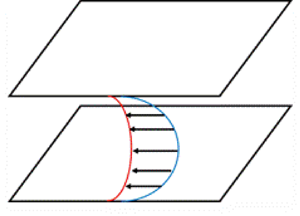
A universal velocity transformation for boundary layers with pressure gradients
-
- Journal:
- Journal of Fluid Mechanics / Volume 970 / 10 September 2023
- Published online by Cambridge University Press:
- 25 August 2023, A3
-
- Article
- Export citation
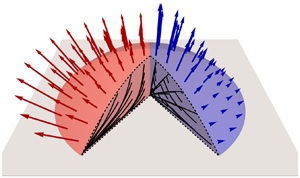
The effect of the spatial variation of the evaporative flux on the deposition from a thin sessile droplet
-
- Journal:
- Journal of Fluid Mechanics / Volume 970 / 10 September 2023
- Published online by Cambridge University Press:
- 25 August 2023, A1
-
- Article
-
- You have access
- Open access
- HTML
- Export citation
-
A mathematical model for the effect of the spatial variation of the local evaporative flux on the evaporation of and deposition from a thin pinned particle-laden sessile droplet is formulated and solved. We then analyse the behaviour for a one-parameter family of local evaporative fluxes with the free parameter $n \, (>-1)$ that exhibits qualitatively different behaviours mimicking those that can be obtained by, for example, surrounding the droplet with a bath of fluid or using a mask with one or more holes in it to achieve a desired pattern of evaporation enhancement and/or suppression. We show that when $-1< n<1$ (including the special cases $n=-1/2$ of diffusion-limited evaporation into an unbounded atmosphere and $n=0$ of spatially uniform evaporation), all of the particles are eventually advected to the contact line, and so the final deposit is a ring deposit at the contact line, whereas when $n>1$ all of the particles are eventually advected to the centre of the droplet, and so the final deposit is at the centre of the droplet. In particular, the present work demonstrates that a singular (or even a non-zero) evaporative flux at the contact line is not an essential requirement for the formation of a ring deposit. In addition, we calculate the paths of the particles when diffusion is slower than both axial and radial advection, and show that in this regime all of the particles are captured by the descending free surface before eventually being deposited onto the substrate.


Condensed Matter Field Theory
-
- Published online:
- 24 August 2023
- Print publication:
- 14 September 2023
Equidistribution of exponential sums indexed by a subgroup of fixed cardinality
- Part of
-
- Journal:
- Mathematical Proceedings of the Cambridge Philosophical Society / Volume 176 / Issue 1 / January 2024
- Published online by Cambridge University Press:
- 24 August 2023, pp. 65-94
- Print publication:
- January 2024
-
- Article
-
- You have access
- Open access
- HTML
- Export citation
FLM volume 969 Cover and Front matter
-
- Journal:
- Journal of Fluid Mechanics / Volume 969 / 25 August 2023
- Published online by Cambridge University Press:
- 24 August 2023, p. f1
-
- Article
-
- You have access
- Export citation
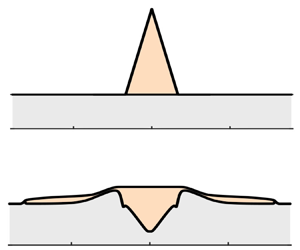
Dynamics and containment of a viscous liquid atop a granular bed
-
- Journal:
- Journal of Fluid Mechanics / Volume 969 / 25 August 2023
- Published online by Cambridge University Press:
- 23 August 2023, R3
-
- Article
-
- You have access
- Open access
- HTML
- Export citation
-
We consider the dynamics of a gravity current of viscous liquid propagating above a dense granular medium that obeys a $\mu (I)$-rheology. Initially, the pool of liquid depresses the granular layer to form levees at its edges. Next, these levees are pushed outwards by the gravity-driven slumping of the liquid, but the levees are not surmounted. In the third stage, the top of the levee is pushed out beyond the rest of the levee. This segregates the liquid into a pond trapped by the remnant of the original levees, and a slowly spreading thin film ahead of the levees. The trapped fraction of liquid depends on the extent of the early granular erosion, which in turn is controlled by the initial shape of the deposit and the yield criterion of the granular layer. The key physical ingredients that lead to such dynamics are inertia-less flow and a lower layer with a yield criterion. The latter gives rise to the all-important levees, which lead to the eventual trapping.

On the values taken by slice torus invariants
-
- Journal:
- Mathematical Proceedings of the Cambridge Philosophical Society / Volume 176 / Issue 1 / January 2024
- Published online by Cambridge University Press:
- 23 August 2023, pp. 55-63
- Print publication:
- January 2024
-
- Article
-
- You have access
- Open access
- HTML
- Export citation
Gyrokinetic applications in electron–positron and non-neutral plasmas
- Part of
-
- Journal:
- Journal of Plasma Physics / Volume 89 / Issue 4 / August 2023
- Published online by Cambridge University Press:
- 23 August 2023, 935890403
-
- Article
-
- You have access
- Open access
- HTML
- Export citation
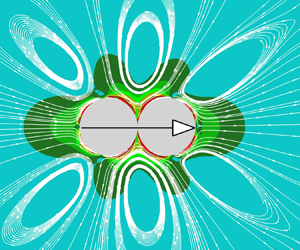
Swimming of an inertial squirmer and squirmer dumbbell through a viscoelastic fluid
-
- Journal:
- Journal of Fluid Mechanics / Volume 969 / 25 August 2023
- Published online by Cambridge University Press:
- 23 August 2023, A34
-
- Article
- Export citation
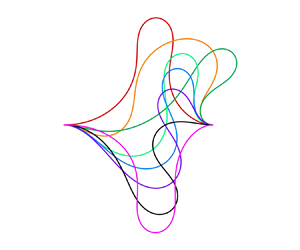
Snap-through dynamics of a buckled flexible filament in a uniform flow
-
- Journal:
- Journal of Fluid Mechanics / Volume 969 / 25 August 2023
- Published online by Cambridge University Press:
- 22 August 2023, A33
-
- Article
- Export citation
