Refine search
Actions for selected content:
238141 results in Physics and Astronomy
Appendix A - Notation and Other Conventions
- from Part III - Appendices
-
- Book:
- Data Modeling for the Sciences
- Published online:
- 17 August 2023
- Print publication:
- 31 August 2023, pp 347-348
-
- Chapter
- Export citation

Numerical Methods in Physics with Python
-
- Published online:
- 30 August 2023
- Print publication:
- 20 July 2023
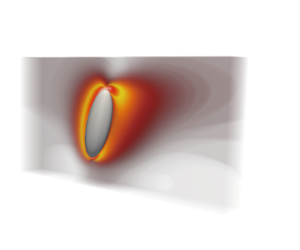
Fluid-inertia torque on spheroids in pseudo-plastic fluid flows: effect of shear-thinning rheology
-
- Journal:
- Journal of Fluid Mechanics / Volume 970 / 10 September 2023
- Published online by Cambridge University Press:
- 30 August 2023, A12
-
- Article
- Export citation
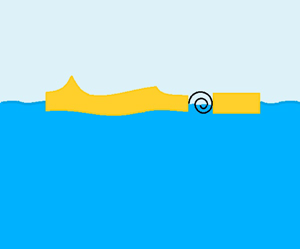
Eigenmodes and added-mass matrices of hydroelastic vibrations of complex structures
-
- Journal:
- Journal of Fluid Mechanics / Volume 970 / 10 September 2023
- Published online by Cambridge University Press:
- 30 August 2023, A14
-
- Article
- Export citation
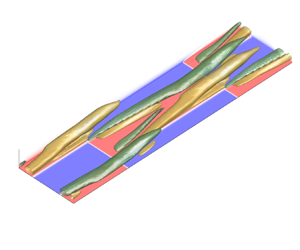
Secondary flows induced by two-dimensional surface temperature heterogeneity in stably stratified channel flow
-
- Journal:
- Journal of Fluid Mechanics / Volume 970 / 10 September 2023
- Published online by Cambridge University Press:
- 30 August 2023, A20
-
- Article
- Export citation
-
The structure and impact of thermally induced secondary motions in stably stratified channel flows with two-dimensional surface temperature inhomogeneities is studied using direct numerical simulation (DNS). Starting from a configuration with only spanwise varying surface temperature, where the streamwise direction is homogeneous (Bon & Meyers, J. Fluid Mech., 2022, pp. 1–38), we study cases where the periodic temperature strip length $l_x/h$ (with $h$ the half-channel height) assumes finite values. The patch width ( $l_y/h =\{{\rm \pi} /4, {\rm \pi}/8$}) and length are varied at fixed stability and two different Reynolds numbers. Results indicate that for the investigated patch widths, the streamwise development of the secondary flows depends on the patch aspect ratio ( $a=l_x/l_y$), while they reach a fully developed state after approximately $25l_y$. The strength of the secondary motions, and their impact on momentum and heat transfer through the dispersive fluxes, is strongly reduced as the length of the temperature strips decreases, and becomes negligible when $a\lesssim 1$. We demonstrate that upward dispersive and turbulent heat transport in locally unstably stratified regions above the high-temperature patches lead to reduced overall downward heat transfer. Comparison to local Monin–Obukhov similarity theory (MOST) reveals that scaled velocity and temperature gradients in homogeneous stably stratified channel flow at $Re_\tau =550$ agree reasonably well with empirical correlations obtained from meteorological data. For thermally heterogeneous cases with strips of finite length, the similarity functions only collapse higher above the surface, where dispersive fluxes are negligible. Lastly, we show that mean profiles of all simulations collapse when using outer-layer scaling based on displacement thickness.


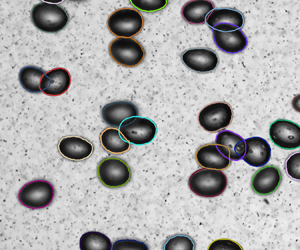
Effects of surfactants on bubble-induced turbulence
-
- Journal:
- Journal of Fluid Mechanics / Volume 970 / 10 September 2023
- Published online by Cambridge University Press:
- 30 August 2023, A13
-
- Article
-
- You have access
- Open access
- HTML
- Export citation
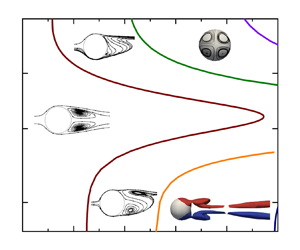
Linear global stability of a flow past a sphere under a streamwise magnetic field
-
- Journal:
- Journal of Fluid Mechanics / Volume 970 / 10 September 2023
- Published online by Cambridge University Press:
- 30 August 2023, A16
-
- Article
- Export citation
-
The global linear stability analysis for the magnetohydrodynamic liquid metal flow past an insulated sphere subjected to a constant streamwise magnetic field is investigated in the range of the Reynolds number $Re\leq 400$ and the interaction number $N\leq 40$ coupled with direct numerical simulations, where $N$ stands for strength of the electromagnetic force. The stability of the steady axisymmetric base flow to independent time-azimuthal modes is discussed. Five critical curves associated with various wake transitions are obtained in the $\{Re, N\}$ phase diagram. These critical curves reveal the stabilising effect of a weak magnetic field, the destabilising effect of a strong magnetic field and re-stabilising effect of a much stronger magnetic field. To explore the impact of the magnetic field on flow instability, a sensitivity analysis utilizing an adjoint method is performed for the first regular bifurcation. Sensitivity functions of growth rate to base-flow modifications and Lorentz force are defined to identify the region that has the most significant influence on flow instability, such as the recirculation region responsible for the stabilising effect at a weak magnetic field and the shear layer region responsible for the destabilising effect at a strong magnetic field. Furthermore, a competition between the stabilising and shear destabilising effects of the magnetic field is discussed. This analysis provides valuable insights into the non-monotonic effect of the magnetic field on flow instability.


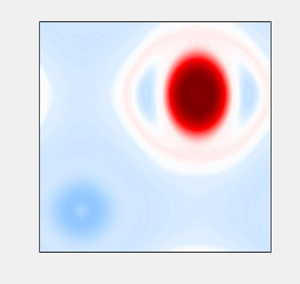
Exact coherent structures in fully developed two-dimensional turbulence
-
- Journal:
- Journal of Fluid Mechanics / Volume 970 / 10 September 2023
- Published online by Cambridge University Press:
- 30 August 2023, A18
-
- Article
-
- You have access
- Open access
- HTML
- Export citation

Macroscopic model for generalised Newtonian inertial two-phase flow in porous media
-
- Journal:
- Journal of Fluid Mechanics / Volume 970 / 10 September 2023
- Published online by Cambridge University Press:
- 30 August 2023, A19
-
- Article
- Export citation
Development of compact tokamak fusion reactor use cases to inform future transport studies
- Part of
-
- Journal:
- Journal of Plasma Physics / Volume 89 / Issue 4 / August 2023
- Published online by Cambridge University Press:
- 30 August 2023, 905890418
-
- Article
-
- You have access
- Open access
- HTML
- Export citation
-
The OMFIT STEP (Meneghini et al., Nucl. Fusion, vol. 10, 2020, p. 1088) workflow has been used to develop inductive and steady-state H-mode core plasma scenario use cases for a $B_0 = 8 \, {\rm T}$
 , $R_0 = 4 \, {\rm m}$
 machine to help guide and inform future higher-fidelity studies of core transport and confinement in compact tokamak reactors. Both use cases are designed to produce 200 MW or more of net electric power in an up-down symmetric plasma with minor radius $a = 1.4 \, {\rm m}$
 , elongation $\kappa = 2.0$
 , triangularity $\delta = 0.5$
 and effective charge $Z_{{\rm eff}} \simeq 2$
 . Additional considerations based on the need for compatibility of the core with reactor-relevant power exhaust solutions and external actuators were used to guide and constrain the use case development. An extensive characterization of core transport in both scenarios is presented, the most important feature of which is the extreme sensitivity of the results to the quantitative stiffness level of the transport model used as well as the predicted critical gradients. This sensitivity is shown to arise from different levels of transport stiffness exhibited by the models, combined with the gyroBohm-normalized fluxes of the predictions being an order of magnitude larger than other H-mode plasmas. Additionally, it is shown that although heating in both plasmas is predominantly to the electrons and collisionality is low, the plasmas remain sufficiently well coupled for the ions to carry a significant fraction of the thermal transport. As neoclassical transport is negligible in these conditions, this situation inherently requires long-wavelength ion gyroradius-scale turbulence to be the dominant transport mechanism in both plasmas. These results are combined with other basic considerations to propose a simple heuristic model of transport in reactor-relevant plasmas, along with simple metrics to quantify coupling and core transport properties across burning and non-burning plasmas.


The Rapid ASKAP Continuum Survey III: Spectra and Polarisation In Cutouts of Extragalactic Sources (SPICE-RACS) first data release
-
- Journal:
- Publications of the Astronomical Society of Australia / Volume 40 / 2023
- Published online by Cambridge University Press:
- 30 August 2023, e040
-
- Article
-
- You have access
- Open access
- HTML
- Export citation
-
The Australian SKA Pathfinder (ASKAP) radio telescope has carried out a survey of the entire Southern Sky at 887.5 MHz. The wide area, high angular resolution, and broad bandwidth provided by the low-band Rapid ASKAP Continuum Survey (RACS-low) allow the production of a next-generation rotation measure (RM) grid across the entire Southern Sky. Here we introduce this project as Spectral and Polarisation in Cutouts of Extragalactic sources from RACS (SPICE-RACS). In our first data release, we image 30 RACS-low fields in Stokes I, Q, U at 25 $^{\prime\prime}$ angular resolution, across 744–1032 MHz with 1 MHz spectral resolution. Using a bespoke, highly parallelised, software pipeline we are able to rapidly process wide-area spectro-polarimetric ASKAP observations. Notably, we use ‘postage stamp’ cutouts to assess the polarisation properties of 105912 radio components detected in total intensity. We find that our Stokes Q and U images have an rms noise of $\sim$80 $\unicode{x03BC}$Jy PSF $^{-1}$, and our correction for instrumental polarisation leakage allows us to characterise components with $\gtrsim$1% polarisation fraction over most of the field of view. We produce a broadband polarised radio component catalogue that contains 5818 RM measurements over an area of $\sim$1300 deg $^{2}$ with an average error in RM of $1.6^{+1.1}_{-1.0}$ rad m $^{-2}$, and an average linear polarisation fraction $3.4^{+3.0}_{-1.6}$ %. We determine this subset of components using the conditions that the polarised signal-to-noise ratio is $>$8, the polarisation fraction is above our estimated polarised leakage, and the Stokes I spectrum has a reliable model. Our catalogue provides an areal density of $4\pm2$ RMs deg $^{-2}$; an increase of $\sim$4 times over the previous state-of-the-art (Taylor, Stil, Sunstrum 2009, ApJ, 702, 1230). Meaning that, having used just 3% of the RACS-low sky area, we have produced the 3rd largest RM catalogue to date. This catalogue has broad applications for studying astrophysical magnetic fields; notably revealing remarkable structure in the Galactic RM sky. We will explore this Galactic structure in a follow-up paper. We will also apply the techniques described here to produce an all-Southern-sky RM catalogue from RACS observations. Finally, we make our catalogue, spectra, images, and processing pipeline publicly available.


eXawatt Center for Extreme Light Studies
- Part of
-
- Journal:
- High Power Laser Science and Engineering / Volume 11 / 2023
- Published online by Cambridge University Press:
- 30 August 2023, e78
-
- Article
-
- You have access
- Open access
- HTML
- Export citation
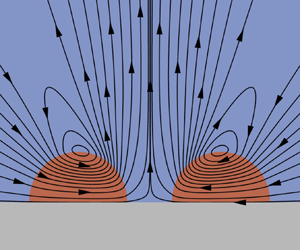
A thermodynamically consistent diffuse interface model for the wetting phenomenon of miscible and immiscible ternary fluids
-
- Journal:
- Journal of Fluid Mechanics / Volume 970 / 10 September 2023
- Published online by Cambridge University Press:
- 30 August 2023, A17
-
- Article
-
- You have access
- Open access
- HTML
- Export citation
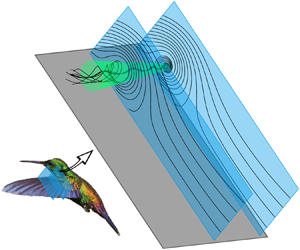
A theory on leading-edge vortex stabilization by spanwise flow
-
- Journal:
- Journal of Fluid Mechanics / Volume 970 / 10 September 2023
- Published online by Cambridge University Press:
- 30 August 2023, R1
-
- Article
- Export citation
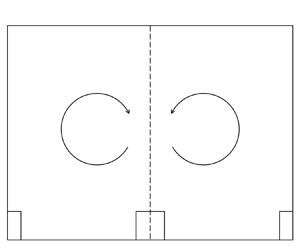
Asymmetric secondary flows above geometrically symmetric surface roughness
-
- Journal:
- Journal of Fluid Mechanics / Volume 970 / 10 September 2023
- Published online by Cambridge University Press:
- 30 August 2023, A15
-
- Article
-
- You have access
- Open access
- HTML
- Export citation
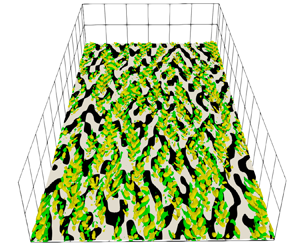
Nonlinear optimal perturbation of turbulent channel flow as a precursor of extreme events
-
- Journal:
- Journal of Fluid Mechanics / Volume 970 / 10 September 2023
- Published online by Cambridge University Press:
- 29 August 2023, A6
-
- Article
- Export citation
-
This work aims at studying the mechanisms behind the occurrence of extreme dissipation events in a channel flow, identifying nonlinear optimal perturbations as potential precursors of these events. Nonlinear optimal perturbations with respect to a generic turbulent instantaneous snapshot are computed for the first time using a direct-adjoint algorithm in the channel flow at $Re_{\tau }\approx 180$. The resulting initial perturbation displays the upstream tilting characteristic of Orr's mechanism and is positioned along the interfaces between two opposite-sign velocity streaks of the pre-existing turbulent field. Such a perturbation induces a sudden breakdown of the pre-existing structures and a heavier tail in the dissipation probability density function distribution. Different mechanisms are at play during this process: the high shear present at the interface between coherent low- and high-momentum regions is exploited to break down the larger structures and drive energy to small scales. This energy cascade is fed by an enhanced lift-up effect that produces intense streaks near the wall. It is found that the optimal perturbation grows exponentially during the first phase of its evolution reflecting the existence of a secondary modal instability of the streaks. To corroborate the results, the conditional spatiotemporal proper orthogonal decomposition (POD) analysis of Hack & Schimdt (J. Fluid Mech., vol. 907, 2021, A9) is performed both in the perturbed and in the unperturbed flow, showing a clear agreement between the two cases and with the reference study. Thus, the optimal perturbation at initial time can be considered as a precursor of extreme events.

All-optical nonlinear chiral ultrafast magnetization dynamics driven by circularly polarized magnetic fields
-
- Journal:
- High Power Laser Science and Engineering / Volume 11 / 2023
- Published online by Cambridge University Press:
- 29 August 2023, e82
-
- Article
-
- You have access
- Open access
- HTML
- Export citation
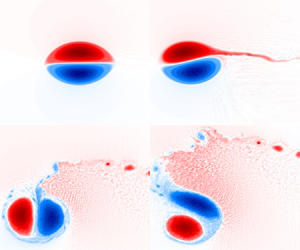
The evolution of surface quasi-geostrophic modons on sloping topography
-
- Journal:
- Journal of Fluid Mechanics / Volume 970 / 10 September 2023
- Published online by Cambridge University Press:
- 29 August 2023, A10
-
- Article
-
- You have access
- Open access
- HTML
- Export citation
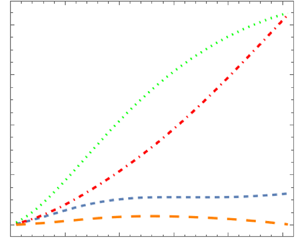
The polar-Cartesian mild-slope equation
-
- Journal:
- Journal of Fluid Mechanics / Volume 970 / 10 September 2023
- Published online by Cambridge University Press:
- 29 August 2023, A4
-
- Article
-
- You have access
- Open access
- HTML
- Export citation
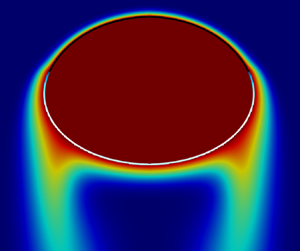
Impact of surfactants on the rise of deformable bubbles and interfacial gas–liquid mass transfer
-
- Journal:
- Journal of Fluid Mechanics / Volume 970 / 10 September 2023
- Published online by Cambridge University Press:
- 29 August 2023, A5
-
- Article
- Export citation
-
Axisymmetric numerical simulations of the hydrodynamics around rising bubbles are performed in order to investigate the impact of surfactants on the bubble dynamics. Surfactants are assumed to be insoluble. The transport of the adsorbed surfactants is computed along the deforming surface at large surface Péclet number, and Marangoni stresses are taken into account. This simulation model leads to the stagnant-cap regime, with partially immobile interfaces. A parametric study is performed on cases at given Archimedes number, by varying the degree of contamination (Marangoni number) but maintaining a nearly constant Eötvös number. The presence of surfactants affects the rise velocity for oblate bubbles less than for spherical bubbles: the increase of the drag coefficient, due to interface contamination, is mitigated by a lower bubble deformation. When the cap angle $\theta _{cap}$ belongs to the southern hemisphere, the aspect ratio $\chi$ is found to decrease with contamination: the dynamic pressure responsible for the bubble distortion is lowered, related to the decline of kinetic energy. As soon as $\theta _{cap}$ lies in the northern hemisphere, the pressure stress causing distortion becomes independent on $\theta _{cap}: \chi$ no longer evolves with contamination, and already matches the prediction for fully immobile interfaces. Mass transfer of a passive scalar across the contaminated interface is also analysed. Surprisingly, the Sherwood number $Sh$ is found to follow the same law as for spherical shapes (Kentheswaran et al., Intl J. Heat Mass Transfer, vol. 198, 2022, 123325), allowing us to predict the decrease in $Sh$ due to contamination. These results reveal the couplings between interface immobilisation, bubble deformation, rise velocity and interfacial mass transfer.


