Refine search
Actions for selected content:
238141 results in Physics and Astronomy
Author index
-
- Book:
- Quantum Chromodynamics and the Pomeron
- Published online:
- 05 November 2022
- Print publication:
- 09 February 2023, pp 246-252
-
- Chapter
-
- You have access
- Open access
- Export citation
Part VII - Power corrections in QCD
-
- Book:
- QCD as a Theory of Hadrons
- Published online:
- 04 November 2022
- Print publication:
- 09 February 2023, pp 283-284
-
- Chapter
-
- You have access
- Open access
- Export citation
4 - Kinks in quantum field theory
-
- Book:
- Kinks and Domain Walls
- Published online:
- 04 November 2022
- Print publication:
- 09 February 2023, pp 50-72
-
- Chapter
-
- You have access
- Open access
- Export citation
7 - Proportional counters
-
- Book:
- Gaseous Radiation Detectors
- Published online:
- 04 November 2022
- Print publication:
- 09 February 2023, pp 182-210
-
- Chapter
-
- You have access
- Open access
- Export citation
PSP volume 174 issue 2 Cover and Back matter
-
- Journal:
- Mathematical Proceedings of the Cambridge Philosophical Society / Volume 174 / Issue 2 / March 2023
- Published online by Cambridge University Press:
- 08 February 2023, pp. b1-b2
- Print publication:
- March 2023
-
- Article
-
- You have access
- Export citation
PSP volume 174 issue 2 Cover and Front matter
-
- Journal:
- Mathematical Proceedings of the Cambridge Philosophical Society / Volume 174 / Issue 2 / March 2023
- Published online by Cambridge University Press:
- 08 February 2023, pp. f1-f2
- Print publication:
- March 2023
-
- Article
-
- You have access
- Export citation

How can quantum technologies be applied in healthcare, medicine and the life sciences?
-
- Journal:
- Research Directions: Quantum Technologies / Volume 1 / 2023
- Published online by Cambridge University Press:
- 08 February 2023, e7
-
- Article
-
- You have access
- Open access
- HTML
- Export citation
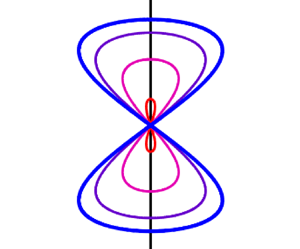
A high-order asymptotic analysis of the Benjamin–Feir instability spectrum in arbitrary depth
-
- Journal:
- Journal of Fluid Mechanics / Volume 956 / 10 February 2023
- Published online by Cambridge University Press:
- 08 February 2023, A29
-
- Article
- Export citation
Localisation of gamma-ray bursts from the combined SpIRIT+HERMES-TP/SP nano-satellite constellation
-
- Journal:
- Publications of the Astronomical Society of Australia / Volume 40 / 2023
- Published online by Cambridge University Press:
- 08 February 2023, e008
-
- Article
-
- You have access
- Open access
- HTML
- Export citation
-
Multi-messenger observations of the transient sky to detect cosmic explosions and counterparts of gravitational wave mergers critically rely on orbiting wide-FoV telescopes to cover the wide range of wavelengths where atmospheric absorption and emission limit the use of ground facilities. Thanks to continuing technological improvements, miniaturised space instruments operating as distributed-aperture constellations are offering new capabilities for the study of high-energy transients to complement ageing existing satellites. In this paper we characterise the performance of the upcoming joint SpIRIT and HERMES-TP/SP constellation for the localisation of high-energy transients through triangulation of signal arrival times. SpIRIT is an Australian technology and science demonstrator satellite designed to operate in a low-Earth Sun-synchronous Polar orbit that will augment the science operations for the equatorial HERMES-TP/SP constellation. In this work we simulate the improvement to the localisation capabilities of the HERMES-TP/SP constellation when SpIRIT is included in an orbital plane nearly perpendicular (inclination = 97.6°) to the HERMES-TP/SP orbits. For the fraction of GRBs detected by three of the HERMES satellites plus SpIRIT, we find that the combined constellation is capable of localising 60% of long GRBs to within ${\sim}30\,\textrm{deg}^{2}$ on the sky, and 60% of short GRBs within ${\sim}1850\,\textrm{deg}^{2}$ ( $1\sigma$ confidence regions), though it is beyond the scope of this work to characterise or rule out systematic uncertainty of the same order of magnitude. Based purely on statistical GRB localisation capabilities (i.e., excluding systematic uncertainties and sky coverage), these figures for long GRBs are comparable to those reported by the Fermi Gamma Burst Monitor instrument. These localisation statistics represents a reduction of the uncertainty for the burst localisation region for both long and short GRBs by a factor of ${\sim}5$ compared to the HERMES-TP/SP alone. Further improvements by an additional factor of 2 (or 4) can be achieved by launching an additional 4 (or 6) SpIRIT-like satellites into a Polar orbit, respectively, which would both increase the fraction of sky covered by multiple satellite elements, and also enable localisation of ${\geq} 60\%$ of long GRBs to within a radius of ${\sim}1.5^{\circ}$ (statistical uncertainty) on the sky, clearly demonstrating the value of a distributed all-sky high-energy transient monitor composed of nano-satellites.


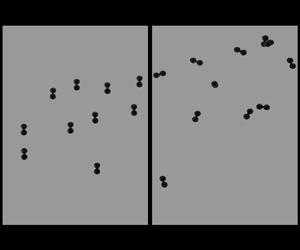
Dynamics of mass polar spheroids during sedimentation
-
- Journal:
- Journal of Fluid Mechanics / Volume 956 / 10 February 2023
- Published online by Cambridge University Press:
- 07 February 2023, A28
-
- Article
-
- You have access
- Open access
- HTML
- Export citation
-
The dynamics of sedimenting particles under gravity are surprisingly complex due to the presence of effective long-ranged forces. When the particles are polar with a well-defined symmetry axis and non-uniform density, recent theoretical predictions suggest that prolate objects will repel and oblate ones will weakly attract. We tested these predictions using mass polar prolate spheroids, which are composed of 2 mm spheres glued together. We probed different aspect ratios ( $\kappa$) and centre of mass variations ( $\chi$) by combining spheres of different densities. Experiments were done in both quasi-two-dimensional (2-D) and three-dimensional (3-D) chambers. By optically tracking the motion of single particles, we found that the dynamics were well described by a reduced mobility matrix model that could be solved analytically. Pairs of particles exhibited an effective repulsion, and their separation roughly scaled as $(\kappa - 1)/\chi ^{0.39}$, i.e. particles that were more prolate or had smaller mass asymmetry had stronger repulsion effects. In three dimensions, particles with $\chi >0$ were distributed more uniformly than $\chi =0$ particles, and the degree of uniformity increased with $\kappa$, indicating that the effective 2-body repulsion manifests for a large number of particles.


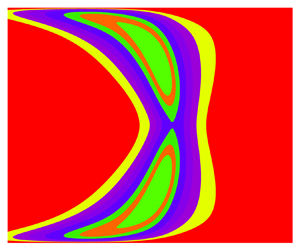
Composition of resolvents enhanced by random sweeping for large-scale structures in turbulent channel flows
-
- Journal:
- Journal of Fluid Mechanics / Volume 956 / 10 February 2023
- Published online by Cambridge University Press:
- 07 February 2023, A31
-
- Article
- Export citation
-
Composite sweeping-enhanced resolvents, referred to as the ${\boldsymbol {R}}_s^2$ model, are proposed to predict the space–time statistics of large-scale structures in turbulent channel flows. This model incorporates two key mechanisms: (i) eddy damping is introduced to represent random sweeping decorrelation caused by nonlinear forcing, leading to a sweeping-enhanced resolvent ${{\boldsymbol {R}}_s}$; and (ii) the sweeping-enhanced resolvent ${{\boldsymbol {R}}_s}$ is composited into its iterations ${\boldsymbol {R}}_s^2$ to yield non-zero Taylor time microscales. The resulting ${\boldsymbol {R}}_s^2$ model can correctly predict the frequency spectra and two-point cross-spectra of large-scale structures. This model is compared numerically with eddy-viscosity-enhanced resolvent models. The latter are designed to represent energy transfer instead for time decorrelation, and thus underpredict the characteristic decay time scales. The ${\boldsymbol {R}}_s^2$ model correctly yields the characteristic decay time scales in turbulent channel flows.


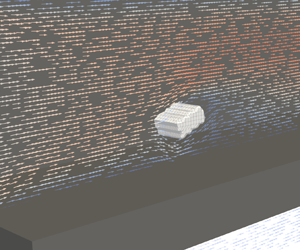
Numerical investigation of detachment and transport of particulate structures in wall-flow filters using lattice Boltzmann methods
-
- Journal:
- Journal of Fluid Mechanics / Volume 956 / 10 February 2023
- Published online by Cambridge University Press:
- 07 February 2023, A30
-
- Article
-
- You have access
- Open access
- HTML
- Export citation
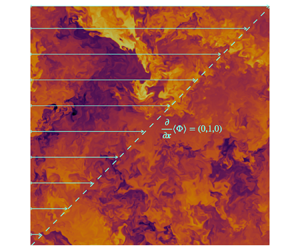
A non-local spectral transfer model and new scaling law for scalar turbulence
-
- Journal:
- Journal of Fluid Mechanics / Volume 956 / 10 February 2023
- Published online by Cambridge University Press:
- 07 February 2023, A26
-
- Article
-
- You have access
- Open access
- HTML
- Export citation
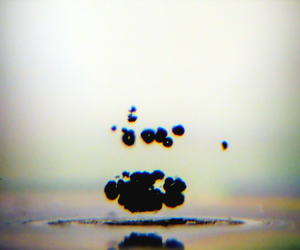
Acoustic responses of underwater superhydrophobic surfaces subjected to an intense pulse
-
- Journal:
- Journal of Fluid Mechanics / Volume 956 / 10 February 2023
- Published online by Cambridge University Press:
- 07 February 2023, A32
-
- Article
- Export citation
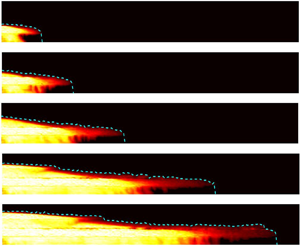
Experimental insights into gravity-driven flows and mixing in layered porous media
-
- Journal:
- Journal of Fluid Mechanics / Volume 956 / 10 February 2023
- Published online by Cambridge University Press:
- 07 February 2023, A27
-
- Article
-
- You have access
- Open access
- HTML
- Export citation
-
The heterogeneity of permeability in a porous medium considerably alters the behaviour of density-driven flows from what is observed in a medium of homogeneous permeability, and significantly enhances the mixing between the dense and light fluids during the flow. In this work, we present results from laboratory experiments performed in heterogeneous media consisting of horizontal layers of different permeabilities, investigating their effects on gravity current flows. We find that the mixing in our heterogeneous experimental set-ups can be ${O}(2)$ greater than that in a homogeneous medium of similar depth-averaged properties. The enhanced mixing in this setting is primarily because of transverse gravity-driven fingers and produced blunt front, which is the direct result of the layered structure. This enhanced rate of mixing dictates the gravity current height and length, making the current lose its long and thin shape much faster than a comparable current in a homogeneous medium. We discuss the experimental observations in detail and present relevant physical interpretations. Based on the experimental measurements and dimensionless modelling, we also derive semi-empirical formulas for predicting the gravity current length, height and mixing in a heterogeneous medium. Results from this work can be used in predicting the scale of mixing between different density fluids during contaminant transport in the subsurface environment.

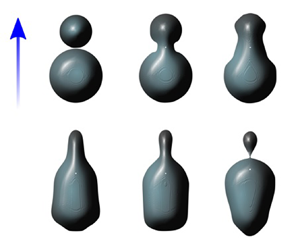
Electric-field-mediated morpho-dynamic evolution in drop–drop coalescence phenomena in the inertio-capillary regime
-
- Journal:
- Journal of Fluid Mechanics / Volume 956 / 10 February 2023
- Published online by Cambridge University Press:
- 07 February 2023, A22
-
- Article
- Export citation
Bio-inspired variable-stiffness flaps for hybrid flow control, tuned via reinforcement learning
-
- Journal:
- Journal of Fluid Mechanics / Volume 956 / 10 February 2023
- Published online by Cambridge University Press:
- 05 February 2023, R4
-
- Article
- Export citation
Morphology evolution of a melting solid layer above its melt heated from below
-
- Journal:
- Journal of Fluid Mechanics / Volume 956 / 10 February 2023
- Published online by Cambridge University Press:
- 05 February 2023, A23
-
- Article
-
- You have access
- Open access
- HTML
- Export citation
-
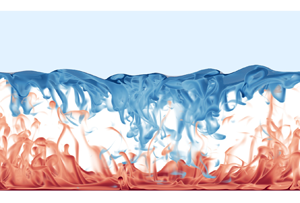
We numerically study the melting process of a solid layer heated from below such that a liquid melt layer develops underneath. The objective is to quantitatively describe and understand the emerging topography of the structures (characterized by the amplitude and wavelength), which evolve out of an initially smooth surface. By performing both two-dimensional (achieving Rayleigh number up to $Ra=10^{11}$) and three-dimensional (achieving Rayleigh number up to $Ra=10^9$) direct numerical simulations with an advanced finite difference solver coupled to the phase-field method, we show how the interface roughness is spontaneously generated by thermal convection. With increasing height of the melt the convective flow intensifies and eventually even becomes turbulent. As a consequence, the interface becomes rougher but is still coupled to the flow topology. The emerging structure of the interface coincides with the regions of rising hot plumes and descending cold plumes. We find that the roughness amplitude scales with the mean height of the liquid layer. We derive this scaling relation from the Stefan boundary condition and relate it to the non-uniform distribution of heat flux at the interface. For two-dimensional cases, we further quantify the horizontal length scale of the morphology, based on the theoretical upper and lower bounds given for the size of convective cells known from Wang et al. (Phys. Rev. Lett., vol. 125, 2020, 074501). These bounds agree with our simulation results. Our findings highlight the key connection between the morphology of the melting solid and the convective flow structures in the melt beneath.


Global receptivity analysis: physically realizable input–output analysis
-
- Journal:
- Journal of Fluid Mechanics / Volume 956 / 10 February 2023
- Published online by Cambridge University Press:
- 03 February 2023, R5
-
- Article
- Export citation
Beads, bubbles and drops in microchannels: stability of centred position and equilibrium velocity
-
- Journal:
- Journal of Fluid Mechanics / Volume 956 / 10 February 2023
- Published online by Cambridge University Press:
- 03 February 2023, A21
-
- Article
-
- You have access
- Open access
- HTML
- Export citation
-
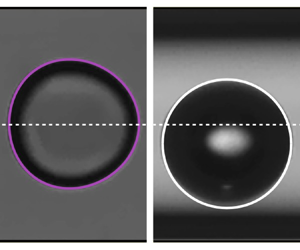
Understanding and predicting the dynamics of dispersed micro-objects in microfluidics is crucial in numerous natural, industrial and technological situations. In this paper, we experimentally characterized the equilibrium velocity $V$ and lateral position $\varepsilon$ of various dispersed micro-objects, such as beads, bubbles and drops, in a cylindrical microchannel over an unprecedentedly wide range of parameters. By varying the dimensionless object size ( $d \in [0.1; 1]$), the viscosity ratio (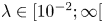 $\lambda \in [10^{-2}; \infty [$), the density ratio ( $\varphi \in [10^{-3}; 2]$), the Reynolds number ( $Re \in [10^{-2}; 10^2]$) and the capillary number ( $Ca \in [10^{-3}; 0.3]$), we offer an exhaustive parametric study exploring various dynamics from the non-deformable viscous regime to the deformable inertial regime, thus enabling us to highlight the sole and combined roles of inertia and capillary effects on lateral migration. Experiments are compared and agree well with a steady three-dimensional Navier–Stokes model for incompressible two-phase fluids, including the effects of inertia and possible interfacial deformations. This model enables us to propose a correlation for the object velocity $V$ as functions of $d$,
$d$,  $\varepsilon$ and $\lambda$, obtained in the ${Re}={Ca}=0$ limit, but valid for a larger range of values of ${Re}$ and ${Ca}$ delimited by the validity of the linear regime. Next, we present stability maps for the centred position showing that non-deformable objects dominated by inertial effects are only stable if large enough, typically for $d \gtrsim 0.7$, whereas deformable objects dominated by capillary effects can be stable for much smaller sizes, provided the viscosity ratio is outside the range $0.7 \lesssim \lambda \lesssim 10$, in which deformability also plays a destabilizing effect, as for inertia.


