Refine search
Actions for selected content:
238141 results in Physics and Astronomy
Unsteady dissipation scaling in static- and active-grid turbulence
-
- Journal:
- Journal of Fluid Mechanics / Volume 956 / 10 February 2023
- Published online by Cambridge University Press:
- 03 February 2023, A20
-
- Article
- Export citation
-
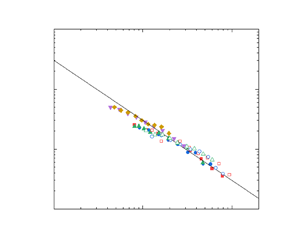
A new time-dependent analysis of the global and local fluctuating velocity signals in grid turbulence is conducted to assess the scaling laws for non-equilibrium turbulence. Experimental datasets of static- and active-grid turbulence with different Rossby numbers $R_o({=}U/\varOmega M$: $U$ is the mean velocity, $\varOmega$ is the mean rotation rate and $M$ is the grid mesh size) are considered. Although the global (long-time-averaged) non-dimensional dissipation rate $C_\varepsilon$ is independent of the Reynolds number $Re_\lambda$ based on the global Taylor microscale, the local (short-time-averaged) non-dimensional dissipation rate $\left \langle C_\varepsilon (t_i) \right \rangle$ ( $t_i$ is the local time) both in the static- and active-grid turbulence clearly show the non-equilibrium scaling $\left \langle C_\varepsilon (t_i)\right \rangle / \sqrt {Re_0} \propto \left \langle Re_\lambda (t_i) \right \rangle ^{-1}$ ( $\left \langle Re_\lambda (t_i) \right \rangle$ and $Re_0$ are the Reynolds numbers based on the local Taylor microscale $\lambda (t_i)$ and the global integral length scale, respectively), which has only been confirmed for global statistics in the near field of grid turbulence. The local value of $\left \langle L(t_i) / \lambda (t_i) \right \rangle$ ( $L(t_i)$ is the local integral length scale) shifts from the equilibrium to non-equilibrium scaling as $\left \langle Re_\lambda (t_i) \right \rangle$ increases, further confirming that the non-equilibrium scalings are recovered for local statistics both in the static- and active-grid turbulence. The local values of $\left \langle C_\varepsilon (t_i) \right \rangle$ and $\left \langle L(t_i) / \lambda (t_i) \right \rangle$ follow the theoretical predictions for global statistics (Bos & Rubinstein, Phys. Rev. Fluids, vol. 2, 2017, 022601).


Thermotactic navigation of an artificial microswimmer near a plane wall
-
- Journal:
- Journal of Fluid Mechanics / Volume 956 / 10 February 2023
- Published online by Cambridge University Press:
- 03 February 2023, A25
-
- Article
- Export citation
-
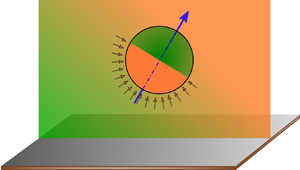
Despite significant advances in the field of man-made micro- and nanomotors, it remains a challenge to precisely control their motion in bounded environments. Here, we present a theoretical analysis of a thermally activated micromotor near a plane wall under the action of a background linear temperature field. The coupling between the autonomous and field-directed motions has been resolved using a combined analytical–numerical framework comprising general solutions in bispherical coordinates and the reciprocal theorem for creeping flows. Results reveal giant augmentation in swimming speeds, the controlling parameter zones for positive and negative thermotaxes and the flexibility of steering perpendicular to the field gradient for an isolated micromotor. Boundary-instigated thermo-fluidic modulations at different levels of confinements and preferential orientations cause directional switching of both the vertical translation and rotation parallel to the wall, thereby drastically altering the phase portraits of the swimmer dynamics. Contrasting trajectory characteristics, e.g. escape, attraction, are partitioned by unstable separatrices in the phase portraits, while competitive repulsion (attraction) after attraction (repulsion) characteristics emerge for different relative field strengths $\mathcal {S}$ and gradient orientations $\theta _T$. Below $\mathcal {S}=0.25$, highly counter-intuitive trajectories result when the micromotor is initially launched from an overlapping escape zone. Moreover, external-field-assisted microswimming can uniquely tune the directionality of wall-parallel translation, broadening the scope of dynamic regulation of self-propulsion. Thus, providing insights into a precisely controlled fuel-free actuation of micromotors near a physical obstacle, the present study stands as a step toward addressing the increasing demand for successful implementation of micromotors in futuristic clinical and environmental applications.


Controlling the breakup of spiralling jets: results from experiments, nonlinear simulations and linear stability analysis
-
- Journal:
- Journal of Fluid Mechanics / Volume 956 / 10 February 2023
- Published online by Cambridge University Press:
- 03 February 2023, A24
-
- Article
-
- You have access
- Open access
- HTML
- Export citation
Direct numerical simulations of turbulent pipe flow up to $Re_\tau \approx 5200$
-
- Journal:
- Journal of Fluid Mechanics / Volume 956 / 10 February 2023
- Published online by Cambridge University Press:
- 02 February 2023, A18
-
- Article
-
- You have access
- Open access
- HTML
- Export citation
-
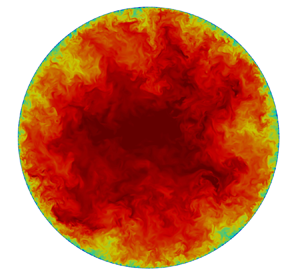
Well-resolved direct numerical simulations (DNS) have been performed of the flow in a smooth circular pipe of radius $R$ and axial length $10{\rm \pi} R$ at friction Reynolds numbers up to $Re_\tau =5200$ using the pseudo-spectral code OPENPIPEFLOW. Various turbulence statistics are documented and compared with other DNS and experimental data in pipes as well as channels. Small but distinct differences between various datasets are identified. The friction factor $\lambda$ overshoots by $2\,\%$ and undershoots by $0.6\,\%$ the Prandtl friction law at low and high $Re$ ranges, respectively. In addition, $\lambda$ in our results is slightly higher than in Pirozzoli et al. (J. Fluid Mech., vol. 926, 2021, A28), but matches well the experiments in Furuichi et al. (Phys. Fluids, vol. 27, issue 9, 2015, 095108). The log-law indicator function, which is nearly indistinguishable between pipe and channel up to $y^+=250$, has not yet developed a plateau farther away from the wall in the pipes even for the $Re_\tau =5200$ cases. The wall shear stress fluctuations and the inner peak of the axial turbulence intensity – which grow monotonically with $Re_\tau$ – are lower in the pipe than in the channel, but the difference decreases with increasing $Re_\tau$. While the wall value is slightly lower in the channel than in the pipe at the same $Re_\tau$, the inner peak of the pressure fluctuation shows negligible differences between them. The Reynolds number scaling of all these quantities agrees with both the logarithmic and defect-power laws if the coefficients are properly chosen. The one-dimensional spectrum of the axial velocity fluctuation exhibits a $k^{-1}$ dependence at an intermediate distance from the wall – also seen in the channel. In summary, these high-fidelity data enable us to provide better insights into the flow physics in the pipes as well as the similarity/difference among different types of wall turbulence.


High humidity enhances the evaporation of non-aqueous volatile sprays
-
- Journal:
- Journal of Fluid Mechanics / Volume 956 / 10 February 2023
- Published online by Cambridge University Press:
- 02 February 2023, A19
-
- Article
-
- You have access
- Open access
- HTML
- Export citation

An investigation of rotor aeroacoustics with unsteady motions and uncertainty factors
-
- Journal:
- Journal of Fluid Mechanics / Volume 956 / 10 February 2023
- Published online by Cambridge University Press:
- 01 February 2023, A16
-
- Article
-
- You have access
- Open access
- HTML
- Export citation
Effects of oscillating gas-phase flow on an evaporating multicomponent droplet
-
- Journal:
- Journal of Fluid Mechanics / Volume 956 / 10 February 2023
- Published online by Cambridge University Press:
- 01 February 2023, A17
-
- Article
-
- You have access
- Open access
- HTML
- Export citation
Interfacial-dominated torque response in liquid–liquid Taylor–Couette flows
-
- Journal:
- Journal of Fluid Mechanics / Volume 956 / 10 February 2023
- Published online by Cambridge University Press:
- 01 February 2023, A15
-
- Article
-
- You have access
- Open access
- HTML
- Export citation
-
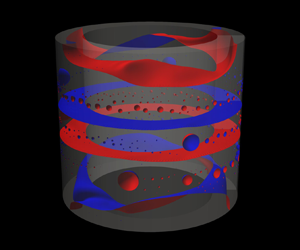
Immiscible and incompressible liquid–liquid flows are considered in a Taylor–Couette geometry and analysed by direct numerical simulations coupled with the volume-of-fluid method and a continuum surface force model. The system Reynolds number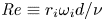 $Re \equiv r_i \omega _i d / \nu$ is fixed to $960$, where the single-phase flow is in the steady Taylor vortex regime, whereas the secondary-phase volume fraction $\varphi$ and the system Weber number $We \equiv \rho r_i^2 \omega _i^2 d / \sigma$ are varied to study the interactions between the interface and the Taylor vortices. We show that different Weber numbers lead to two distinctive flow regimes, namely an advection-dominated regime and an interface-dominated regime. When $We$ is high, the interface is easily deformed because of its low surface tension. The flow patterns are then similar to the single-phase flow, and the system is dominated mainly by advection (advection-dominated regime). However, when $We$ is low, the surface tension is so large that stable interfacial structures with sizes comparable to the cylinder gap can exist. The background velocity field is modulated largely by these persistent structures, thus the overall flow dynamics is governed by the interface (interface-dominated regime). The effect of the interface on the global system response is assessed by evaluating the Nusselt number $Nu_{\omega }$ based on the non-dimensional angular velocity transport. It shows non-monotonic trends as functions of the volume fraction $\varphi$ for both low and high $We$. We explain how these dependencies are closely linked to the velocity and interfacial structures.


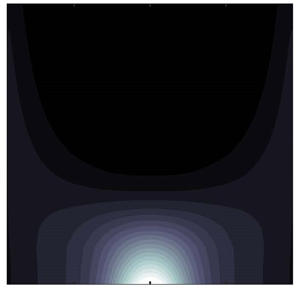
The laminar seabed thermal boundary layer forced by propagating and standing free-surface waves
-
- Journal:
- Journal of Fluid Mechanics / Volume 956 / 10 February 2023
- Published online by Cambridge University Press:
- 31 January 2023, A11
-
- Article
-
- You have access
- Open access
- HTML
- Export citation
Frontiers of astrobiology and the humanities
-
- Journal:
- International Journal of Astrobiology / Volume 22 / Issue 3 / June 2023
- Published online by Cambridge University Press:
- 31 January 2023, pp. 229-237
-
- Article
- Export citation
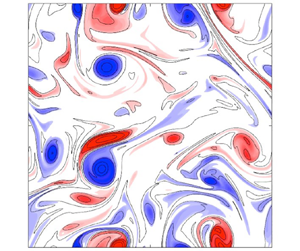
Selective energy and enstrophy modification of two-dimensional decaying turbulence
-
- Journal:
- Journal of Fluid Mechanics / Volume 956 / 10 February 2023
- Published online by Cambridge University Press:
- 31 January 2023, A12
-
- Article
- Export citation
Simultaneous p-adic Diophantine approximation
- Part of
-
- Journal:
- Mathematical Proceedings of the Cambridge Philosophical Society / Volume 175 / Issue 1 / July 2023
- Published online by Cambridge University Press:
- 31 January 2023, pp. 13-50
- Print publication:
- July 2023
-
- Article
- Export citation
Terahertz radiation in the interaction of a focused laser pulse with plasma
-
- Journal:
- Journal of Plasma Physics / Volume 89 / Issue 1 / February 2023
- Published online by Cambridge University Press:
- 31 January 2023, 905890107
-
- Article
- Export citation
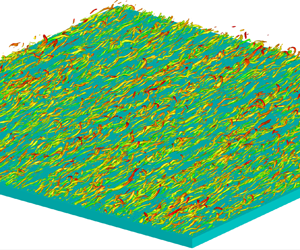
On wind–wave interaction phenomena at low Reynolds numbers
-
- Journal:
- Journal of Fluid Mechanics / Volume 956 / 10 February 2023
- Published online by Cambridge University Press:
- 31 January 2023, A13
-
- Article
-
- You have access
- Open access
- HTML
- Export citation
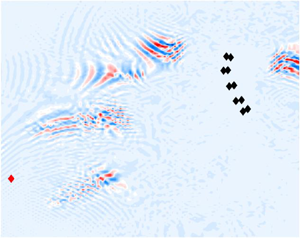
On the propagation of acoustic–gravity waves due to a slender rupture in an elastic seabed
-
- Journal:
- Journal of Fluid Mechanics / Volume 956 / 10 February 2023
- Published online by Cambridge University Press:
- 31 January 2023, A6
-
- Article
-
- You have access
- Open access
- HTML
- Export citation
A head-driven model of turbine fence performance
-
- Journal:
- Journal of Fluid Mechanics / Volume 956 / 10 February 2023
- Published online by Cambridge University Press:
- 31 January 2023, A14
-
- Article
-
- You have access
- Open access
- HTML
- Export citation
Freeze-out of perturbation growth of single-mode helium–air interface through reflected shock in Richtmyer–Meshkov flows
-
- Journal:
- Journal of Fluid Mechanics / Volume 956 / 10 February 2023
- Published online by Cambridge University Press:
- 30 January 2023, R2
-
- Article
-
- You have access
- HTML
- Export citation
-
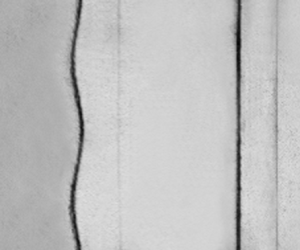
‘Freeze-out’ of amplitude growth, i.e. the amplitude growth stagnation of a shocked helium–air interface, is realized through a reflected shock, which produces baroclinic vorticity of the opposite sign to that deposited by the first shock. Theoretically, a model is constructed to calculate the relations among the initial parameters for achieving freeze-out. In particular, if the amplitude growth is within the linear regime at the arrival of the reflected shock, the time interval between the impacts of two shock waves is linearly related to the initial perturbation wavelength, and is independent of the initial perturbation amplitude. Experimentally, an air–SF $_6$ (or air–argon) plane interface is adopted to produce a weak reflected shock. Seven experimental runs with specific initial conditions are examined. For all cases, freeze-out is achieved after the reflected shock impact under the designed conditions.

Particle force-based density segregation theory for multi-component granular mixtures in a periodic chute flow
- Part of
-
- Journal:
- Journal of Fluid Mechanics / Volume 956 / 10 February 2023
- Published online by Cambridge University Press:
- 30 January 2023, A8
-
- Article
-
- You have access
- HTML
- Export citation
Disk wakes in nonlinear stratification
-
- Journal:
- Journal of Fluid Mechanics / Volume 956 / 10 February 2023
- Published online by Cambridge University Press:
- 30 January 2023, A5
-
- Article
-
- You have access
- Open access
- HTML
- Export citation
-
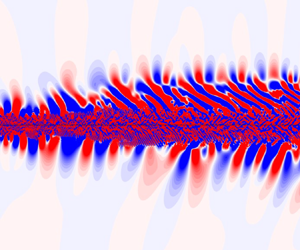
Nonlinearity of density stratification modulates buoyancy effects. We report results from a body-inclusive large eddy simulation of a wake in nonlinear stratification, specifically for a circular disk at diameter-based Reynolds number ( ${\it Re} $) of $5000$. Five density profiles are considered; the benchmark has linear stratification and the other four have hyperbolic tangent profiles of the same thickness to model a pycnocline. The disk moves inside the central core of the pycnocline in two of those four cases and, in the other two cases with a shifted density profile, the disk moves partially/completely outside the pycnocline. The maximum buoyancy frequency ( $N_{max}$) for all the profiles is the same. The first part of the study investigates the centred cases. Non-uniform stratification results in increasing wake turbulence relative to the benchmark owing to reduced suppression of turbulence production as well as wave trapping in the pycnocline. Steady lee waves are also quantified to understand the limitations of linear theory. The second part pays attention to the effect of a relative shift between the pycnocline and the disk. The wake defect velocity decays substantially faster in the cases with a shift and the wake has higher turbulence level. The effect of disk location on the Kelvin wake waves (a family of steady waves within the pycnocline) and its modal form is obtained and explained by solving the Taylor–Goldstein equation. The family of unsteady internal gravity waves that are generated by the wake is also studied and the effect of disk shift is quantified.


Critical balance and scaling of strongly stratified turbulence at low Prandtl number
-
- Journal:
- Journal of Fluid Mechanics / Volume 956 / 10 February 2023
- Published online by Cambridge University Press:
- 30 January 2023, A7
-
- Article
- Export citation
-
We extend the scaling relations of strongly (stably) stratified turbulence from the geophysical regime of unity Prandtl number to the astrophysical regime of extremely small Prandtl number applicable to stably stratified regions of stars and gas giants. A transition to a new turbulent regime is found to occur when the Prandtl number drops below the inverse of the buoyancy Reynolds number, i.e. $Pr\,Rb<1$, which signals a shift of the dominant balance in the buoyancy equation. Application of critical balance arguments then derives new predictions for the anisotropic energy spectrum and dominant balance of the Boussinesq equations in the $Pr\,Rb\ll 1$ regime. We find that all the standard scaling relations from the unity $Pr$ limit of strongly stratified turbulence simply carry over if the Froude number, $Fr$, is replaced by a modified Froude number, $Fr_M\equiv Fr/(Pr\,Rb)^{1/4}$. The geophysical and astrophysical regimes are thus smoothly connected across the $Pr\,Rb=1$ transition. Applications to vertical transport in stellar radiative zones and modification to the instability criterion for the small-scale dynamo are discussed.


