Refine search
Actions for selected content:
238152 results in Physics and Astronomy
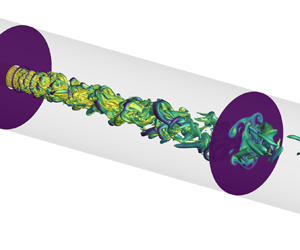
Coaxial jets with disparate viscosity: mixing and laminarization characteristics
-
- Journal:
- Journal of Fluid Mechanics / Volume 955 / 25 January 2023
- Published online by Cambridge University Press:
- 25 January 2023, A43
-
- Article
-
- You have access
- Open access
- HTML
- Export citation
-
Mixing of fluids in a coaxial jet is studied under four distinct viscosity ratios, $m=1$, $10$,
$10$,  $20$ and $40$, using highly resolved large-eddy simulations (LES), particle image velocimetry and planar laser-induced fluorescence. The accuracy of predictions is tested against data obtained by the simultaneous experimental measurements of velocity and concentration fields. For the highest and lowest viscosity ratios, standard RANS models with unclosed terms pertaining to viscosity variations are employed. We show that the standard Reynolds-averaged Navier–Stokes (RANS) approach with no explicit modelling for variable-viscosity terms is not applicable whereas dynamic LES models provide high-quality agreement with the measurements. To identify the underlying mixing physics and sources of discrepancy in RANS predictions, two distinct mixing modes are defined based on the viscosity ratio. Then, for each mode, the evolution of mixing structures, momentum budget analysis with emphasis on variable-viscosity terms, analysis of the turbulent activity and decay of turbulence are investigated using highly resolved LES data. The mixing dynamics is found to be quite distinct in each mixing mode. Variable viscosity manifests multiple effects that are working against each other. Viscosity gradients induce additional instabilities while increasing overall viscosity decreases the effective Reynolds number leading to laminarization of the turbulent jet, explaining the lack of dispersion and turbulent diffusion. Momentum budget analysis reveals that variable-viscosity terms are significant to be neglected. The scaling of the energy spectrum cascade suggests that in the TLL mode the unsteady laminar shedding is responsible for the eddies observed.


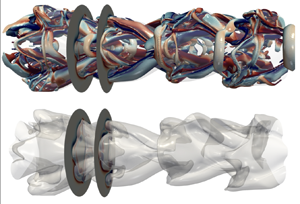
Direct numerical simulations of turbulent jets: vortex–interface–surfactant interactions
-
- Journal:
- Journal of Fluid Mechanics / Volume 955 / 25 January 2023
- Published online by Cambridge University Press:
- 24 January 2023, A42
-
- Article
-
- You have access
- Open access
- HTML
- Export citation
Comparison of the compressible μ(I) class of models and non-local models with the discrete element method (DEM) for steady fully developed flow of cohesionless granular materials through a vertical channel – CORRIGENDUM
-
- Journal:
- Journal of Fluid Mechanics / Volume 955 / 25 January 2023
- Published online by Cambridge University Press:
- 24 January 2023, E1
-
- Article
-
- You have access
- Open access
- HTML
- Export citation

Thermodynamically consistent phase-field modelling of activated solute transport in binary solvent fluids
-
- Journal:
- Journal of Fluid Mechanics / Volume 955 / 25 January 2023
- Published online by Cambridge University Press:
- 24 January 2023, A41
-
- Article
- Export citation
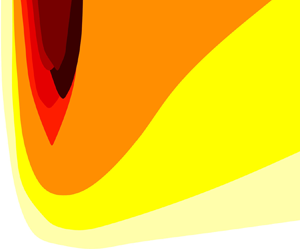
Forced rotation enhances cylinder flow-induced vibrations at subcritical Reynolds number
-
- Journal:
- Journal of Fluid Mechanics / Volume 955 / 25 January 2023
- Published online by Cambridge University Press:
- 24 January 2023, R3
-
- Article
-
- You have access
- Open access
- HTML
- Export citation
-
When a cylinder is mounted on an elastic support within a current, vortex-induced vibrations (VIV) may occur down to a Reynolds number (Re) close to $20$, based on the body diameter ( $D$) and inflow velocity ( $U$), i.e. below the critical value of $47$ reported for the onset of flow unsteadiness when the body is fixed. The impact of a forced rotation of the elastically mounted cylinder on the system behaviour is explored numerically for $Re \leqslant 30$, over wide ranges of values of the rotation rate (ratio between body surface velocity and $U$,
$U$,  $\alpha \in [0,5]$) and reduced velocity (inverse of the oscillator natural frequency non-dimensionalized by $D$ and $U$,
$U$,  $U^\star \in [2,30]$). The influence of the rotation is not monotonic, but the most prominent effect uncovered in this work is a substantial enhancement of the subcritical-Re, flow-induced vibrations beyond $\alpha =2$. This enhancement is twofold. First, the rotation results in a considerable expansion of the vibration/flow unsteadiness region in the $({Re},U^\star )$ domain, down to $Re=4$. Second, the elliptical orbits described by the rotating body are subjected to a major amplification, with a transition from VIV to responses whose magnitude tends to increase unboundedly with $U^\star$, even though still synchronized with flow unsteadiness. The emergence of such galloping-like oscillations close to the onset of vibrations disrupts the scenario of gradual vibration growth with Re, as amplitudes larger than $10$ body diameters may be observed at $Re=10$.


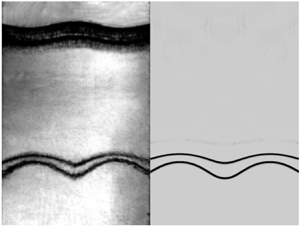
Hydrodynamic instabilities of two successive slow/fast interfaces induced by a weak shock
-
- Journal:
- Journal of Fluid Mechanics / Volume 955 / 25 January 2023
- Published online by Cambridge University Press:
- 23 January 2023, A40
-
- Article
- Export citation
Demonstration of a petawatt-scale optical parametric chirped pulse amplifier based on yttrium calcium oxyborate
-
- Journal:
- High Power Laser Science and Engineering / Volume 11 / 2023
- Published online by Cambridge University Press:
- 23 January 2023, e2
-
- Article
-
- You have access
- Open access
- HTML
- Export citation
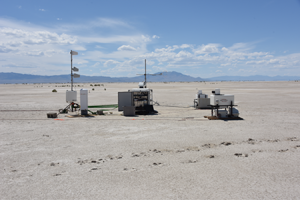
Identification of the energy contributions associated with wall-attached eddies and very-large-scale motions in the near-neutral atmospheric surface layer through wind LiDAR measurements
-
- Journal:
- Journal of Fluid Mechanics / Volume 955 / 25 January 2023
- Published online by Cambridge University Press:
- 23 January 2023, A39
-
- Article
-
- You have access
- Open access
- HTML
- Export citation
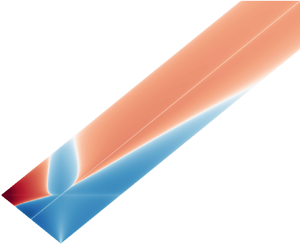
Locality of triad interaction and Kolmogorov constant in inertial wave turbulence
-
- Journal:
- Journal of Fluid Mechanics / Volume 955 / 25 January 2023
- Published online by Cambridge University Press:
- 23 January 2023, R2
-
- Article
- Export citation
-
Using the theory of wave turbulence for rapidly rotating incompressible fluids derived by Galtier (Phys. Rev. E, vol. 68, 2003, 015301), we find the locality conditions that the solutions of the kinetic equation must satisfy. We show that the exact anisotropic Kolmogorov–Zakharov spectrum satisfies these conditions, which justifies the existence of this constant (positive) energy flux solution. Although a direct cascade is predicted in the transverse ( $\perp$) and parallel ( $\parallel$) directions to the rotation axis, we show numerically that in the latter case some triadic interactions can have a negative contribution to the energy flux, while in the former case all interactions contribute to a positive flux. Neglecting the parallel energy flux, we estimate the Kolmogorov constant at $C_K \simeq 0.749$. These results provide theoretical support for recent numerical and experimental studies.



Turbulent Flows
-
- Published online:
- 20 January 2023
- Print publication:
- 10 August 2000
-
- Book
- Export citation
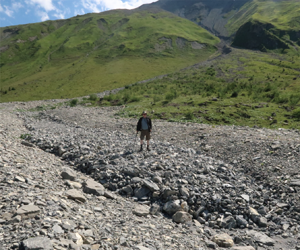
Particle-size segregation in self-channelized granular flows
-
- Journal:
- Journal of Fluid Mechanics / Volume 955 / 25 January 2023
- Published online by Cambridge University Press:
- 20 January 2023, A38
-
- Article
-
- You have access
- Open access
- HTML
- Export citation

Role of turbulent kinetic energy modulation by particle–fluid interaction in sediment pick-up
-
- Journal:
- Journal of Fluid Mechanics / Volume 955 / 25 January 2023
- Published online by Cambridge University Press:
- 20 January 2023, A37
-
- Article
-
- You have access
- Open access
- HTML
- Export citation
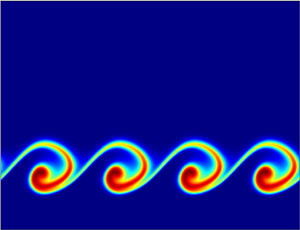
Reaction-induced Kelvin–Helmholtz instability in a layered channel flow
-
- Journal:
- Journal of Fluid Mechanics / Volume 955 / 25 January 2023
- Published online by Cambridge University Press:
- 19 January 2023, A36
-
- Article
- Export citation
From snapshots to manifolds – a tale of shear flows
-
- Journal:
- Journal of Fluid Mechanics / Volume 955 / 25 January 2023
- Published online by Cambridge University Press:
- 19 January 2023, A34
-
- Article
-
- You have access
- Open access
- HTML
- Export citation
-
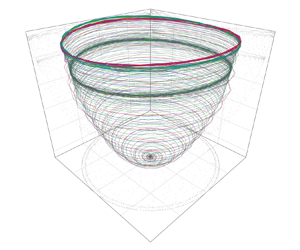
We propose a novel nonlinear manifold learning from snapshot data and demonstrate its superiority over proper orthogonal decomposition (POD) for shedding-dominated shear flows. Key enablers are isometric feature mapping, Isomap, as encoder and, $K$-nearest neighbours ( $K$NN) algorithm as decoder. The proposed technique is applied to numerical and experimental datasets including the fluidic pinball, a swirling jet and the wake behind a couple of tandem cylinders. Analysing the fluidic pinball, the manifold is able to describe the pitchfork bifurcation and the chaotic regime with only three feature coordinates. These coordinates are linked to the vortex-shedding phases and the force coefficients. The manifold coordinates of the swirling jet are comparable to the POD mode amplitudes, yet allow for a more distinct and less noise-sensitive manifold identification. A similar observation is made for the wake of two tandem cylinders. The tandem cylinders are aligned and located at a streamwise distance which corresponds to the transition between the single bluff body and the reattachment regimes of vortex shedding. Isomap unveils these two shedding regimes while the Lissajous plot of the first two POD mode amplitudes features a single circle. The reconstruction error of the manifold model is small compared with the fluctuation level, indicating that the low embedding dimensions contain the coherent structure dynamics. The proposed Isomap– $K$NN manifold learner is expected to be of great importance in estimation, dynamic modelling and control for a large range of configurations with dominant coherent structures.


Merging of the superbanana plateau and $\sqrt \nu$
 transport regimes in nearly quasisymmetric stellarators
-
- Journal:
- Journal of Plasma Physics / Volume 89 / Issue 1 / February 2023
- Published online by Cambridge University Press:
- 19 January 2023, 905890106
-
- Article
- Export citation
-
Alpha particle confinement is one of the most demanding issues for stellarators. It now seems clear that it is possible to design optimized stellarators that confine the background plasma at near tokamak radial transport levels. Moreover, adequate collisionless alpha particle confinement is possible in the core of a highly optimized stellarator. Here, the collisional confinement of barely trapped alphas in an optimized stellarator is considered by accounting for the resonance due to the reversal in direction of the drift within a flux surface and investigating the sensitive role of magnetic shear in keeping this resonance close to the passing boundary in some nearly quasisymmetric stellarator configurations. The treatment relies on a narrow collisional boundary layer formulation that combines the responses of both these resonant pitch angle alphas and the remaining barely trapped alphas. A novel merged regime treatment leads to explicit expressions for the energy diffusivity for both superbanana plateau (or resonant plateau) and $\sqrt \nu$
 transport in the large aspect ratio limit for a slowing down tail alpha distribution function, where $\nu$
 is the effective pitch angle scattering collision frequency of the trapped alphas off the background ions. Depending on the details of the optimization scheme and the sign of the magnetic shear, modest magnetic shear can be used to reduce superbanana (or resonant) plateau transport to below the $\sqrt \nu$
 transport level. In addition, a quasilinear equation retaining spatial diffusion is derived for a general alpha distribution function that allows the radial alpha transport to modify the distribution so it is no longer isotropic in velocity space.


Dynamics of flexible filaments in oscillatory shear flows
-
- Journal:
- Journal of Fluid Mechanics / Volume 955 / 25 January 2023
- Published online by Cambridge University Press:
- 19 January 2023, A35
-
- Article
-
- You have access
- Open access
- HTML
- Export citation
On the role of inertia in channel flows of finite-size neutrally buoyant particles
-
- Journal:
- Journal of Fluid Mechanics / Volume 955 / 25 January 2023
- Published online by Cambridge University Press:
- 18 January 2023, A30
-
- Article
-
- You have access
- Open access
- HTML
- Export citation
-
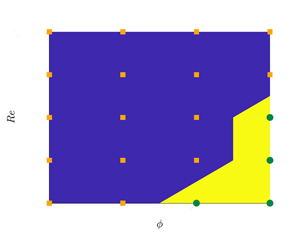
We consider suspensions of finite-size neutrally buoyant rigid spherical particles in channel flow and investigate the relevance of different momentum transfer mechanisms and the relation between the local particle dynamics and the bulk flow properties in the highly inertial regime. Interface-resolved simulations are performed in the range of Reynolds numbers $3000 \leq Re \leq 15\ 000$ and solid volume fractions $0 \leq \phi \leq 0.3$. The Lagrangian particle statistics show that pair interactions are highly inhomogeneous and dependent on the distance from the wall: in their vicinity, the underlying mean shear drives the pair interactions, while a high degree of isotropy, dictated by more frequent collisions, characterizes the core region. Analysis of the momentum balance reveals that while the particle-induced stresses govern the dynamics in dense conditions, $\phi =0.3$, and moderate Reynolds numbers, $Re <10\ 000$, the turbulent stresses take over at higher Reynolds numbers. This behaviour is associated with a reduced particle migration toward the channel core, which decreases the importance of the particle-induced stress and increases the turbulent activity. Our results indicate that Reynolds stresses and the associated velocity fluctuations, characteristics of near-wall turbulence, prevail at high inertia over the resistance to deformation presented by the particles for volume fractions lower than 30 %.


Interplay between magnetic shear and triangularity in ion temperature gradient and trapped electron mode dominated plasmas
-
- Journal:
- Journal of Plasma Physics / Volume 89 / Issue 1 / February 2023
- Published online by Cambridge University Press:
- 18 January 2023, 905890104
-
- Article
- Export citation
-
Local gyrokinetic simulations, performed with the GENE code, are used to investigate the interaction between (negative) triangularity $\delta$
 and magnetic shear $s$
 , in both ion temperature gradient and trapped electron mode dominated plasmas. Magnetic shear turns out to influence in a non-trivial way the effect of negative triangularity. Also, $\delta <0$
 is found to lead to a reduction of fluxes when $s>1$
 but not anymore when shear is reduced. In certain parameter regimes, this effect can be inverted, up to obtaining higher fluxes when $\delta <0$
 with respect to its $\delta >0$
 counterpart.


Nonlinear dynamics of unstably stratified two-layer shear flow in a horizontal channel
-
- Journal:
- Journal of Fluid Mechanics / Volume 955 / 25 January 2023
- Published online by Cambridge University Press:
- 18 January 2023, A32
-
- Article
-
- You have access
- Open access
- HTML
- Export citation
An experimental and numerical study of turbulent oscillatory flow over an irregular rough wall
-
- Journal:
- Journal of Fluid Mechanics / Volume 955 / 25 January 2023
- Published online by Cambridge University Press:
- 18 January 2023, A33
-
- Article
-
- You have access
- Open access
- HTML
- Export citation
-
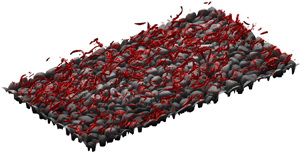
The hydrodynamics of turbulent oscillatory flow over a gravel-based irregular rough wall is investigated using laser-Doppler anemometry measurements of velocities in a large oscillatory flow tunnel and direct numerical simulation (DNS) of the Navier–Stokes equations. The same periodic irregular roughness was used for both experiments and DNS. Four flow shapes are investigated: sinusoidal, skewed, asymmetric and combined skewed–asymmetric. The experiments were conducted for target Reynolds numbers (based on the Stokes length and standard deviation of free-stream velocity) of $R_{\delta,\sigma }=800$ and $R_{\delta,\sigma }=1549$; DNS was conducted for flows with target $R_{\delta,\sigma }=800$. Boundary layer thickness, bottom phase lead and friction factor are in good agreement with previous studies. For the first time, evidence of Prandtl's secondary flows of the second kind in oscillatory flow is presented. Turbulence structure is visualised using isosurfaces of $\lambda _{2}$ (Jeong & Hussain J. Fluid Mech., vol. 285, 1995, pp. 69–94), revealing densely packed structures that grow stronger and weaker in correspondence with the free-stream velocity. Reynolds and dispersive stresses peak just below the highest roughness crest, with dispersive stress vanishing a short distance above the roughness. Bursts of turbulence kinetic energy and wake kinetic energy are generated each flow half-cycle, with variable behaviour depending on flow shape. Non-Gaussian turbulence statistics are observed that originate near the wall, becoming increasingly non-Gaussian far from the wall. Probability density functions of turbulence statistics can be closely approximated by a fourth-order Gram–Charlier distribution at most phases and elevations, though when statistics deviate more strongly from Gaussian, streamwise and wall-normal (spanwise) statistics are better described by a Pearson type IV (VII) distribution.


